
Survodutide Weight Loss: What the Phase 3 Trials Really Show
Survodutide cut body weight by 13–17% in phase 3 — close to Wegovy, below Zepbound. Its real strength is liver fat, and its weak spot is how many people stopped.

Survodutide is an experimental weekly injection that lowered body weight by 13.0% over 76 weeks in its main phase 3 trial, or 16.6% among people who stayed on treatment as planned. That puts it roughly level with Wegovy and below Zepbound for weight loss, not ahead of them. Where survodutide stands out is liver fat, which fell by about 63% in an MRI substudy. The trade-off is tolerability: about one in four participants stopped the drug because of side effects, and it is not yet approved anywhere.
Key Takeaways
- In the SYNCHRONIZE-1 trial of 725 adults without diabetes, weight fell 13.0% on the 6.0 mg dose versus 5.4% on placebo in the primary analysis.
- The widely quoted 16.6% comes from a different analysis that counts only people who stayed on treatment, so it should not be compared directly with other drugs' headline numbers.
- Liver results are the strongest part of the data: in a phase 2 trial, 62% of people on the best dose saw their fatty liver inflammation (MASH) improve, versus 14% on placebo.
- About 24–25% of participants on survodutide stopped because of adverse events, compared with 5.4% on placebo, mostly due to nausea and other digestive effects.
- As of November 2026, survodutide is investigational, and Boehringer Ingelheim has not announced a regulatory filing for obesity.
What Is Survodutide and How Does It Work?
Survodutide is a dual agonist, meaning one molecule activates two hormone receptors. It is being developed by Boehringer Ingelheim with Zealand Pharma and is given as a weekly injection.
- GLP-1 receptor: the same target as semaglutide (Wegovy, Ozempic). It reduces appetite, slows stomach emptying and improves blood sugar control.
- Glucagon receptor: a target the approved drugs do not hit. Glucagon signaling raises energy use and pushes the liver to burn stored fat, which is why researchers expected a strong effect on fatty liver disease.
Most of the weight loss from GLP-1 drugs comes from eating less; VitaWell's summary of research showing semaglutide users eat about a quarter fewer calories explains that mechanism. The glucagon component adds a second lever, aimed mainly at the liver.
What the SYNCHRONIZE-1 Trial Found
SYNCHRONIZE-1 was a double-blind, placebo-controlled phase 3 trial of 725 adults with obesity or overweight but no diabetes, run at 116 sites in 14 countries. Participants received survodutide 3.6 mg, survodutide 6.0 mg or placebo weekly for 76 weeks. Full results were presented at the American Diabetes Association meeting and published in the New England Journal of Medicine in June 2026, as summarized by the Cleveland Clinic Journal of Medicine (2026):
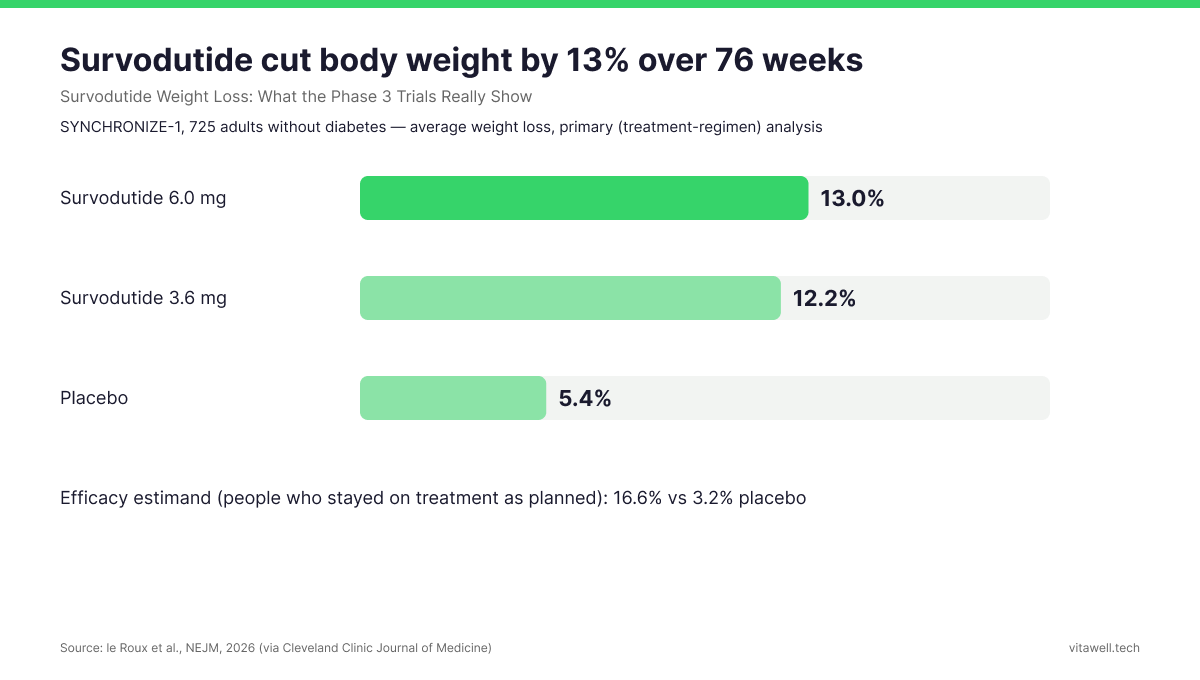
- Average weight loss in the primary analysis: 13.0% on 6.0 mg, 12.2% on 3.6 mg and 5.4% on placebo.
- At least 5% weight loss: 72.6% on 6.0 mg and 71.9% on 3.6 mg, versus 46.3% on placebo.
- In an MRI substudy of 25 people per group, visceral (deep belly) fat fell 34.0% on 6.0 mg versus 11.8% on placebo.
Why There Are Two Weight-Loss Numbers
Drug trials report results using different estimands, which are pre-defined rules for handling people who stop treatment. The "treatment-regimen" analysis counts everyone as randomized, including those who quit; it reflects what happens in real life. The "efficacy" estimand estimates the effect if everyone had kept taking the drug as planned.
For survodutide the gap between the two is large: 13.0% versus 16.6%. A big gap usually signals that many people stopped treatment early, which is exactly what the side-effect data shows. Comparing survodutide's 16.6% with another drug's primary-analysis figure makes survodutide look better than the trials support.
How Survodutide Compares With Wegovy, Zepbound and Retatrutide
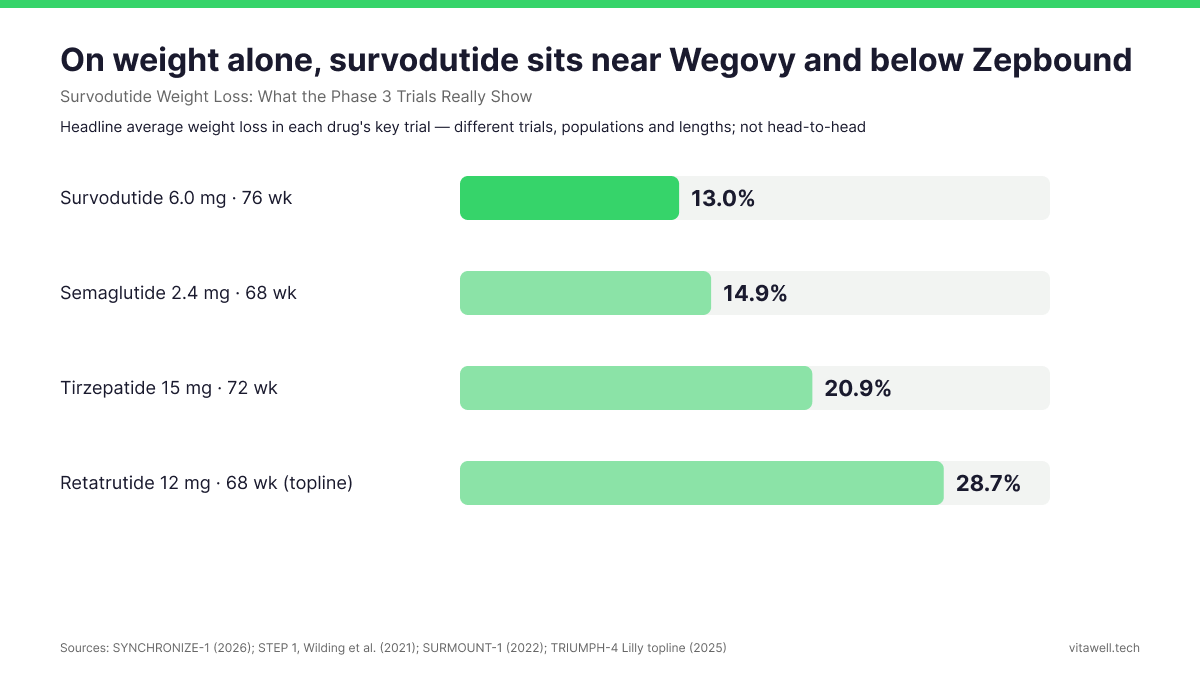
The table lines up each drug's headline result with the analysis it comes from and how many people stopped because of side effects. Trials enrolled different populations over different lengths of time, so this is a guide to the evidence, not a head-to-head ranking.
| Drug | Receptors targeted | Key trial and length | Average weight loss (analysis) | Stopped due to side effects | Status, Nov 2026 |
|---|---|---|---|---|---|
| Survodutide 6.0 mg | GLP-1 + glucagon | SYNCHRONIZE-1, 76 weeks | 13.0% (primary); 16.6% (efficacy estimand) | About 25% vs 5.4% placebo | Investigational; no obesity filing announced |
| Semaglutide 2.4 mg (Wegovy) | GLP-1 | STEP 1, 68 weeks | 14.9% (primary) | 4.5% for digestive effects vs 0.8% | Approved |
| Tirzepatide 15 mg (Zepbound) | GLP-1 + GIP | SURMOUNT-1, 72 weeks | 20.9% (primary) | 6.2% vs 2.6% placebo | Approved |
| Retatrutide 12 mg | GLP-1 + GIP + glucagon | TRIUMPH-4, 68 weeks (people with knee osteoarthritis) | 28.7% (company topline) | Not reported in topline numbers | Investigational |
Sources for the comparators: the STEP 1 trial in the New England Journal of Medicine (Wilding et al., 2021) with 1,961 participants; SURMOUNT-1 results (2022) with 2,539 participants; and Eli Lilly's TRIUMPH-4 topline announcement (December 2025), which is not yet peer reviewed.
The practical reading: on weight alone, survodutide is in the same range as semaglutide and clearly behind tirzepatide. Its case rests on the liver and on giving doctors another option, not on being the strongest weight-loss drug.
The Liver Story: Where Survodutide Stands Out
MASLD (metabolic dysfunction-associated steatotic liver disease) is the current name for fatty liver disease linked to excess weight and insulin resistance. Its more serious form, MASH, adds inflammation and can lead to scarring (fibrosis) and cirrhosis. This is where survodutide's glucagon effect shows up most clearly:
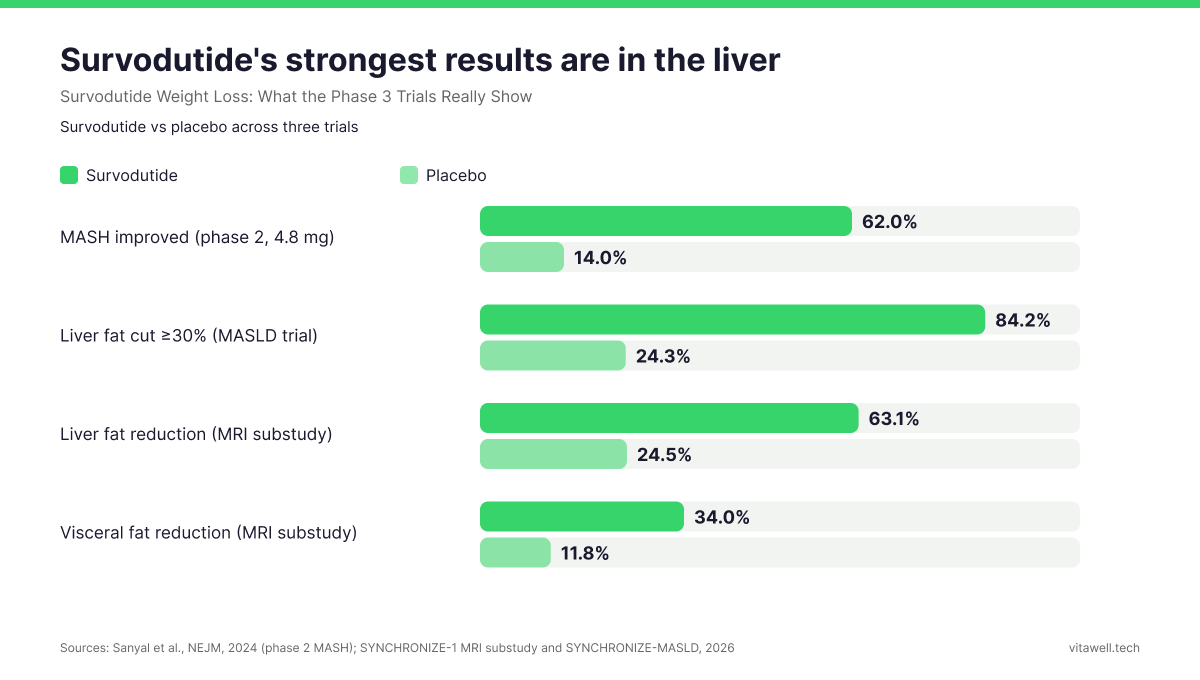
- Phase 2 MASH trial: in a 48-week trial of 293 adults with biopsy-confirmed MASH (Sanyal et al., NEJM, 2024), MASH improved without worsening fibrosis in 47%, 62% and 43% of people on the three doses, versus 14% on placebo. Fibrosis improved by at least one stage in 34–36%, versus 22%.
- SYNCHRONIZE-1 MRI substudy: liver fat fell 63.1% on 6.0 mg, versus 24.5% on placebo.
- SYNCHRONIZE-MASLD: in 216 adults with obesity and at-risk fatty liver, 84.2% on survodutide cut liver fat by at least 30% over 48 weeks, versus 24.3% on placebo. According to Pharmacy Times (2026), about 6 in 10 treated patients reached normal liver fat levels.
Two caveats apply. The MASLD trial did not use liver biopsies, so MASH status was judged by non-invasive tests. And the phase 2 MASH result has not yet been confirmed in phase 3: the LIVERAGE trials, with about 1,800 and 1,590 participants, are still running. Visceral fat matters beyond the liver too; VitaWell's piece on why waist size predicts heart failure risk explains why deep belly fat is the more dangerous kind.
Results in People With Type 2 Diabetes
People with type 2 diabetes usually lose less weight on these drugs than people without diabetes, and survodutide followed that pattern. In SYNCHRONIZE-2, a 76-week trial of 755 adults with obesity or overweight and type 2 diabetes presented in October 2026, Boehringer Ingelheim (2026) reported:
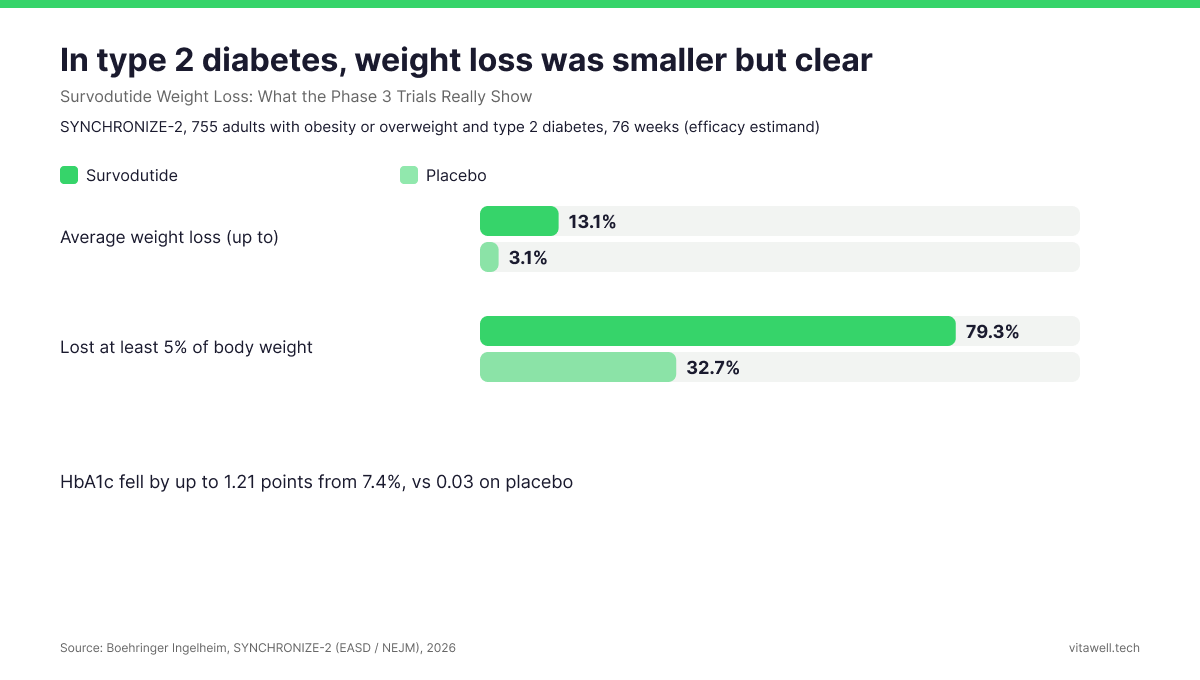
- Weight loss of up to 13.1% versus 3.1% on placebo (efficacy estimand).
- At least 5% weight loss in up to 79.3% of people on survodutide, versus 32.7% on placebo.
- HbA1c, a measure of average blood sugar over about three months, fell by up to 1.21 percentage points from a starting level of 7.4%, versus 0.03 on placebo.
Side Effects: Why About One in Four Stopped Treatment
As with other GLP-1 drugs, the most common side effects were nausea, vomiting and diarrhea, mostly mild to moderate and concentrated in the dose-increase phase. The difference is how often people quit. According to Fierce Biotech's report on the ADA 2026 data:
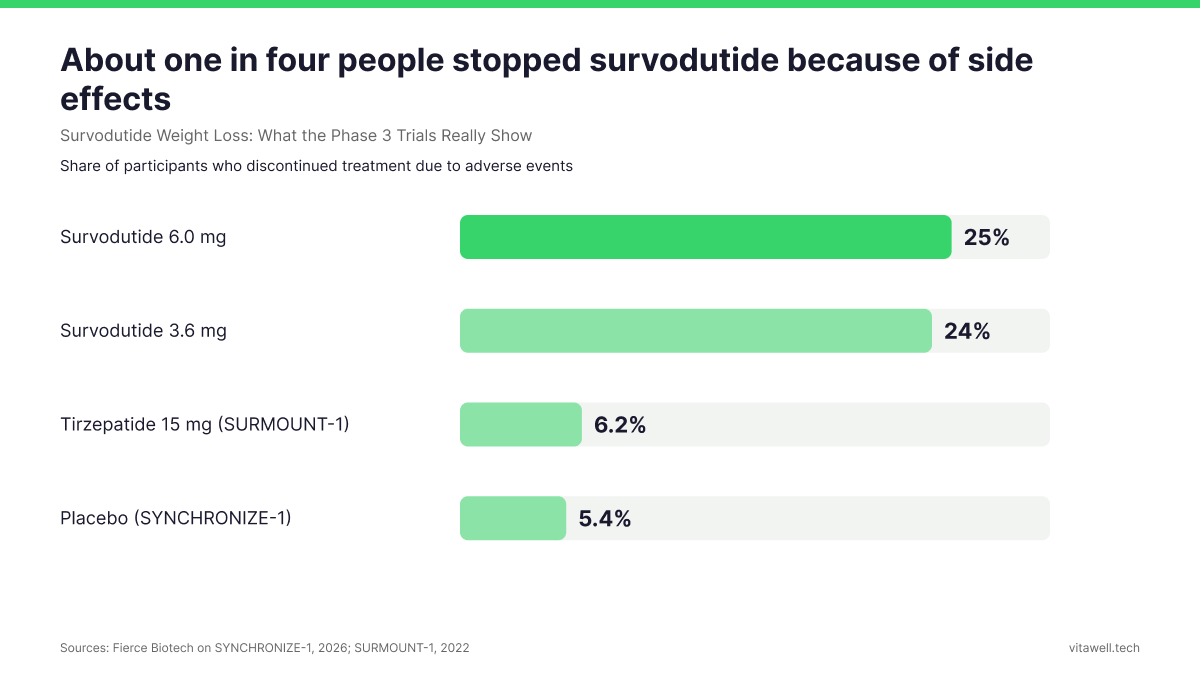
- About 24% (3.6 mg) and 25% (6.0 mg) of participants stopped survodutide because of adverse events, versus 5.4% on placebo.
- 19% stopped specifically because of digestive side effects, versus 2.9% on placebo.
- In the Wegovy and Zepbound pivotal trials, side-effect-related discontinuation ranged from 2.6% to 7.1% depending on dose.
The phase 2 MASH trial showed the same pattern: nausea in 66% of people on survodutide versus 23% on placebo, and vomiting in 41% versus 4%. Some of this may reflect how fast the dose was increased, and Boehringer has said tolerability is consistent with the drug class. For now, it is the clearest weakness in the data. The broader picture of digestive and other effects across this drug class is covered in VitaWell's guide to GLP-1 side effects patients don't expect.
Who Might Benefit Most — and Who Should Wait
Survodutide is not available, but the data already suggests where it may fit if it is approved. Use this as a checklist for a conversation with a doctor, not as a treatment plan:
- Fatty liver is the main concern: the liver results are the most distinctive part of the evidence, so people with MASLD or MASH are the most likely future candidates.
- Maximum weight loss is the goal: tirzepatide currently has stronger trial results, and it is approved.
- A history of strong nausea on GLP-1 drugs: the discontinuation data suggests survodutide may be harder to tolerate, at least with the dosing used in trials.
- Heart, kidney or metabolic risk alongside weight: current guidelines already favor approved drugs with outcome data, as described in VitaWell's piece on the heart-kidney-obesity connection.
- Considering a clinical trial: the LIVERAGE and other survodutide trials are listed on ClinicalTrials.gov; eligibility depends on liver stage and other criteria.
When Could Survodutide Be Available?
The key milestones so far:
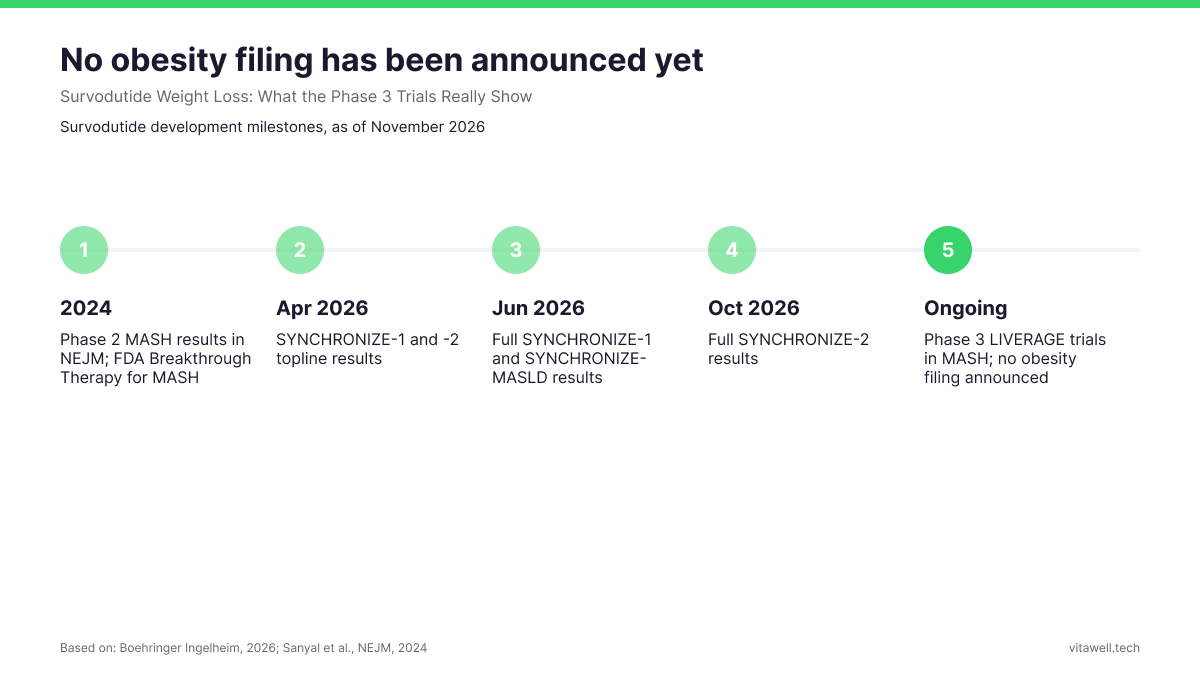
- 2024: phase 2 MASH results published in NEJM; the US FDA granted Breakthrough Therapy designation for MASH.
- April 2026: SYNCHRONIZE-1 and SYNCHRONIZE-2 topline results announced.
- June 2026: full SYNCHRONIZE-1 and SYNCHRONIZE-MASLD results published.
- October 2026: full SYNCHRONIZE-2 results presented and published.
- Ongoing: phase 3 LIVERAGE trials in MASH with fibrosis and in compensated cirrhosis.
As of November 2026, Boehringer Ingelheim (2026) describes survodutide as investigational and has not announced a submission date for obesity. Once a company files, a standard FDA review usually takes about a year, so any approval for weight management would come after a filing that has not yet been made public.
When to Talk to a Professional
- You want medication for weight management: approved options with outcome data are available now.
- You have been told you have fatty liver, raised liver enzymes or liver scarring; ask whether MASH testing or a clinical trial is appropriate.
- You are on a GLP-1 drug and have persistent vomiting, severe abdominal pain or signs of dehydration.
- You are offered "survodutide" online: it is not approved, and products sold under that name are not regulated.
Frequently Asked Questions
How much weight do people lose on survodutide?
In the 76-week SYNCHRONIZE-1 trial, people on the 6.0 mg dose lost 13.0% of body weight on average in the primary analysis, versus 5.4% on placebo. Among people who stayed on treatment as planned, average loss was 16.6%. About 73% lost at least 5% of their starting weight.
Is survodutide better than Zepbound?
Not for weight loss, based on current trials. Tirzepatide (Zepbound) produced 20.9% average weight loss in SURMOUNT-1, compared with 13.0% for survodutide in its comparable primary analysis. No head-to-head trial exists. Survodutide's potential advantage is its effect on liver fat and liver inflammation.
What are the side effects of survodutide?
The most common are nausea, vomiting and diarrhea, mostly mild to moderate and most frequent while the dose is being increased. In SYNCHRONIZE-1, about a quarter of participants stopped treatment because of adverse events, versus 5.4% on placebo, which is higher than in the Wegovy and Zepbound trials.
When will survodutide be available?
There is no confirmed date. As of November 2026, survodutide is investigational and Boehringer Ingelheim has not announced an obesity filing. A standard FDA review typically takes about a year after submission, so availability depends on a filing that has not yet been made public.
Does survodutide help fatty liver disease?
The evidence so far is promising. In a phase 2 trial, up to 62% of people with MASH improved versus 14% on placebo, and in SYNCHRONIZE-MASLD 84.2% cut liver fat by at least 30%. Larger phase 3 liver trials are still running, so the benefit is not yet confirmed.
Conclusion
Survodutide is a serious new option, but not the weight-loss leader its early headlines suggested. Measured the same way as other drugs, its weight loss sits near semaglutide and below tirzepatide, and more people stopped it because of side effects. Its standout result is in the liver, where it cut fat and improved inflammation more than placebo across three trials. If you are working on weight or metabolic health now, VitaWell's AI life planner can help you track the habits that support any treatment, from activity and sleep to regular check-ins with your doctor.
Related on VitaWell
- GLP-1 Medications and Fertility: What New Research Says for Men and Women With Obesity — what this drug class may mean for people planning a pregnancy.
- GLP-1 Drugs Like Ozempic Don't Just Shrink Your Waistline — New Study of 600,000 People Shows They Also Silence the Craving Behind Addiction — effects of GLP-1 drugs beyond weight.
- Working Long Hours Is Making You Heavier — What New Research Reveals About Overwork and Obesity — the lifestyle drivers of weight gain that medication alone does not address.
This article is for informational purposes only and is not medical advice. Survodutide is an investigational drug; talk to a qualified healthcare professional before starting or changing any weight or liver treatment.
Sources
- 'Next-Gen' GLP-1 Leads to 16% More Weight Loss — Healthline
- Cleveland Clinic Journal of Medicine, 2026 — SYNCHRONIZE-1 and SYNCHRONIZE-MASLD results (le Roux et al., NEJM; Kaplan et al., Nature Medicine)
- Fierce Biotech, 2026 — Survodutide tolerability at ADA 2026
- Boehringer Ingelheim, 2026 — SYNCHRONIZE-2 phase III data in obesity and type 2 diabetes
- Boehringer Ingelheim, 2026 — Positive data from two phase III SYNCHRONIZE trials
- Sanyal et al., 2024 — A phase 2 randomized trial of survodutide in MASH and fibrosis (NEJM)
- Pharmacy Times, 2026 — Survodutide, visceral fat and liver fat in MASLD
- Wilding et al., 2021 — STEP 1: once-weekly semaglutide in adults with overweight or obesity (NEJM)
- HCPLive, 2022 — SURMOUNT-1 tirzepatide results
- PharmExec, 2025 — Retatrutide TRIUMPH-4 topline results