
Semaglutide Helps People Eat 24% Fewer Calories Over a Full Year, Study Finds

When people start taking semaglutide, the appetite-suppressing effects can feel dramatic — hunger nearly disappears, food stops feeling as rewarding, and losing weight feels almost effortless. But many patients notice something unsettling after the first few months: hunger starts to creep back. The same feelings they had before the medication. And the fear follows: has the drug stopped working?
What the Study Found: A Year of Sustained Calorie Reduction
A landmark new study from Penn Medicine, published in the American Journal of Clinical Nutrition, offers a reassuring and scientifically important answer to that fear. Even as subjective feelings of hunger partially return over time, the medication's most important effect — keeping calorie intake significantly lower — persists throughout a full year of treatment.
The Study Design: Measuring What People Actually Eat
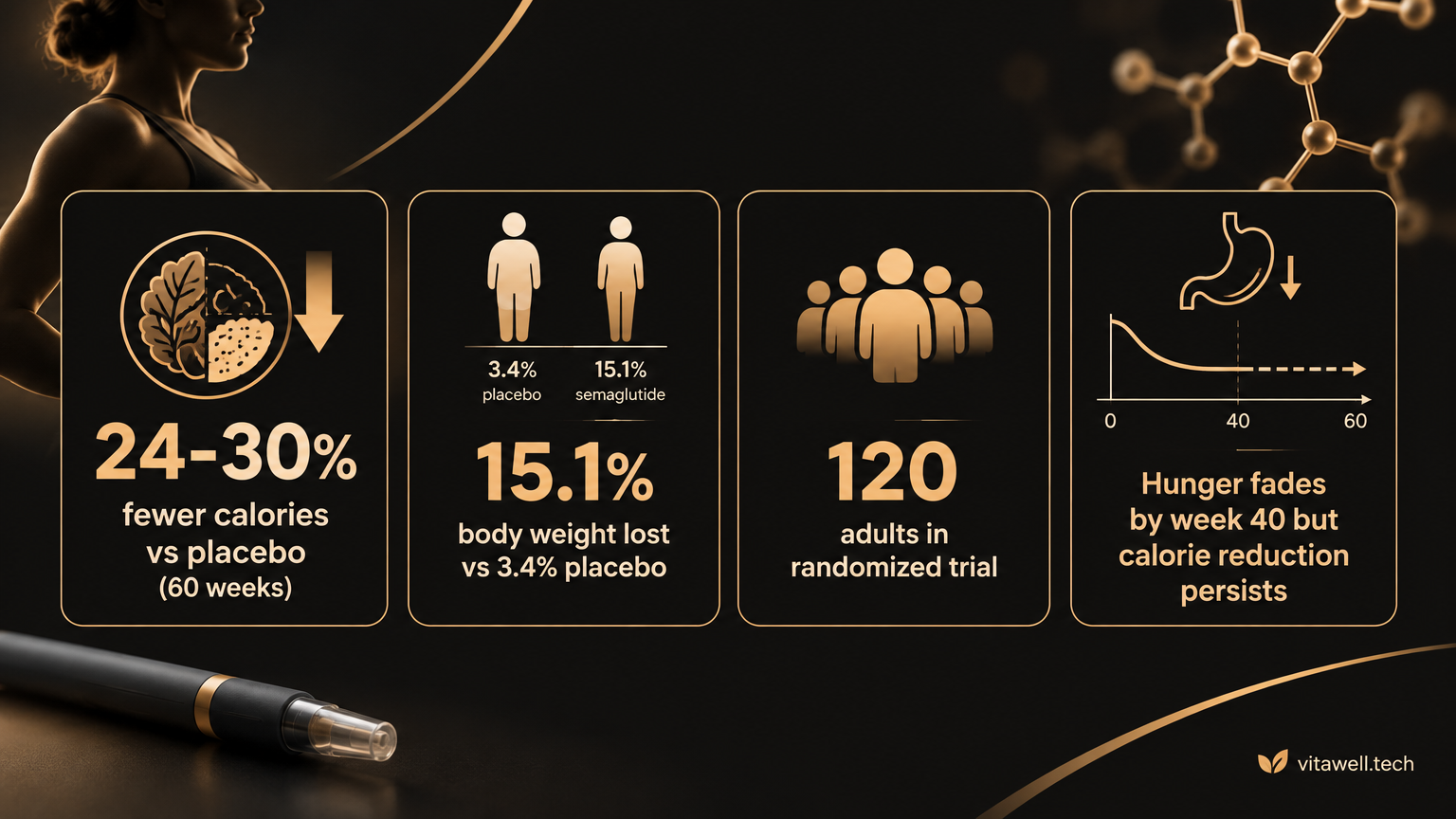
The study enrolled 120 adults with overweight or obesity in a randomized, double-blind clinical trial. Participants received either once-weekly 2.4 mg semaglutide (the dose used for weight management, marketed as Wegovy) or a placebo, and both groups participated in regular lifestyle counseling covering healthy eating and physical activity. The trial ran for 60 weeks — more than a year.
What set this study apart was its measurement methodology. Rather than relying solely on participants' self-reports about how hungry they felt or how much they thought they ate, the researchers brought participants into a laboratory at baseline and at weeks 20, 40, and 60 for standardized eating assessments. After a standardized breakfast, participants were offered lunch and told to eat until comfortably full. The research team measured exactly how many calories each person consumed under these controlled conditions. This objective measurement approach gave the team a far more reliable picture of what semaglutide was actually doing to calorie intake over time, independent of how people perceived their own hunger.
The Key Finding: 24–30% Fewer Calories, Consistently
The results were striking in their consistency. Participants taking semaglutide consumed approximately 24% to 30% fewer calories than participants in the placebo group at every follow-up assessment through week 60. This wasn't a one-time effect that faded — the caloric gap between the semaglutide group and the placebo group remained stable across the entire duration of the study.
The weight loss data mirrored these findings. At week 60, the semaglutide group had lost an average of 15.1% of their initial body weight, compared to just 3.4% in the placebo group. The maintained calorie reduction appears to be the primary mechanism behind this sustained weight loss — not metabolic shifts or other factors, but the simple, consistent fact that people on semaglutide continued to eat significantly less than they would have otherwise.
Why Hunger Returns — But Calorie Intake Stays Low
To understand why this finding matters, it helps to track what actually happened to participants' subjective experience of hunger across the 60-week trial. The pattern reveals something important and counterintuitive about how semaglutide actually works.
What Happens to Hunger Over Time
During the first 20 weeks of the study, participants taking semaglutide reported dramatically different subjective experiences compared to the placebo group. They felt significantly less hungry, had stronger appetite control, thought about food less frequently, and experienced what many patients describe as a reduction in "food noise" — the persistent background preoccupation with food, cravings, and eating that characterizes many people's daily mental experience.
These differences were statistically significant and clinically meaningful. For many participants, this phase of treatment felt transformative. The mental bandwidth previously consumed by food thoughts became available for other things. Eating felt like a deliberate choice rather than a compelling drive.
But by weeks 40 and 60, something had changed. The differences between the semaglutide group and the placebo group on many of these subjective appetite measures were no longer statistically significant. Hunger, appetite control, food preoccupation — the experiential gap between the two groups had narrowed substantially. For many patients, this is the moment they begin to worry.
The Perception vs. Reality Gap
Dr. Thomas A. Wadden, professor of Psychology in Psychiatry and former director of Penn's Center for Weight and Eating Disorders, identifies this as a critical distinction the study helps clarify. "This study highlights an important distinction between people's perceptions of their appetite and how they actually eat," he said. "People taking semaglutide for weight loss often notice dramatic reductions in hunger and food noise when they begin this treatment. If those sensations gradually become less noticeable, some may incorrectly assume the medication is no longer effective."
The study's data shows that this assumption would be wrong. While the subjective experience of hunger returns to something closer to baseline, the actual behavioral impact on food intake does not. People feel hungrier, but they still eat substantially less. Dr. Jena S. Tronieri, the study's lead author and a senior research investigator at Penn's Center for Weight and Eating Disorders, explained the clinical implication directly: "Many patients worry that their medication has stopped working if they notice some return of hunger after the first several months. Our findings show that even when people feel some of those sensations returning, semaglutide continues to help them eat less. That sustained reduction in calorie intake appears to be a key reason why weight loss is maintained over time."
This gap between perceived hunger and actual eating behavior is one of the most important and least understood aspects of GLP-1 medications. It suggests that semaglutide may work through multiple parallel pathways — some of which are more consciously perceptible to patients than others.
How Semaglutide Works: The Mechanism Behind Long-Term Weight Loss
To understand why the drug continues to reduce calorie intake even as the subjective experience of hunger shifts, it helps to understand how semaglutide actually works in the body and brain.
GLP-1 Receptor Agonists and Appetite Regulation
Semaglutide belongs to a class of medications called GLP-1 receptor agonists. GLP-1 (glucagon-like peptide-1) is a hormone naturally produced in the gut after eating. It signals fullness to the brain, slows gastric emptying (which is how quickly food moves from the stomach to the intestine), and influences how rewarding food feels through pathways in the brain's reward circuitry.
Semaglutide mimics this hormone but with significantly longer duration of action and greater potency than the body's naturally produced GLP-1. The result is a sustained suppression of appetite signals across multiple systems simultaneously — not just a single appetite switch being turned off, but a coordinated reduction across the hormonal, neurological, and behavioral systems that govern food intake.
Food Noise and Why It Matters
"Food noise" has become one of the most discussed effects of GLP-1 medications — the reduction in the constant background mental chatter about food, cravings, and eating that many people with overweight or obesity experience as a normal part of their mental life. For many patients, the near-elimination of food noise in the early months of treatment is the most psychologically meaningful change the medication produces.
What the Penn study suggests is that food noise and actual calorie intake, while related, are not the same thing. The subjective quieting of food thoughts fades over time — but the behavioral impact on how much people actually eat when given an opportunity to eat does not fade at the same rate. This may be because semaglutide's effects on satiety signaling (how full you feel during and after eating) and gastric emptying are more durable than its effects on the conscious anticipation of food.
What This Means for Patients on Semaglutide
The practical implications of these findings for the millions of people currently taking semaglutide for weight management are significant and largely reassuring.
Don't Mistake Partial Hunger Return for Medication Failure
The most direct clinical message from this research is about managing expectations and avoiding unnecessary discontinuation. As Dr. Tronieri put it: "Our results suggest that patients may experience a partial return of appetite sensations over time, without losing the medication's benefit of continuing to reduce calorie intake, which is needed to maintain their new, lower body weight."
Patients who stop taking semaglutide because they feel the drug "isn't working anymore" may be making a decision based on a subjective experience that doesn't accurately reflect the drug's ongoing physiological effects. The maintained 24–30% calorie reduction compared to placebo is a substantial metabolic advantage. Abandoning it based on the perceived return of hunger could undermine weight loss that has taken months to achieve.
The Role of Lifestyle Counseling
Both groups in the Penn study received regular lifestyle counseling on healthy eating and physical activity — a detail worth noting. The placebo group, with counseling alone, lost about 3.4% of their body weight over 60 weeks. The semaglutide group, with the same counseling plus medication, lost 15.1%. This gap underscores that while lifestyle counseling matters, the medication adds substantial additional effect.
It also suggests that the behavioral framework provided by counseling may help patients maintain the eating patterns established during the drug's most powerfully appetite-suppressing phase, even as subjective hunger gradually returns. Sustainable weight management likely requires both — the physiological assist from the medication and the behavioral foundation built through ongoing support.
What We Still Don't Know
This study represents a meaningful advance in understanding how semaglutide maintains its effectiveness over time, but several important questions remain unanswered.
The 60-week timeframe, while longer than many prior studies, doesn't tell us what happens beyond that point. Whether calorie reduction remains 24–30% lower than placebo at 18 months, two years, or five years isn't yet established. Long-term data on these medications is still accumulating.
The study focused specifically on semaglutide at the 2.4 mg weekly dose. Whether the same pattern of sustained calorie reduction despite partial hunger return applies to other GLP-1 medications — including tirzepatide (which targets both GLP-1 and GIP receptors) or lower doses of semaglutide — remains an open question.
Side effects and what happens when people stop taking the medication were not the focus of this research. It's well established from other studies that weight typically returns when semaglutide is discontinued, underscoring that the maintained calorie reduction is an ongoing pharmacological effect rather than a durable behavior change that persists independently of the drug.
Finally, the study was supported in part by a Novo Nordisk research grant — the company that manufactures semaglutide. The researchers noted that Novo Nordisk played no part in the conception, conduct, analysis, or reporting of the study, and the university-led design and independent publication provide meaningful safeguards. But the funding source is worth noting as context when evaluating the findings.
Conclusion: Semaglutide's Deepest Effect May Be Its Most Durable
The Penn Medicine study offers something genuinely valuable to patients, clinicians, and researchers alike: evidence that semaglutide's most clinically meaningful effect — reducing how much people actually eat — persists throughout a full year of treatment even as the subjective experience of that effect fades.
This reframes how patients should think about their experience on the medication. The dramatic suppression of hunger and food noise in the early months is real, clinically significant, and psychologically transformative for many people. But it's not the whole story of how semaglutide works. Underneath that noticeable effect is a more durable, perhaps quieter mechanism: a sustained reduction in calorie intake that continues to do its job even when the patient can no longer feel it as vividly as they once could.
Persistent hunger sensation, in this context, is not a sign that the medication has stopped working. It's a sign that the medication is working in a different way than it did at the beginning — a distinction that could matter enormously for the millions of people now relying on these medications to manage a chronic health condition.
Sources
Penn Medicine — Semaglutide Still Has Benefits After One Year
Newswise — Study: Semaglutide Sustains Lower Calorie Intake for More Than a Year
Consumer Affairs — Semaglutide May Keep Calorie Intake Lower Even as Hunger Returns