
Why Your Body Reacts to Stress So Fast — The Science of Fight, Flight, and Freeze

Your heart pounds. Your palms sweat. Your muscles clench — before you've consciously registered what triggered the alarm. The human stress response is one of the fastest and most dramatic events the body can stage, and it unfolds almost entirely below the level of conscious thought. Understanding what's actually happening when you feel threatened — and why it feels the way it does — is one of the most practically useful things you can know about your own nervous system.
How Fast Is the Stress Response?
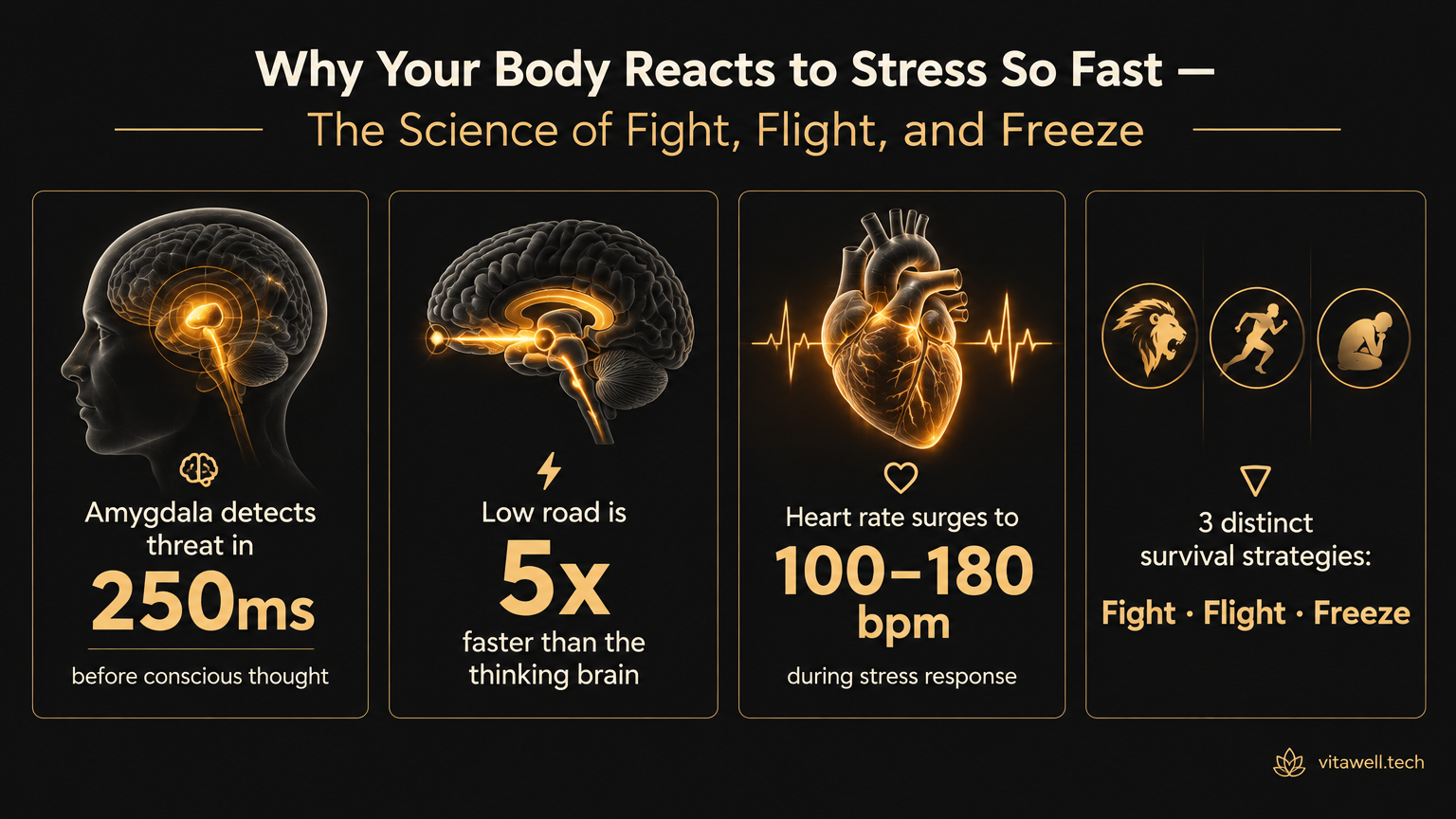
The stress response begins in a part of the brain called the amygdala, two almond-shaped clusters of neurons buried deep in the temporal lobes. The amygdala is your brain's threat-detection center, and it operates at remarkable speed. Neuroscience research suggests it can begin processing a potential threat in as little as 250 milliseconds — roughly a quarter of a second — before your conscious mind has formed any awareness of danger.
Psychologist Daniel Goleman popularized the term "amygdala hijack" to describe what happens when this rapid-fire system overrides rational thinking. The key insight is that threat information travels two pathways simultaneously: the "low road," which goes directly from your sensory organs to the amygdala for near-instant emotional processing, and the "high road," which passes through the prefrontal cortex for slower, more considered assessment. Research suggests the low road operates up to five times faster than the high road — meaning your body has often already begun preparing a response by the time your thinking brain arrives at the scene.
The term "fight-or-flight" itself was coined by Harvard physiologist Walter Cannon in the 1920s, based on his observations of how animals responded to threat. Cannon recognized that the body's alarm system wasn't random — it was a highly coordinated biological mobilization designed to do one thing: maximize your chances of surviving the next few seconds. For most of human evolutionary history, those few seconds were often what determined survival. That speed is a feature, not a bug.
The Biology of Stress — What Happens Inside Your Body
The Amygdala Sounds the Alarm
When your amygdala detects a potential threat — a sudden noise, a confrontational tone of voice, a frightening image — it sends an immediate signal to the hypothalamus, the brain's command center. The hypothalamus functions like a relay station between the brain and the rest of the body, communicating through the autonomic nervous system: the network of nerves that control involuntary bodily functions like heartbeat, breathing, and digestion.
The hypothalamus activates the sympathetic nervous system — the "gas pedal" branch of the autonomic nervous system — which triggers a cascade of rapid-fire physiological changes throughout the body. This activation happens before you've made any conscious decision to feel afraid, angry, or threatened. The body acts first. The mind catches up.
The Hormone Cascade
The sympathetic activation signals the adrenal glands, two small glands sitting atop the kidneys, to release adrenaline (epinephrine) into the bloodstream. This happens within seconds of the initial threat signal. Adrenaline is the accelerant that drives the acute stress response: it causes the heart to beat faster and harder, diverts blood from the digestive system and skin to the large muscle groups, dilates the airways to allow more oxygen in, and sharpens sensory perception.
If the threat persists, the hypothalamus triggers a second hormonal cascade through the HPA (hypothalamic-pituitary-adrenal) axis, releasing cortisol — often called the stress hormone — from the adrenal cortex. Cortisol arrives minutes after the initial adrenaline surge and sustains the stress response over a longer timeframe. It increases blood sugar to fuel muscles, suppresses the immune system (a costly trade-off that evolution made for immediate survival), and enhances the brain's alert state.
The combined effect is dramatic: heart rate can jump from a resting 70 beats per minute to 100–180 beats per minute. Blood pressure rises. Muscles flood with oxygen-rich blood. Digestion pauses. Pupils dilate to take in more visual information. The body is now, in a very real physiological sense, prepared for the most demanding physical performance it may ever be called on to deliver.
What Does Each Stress Response Look Like?
Not every person in every threatening situation responds the same way. The body selects among three distinct survival strategies based on factors that are partly genetic, partly shaped by past experience, and partly determined by the nature of the threat itself. Those three strategies — fight, flight, and freeze — each have a characteristic set of physical symptoms that most people experience but rarely recognize for what they are.
The Fight Response — Confronting the Threat
The fight response mobilizes the body for confrontation. It's the stress response that feels most like anger, and it makes evolutionary sense: if you assess that you can overpower the threat, standing your ground may be safer than running. The physiological preparation for fighting is remarkably specific.
People in a fight response often experience muscle tension throughout the body — particularly in the jaw, neck, shoulders, and hands. The jaw clenches. The fists close. The shoulders rise. Blood floods into the large muscle groups of the arms and legs, preparing them for maximum force output. The pupils dilate fully, and there's often a subjective sense of hyper-alertness — colors seem sharper, sounds seem louder. Some people experience a feeling of heat or flushing as blood vessels in the face dilate. Aggression or irritability may surface, sometimes seemingly out of nowhere.
When the fight response is chronically triggered — as it is in high-stress work environments, difficult relationships, or anxiety disorders — the sustained muscle tension leads to characteristic physical complaints: tension headaches, neck and shoulder pain, jaw pain (bruxism), and chronic back tightness. The body has been holding itself in fight-readiness for so long that the tension has become structural.
The Flight Response — Running From the Threat
The flight response prepares the body for rapid escape. Where the fight response directs energy toward upper-body power, the flight response emphasizes cardiovascular output and lower-body speed. If you've ever felt the urge to leave a room, avoid a confrontation, or simply get as far from a situation as possible, you've experienced the beginning of the flight response.
Physically, flight feels unmistakable: the heart rate surges, often reaching 120–180 beats per minute even without any actual physical exertion. Breathing becomes shallow and rapid, drawing in more oxygen in preparation for sustained movement. The stomach empties — blood leaving the digestive system is redirected to the limbs, creating the distinctive "butterflies" or queasiness that many people feel when anxious. The mouth dries out, because salivary gland activity decreases. Sweating begins, partly to cool the body in anticipation of physical effort, and partly for another remarkable evolutionary reason: sweaty palms were thought to improve grip on rough surfaces during escape.
Many people in a flight response also experience trembling or shaking, particularly in the legs and hands — a byproduct of muscles rapidly loading and unloading in preparation for movement that never comes. When the response is chronic, flight-dominant individuals often experience persistent anxiety, restlessness, insomnia, and a generalized sense of urgency or inability to relax.
The Freeze Response — Shutting Down
The freeze response is the least understood of the three, and the most likely to be misread — both by the person experiencing it and by those around them. While fight and flight are both sympathetic nervous system responses involving high arousal and mobilization, freeze involves something physiologically distinct: an activation of the dorsal vagal complex, a branch of the parasympathetic nervous system described in psychologist Stephen Porges' polyvagal theory.
Where the sympathetic nervous system says "move," the dorsal vagal complex says "stop." It triggers a profound shutdown of voluntary movement and a dulling of pain and sensation. This is not passivity — it is an active physiological state, the human equivalent of what biologists call tonic immobility, or "playing dead." In many predator-prey interactions, immobility is a survival advantage: some predators lose interest in motionless prey, and playing dead can reduce the risk of further attack.
The physical experience of freeze is distinct from either fight or flight. People describe "jelly legs" — a sudden loss of muscle tone that makes it difficult to stand. Nausea and dizziness are common, as is a sensation of dissociation or unreality: the feeling of watching yourself from outside your own body, or of the world becoming flat, grey, or muffled. Thinking becomes foggy, slow, and difficult to direct. Some people experience sudden-onset migraines. There is often a profound sense of emotional numbness — a blankting of feeling that serves to distance the individual from an overwhelming experience.
Freeze is more commonly experienced in situations of extreme threat or helplessness — where neither fighting nor fleeing seems viable. It's frequently reported by survivors of trauma, assault, and accidents. The misidentification of freeze as simple passivity or cowardice has caused enormous harm, particularly in legal and clinical contexts where people who froze during traumatic events are questioned about why they didn't act. The neurobiology is clear: the freeze response is not a choice.
When the Stress Response Misfires
The fight-flight-freeze system evolved to handle immediate physical threats — the kind that resolve within minutes. A predator either catches you or it doesn't. A rival either backs down or the confrontation ends. The physiological activation rises sharply and then, when the threat resolves, dissipates.
Modern human stressors are categorically different. An overflowing inbox, a difficult manager, financial pressure, relationship conflict — these are threats that don't resolve in seconds. They persist for hours, days, months, or years. And the nervous system cannot distinguish between a tiger and a tense email: the same ancient survival system activates in response to both.
The consequences of chronically elevated cortisol are well-documented and significant. Sustained cortisol elevation suppresses the immune system, disrupts sleep architecture, impairs memory consolidation (cortisol literally damages the hippocampus), promotes abdominal fat deposition, and elevates cardiovascular risk. Anxiety disorders, in many ways, represent a dysregulation of the threat-response system — a brain that has learned to treat ordinary situations as emergencies, keeping the body in a state of low-grade fight-flight-freeze activation that was never designed to be sustained.
How to Work With Your Stress Response
Understanding the stress response isn't just interesting neuroscience — it creates practical leverage. Because the system works through specific physiological mechanisms, those mechanisms can be deliberately influenced.
Breathing is the most direct tool. The sympathetic nervous system accelerates breathing; the parasympathetic nervous system slows it. But the relationship is bidirectional. By deliberately slowing and deepening your breathing — particularly by extending the exhale to be longer than the inhale — you activate the vagus nerve and shift the autonomic balance back toward parasympathetic regulation. Even a few slow, deep breaths can measurably reduce heart rate and reduce the subjective experience of acute stress.
Physical movement metabolizes stress hormones. When fight-or-flight prepares the body for action, it releases adrenaline and mobilizes glucose and oxygen for muscular effort. If that effort never comes — if you sit at your desk feeling anxious, without any physical outlet — those hormones linger in the bloodstream. Moderate physical activity, even a brisk walk, helps the body complete the stress cycle by using up the biochemical fuel that was mobilized but never spent.
Labeling the experience reduces its intensity. Neuroscientist Matthew Lieberman's research found that putting feelings into words — a process called affect labeling — reduces amygdala activation. Simply naming what you're experiencing ("this is a stress response," "my body thinks I'm in danger," "this is adrenaline") engages the prefrontal cortex and partially interrupts the amygdala hijack. The clinical shorthand is "name it to tame it," and the research supports it.
For the freeze response specifically, grounding techniques can help restore a sense of safety and presence. The 5-4-3-2-1 method — identifying five things you can see, four you can touch, three you can hear, two you can smell, and one you can taste — deliberately activates sensory processing and can interrupt the dissociative shutdown state.
Conclusion
The fight, flight, and freeze responses are not flaws in the human design. They are among the most sophisticated emergency management systems in the natural world, refined by millions of years of evolution to maximize survival under acute threat. The speed with which the amygdala can mobilize the entire body, the precision with which adrenaline redirects blood and energy, the remarkable specificity of each response's physical signature — these are marvels of biological engineering.
What creates modern suffering isn't the system itself, but its mismatch with the environment it now operates in. When a threat-detection system designed for immediate physical danger meets the sustained psychological pressures of contemporary life, the result is chronic activation that the body was never built to sustain. Understanding that mismatch — knowing that your dry mouth, your pounding heart, your foggy thinking, or your sudden immobility are all ancient signals that worked for a very different world — is the beginning of building a more skillful relationship with your own nervous system.
Sources
Psychology Today — Why Your Body Freezes, Flees, or Fights Under Stress
Healthline — Fight, Flight, or Freeze: How We Respond to Threats
Simply Psychology — Amygdala Hijack
Positive Psychology — The Fight-or-Flight Response: Everything You Need to Know