
When Workplace Purpose Backfires: How Thwarted Impact Is Costing Companies Their Best People

Your best employees aren't leaving because they don't care. They're leaving because they care too much — and something in your organization is getting in the way. This is the quiet crisis at the heart of a 2026 Harvard Business Review analysis on thwarted impact: the phenomenon of purpose-driven employees becoming your greatest retention risk precisely because their motivation is highest.
The Purpose Paradox — Why the Most Motivated Employees Leave First
It seems like a contradiction. You hire for passion, mission alignment, and intrinsic motivation — and then those exact people are the first ones out the door. But research increasingly shows this is not an anomaly. It is a pattern, and it has a name: the purpose paradox.
According to HBR's June 2026 analysis, highly purpose-driven employees experience a sharper and more painful form of disengagement when their ability to make an impact is blocked. The more someone believes in the work, the harder it hits when that work feels futile or obstructed. This creates a devastating irony for organizations: the talent they invest the most in recruiting — the mission-aligned, the intrinsically motivated, the high performers — is the most likely to leave when they hit structural walls.
What 'Thwarted Impact' Actually Means
Thwarted impact is not the same as being unhappy at work. It is a specific experience: an employee believes their contributions could make a real difference, and yet something — a process, a manager, a culture, a system — consistently prevents that difference from happening. Their ideas are ignored, their projects are stalled, their autonomy is curtailed. The gap between their potential for impact and their actual experience of impact becomes unbearable.
This distinguishes thwarted impact from general job dissatisfaction. Someone with low purpose investment may shrug and adapt. Someone who deeply cares about the work cannot. For them, every blocked initiative is not just a frustration — it is a signal that the organization does not value what they value. And eventually, they find somewhere that does.
The Data Behind the Paradox
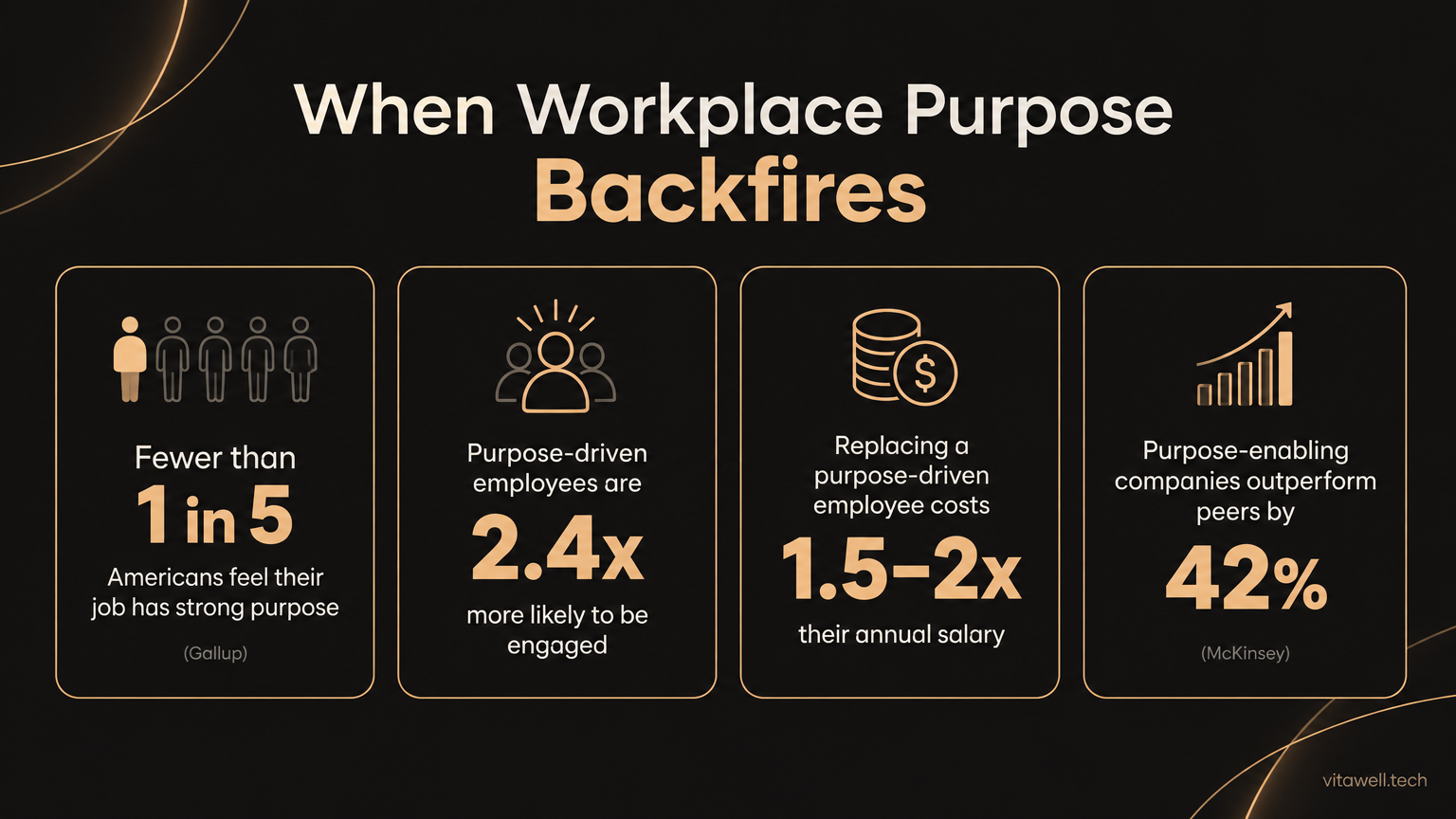
The numbers back this up across multiple studies. Gallup research finds that fewer than 1 in 5 Americans feel their job has a strong sense of purpose — yet those who do are 2.4 times more likely to be engaged at work. That same group, when their purpose is thwarted, becomes the most volatile segment of the workforce. University of Iowa research on proactive employees found that those with higher initiative and purpose-orientation are significantly more likely to leave when frustrated compared to less proactive colleagues. The logic is clear: your most invested employees have the most to lose when impact is blocked.
Korn Ferry data adds the financial dimension. Replacing a purpose-driven employee costs between 1.5 and 2 times their annual salary, accounting for recruiting, onboarding, lost productivity, and institutional knowledge transfer. Multiply that across an organization's high performers, and the hidden cost of purpose thwarting runs into the millions.
How Purpose Thwarting Unfolds — The Frustration Cycle
Purpose thwarting rarely happens all at once. It follows a predictable cycle, described in Purdue University's Daniels School of Business 2026 research as a progression from alignment through friction to disengagement and exit. Understanding each stage is the first step to interrupting it.
Stage 1 — The Alignment Phase
It starts with a great hire. The organization markets itself on mission, impact, and meaning. The candidate is drawn in by exactly these promises. They join energized, believing their work will matter. This is the alignment phase — and it contains the seeds of future disappointment, because the promises made in recruiting are rarely operationalized into systems and structures once the employee is onboard.
Stage 2 — The Friction Phase
Several weeks or months in, the purpose-driven employee begins to encounter obstacles. Approval processes that slow everything down. Managers who micromanage instead of enabling. Ideas that go nowhere. A culture of caution that discourages initiative. This is the friction phase, and it introduces the concept researchers call purpose theater — the gap between what organizations say about their mission and what employees actually experience day to day. The company's website talks about changing the world. The Monday standup is about meeting quotas.
Stage 3 — Quiet Cracking
If friction persists, something subtler than quiet quitting begins. Researchers at Innovative Human Capital describe this as quiet cracking: the silent, gradual erosion of a purpose-driven employee's engagement. Unlike quiet quitting, where an employee consciously withdraws effort, quiet cracking is psychological. The employee is still showing up, still performing at a surface level — but their sense of meaning is draining away. They stop volunteering for extra projects. They stop raising ideas. They stop believing it matters.
This is the most dangerous stage for organizations because it is invisible. Performance metrics may not yet show a decline. Exit interviews will not capture it. But the employee is already mentally halfway out the door — and the organization has no idea.
Stage 4 — Revenge Quitting
Quiet cracking eventually reaches a tipping point. When it does, purpose-thwarted employees often exit suddenly and completely — in what has been called revenge quitting. This is not a carefully negotiated departure with a two-month transition period. It is an abrupt exit that leaves the organization scrambling, often taking institutional knowledge, client relationships, and team morale with it. ITPro research finds that employees who feel chronically thwarted are especially likely to quit without warning, and that this trend is accelerating particularly among Gen Z and Millennial workers who entered the workforce with explicit expectations around meaningful work.
The Hidden Cost of Losing Purpose-Driven Employees
The financial cost of losing a single purpose-driven employee is significant. The organizational cost of losing many of them systematically is catastrophic.
The Financial Toll
McKinsey research shows that companies which successfully enable employee purpose outperform their peers by 42% across key performance metrics. The inverse is equally true: organizations that consistently thwart impact operate with a significant structural disadvantage. When you combine the direct replacement cost of 1.5–2x annual salary with lost productivity during vacancies, reduced team performance during transitions, and the compounding effect of knowledge walking out the door, the financial case for investing in purpose enablement becomes overwhelming.
The Talent Pipeline Problem
There is a second-order effect that is even more damaging over time. When purpose-thwarting becomes systemic, organizations enter a cycle of adverse selection. The most proactive, most mission-aligned employees leave. The less invested stay. Over months and years, this reshapes the workforce into one that is progressively less innovative, less engaged, and less capable of the kind of high-performance execution that drives competitive advantage. The organization doesn't just lose individual employees — it loses its capacity for excellence.
Gen Z and the New Expectations Economy
This dynamic is intensifying as the workforce composition shifts. Research consistently shows that Gen Z and Millennials — now the majority of the working-age population — rate purpose as a top-three retention factor, ahead of compensation in many surveys. For these cohorts, a job without impact is simply not worth keeping, and they have both the market mobility and the generational confidence to act on that belief. Organizations that fail to enable purpose face not just current retention challenges but accelerating hiring difficulties as word spreads about where purpose goes to die.
What 'Purpose Theater' Looks Like — And How to Stop It
Purpose theater is endemic in organizations that have invested in purpose communication without investing in purpose enablement. Here is how to recognize it and what to do about it.
Six Signs Your Organization Is Running Purpose Theater
- Purpose is prominently stated in company values, mission statements, and recruiting materials — but is never referenced in performance reviews, project decisions, or day-to-day management
- Impact metrics are either not tracked or not shared with employees, so no one can see whether their work is actually moving the needle
- Employee ideas and improvement suggestions go through approval chains so long and slow that most are abandoned before they are ever implemented
- Leaders talk about innovation and initiative but respond to new ideas with risk-aversion, skepticism, or silence
- There is no psychological safety to name what is getting in the way — employees who raise obstacles are seen as complainers rather than problem-solvers
- Recognition systems reward hours worked and tasks completed rather than impact created and problems solved
The Leader's Role in Removing Purpose Blockers
McKinsey's research is explicit on this point: the leader's primary responsibility in a purpose-enabling culture is not to articulate the vision — it is to actively remove the obstacles that prevent employees from living it. This requires leaders to ask different questions: not "What are we delivering?" but "What is getting in the way of our best work?" Not "Are people meeting their KPIs?" but "Are people able to make the kind of impact they were hired to make?"
Leaders who do this well conduct regular purpose-blocker conversations with their teams, treat bureaucratic friction as a problem to solve rather than a fact of life, and model the psychological safety required for employees to raise concerns without fear.
Building a Purpose-Enabling Culture — What Works
The good news is that purpose thwarting is not inevitable. Organizations that treat purpose enablement as a strategic priority — not an HR talking point — consistently retain their best people and outperform their competitors. Here is what that looks like in practice.
Make Impact Visible
One of the most common sources of purpose thwarting is not that impact isn't happening — it's that employees can't see it. When individual contributions are disconnected from organizational outcomes, purpose-driven employees lose their sense of meaning even when their work is genuinely making a difference. The fix is systematic impact storytelling: regular, specific communication that connects what people do to what it changes. This can be as simple as a weekly team update that ties completed work to customer outcomes, or as structured as an annual impact report that shows how individual roles contributed to organizational goals.
Structural Autonomy — Giving Purpose-Driven Employees Room to Act
Purpose-driven employees need the autonomy to pursue impact, not just permission to try. This means reducing unnecessary approval chains, creating protected time for meaningful projects (sometimes called "impact time" or "maker time"), and establishing norms of psychological safety that allow employees to try new approaches without fear of punishment for failure. When autonomy is structural — built into how work is organized, not just stated as a value — purpose-driven employees can actually do what they were hired to do.
The Purpose Audit — Identify and Remove Blockers
A purpose audit is a structured process for identifying what is getting in the way of meaningful impact in your organization. Consider the following questions:
- What are the three things that most prevent people on our team from making the impact they want to make?
- Which of our current processes exist to manage risk, and which exist out of habit or inertia?
- When was the last time an employee's new idea was implemented? What happened?
- Do our managers spend more time enabling their teams or reviewing and approving their teams' work?
- What would our best people say if asked why they might leave — and are we asking?
The answers to these questions will almost always surface concrete, actionable purpose blockers that can be addressed without major organizational restructuring.
Recognition That Reinforces Purpose
How organizations recognize and reward work sends powerful signals about what actually matters. Recognition systems that celebrate hours worked, tasks completed, and metrics hit without connecting those outputs to meaningful outcomes inadvertently reinforce the message that impact is not what matters — compliance is. Purpose-enabling organizations redesign recognition to celebrate the why as much as the what: they tell stories of impact alongside announcements of achievement, they ask employees to share what their work meant to them, and they tie advancement and reward to the ability to create and enable meaningful outcomes, not just to execute tasks.
Conclusion
The organizations losing their best people to thwarted impact are not necessarily doing everything wrong. Many have strong values, authentic leaders, and genuinely meaningful missions. What they are missing is the operational infrastructure to turn purpose from a promise into an experience. Purpose-driven employees are simultaneously your greatest asset and your greatest retention risk. The ones who care most will work hardest — and leave fastest — if that care is consistently blocked.
The question is not whether your organization has a purpose. It is whether that purpose is something your employees can actually live every day. If the answer is no, your best people already know it. The good news is that the path forward is not about grand cultural transformation — it starts with one honest conversation about what is getting in the way, and one concrete step to remove it.
Sources
Harvard Business Review — When Purpose Backfires
McKinsey — Help Your Employees Find Purpose or Watch Them Leave
Gallup — Workplace Purpose and Engagement Data
Purdue Daniels School of Business — When Employee Purpose Hits a Wall