
How Coffee May Help Slow Down Aging, According to a New Study

Your morning cup of coffee might be doing more than waking you up. A growing body of research suggests that regular coffee consumption is linked to slower biological aging, longer telomeres, and significantly lower risk of the chronic diseases that cut healthy years short. Here's what the latest science says — and what it means for how you drink your coffee.
What New Research Says About Coffee and Aging
The past two years have seen a remarkable cluster of research converging on the same conclusion: moderate coffee consumption appears to be meaningfully associated with healthier, longer lives. These aren't fringe studies — they come from prestigious journals and large population datasets, and they're consistent enough to take seriously.
Coffee and Telomere Length: The Biological Clock Study
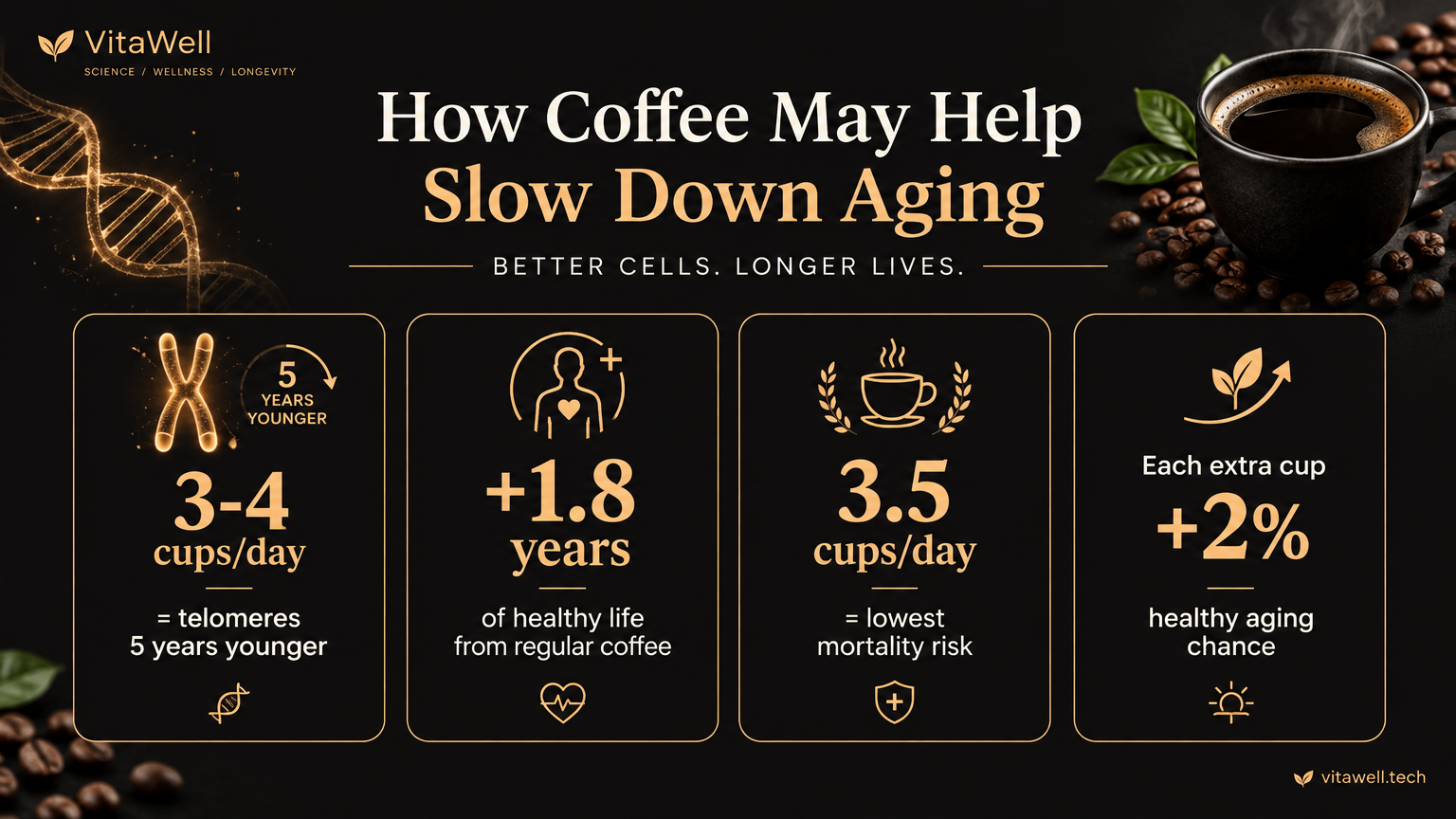
One of the most striking recent findings comes from a November 2025 study published in BMJ Mental Health, conducted in Norway. Researchers examined adults aged 18 to 65 with major psychiatric disorders and found that those who drank three to four cups of coffee per day had significantly longer telomeres than those who drank none.
Telomeres are the protective caps at the ends of our chromosomes — think of them as the plastic tips on shoelaces that prevent fraying. As we age, telomeres naturally shorten, and shorter telomeres are associated with accelerated biological aging, increased inflammation, and higher risk of age-related disease. The telomere length of coffee drinkers in this study was comparable to people approximately five years younger biologically than the non-coffee drinkers.
The researchers noted that the coffee drinkers in the study showed no additional telomere benefit from drinking more than four cups per day — suggesting a ceiling effect. The study was cross-sectional, so it cannot prove causation, and intake was self-reported. But the finding aligns with what researchers know about coffee's bioactive compounds. Dietitian Michelle Routhenstein, MS, RD, points to chlorogenic acids and trigonelline — two potent antioxidants abundant in coffee — as likely contributors to the cellular protection observed.
Nearly Two Extra Years of Healthy Life
A separate review published in Ageing Research Reviews in December 2024 analyzed more than 50 studies and found that regular coffee consumption was associated with an average of 1.8 additional years of healthy living — described by the researchers as "almost two years."
The review, led by Rodrigo Cunha of the University of Coimbra, found that coffee was consistently linked to lower rates of all-cause mortality, cardiovascular disease, cancer, respiratory disease, cognitive decline, and physical frailty. The magnitude of the finding is significant: for a single dietary habit — one that billions of people already practice — adding nearly two healthy years is a meaningful outcome.
Cunha also noted that the traditional advice given to older adults — to cut back on or avoid coffee entirely — may need to be reconsidered. The emerging evidence suggests that for most healthy adults, moderate coffee consumption is not only harmless but potentially protective in later life.
The Science Behind Coffee's Anti-Aging Properties
To understand why coffee might slow aging, it helps to understand what coffee actually contains. Coffee is not simply caffeine dissolved in hot water — it's a chemically complex beverage with a surprisingly rich biological profile.
Coffee's 2,000 Bioactive Compounds
Coffee contains more than 2,000 potentially bioactive compounds, many of which have been shown in laboratory and observational studies to have health-relevant effects. The most studied include:
- Chlorogenic acids — the primary polyphenol group in coffee, with antioxidant and anti-inflammatory properties. They appear to reduce oxidative stress at the cellular level and may protect DNA from damage.
- Trigonelline — a naturally occurring alkaloid that acts as an antioxidant and may help regulate blood sugar levels and protect neurons.
- Polyphenols broadly — a family of plant compounds that research has linked to reduced inflammation, reduced neuroinflammation specifically, and improved regulation of insulin sensitivity.
- Caffeine — the most famous compound in coffee, with demonstrated effects on cognitive performance, alertness, and, in some research, neuroprotection.
Together, these compounds work through multiple pathways. They appear to reduce systemic inflammation, which is now understood to be a core driver of aging and most chronic disease. They support cellular repair mechanisms, protect DNA integrity, and may regulate the processes by which damaged cells accumulate over time — a process known as cellular senescence, which is closely tied to biological aging.
What Diseases Coffee May Help Prevent
A major review published in the journal Nutrients in August 2025, conducted by Farin Kamangar, MD, PhD, found that three to five cups of coffee per day was associated with significantly lower risk of a wide range of chronic diseases. The list is striking in its breadth:
- Cardiovascular disease
- Type 2 diabetes
- Certain cancers
- Cognitive decline and dementia
- Respiratory illness
The review found that the lowest overall mortality risk appeared at around 3.5 cups per day. Perhaps most surprising: both regular and decaffeinated coffee showed these associations, suggesting that caffeine alone is not responsible for the benefits — the broader chemical composition of coffee matters.
Kamangar noted that for most adults, moderate coffee consumption can be "safely encouraged," with one important caveat: the benefits apply to plain or lightly sweetened coffee. Adding substantial sugar, cream, or flavored syrups appears to blunt or potentially negate the metabolic and anti-inflammatory benefits of the coffee itself.
The Numbers: How Much Coffee Is Enough?
The science consistently points to a moderate intake range, and multiple regulatory and research bodies have converged on similar figures. Understanding the optimal amount — and what the limits are — is important for anyone looking to intentionally incorporate coffee into a longevity-conscious lifestyle.
The 3 to 5 Cup Sweet Spot
The European Food Safety Authority considers up to 400 milligrams of caffeine per day — which corresponds roughly to three to five cups of standard brewed coffee — to be moderate and safe for most healthy adults. This range aligns almost exactly with what the research shows to be associated with the greatest health benefits.
Pregnant and lactating women are advised to stay at or below 200 milligrams per day (approximately one to two cups), as caffeine crosses the placental barrier and metabolizes more slowly during pregnancy.
For the general adult population, the evidence suggests that the sweet spot is around three to four cups per day. The telomere study showed no additional benefit beyond four cups. The mortality data peaks around 3.5 cups. Neither too little nor too much appears to maximize the benefit — the middle range is where the evidence is strongest.
What the Nurses' Health Study Found
Data from the Nurses' Health Study — one of the largest and longest-running cohort studies in history, involving approximately 47,513 women — provided some of the most detailed evidence on coffee and healthy aging. The analysis was presented at the Nutrition 2025 conference and published in Current Developments in Nutrition.
Lead author Sara Mahdavi, BSc, HBSc, RD, MSc, PhD, of Harvard T.H. Chan School of Public Health and the University of Toronto, found that each additional cup of coffee per day was associated with approximately a 2% higher probability of healthy aging. The cumulative effect is meaningful — someone drinking four cups a day would have an approximately 8% higher chance of aging healthfully than a non-coffee drinker, based on this estimate.
The study defined "healthy aging" rigorously: reaching older age without major chronic disease, cognitive decline, physical impairment, poor mental health, or significant functional limitation. This definition is worth noting — it's not just living longer, but living better.
By contrast, drinking cola was associated with a 20% lower chance of healthy aging — a stark contrast that highlights the difference between beverages that share caffeine content but differ dramatically in sugar, additives, and overall nutritional profile. Tea and decaf coffee were not significantly associated in this dataset, though other research finds decaf beneficial.
Who Benefits the Most — and Who Should Be Cautious
Coffee's relationship with health is not uniform across all people. Individual variation matters, and the evidence is nuanced enough to call for personalized thinking about coffee consumption rather than a one-size-fits-all recommendation.
One of the most important sources of variation is genetic. The CYP1A2 gene encodes an enzyme responsible for metabolizing caffeine in the liver. People with certain variants of this gene metabolize caffeine more slowly, meaning caffeine stays in their bloodstream longer after each cup. Research suggests that slower metabolizers may experience fewer of the cardiovascular benefits of coffee and may face higher risk of adverse effects — including elevated blood pressure and disrupted sleep — at the same intake levels that benefit faster metabolizers.
Rodrigo Cunha, whose review found the 1.8-year healthy aging benefit, explicitly noted that "coffee is not universally beneficial" and that individuals differ in how much they can benefit. For people who are sensitive to caffeine — who notice anxiety, elevated heart rate, or poor sleep even from moderate amounts — the evidence does not suggest pushing through that sensitivity in pursuit of longevity benefits. The goal is not maximum coffee consumption, but optimal consumption for your individual physiology.
Older adults, historically advised to cut back on coffee, may in fact be among those with the most to gain from moderate consumption — given the evidence on cognitive protection, reduced frailty, and cardiovascular benefits in older populations. The assumption that coffee is risky for older people deserves to be re-examined in light of the current evidence.
Practical Takeaways: How to Make Your Coffee Work for You
Translating the research into daily habits doesn't require major changes for most coffee drinkers — just some intentional adjustments. Here are five evidence-grounded ways to maximize the longevity benefits of your coffee habit:
- Drink it black or lightly sweetened. The polyphenols and antioxidants in coffee do their best work without being offset by high sugar loads. If you need sweetness, a small amount is unlikely to cancel the benefit — but heavy cream drinks and sweetened coffee beverages essentially become a different category of drink.
- Aim for three to four cups per day. This range appears most consistently across studies for telomere protection, mortality reduction, and healthy aging probability. More than five cups adds no demonstrated benefit and may carry increased risk for some individuals.
- Time your coffee strategically. Caffeine has a half-life of around five to six hours in most people, meaning a 3pm cup still has measurable effects by 9pm. Protecting sleep quality is essential for longevity — poor sleep is itself strongly associated with accelerated aging. Keep your last cup to early afternoon.
- Don't add cola to your longevity toolkit. The Nurses' Health Study data is a useful reminder that not all caffeinated drinks carry the same associations. The benefits appear specifically linked to coffee's unique compound profile, not just caffeine.
- Know your metabolism. If you're sensitive to caffeine — anxious, disrupted sleep, heart racing — that's worth attending to. Consider whether genetic testing might clarify your CYP1A2 status, and adjust your intake to what your body actually tolerates well.
Conclusion: A Daily Habit Worth Keeping
The evidence is mounting, consistent, and coming from credible sources: for most adults, moderate coffee consumption is associated with meaningful protection against biological aging, chronic disease, and premature death. It may add nearly two years of healthy life. It may protect the cellular machinery that determines how fast we age at the chromosomal level. It may lower the risk of some of the most feared diseases of later life.
None of this makes coffee a magic potion. The same research consistently shows that coffee works best as part of a broader pattern of healthy behavior — not as a substitute for sleep, physical activity, or a nutritious diet. And the benefits are population-level associations, not guarantees for any individual.
But in a world where most longevity interventions are expensive, effortful, or require significant lifestyle upheaval, the coffee finding is a rare piece of good news: a habit billions of people already enjoy appears to be quietly doing a great deal of good. The question isn't whether to drink coffee — for most healthy adults, the evidence increasingly suggests you should. The question is how to drink it in a way that lets those 2,000 bioactive compounds do their best work.
Sources
Medical News Today — How Coffee May Help Slow Down Aging, According to a New Study
Medical News Today — Longevity: Here's How Coffee May Benefit Healthy Aging (3 Studies)
Global Coffee Report — Study Finds Daily Coffee May Add Two Years of Healthy Ageing