
How Often Should Couples Have Sex? Research Finally Reveals the Sweet Spot for Satisfaction

It's one of the most common unspoken questions in long-term relationships: are we having enough sex? Too little? Too much? For decades, couples navigated this question by guessing, comparing, and worrying. Now, a growing body of research offers a surprisingly clear answer — and it challenges most of our cultural assumptions about sex, intimacy, and what it means to have a healthy relationship.
What the Research Actually Says About Sexual Frequency
The science of sexual frequency and relationship satisfaction has matured significantly over the past decade. What emerged from multiple large-scale studies is a finding that is both reassuring and counterintuitive: when it comes to sex and relationship happiness, more is not always better.
The Study That Changed the Conversation
The landmark study on this topic was published in 2016 by Amy Muise, Ulrich Schimmack, and Emily Impett in Social Psychological and Personality Science. Titled "Sexual frequency predicts greater well-being, but more is not always better," it analyzed data from over 25,000 Americans across multiple large surveys, including the General Social Survey and an independent study of couples.
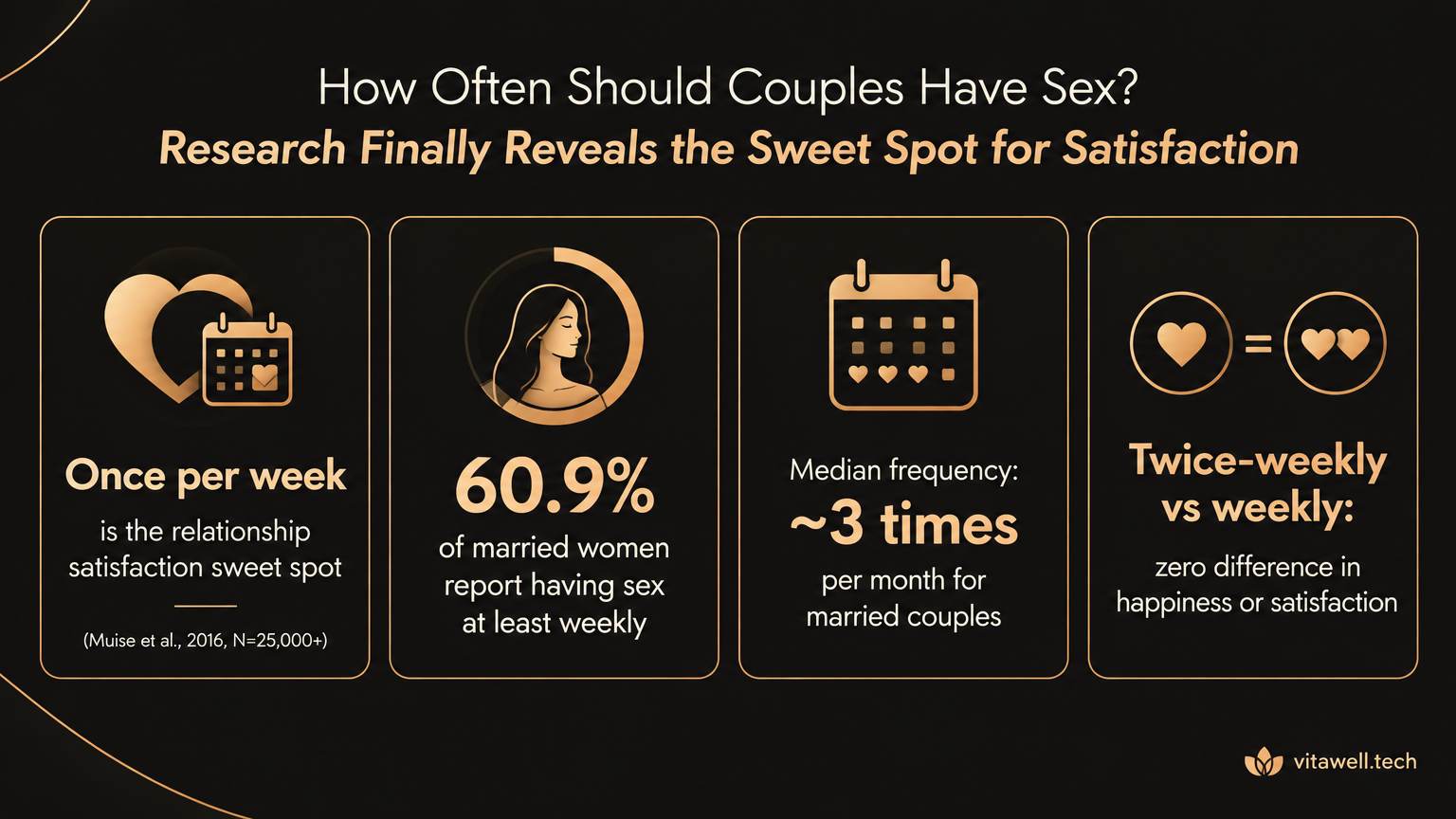
The researchers examined the relationship between how often couples had sex and multiple measures of well-being — including happiness, relationship satisfaction, and feelings of closeness. Their key finding: sexual frequency was positively associated with well-being, but only up to once per week. Beyond that point, the relationship between frequency and satisfaction flattened completely. Couples having sex two or three times a week reported no higher levels of happiness or relationship satisfaction than couples having sex once a week.
Critically, this finding held across both same-sex and different-sex couples, across age groups, and across relationship durations. Dr. Nicole K. McNichols, PhD, a psychology lecturer at the University of Washington who has written about the research, notes that the finding reflects a "sweet spot" rather than a floor: once a week appears to be where the meaningful relationship benefits of sexual intimacy are largely captured.
Once a Week — What the Data Shows
The plateau effect in the Muise et al. data is striking. The difference in well-being between people having no sex and those having sex once a week was substantial and statistically significant. The difference between once a week and twice a week was essentially zero.
What this means practically: couples who feel pressure to have sex more frequently than they naturally do — whether from media portrayals, peer comparisons, or internal expectations — may be generating stress and performance pressure without any corresponding benefit to their relationship quality. The research suggests that meeting the threshold of roughly weekly sexual connection is what matters, not exceeding it.
How Often Are Couples Actually Having Sex?
Understanding the research is one thing. Knowing where you actually stand relative to other couples is another — and the gap between cultural expectations and research norms is significant.
The Real Numbers by Age and Relationship Status
Several large epidemiological surveys provide solid data on sexual frequency in real-world couples. According to data cited by Medical News Today, 57.7% of married men and 60.9% of married women report having sex at least weekly. That means roughly 40% of married couples are having sex less than once a week — and they're in good company.
Wellings and colleagues' 2019 analysis in the BMJ, drawing from the National Survey of Sexual Attitudes and Lifestyles (Natsal), found that the median frequency for married and cohabiting couples is approximately three times per month — not four or five. The mean is higher, pulled upward by outliers, but the typical experience is around weekly or slightly less.
Age matters significantly. Research by Ueda and colleagues (2020), analyzing data from 9,504 Americans, found notable differences by age group. Among adults aged 18 to 24, 37% of men and 52% of women reported having sex at least weekly. Among adults aged 25 to 44 — the core working-and-parenting demographic — weekly or more frequent sex was reported by roughly 50 to 54% of respondents. Frequency declines predictably through middle age and beyond, though it rarely disappears.
Why the Gap Between Expectations and Reality Matters
Media — film, television, advertising, and especially social media — systematically overcounts how much sex people are having. Characters in long-term relationships seem to have effortless, frequent, passionate encounters. The same is true of idealized portrayals in popular culture. For couples comparing their own experience to these imagined norms, the gap can generate real psychological distress.
The research data tells a more human story. Several factors naturally shift sexual frequency over the course of a relationship, and none of them signal dysfunction:
- The arrival of children, especially young children, dramatically reduces average frequency for most couples — a temporary pattern that typically shifts as children grow older
- High-stress work periods, career transitions, and financial pressures reliably reduce sexual interest and energy for both partners
- Physical health changes, hormonal shifts, and certain medications affect libido in ways that have nothing to do with relationship quality
- Longer relationship duration is associated with moderate frequency declines — a natural shift from the intensity of new partnership, not a sign that attraction has disappeared
Understanding that these patterns are normal — not warnings — allows couples to navigate them without the added burden of believing something is fundamentally wrong with their relationship.
The Science of Sexual Desire: Why More Isn't Always Better
To understand the research on sexual frequency, it helps to understand how sexual desire actually works — which is more complex than most people realize, and significantly different from how it is usually portrayed.
Responsive vs. Spontaneous Desire
Sex researchers distinguish between two types of desire: spontaneous desire, which arises unprompted — you're going about your day and suddenly feel turned on — and responsive desire, which emerges in response to context, touch, or initiation.
Cultural narratives tend to treat spontaneous desire as the norm and responsive desire as a deficiency. Research suggests the opposite: responsive desire is extremely common, particularly in long-term relationships and particularly (though not exclusively) among women. Many people who describe "low libido" are actually experiencing normal responsive desire and misinterpreting it as a problem.
The practical implication is significant: if you wait to feel desire before initiating, and your desire is primarily responsive, you may wait indefinitely — not because you don't want your partner, but because your desire type requires a different entry point. Dr. McNichols notes that understanding this pattern can fundamentally change how couples think about initiation and frequency. Desire, for many people, follows the encounter rather than preceding it.
When Frequency Becomes Pressure
When couples treat sexual frequency as a performance metric — a number to hit, a target to exceed — research suggests this framing can actively undermine the sexual satisfaction it's meant to protect. Sexual performance anxiety, which affects both men and women, is associated with lower desire, reduced arousal, and less satisfying encounters.
The irony is real: couples who feel they "should" be having more sex often find that the pressure makes the sex they do have less enjoyable. The goal is not a number on a calendar. It is the experience of mutual desire, genuine presence, and physical and emotional connection — experiences that frequency statistics can track but cannot create.
What Actually Predicts Sexual Satisfaction (Beyond Frequency)
The most important insight from the research literature may be this: frequency is an imperfect proxy for the quality and meaning of a couple's sex life. Several other variables predict sexual satisfaction more robustly than raw frequency.
The Role of Affectionate Touch
Research by Prause and colleagues (2021), published in PLoS One, found that non-sexual affectionate touch — including kissing, cuddling, holding hands, and physical closeness — is meaningfully associated with both sexual desire and overall relationship closeness. Debrot and colleagues (2017) found that affectionate touch specifically mediates the relationship between sexual frequency and relationship satisfaction: it's partly through the warmth and closeness of physical affection that sex translates into relationship well-being.
Practically, this means that building daily non-sexual affection tends to support both desire and satisfaction over time. The types of touch that matter include:
- Kissing hello and goodbye as a consistent ritual, not just a perfunctory gesture
- Physical closeness in non-sexual contexts — sitting together, touching while watching something, back rubs or foot rubs with no expectation attached
- Holding hands, which research consistently identifies as a simple but meaningful signal of connection and security
- Spontaneous physical affection: a hand on a shoulder, a touch as you pass in the kitchen
Household Equity and Its Surprising Effect
One of the more surprising findings in the research on sexual frequency involves household labor. A study published in the Archives of Sexual Behavior (Springer) found that couples who share household responsibilities more equitably report higher sexual frequency and greater sexual satisfaction compared to couples with more inequitable divisions of domestic labor.
The mechanism is not mysterious when examined closely. Persistent inequity in household labor generates low-grade resentment, often in the partner carrying more of the load. That resentment doesn't disappear at bedtime. When both partners feel that the domestic partnership is fair, there is more emotional warmth and goodwill available — warmth that supports desire and willingness to initiate. Fairness, in this research, functions as a form of foreplay.
Communication and Quality Over Quantity
Research by Frederick, Lever, Gillespie, and Garcia (2017), titled "What keeps passion alive?" and published in the Journal of Sex Research, found that couples who reported the highest sexual satisfaction shared several characteristics beyond frequency: they communicated openly about their sexual preferences and desires, they expressed appreciation for each other, and they prioritized making the encounters they did have feel meaningful rather than routine.
Communication about sex — including what feels good, what has changed, what you want more of — is one of the most consistently supported predictors of sexual satisfaction in the research literature. Yet it remains one of the most avoided conversations in many long-term relationships, often because of embarrassment, fear of judgment, or the assumption that a loving partner should simply know.
Practical Strategies to Find Your Couple's Sweet Spot
Translating the research into practice means moving from comparison and pressure toward intentional attention to what your specific relationship and your specific bodies actually need. The following strategies are grounded in the evidence reviewed above.
- Use once a week as a helpful benchmark, not a mandate. The research suggests this is where most of the relationship benefit is captured. If you're averaging roughly weekly, you're in the optimal range. If you're averaging less, there may be room to invest in reconnection — but the goal is a frequency that feels mutually desired, not one that hits a target.
- Reframe scheduling as prioritization. Planned sex is not unromantic — it is a signal to both partners that intimacy is a priority. For couples navigating busy work schedules, children, or high stress, spontaneous sex becomes increasingly rare. Scheduling it is an act of commitment, not a failure of passion.
- Build daily non-sexual affection. The research on affectionate touch is consistent: couples who touch affectionately throughout the day maintain higher levels of desire and connection. This is low-effort, high-return behavior. A three-second kiss goodbye does measurably different things to relationship chemistry than a peck.
- Have the conversation — directly and without blame. Ask your partner what they'd want more of, what feels good, what they've been thinking about. Normalize the conversation enough that it doesn't have to happen only in a moment of tension. Couples who talk about sex regularly report higher satisfaction across the research literature.
- Adjust gracefully for life stages. The couple with a newborn, the couple both working demanding jobs, the couple navigating health challenges — none of these couples should be measuring their frequency against the same benchmark as a couple in an easier life phase. Expectations that flex with circumstances keep couples from pathologizing normal variation.
- Focus on quality and presence during the encounters you do have. Research consistently finds that the subjective quality of sexual encounters — how connected, seen, and pleasured both partners feel — predicts satisfaction more robustly than count. Full presence, genuine attention to your partner's responses, and willingness to communicate in the moment are what transforms frequency into well-being.
Conclusion: The Number Is a Starting Point, Not the Point
The research on sexual frequency offers something genuinely useful: a data-grounded reality check that removes the pressure to perform at some imagined cultural standard. Once a week appears to be the sweet spot where the relationship benefits of sexual intimacy are largely captured — and exceeding it, the evidence suggests, adds little to relationship quality.
But the deeper message in the research isn't about the number. It's about intentionality, communication, and the kind of consistent affectionate investment that keeps long-term partnerships alive and warm. Couples who build daily physical closeness, share domestic labor fairly, talk openly about desire, and treat their sexual relationship as something worthy of attention tend to report higher satisfaction — regardless of whether they're hitting any particular frequency target.
The question isn't really how often should couples have sex. The better question is: are both partners feeling desired, connected, and genuinely satisfied? A couple who answers yes to those questions, at whatever frequency works for them, is doing fine. The number is a starting point. The relationship is the point.
Sources
Psychology Today — What Should Be a Couple's Ideal Sex Frequency? (Dr. Nicole K. McNichols)