
Why Nearly 80% of Young Adults Sacrifice Long-Term Financial Goals — And What Behavioral Science Says to Do Instead
Almost 8 in 10 young adults put short-term needs first. Here is what scarcity research says about why, what a 10-year delay really costs, and the automatic steps that work on a tight budget.

Young adults sacrifice long-term financial goals mostly because money pressure leaves too little cash, and too little mental bandwidth, for anything beyond this month. In a March 2026 survey of 2,000 U.S. Gen Z and Millennial adults, 77% said they lean on short-term tactics such as Buy Now, Pay Later just to cover essentials. The fixes with the strongest evidence are not about more willpower. They are plans that keep working when willpower is low: automatic defaults, savings increases that start later, and a vivid picture of your future self.
Key Takeaways
- Almost 8 in 10 younger adults now put short-term needs ahead of long-term goals, and 7 in 10 say building wealth feels out of reach (Beyond Finance and Operation HOPE, 2026).
- Much of this is a squeeze, not a preference: 57% of Gen Z would run out of money in under three months if they lost their job (Wells Fargo, 2026).
- Money worry can measurably reduce thinking capacity in the moment, so plans that depend on daily discipline tend to fail under stress.
- Defaults beat intentions: auto-enrollment lifts retirement plan participation to 94%, versus 64% when people must opt in (Vanguard, 2026).
- Waiting is expensive: in our worked example, starting $100 a month at 35 instead of 25 leaves about $140,000 less at 65, while you only contribute $12,000 less.
The Numbers: Why Young Adults Put Long-Term Financial Goals Second
The headline figure comes from a survey commissioned by debt-relief company Beyond Finance with the nonprofit Operation HOPE and run by QuestionPro on March 16–18, 2026. It polled 2,000 U.S. adults born between 1981 and 2008. Because a company in the debt industry paid for it and no margin of error was published, treat the exact percentages as a snapshot rather than a census. The direction, though, matches federal data shown further below.
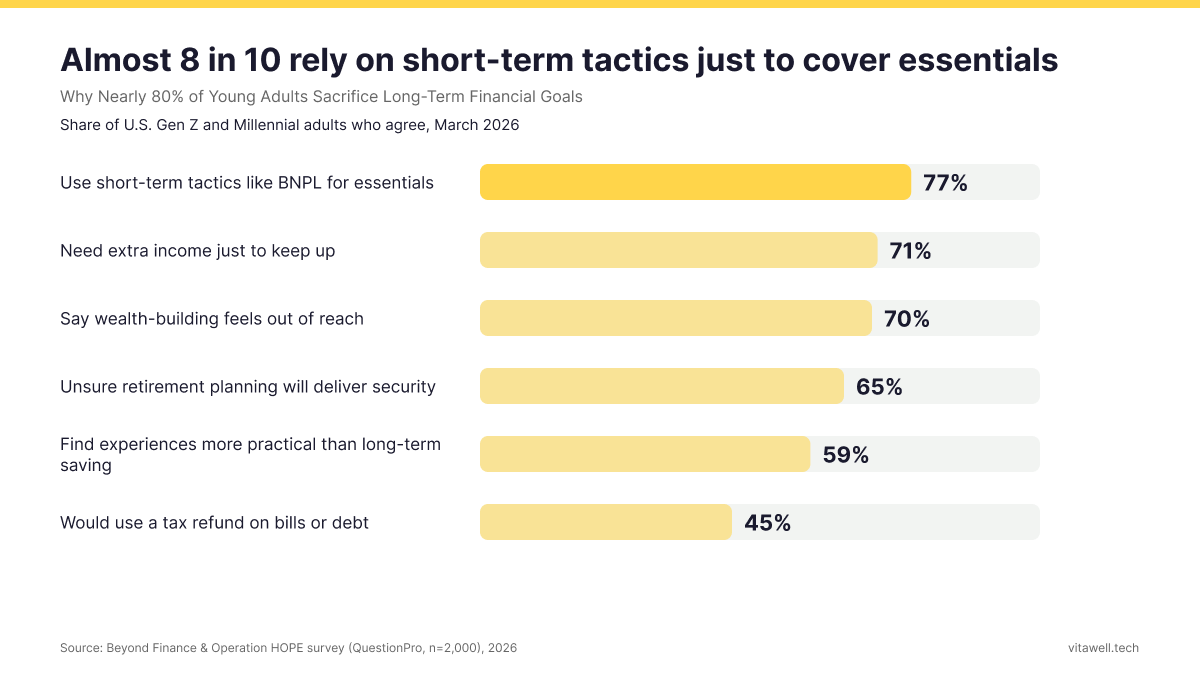
According to the Beyond Finance and Operation HOPE survey summary (2026):
- 77% use short-term strategies such as Buy Now, Pay Later for essentials.
- 71% say they need additional income just to keep up.
- 7 in 10 say wealth-building feels out of reach.
- 65% are unsure that traditional retirement planning will deliver real security.
- 59% find spending on meaningful experiences more practical than saving for long-term goals.
- 45% would put a tax refund toward bills or debt; fewer than 4% would spend it on travel or leisure.
Read together, these numbers describe people who are active with money, not careless with it. The activity simply goes to the nearest fire. Long-term goals lose by default, because nothing in the week forces them onto the agenda.
Forced Short-Termism: A Squeeze, Not a Character Flaw
Financial short-termism means consistently choosing the option that solves this month's problem over the one that builds next decade's security. Sometimes that is a preference. More often for young adults, it is the only option the budget allows.
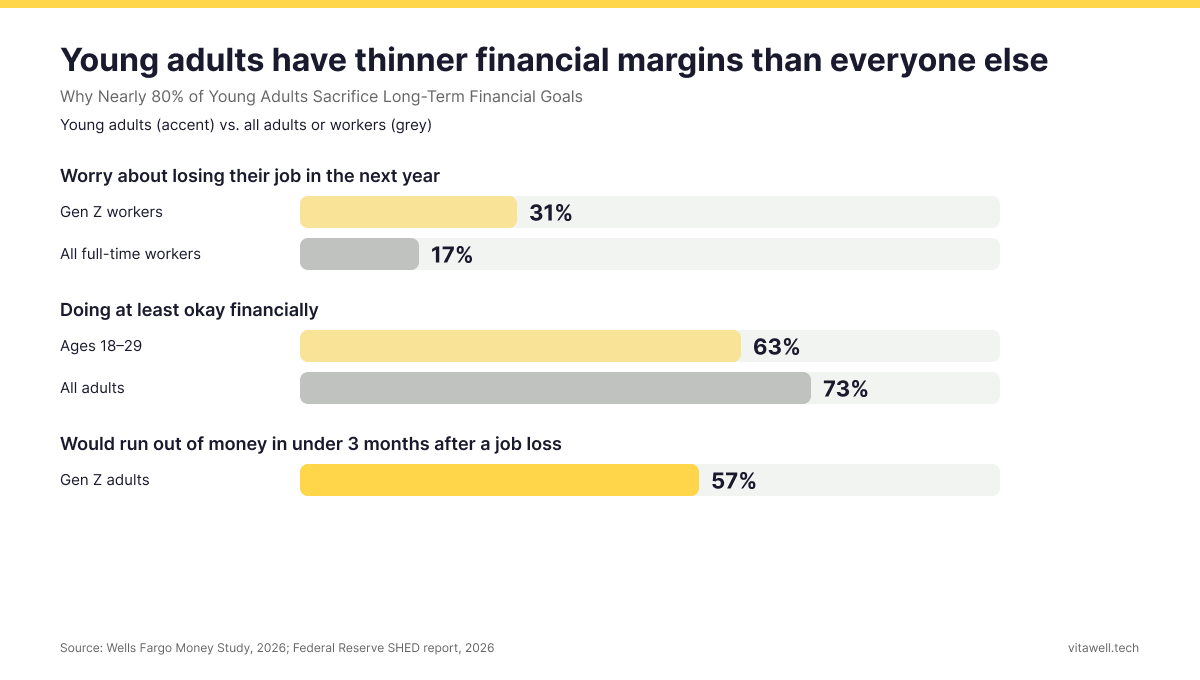
The Wells Fargo 2026 Money Study, which surveyed 3,773 U.S. adults between November and December 2025, found:
- 57% of Gen Z adults would run out of funds in fewer than three months if they lost their job.
- 31% of full-time employed Gen Z workers worry about losing their job in the next year, versus 17% of all full-time workers.
- 64% of parents with Gen Z children aged 18–28 say those children still rely on them financially.
- 46% of Gen Z describe their financial lives as "messy."
Federal data point the same way. In the Federal Reserve's 2025 Survey of Household Economics and Decisionmaking (published May 2026), 63% of adults aged 18–29 said they were doing at least okay financially, compared with 73% of all adults. Only 63% of all adults could cover a $400 surprise expense with cash, and just 35% of non-retirees felt their retirement savings were on track.
When a single car repair can break the month, a retirement contribution looks like a luxury. That is a rational reading of thin margins. The goal is not to shame the trade-off but to design around it.
What Scarcity Does to Decision-Making
The bandwidth tax
The best-known study here is by economists and psychologists Anandi Mani, Sendhil Mullainathan, Eldar Shafir and Jiaying Zhao, published in Science in 2013. In one experiment, about 400 shoppers at a New Jersey mall thought through a hypothetical $1,500 car repair before taking reasoning tests; lower-income participants scored significantly worse than when the repair cost $150, while higher-income participants were unaffected. In a second study, 464 Indian sugarcane farmers scored better on the same tests after harvest, when money was plentiful, than before it.
The authors compared the size of the effect to about 13 IQ points, or the cost of a lost night's sleep, as reported in ScienceDaily's summary of the Princeton study (2013). The point is not that people under money stress are less intelligent. It is that worry occupies cognitive bandwidth, the working memory and attention you use to plan, compare and resist impulses.
How strong is this evidence?
Scarcity research is promising but not settled. A large replication audit in PNAS (O'Donnell and colleagues, 2021) re-ran 20 published scarcity effects and found considerable variability: some replicated clearly, others did not. A fair reading is that money stress can narrow attention toward immediate problems, with effect sizes that vary by task and setting.
Present bias makes the future feel optional
Present bias is the tendency to give extra weight to rewards available now compared with larger rewards later. Combine present bias with a bandwidth squeeze and the result is predictable: the future gets postponed one paycheck at a time. That is why the interventions below share one trait. Each works without asking you to make a hard decision on a hard day.
The Real Price of Waiting: A Worked Example
Compounding means your returns start earning returns of their own, so early contributions carry the most weight. The table below is our own illustration, not a forecast: it assumes a steady 7% average annual return, compounded monthly, with contributions until age 65 and no inflation adjustment or fees. Real markets fluctuate and returns are never guaranteed.
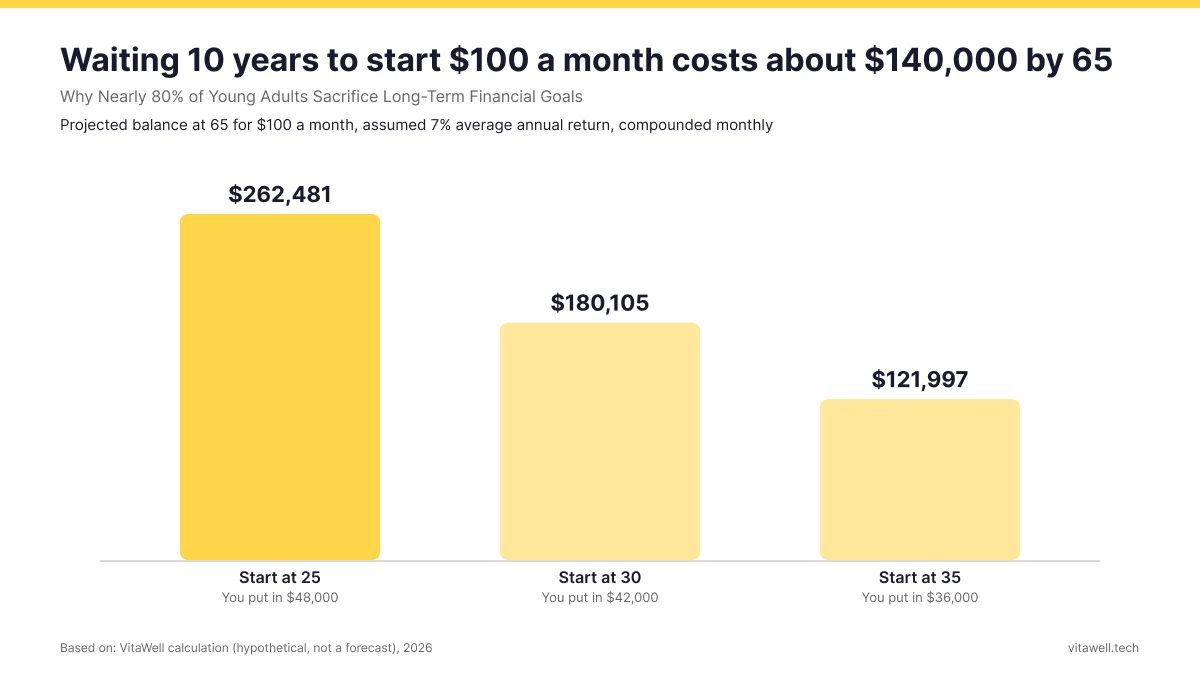
| Monthly amount | Start at 25 (40 years) | Start at 30 (35 years) | Start at 35 (30 years) | Cost of a 10-year delay |
|---|---|---|---|---|
| $50 | $131,241 | $90,053 | $60,999 | $70,242 |
| $100 | $262,481 | $180,105 | $121,997 | $140,484 |
| $200 | $524,963 | $360,211 | $243,994 | $280,969 |
Look at the $100 row. Starting at 25 means contributing $48,000 in total; starting at 35 means $36,000. Those extra $12,000 of contributions are linked to roughly $140,000 more at 65 in this scenario. The practical lesson: a small amount started now usually beats a larger amount started "once things settle down."
What Works When Willpower Is Low
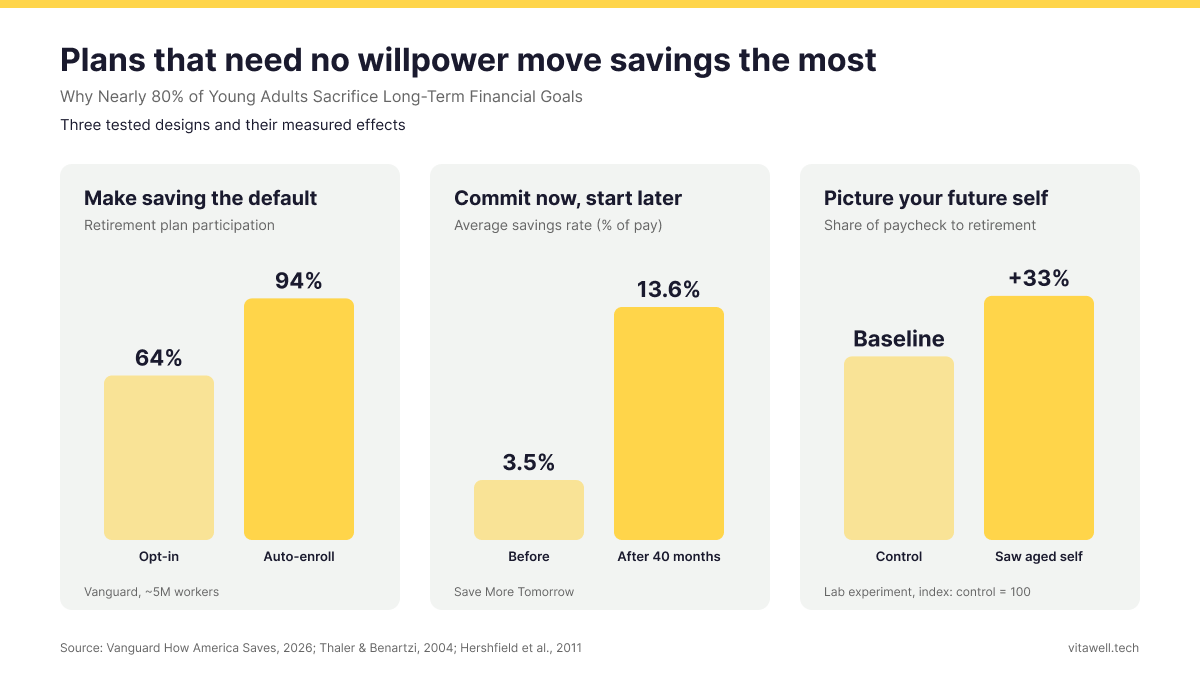
Make saving the default
Defaults are choices that happen unless you act. Vanguard's analysis of nearly five million workers in How America Saves 2026, as reported by PSCA, found 94% participation in plans that automatically enroll employees, versus 64% in plans where workers must sign up themselves. Auto-enrolled savers also contributed slightly more on average: 7.7% of pay versus 7.5%. This is observational data across plans, but the gap is large and consistent with decades of default research.
For a personal version, read our guide on how to automate your finances so saving happens without decisions.
Commit now, start later
Present bias makes giving up money today painful, but agreeing to give up money in the future feels easy. The Save More Tomorrow program by Richard Thaler and Shlomo Benartzi used exactly this: employees agreed in advance to raise their savings rate with each future pay raise. In the original field study, 78% of those offered the plan joined, and their average savings rate rose from 3.5% to 13.6% of pay over 40 months, according to Chicago Booth's summary of the 2004 study. It was one company's program, but the design has since been widely copied through auto-escalation features, which raise your contribution rate automatically each year.
Make your future self feel real
Hal Hershfield and colleagues showed working-age adults digitally aged images of themselves. In their 2011 Journal of Marketing Research experiments, those who saw their older selves were willing to allocate about 33% more of a hypothetical paycheck to retirement, and in a second experiment about twice as much to long-term savings, as reported by NYU Stern (2011). These were lab choices, not real account balances, so the effect on long-term behavior is less certain. A cheap version: write a one-paragraph letter from yourself at 60 describing an ordinary Tuesday.
The Stress-Proof Savings Decision Guide
This guide is our synthesis of the research above. Find the row that matches your situation today, do only the action in that row, and move down when the "move on when" condition is met. Each action is designed to be set up once and then run on autopilot.
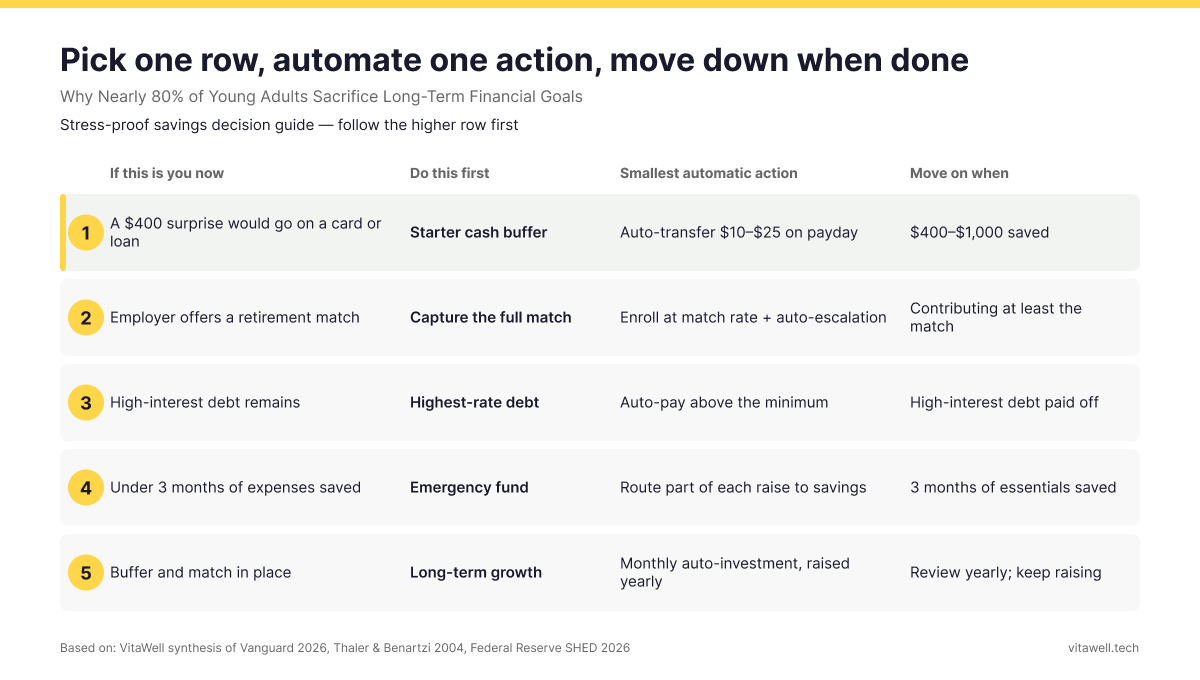
| Your situation now | First priority | Smallest automatic action | Why it works | Move on when |
|---|---|---|---|---|
| A $400 surprise would go on a card or loan | Starter cash buffer | Auto-transfer $10–$25 to savings on payday | Removes the decision; buffer cuts the next crisis | $400–$1,000 saved |
| Employer offers a retirement match | Capture the full match | Enroll at the matching rate and switch on auto-escalation | Defaults and commit-later plans raise saving | Contributing at least the match |
| Starter buffer in place, high-interest debt remains | Debt with the highest interest rate | Automatic payment above the minimum on that one debt | One target lowers mental load | High-interest debt paid off |
| Less than three months of expenses saved | Emergency fund | Route each future raise partly to savings | Future money is easier to give up | Three months of essential costs saved |
| Buffer and match in place | Long-term growth | Monthly automatic investment, raised once a year | Early years compound longest | Review yearly; keep raising |
If several rows apply, follow the higher one first. The order is a common rule of thumb in personal finance, not a law; adjust it to your income stability and obligations.
A 30-Day Starter Protocol
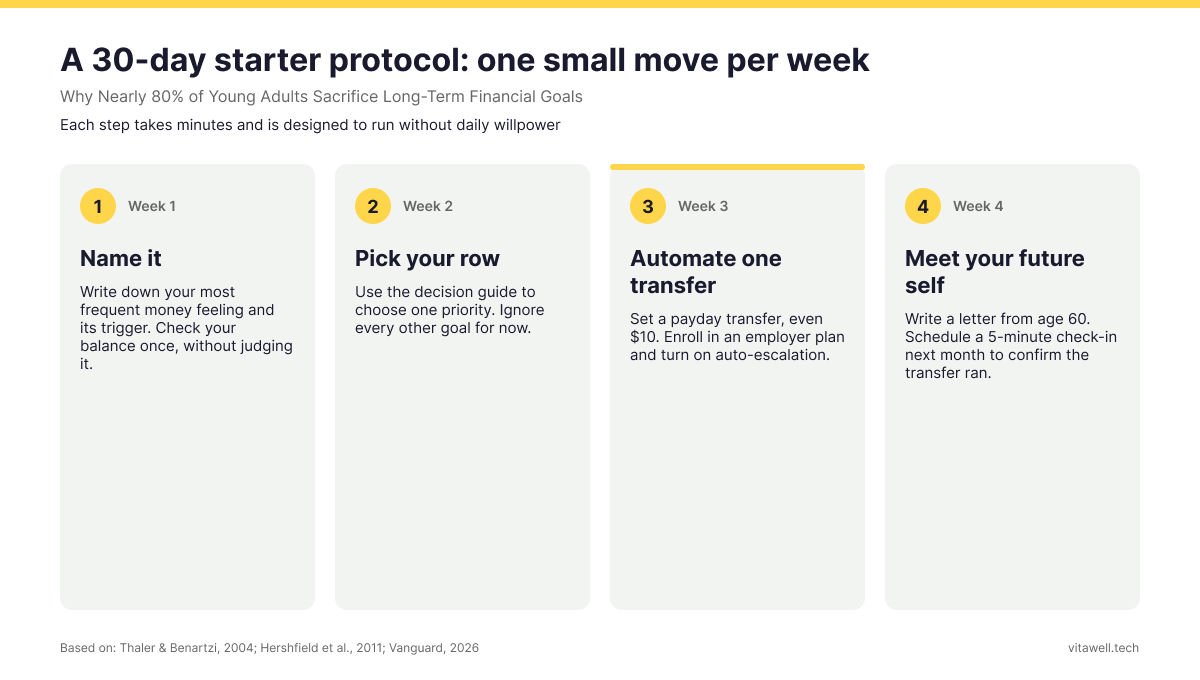
- Week 1 – Name it. Write down the money feeling you have most often (worry, avoidance, shame) and the single situation that triggers it. Check your balance once, without judging it.
- Week 2 – Pick your row. Use the decision guide above to choose one priority. Ignore every other goal for now.
- Week 3 – Automate one transfer. Set a payday transfer, even $10, toward that priority. If you have an employer plan, enroll and turn on auto-escalation.
- Week 4 – Meet your future self. Write the letter from age 60, then schedule a five-minute check-in for the same day next month to confirm the transfer ran.
For more small, evidence-based routines, see six science-backed habits to get your finances under control. If anxiety makes even looking at your accounts hard, our piece on how not to fuse with financial anxiety covers that first step.
When to Talk to a Professional
Consider a nonprofit credit counselor if debt payments take up so much of your income that you miss essentials, or if you are juggling several collection accounts. A fee-only financial planner can help when you face a big decision such as choosing between paying off student loans and investing. If money worry is affecting your sleep, mood or relationships for weeks at a time, a licensed mental health professional is a sensible next call alongside any financial help.
Frequently Asked Questions
Why do young adults struggle to save for the long term?
Most face thin margins: many could not cover three months of expenses after a job loss, and rising costs push spending toward immediate needs. Money worry also competes for attention and working memory, which makes planning harder. Present bias then makes future rewards feel less urgent, so long-term goals keep getting postponed.
Is it too late to start saving at 30?
No. In the worked example above, $100 a month started at 30 grows to about $180,000 by 65 at an assumed 7% return. Starting earlier helps, but starting now always beats waiting longer. Raising contributions with each pay increase can close much of the gap over time.
Should I build an emergency fund or invest first?
A common sequence is a small starter buffer first, then any employer retirement match, then high-interest debt, then a fuller emergency fund and investing. The buffer prevents new debt when surprises hit, and the match is an immediate return on your contribution. Adjust the order to your income stability.
How can I save if I live paycheck to paycheck?
Start with an amount small enough that you will not notice it, such as $10 per payday, and automate it so it does not depend on remembering. Direct part of every future raise or windfall to savings. The goal in the first months is the habit and a small buffer, not a specific balance.
The Bottom Line
Putting short-term needs first is a reasonable response to tight budgets and stretched attention, not proof that you are bad with money. The research points to one design principle: make long-term saving automatic, start it small, and let future raises do the heavy lifting. If you want to balance money with the rest of your life, VitaWell helps you plan finances alongside health, career, relationships and rest, so one area does not quietly consume the others. Pairing this with experience-first financial planning can keep today's life enjoyable while tomorrow is funded.
This article is for informational purposes only and is not financial, legal or mental health advice. Consider speaking with a qualified professional about your situation.
Sources
Psychology Today — How Younger Generations Are Financially Adapting