The Hidden Downside of Being Conscientious — And How to Use Your Goodness for a More Fulfilling Life
Conscientiousness predicts a longer life and the deepest access to flow of any Big Five trait, but it can cost spontaneous joy. Here is how to find which facet is overextended.

The main downside of being conscientious is not that the trait stops working, but that its benefits come with trade-offs: highly orderly people report less amusement in moments meant to be funny, and at extreme levels the trait shades into rigidity and lower well-being. Yet the same trait is the strongest Big Five predictor of flow and is linked to a longer life. The useful question is not whether conscientiousness is good, but which of its facets are running your life and at what cost.
Key Takeaways
- A 2026 University of Galway study of 203 adults found orderliness was the only personality facet negatively related to joy while watching a comedy clip.
- A 2026 KU Leuven meta-analysis of 24 studies found conscientiousness has the strongest link to flow of all Big Five traits (r = 0.33) — the opposite of a common claim.
- Conscientious people get the focus and reward of flow but less of its self-forgetting part: loss of self-consciousness and time distortion correlate only 0.14.
- The trait helps up to a point; studies of 912 adults and 1,258 employees found curvilinear, inverted-U relationships with well-being and job performance.
- Traits can shift: in a randomized trial of 1,523 people, a 3-month coaching app produced desired changes that friends and family also noticed.
What Conscientiousness Is (and Its Six Facets)
Conscientiousness is one of the Big Five personality traits, alongside openness, extraversion, agreeableness and neuroticism. It describes how organized, disciplined and goal-directed a person tends to be. Psychologists split it into facets, smaller sub-traits that can pull in different directions:
- Orderliness — preference for structure, tidiness and routine
- Dutifulness — strong sense of obligation and keeping promises
- Self-discipline — finishing tasks without outside pressure
- Achievement striving — setting high goals and persisting
- Deliberation — thinking before acting
- Competence — confidence in getting things done well
The facet level matters because the costs below come mostly from one or two facets, not from the trait as a whole.
Why Conscientiousness Earns Its Reputation
The trait's good press is deserved. A meta-analysis by Margaret Kern and Howard Friedman (2008) pooled 20 independent samples with more than 8,900 participants and found higher conscientiousness was reliably linked to longer life (r = .11, 95% confidence interval .05–.17), as summarized in Bogg and Roberts' review of conscientiousness and health. The achievement and order facets showed the strongest links. A correlation of .11 sounds small, but across whole populations it is comparable to many standard medical risk factors.
The likely mechanism is behavior, not magic: conscientious people are less likely to smoke or drink to excess and keep routines that protect health. That is also why the costs deserve attention — they come from the same habits.
The Joy Trade-Off: What the 2026 Galway Study Found
Ryan Donovan and colleagues at the University of Galway tested 203 adults aged 18 to 70 (average age 34) on the Big Five and on six basic emotions: anger, disgust, fear, joy, sadness and surprise. Participants watched clips chosen to trigger each emotion; joy came from the diner scene in When Harry Met Sally. In the study in the Journal of Personality, orderliness was the only facet that related negatively to finding the scene funny, while extraversion related positively to joy.
There was an upside in the same data: orderliness also related negatively to general sadness. The authors suggest that structuring your environment may shield you from situations that cause sadness. The study is correlational and the authors call for replication, so treat it as a signal, not a verdict.
Conscientiousness and Flow: The Strongest Link in the Big Five
A popular claim says conscientious people struggle to reach flow, the state of full absorption in a challenging task. The evidence says the opposite. Siem Buseyne, Sameh Said-Metwaly and colleagues at KU Leuven pooled 24 studies and 352 effect sizes in the first meta-analysis of personality and flow (Journal of Personality, 2026).
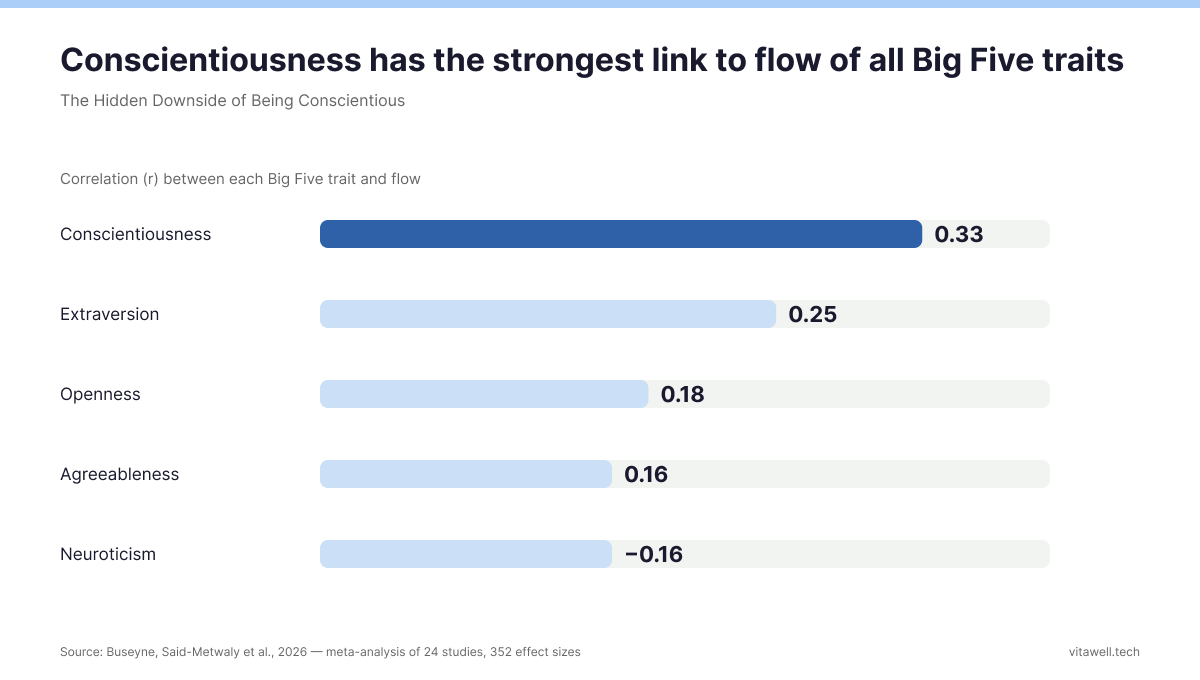
- Conscientiousness: r = 0.33 (medium, the strongest)
- Extraversion: r = 0.25
- Openness: r = 0.18
- Agreeableness: r = 0.16
- Neuroticism: r = −0.16
The link held across settings: 0.39 in education, 0.35 at work and 0.26 in sport. The authors explain it through attentional control, persistence and choosing tasks where challenge matches skill. One caveat: nearly all included studies used self-reports collected at the same time, which can inflate correlations.
Focused, Not Lost: Which Parts of Flow Conscientiousness Feeds
The same meta-analysis broke flow into its dimensions, and this resolves the apparent paradox between the two 2026 studies. Conscientiousness correlated strongly with the "control" side of flow and weakly with its "letting go" side:
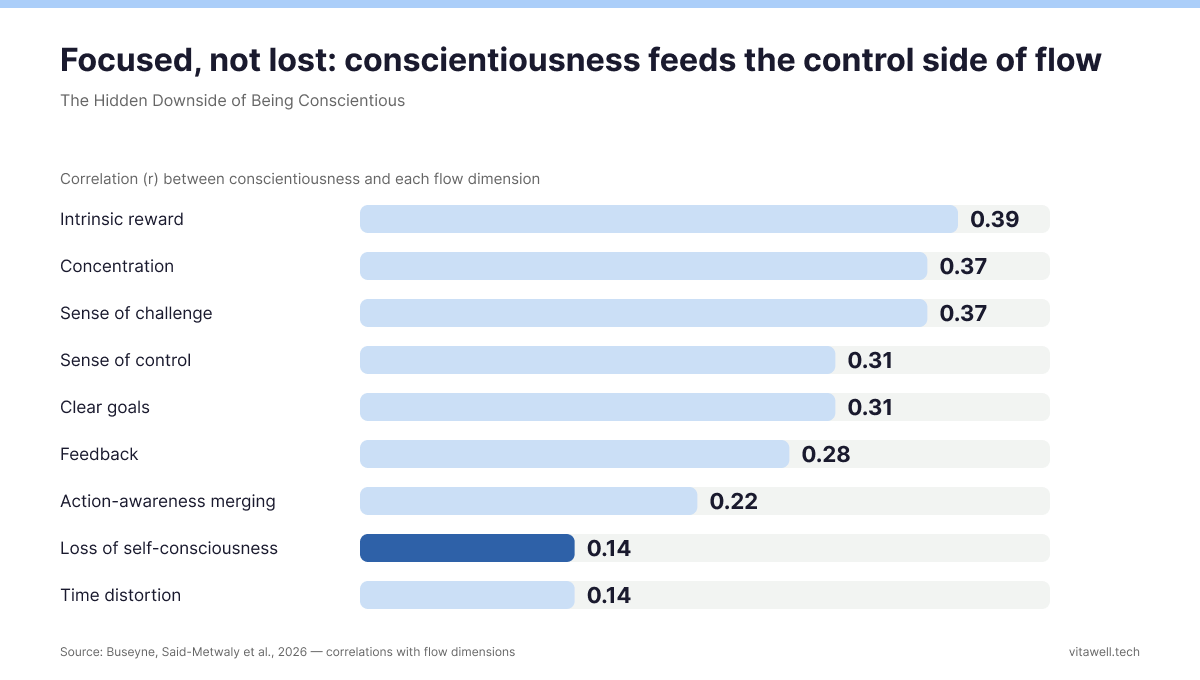
- Intrinsic reward: 0.39; concentration: 0.37; sense of challenge: 0.37
- Sense of control: 0.31; clear goals: 0.31; feedback: 0.28
- Merging of action and awareness: 0.22
- Loss of self-consciousness: 0.14; time distortion: 0.14 (both not significant)
Read together with the Galway result, a consistent picture appears: conscientious people concentrate deeply and find work rewarding, but they rarely forget themselves. The internal monitor stays on. That is a strength in a cockpit and a cost at a comedy, a party or a lazy Sunday.
The Downside of Being Conscientious: When More Stops Helping
Most early research assumed "more is better." Studies built to detect curves found otherwise. Nathan Carter and colleagues (2016) measured 912 people on conscientiousness facets, obsessive-compulsive tendencies and well-being; their Journal of Personality paper found a curvilinear link, with extreme facet scores tied to lower well-being through their obsessive-compulsive versions. An earlier study of 1,258 employees found the same inverted U for job performance, as the Association for Psychological Science reported.
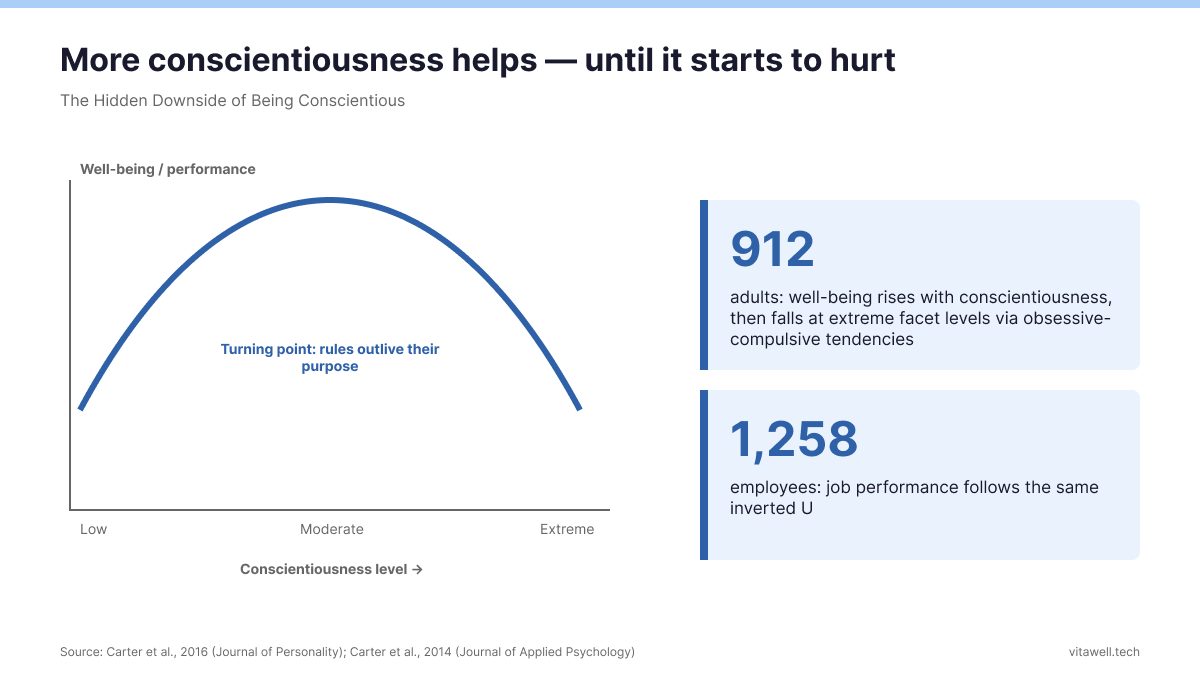
In practice, the turning point shows up as rules that outlive their purpose: rechecking finished work, refusing to delegate, guilt during rest, and plans that cannot bend when life changes.
The Facet Matrix: Benefits, Extremes and Rebalancing Moves
Use this table to locate where your conscientiousness helps and where it may cost you. The extreme versions follow the obsessive-compulsive variants described by Carter and colleagues.
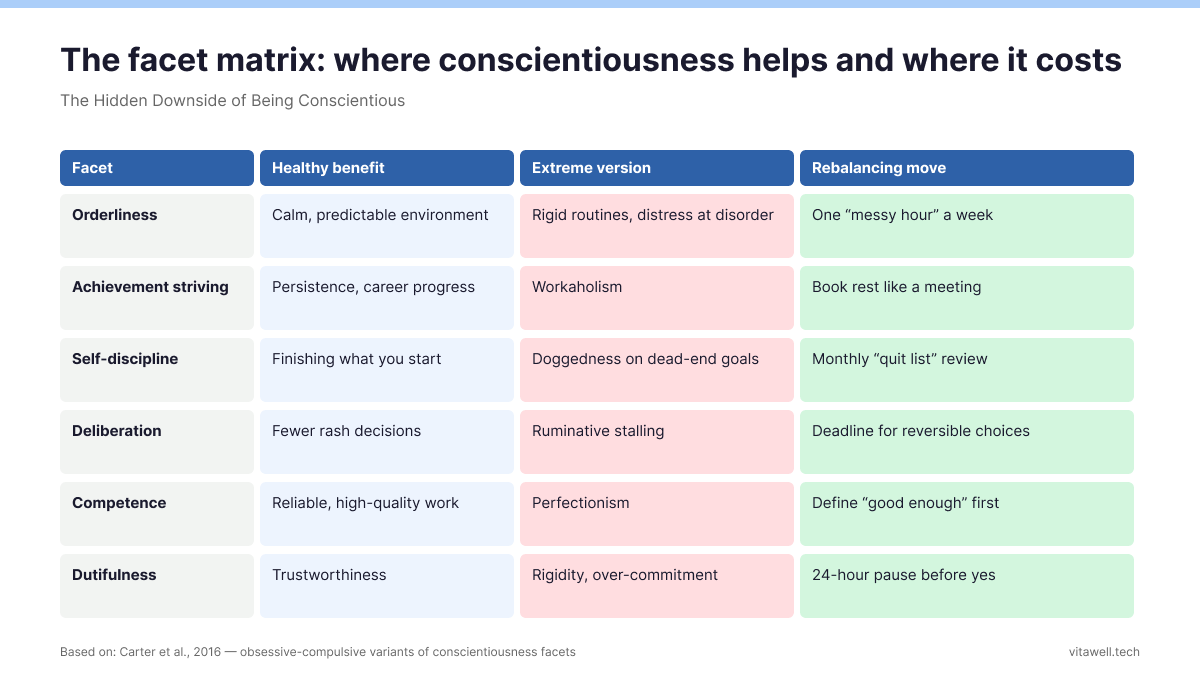
| Facet | Healthy benefit | Extreme version | Early warning sign | Rebalancing move |
|---|---|---|---|---|
| Orderliness | Calm, predictable environment | Rigid routines, distress at disorder | You tidy before you can relax | One "messy hour" a week with no cleanup rule |
| Achievement striving | Persistence, career progress | Workaholism | Rest feels like falling behind | Book rest in the calendar like a meeting |
| Self-discipline | Finishing what you start | Doggedness on dead-end goals | You finish books you dislike | Monthly "quit list" review |
| Deliberation | Fewer rash decisions | Ruminative stalling | Small choices take days | Set a decision deadline for reversible choices |
| Competence | Reliable, high-quality work | Perfectionism | You redo work others accepted | Define "good enough" before starting |
| Dutifulness | Trustworthiness | Moral rigidity, over-commitment | You say yes out of guilt | A 24-hour pause before new commitments |
Is Your Conscientiousness Working for You? A Quick Self-Check
Answer yes or no for the last month. This is a reflection tool, not a diagnostic test.
- I felt guilty during free time at least once a week.
- I redid or rechecked work that was already accepted by others.
- I kept a plan even after it clearly stopped serving its goal.
- I could not remember the last time I lost track of time doing something just for fun.
- People close to me said I seem tense or hard to relax with.
Decision rule: zero or one "yes" means your conscientiousness is mostly working for you. Two or three means one facet is tipping into its extreme version; pick its row in the matrix above. Four or five means the costs are now shaping your well-being, and the plan below plus a conversation with a professional are worth considering.
A 4-Week Rebalancing Plan Across Your Life Areas
The goal is not to become less reliable. It is to keep the control side of the trait where it pays off and to practice the letting-go side elsewhere.
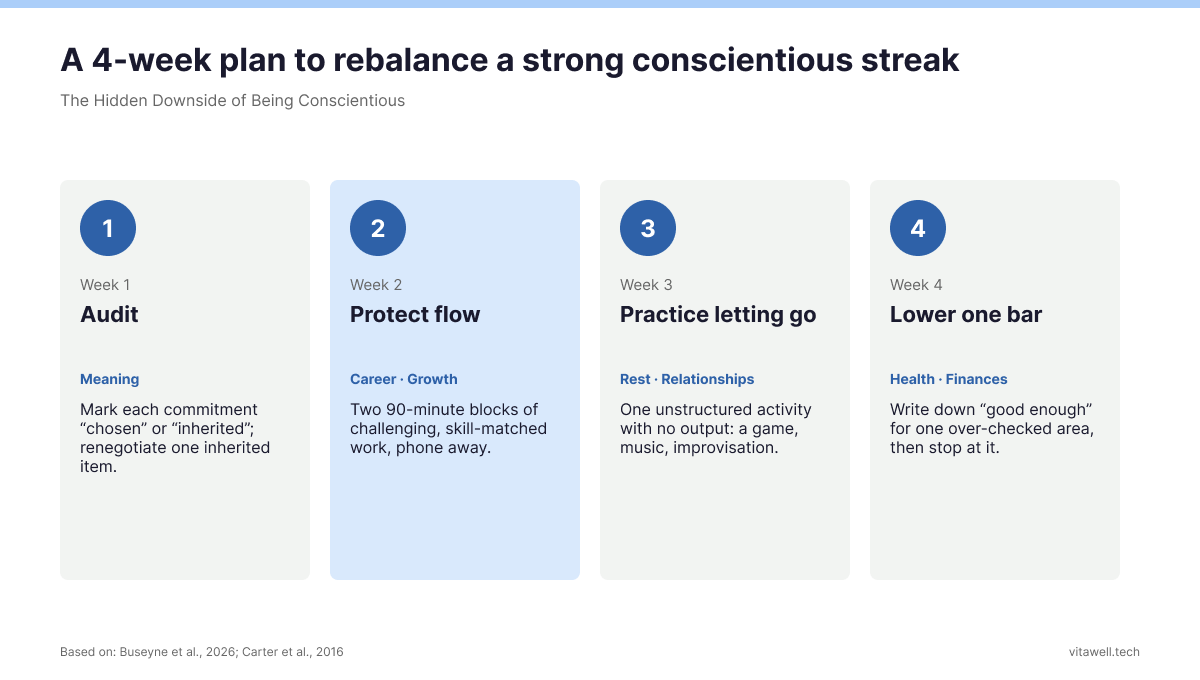
- Week 1 — Audit (Meaning): list your active commitments and mark each as "chosen" or "inherited." Renegotiate one inherited item. The arrival fallacy explains why hitting goals you never chose rarely satisfies.
- Week 2 — Protect flow (Career, Growth): schedule two 90-minute blocks for challenging, skill-matched work, phone away. This uses the trait's strongest flow channels: concentration and challenge.
- Week 3 — Practice letting go (Rest, Relationships): add one unstructured activity with no output, such as a game, improvisation or music. Research on why play matters for adults supports treating it as necessary, not optional.
- Week 4 — Lower one bar (Health, Finances): choose one area where you over-check and define "good enough" in writing. Then stop at it.
VitaWell's 8-area planner can hold the "chosen vs inherited" audit and show whether one life area is absorbing all of your discipline.
Can You Change Your Conscientiousness?
Yes, within limits. In a randomized controlled trial by Mirjam Stieger and colleagues, 1,523 people used a coaching app for three months. Those who wanted to raise a trait reported change with an effect size of d = 0.52, and friends or family also noticed it (d = 0.35); changes lasted at least three months after the program ended, according to the study in PNAS. The same logic works in the other direction: people who want to soften a rigid facet can practice small, repeated behavior changes. If perfectionism is the main issue, our guide to embracing imperfection goes deeper.
When to Talk to a Professional
- Rules and checking take more than an hour a day or cause real distress when interrupted.
- You feel exhausted, cynical or detached from work despite rest — common signs of burnout, covered in our article on burnout recovery.
- Rigidity is damaging relationships at home or at work.
- Low mood, anxiety or loss of enjoyment lasts more than two weeks.
A psychologist can tell the difference between a strong trait, obsessive-compulsive personality patterns and anxiety, which need different approaches.
FAQ
Can you be too conscientious?
Yes. Studies designed to detect curves, including one of 912 adults, found that well-being rises with conscientiousness up to a point and then falls at extreme levels. The drop is driven by obsessive-compulsive versions of facets, such as perfectionism and rigid orderliness, rather than by reliability or effort themselves.
Are conscientious people less happy?
Not overall. Conscientiousness is linked to better health and longer life, and orderliness was tied to less sadness in a 2026 Galway study. The same study found orderly people reacted with less joy to a comedy clip. The trade-off is fewer emotional peaks in both directions, not lower happiness across the board.
Do conscientious people experience flow?
Yes, more than any other Big Five type. A 2026 meta-analysis of 24 studies found the strongest link for conscientiousness (r = 0.33). The link is strongest for concentration and intrinsic reward and weakest for losing self-consciousness, so conscientious people tend to flow while staying self-aware rather than fully lost in the moment.
Is high conscientiousness the same as OCPD?
No. Obsessive-compulsive personality disorder (OCPD) is a clinical pattern of rigid perfectionism and control that impairs daily life. High conscientiousness is a normal trait. Research treats OCPD traits as extreme, maladaptive versions of some conscientiousness facets, which is why only a professional assessment can tell them apart.
Conclusion
Conscientiousness pays real dividends: longer life, reliable work and the deepest access to focused flow of any Big Five trait. Its cost is narrower — fewer moments of self-forgetting and, at the extreme, rules that outlive their purpose. Use the facet matrix to find which part of the trait is overextended, run the four-week plan, and let your discipline serve what you actually chose. If you want a structure for that audit, VitaWell can map your commitments across all 8 life areas.
Related on VitaWell
- Why Flow Is Not a Productivity Hack — the deeper meaning of flow beyond output, useful for conscientious people who flow mostly at work.
- When Ambition Becomes Exhausting — five questions for when achievement striving tips into exhaustion.
- How Perfectionism Quietly Sabotages Your Communication — how the competence facet's extreme version affects relationships.
This article is for informational purposes only and is not medical or psychological advice. If you are concerned about your mental health, speak with a qualified professional.
Sources
- Psychology Today — Is It Possible for Someone to Be Too Good? (Whitbourne, 2026)
- Donovan et al., 2026 — Basic emotions and the Big Five, Journal of Personality
- Buseyne, Said-Metwaly et al., 2026 — Personality and flow: a meta-analysis, Journal of Personality
- Bogg & Roberts, 2013 — The case for conscientiousness (citing Kern & Friedman, 2008)
- Carter et al., 2016 — Downsides of extreme conscientiousness, Journal of Personality
- APS — Personality may be best in moderation (Carter et al., 2014)
- Stieger et al., 2021 — Digital personality change intervention, PNAS