Even Light Drinking Harms Your Brain — What New Research Says About Alcohol, Blood Flow, and Cognitive Risk
A 2026 Stanford MRI study links low-level drinking to reduced brain blood flow. Here is what the evidence says at each drinking level, and how fast the brain recovers.
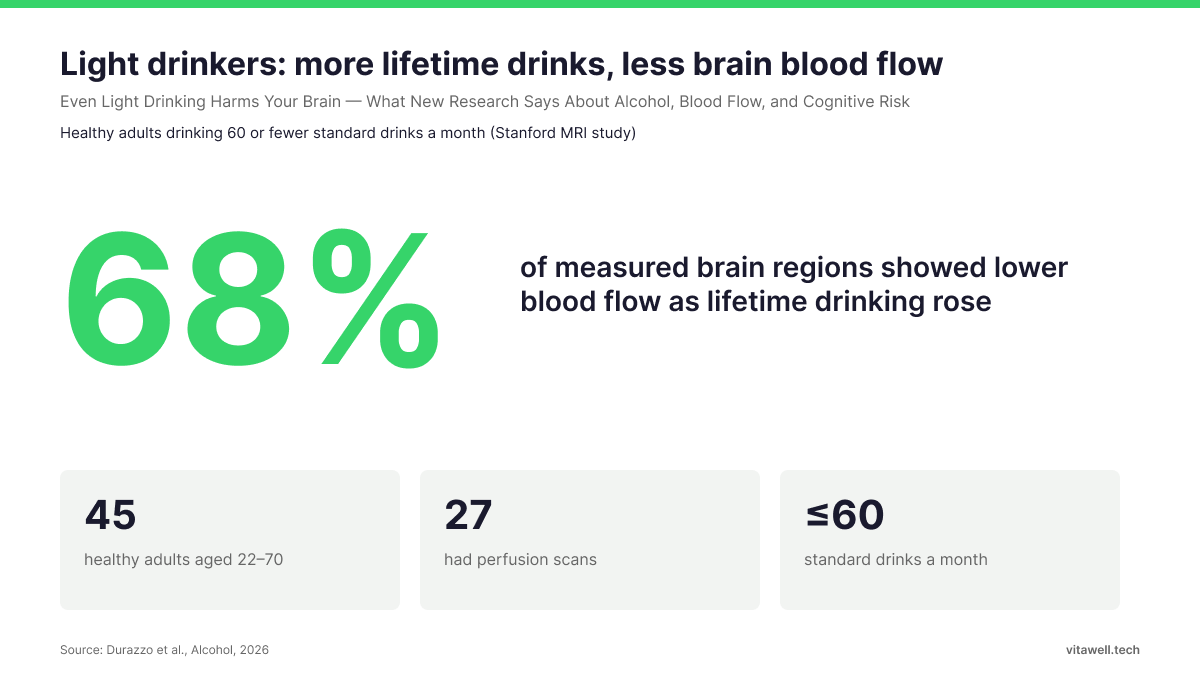
Yes. Light drinking seems to affect the brain too. A 2026 Stanford MRI study of healthy adults who drank within low-risk limits found that the more alcohol people had consumed over their lifetime, the lower the blood flow in 68% of measured brain regions. Larger imaging and genetic studies point the same way: brain changes and dementia risk rise with each extra drink, and none has found a level where the risk stops.
Key Takeaways
- In 45 healthy adults drinking no more than 60 standard drinks a month, more lifetime drinking was linked to lower cortical blood flow and a thinner cortex, especially with age.
- In a UK Biobank study of 36,678 adults, going from one to two UK units a day looked like about two extra years of brain aging at age 50.
- Genetic analysis of 2.4 million people found no protective effect of light drinking on dementia. The old "moderate drinking helps" signal is largely explained by reverse causation.
- The brain can partly recover. In people who quit, cortical thickness recovered in 25 of 34 regions within about 7 months, fastest in the first month.
- Count in standard drinks, not glasses. A 12-ounce craft beer at 10% alcohol already counts as two.
What the Stanford Study Found About Light Drinking
The study that sparked this year's headlines was published in the journal Alcohol in 2026 by Timothy Durazzo of Stanford University School of Medicine and colleagues (Durazzo et al., Alcohol, 2026). It is a small cross-sectional study, meaning it measures people once and looks for associations. It cannot prove cause and effect.
Who was studied and how
The researchers recruited 45 healthy, non-smoking adults aged 22 to 70 with no major medical or psychological conditions. Everyone drank 60 or fewer standard drinks a month in the year before the study, which is roughly two a day or less. Detailed questionnaires estimated average drinks per month over the past year, the past three years and the whole lifetime.
All 45 had structural MRI scans to measure cortical thickness, the depth of the brain's outer layer, where much of thinking happens. A subset of 27 also had perfusion scans, which measure how much blood reaches each region of the cortex.
What the scans showed
- Higher lifetime drinking was linked to lower blood flow in 68% of measured brain regions.
- The combination of older age and more lifetime drinks was strongly linked to lower blood flow in nearly half of the regions, mainly in the frontal, parietal and occipital lobes.
- More lifetime drinks also went with a thinner cortex in several regions, and the age-by-drinking effect showed up mainly in frontal and parietal areas.
The frontal lobes handle planning and self-control. The parietal lobes combine sensory information and spatial awareness. The occipital lobes process vision.
What the study cannot tell you
The authors call the results preliminary. The perfusion group was only 27 people, there were too few women to compare sexes, and diet and exercise were not measured. The study also did not test whether the brain differences affect daily function, such as balance or memory. Treat it as an early warning sign that matches larger studies, not as proof on its own.
Why Age Makes the Effect Stronger
The strongest signals came from the interaction between age and lifetime drinks. In plain terms, the same drinking history was linked to bigger differences in older brains. The authors suggest that oxidative stress, which both alcohol and aging increase, may explain this. That is a hypothesis the study did not test directly.
Lifetime drinks add up faster than most people expect. Here is a worked example:
- One 5-ounce glass of wine, five evenings a week, is 260 standard drinks a year.
- Over 30 years of adult life, that is about 7,800 lifetime drinks.
- A habit that feels light on any single evening becomes a large cumulative exposure by your 50s or 60s, the age when the study saw the biggest differences.
This is why the same nightly glass may matter more at 60 than at 25. The brain has had decades of exposure, and it is also aging.
How Brain Aging Scales With Each Extra Drink
A much larger study shows how the effect grows with dose. Researchers at the University of Pennsylvania analyzed brain scans from 36,678 generally healthy middle-aged and older adults in the UK Biobank (Daviet et al., Nature Communications, 2022). Alcohol intake was linked to lower total brain volume, less grey matter and weaker white matter structure. Grey matter holds nerve cell bodies, and white matter is the wiring between regions.
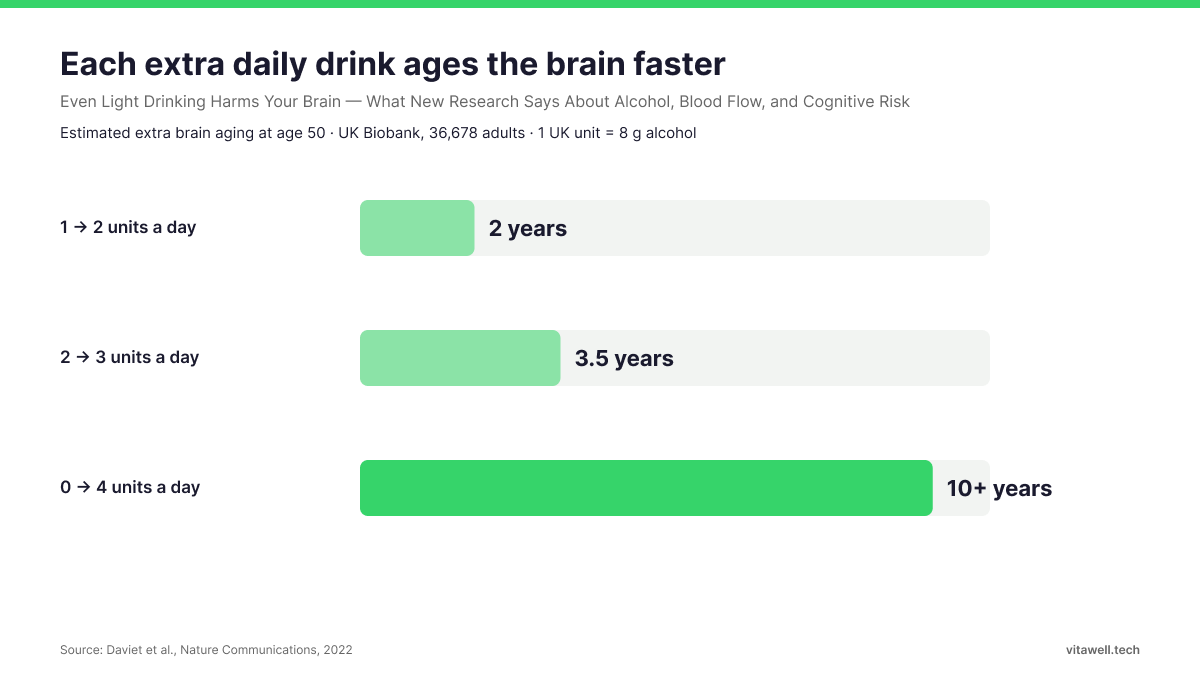
The differences appeared even at an average of one to two UK units a day. A UK unit is 8 grams of alcohol, about half a beer. For a 50-year-old, the researchers estimated:
- Going from one to two units a day matched about 2 years of extra brain aging.
- Going from two to three units a day matched about 3.5 years.
- The gap between zero and four units a day was more than 10 years.
The curve gets steeper as intake rises, so each extra drink costs more than the one before. Like the Stanford study, this is observational. It shows strong associations, not proof of cause.
Why the Idea That Moderate Drinking Protects the Brain Fell Apart
For decades, observational studies showed light drinkers with lower dementia rates than non-drinkers. A 2025 study in BMJ Evidence-Based Medicine led by Anya Topiwala of the University of Oxford tested that pattern in 559,559 adults from the US Million Veteran Program and the UK Biobank, of whom 14,540 developed dementia (Topiwala et al., BMJ Evidence-Based Medicine, 2025).
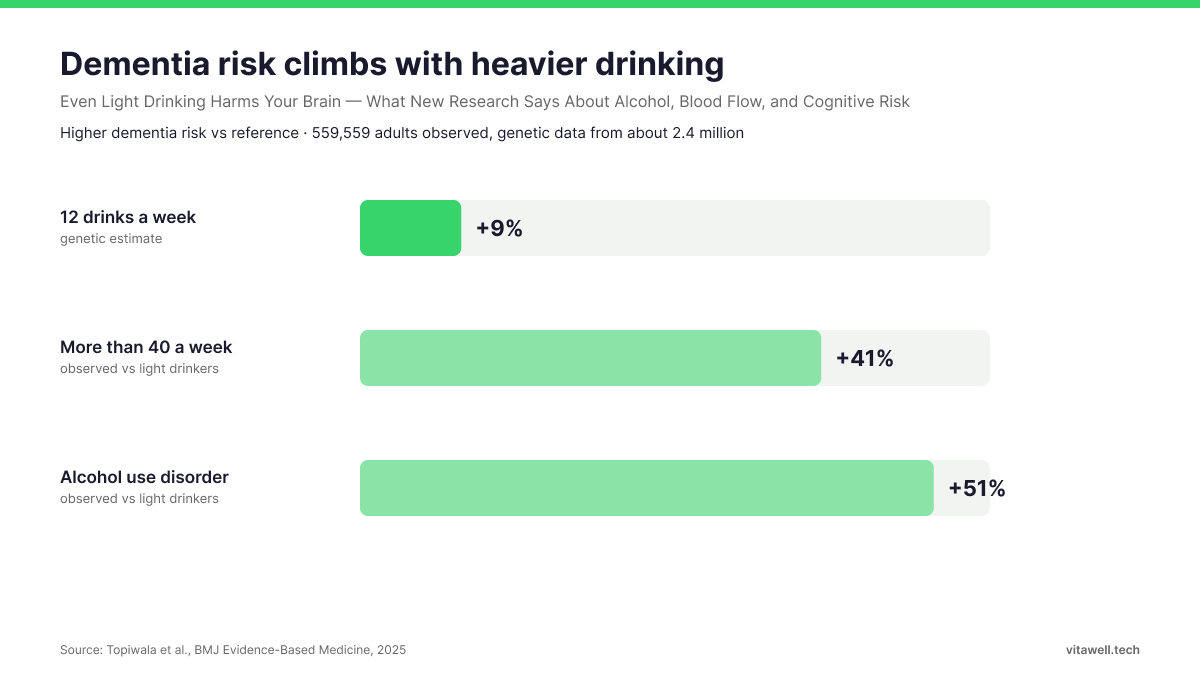
The ordinary observational data showed the familiar U-shape. Compared with light drinkers, people drinking more than 40 drinks a week had a 41% higher dementia risk, and people with alcohol use disorder had a 51% higher risk. But non-drinkers also looked worse.
The team then used Mendelian randomization, a method that uses genes linked to drinking as a natural experiment, so habits and health problems are less likely to distort the result. Using genetic data from about 2.4 million people, they found:
- No U-shape and no protective effect at low intake. Risk rose steadily with dose.
- A genetically predicted increase roughly like going from one to three drinks a week was linked to about 15% higher dementia risk.
- At 12 drinks a week, genetically predicted risk was about 9% higher.
The data also explained the old illusion. People who later developed dementia cut their drinking faster in the years before diagnosis. Early brain changes reduce drinking, which makes light drinkers look protected. This is called reverse causation. Genetic methods rest on assumptions of their own, so the result is strong evidence, not the final word.
The World Health Organization's European office stated in 2023 that no level of drinking is safe for health, noting that about half of alcohol-attributable cancers in the region occur among people who are not heavy drinkers. Its advice was simple: the less you drink, the safer it is.
The Proposed Mechanism: Oxidative Stress
Researchers do not yet know exactly how low-level drinking reduces brain blood flow. The leading idea is oxidative stress, a state in which unstable molecules called free radicals outnumber the body's defenses. The proposed chain looks like this:
- The body breaks alcohol down into acetaldehyde, a toxic compound, and the process generates free radicals.
- Free radicals can damage the lining of small blood vessels.
- Damaged vessels regulate blood flow less well, so some brain regions get less oxygen and glucose.
- Over years, poorly supplied regions may lose cortical thickness.
Each step has support in laboratory and clinical research, but the full chain has not been proven in light drinkers. That is why the Stanford team presents oxidative stress as a possible explanation, not a confirmed one.
What Each Drinking Level Means for Your Brain
First, count in standard drinks
Studies use different units, so start with a common scale. In the US, one standard drink contains 14 grams of pure alcohol (NIAAA):
- 12 ounces of regular beer at 5% alcohol
- 5 ounces of wine at 12% alcohol
- 1.5 ounces of spirits at 40% alcohol
- A 12-ounce craft beer at 10% counts as two drinks, and a standard 750 ml bottle of 12% wine holds about five.
One US standard drink equals about 1.75 UK units. Official numbers have also shifted. The 2025 to 2030 Dietary Guidelines for Americans, released in January 2026, dropped the old daily limits of one drink for women and two for men and now simply advise drinking less (HCPLive, 2026).
The evidence at each weekly level
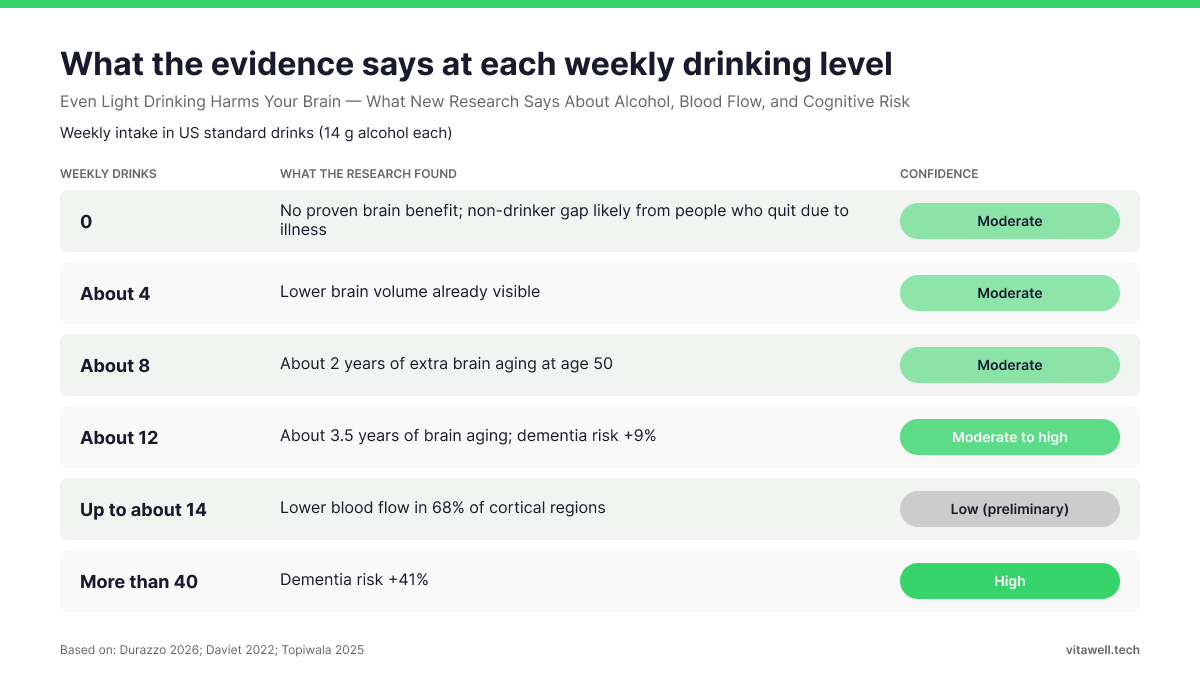
The table puts every study above on one weekly scale, so you can see what the research says about your own intake.
| Weekly intake (US standard drinks) | About (UK units) | What the research found | Study type | Confidence |
|---|---|---|---|---|
| 0 | 0 | Non-drinkers looked worse in observational data, but genetic analysis found no benefit from light drinking. The gap likely reflects people who quit because of illness. | Cohort plus Mendelian randomization (Topiwala 2025) | Moderate |
| About 4 | 7 (1 a day) | Lower brain volume associations already visible at an average of one to two units a day. | Imaging cohort, 36,678 adults (Daviet 2022) | Moderate |
| About 8 | 14 (2 a day) | Moving from one to two units a day matched about 2 years of brain aging at age 50. | Imaging cohort (Daviet 2022) | Moderate |
| About 12 | 21 (3 a day) | Moving from two to three units a day matched about 3.5 years of brain aging. Genetically predicted dementia risk about 9% higher. The Lancet Commission calls more than 21 units a week excessive. | Imaging cohort, genetic study, expert review | Moderate to high |
| Up to about 14 | Up to 24 | Within this range, more lifetime drinks tracked with lower blood flow in 68% of cortical regions and a thinner cortex. | Small MRI study, 45 adults (Durazzo 2026) | Low (preliminary) |
| More than 40 | More than 70 | Dementia risk 41% higher than in light drinkers. | Cohort, 559,559 adults (Topiwala 2025) | High |
The pattern across all three study types is consistent: there is no step where risk drops to zero, and each step up adds more. Excess drinking is one of 14 modifiable risk factors that together account for nearly half of dementia cases, according to the 2024 Lancet Commission on dementia. The others, like inactivity and poor sleep, are covered in our guide to preventing up to 45% of dementia cases.
Can the Brain Recover If You Stop Drinking?
There is good news. A 2023 study by the same Stanford-led group followed 88 people treated for alcohol use disorder and 45 controls, with scans at about one week, one month and 7.3 months of abstinence (Durazzo et al., Alcohol, 2023). Among the 40 who stayed abstinent the whole time:
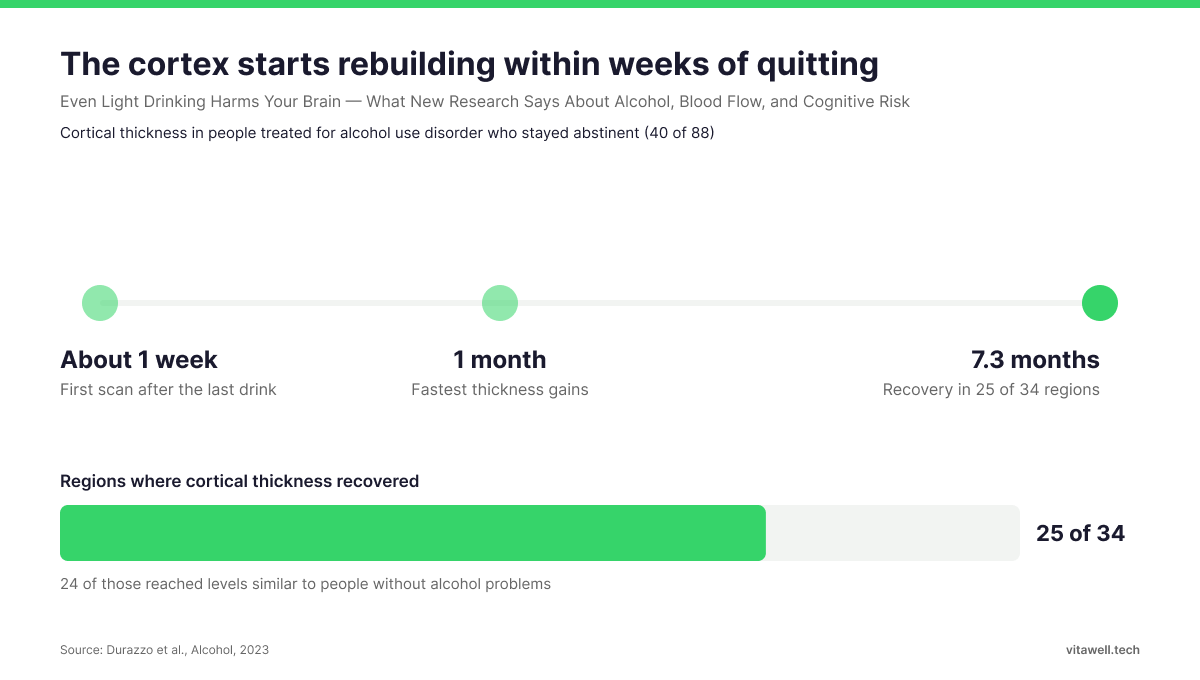
- Cortical thickness recovered in 25 of 34 measured regions.
- In 24 of those regions, thickness reached levels statistically similar to people without alcohol problems.
- Gains were fastest in the first month, then continued more slowly.
- Current smokers recovered more slowly in some regions.
These were heavy drinkers, so the results do not show exactly how a light drinker's brain responds to cutting back. They do show that the cortex can rebuild thickness once alcohol is removed, and that the first weeks count most.
A 4-Week Plan to Protect Your Brain
You do not need to decide today whether to quit for life. Use four weeks to collect your own data and lower your dose.
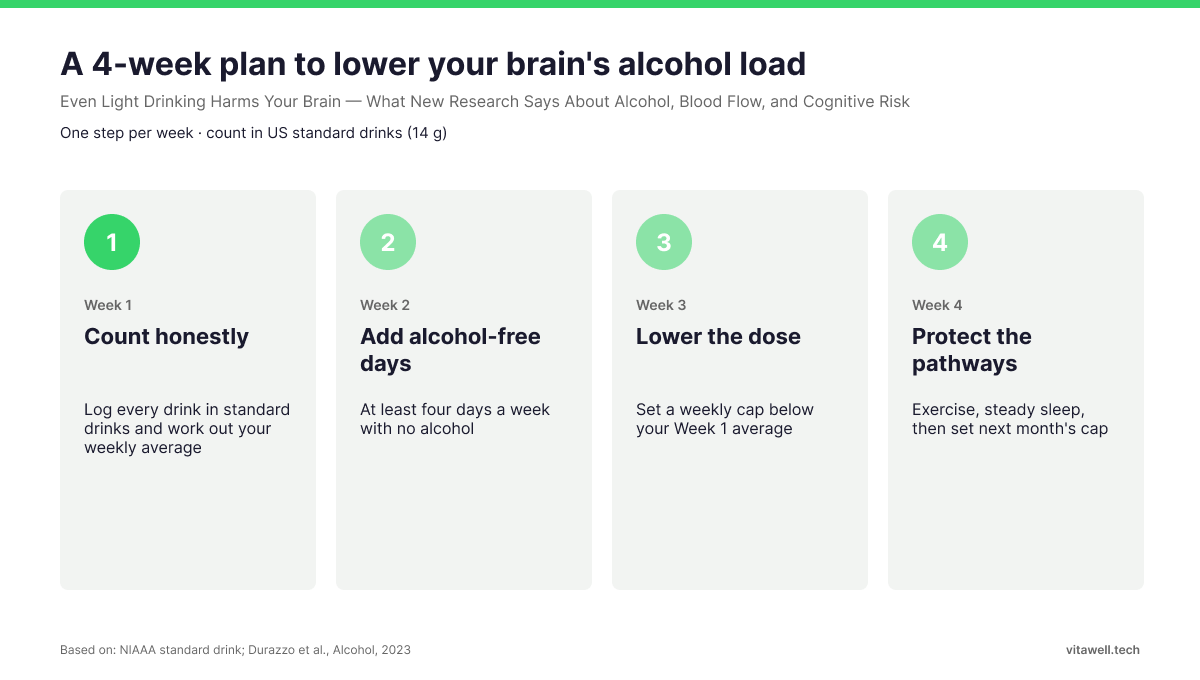
- Week 1: Count honestly. Log every drink in standard drinks, using the label's alcohol percentage and the real glass size. Work out your weekly average and a rough lifetime total.
- Week 2: Add alcohol-free days. Choose at least four days with no alcohol and name the situation that usually triggers a drink. Plan a replacement for it, such as sparkling water, a walk or a call.
- Week 3: Lower the dose. Set a weekly cap below your Week 1 average. Use smaller glasses, pour once and choose lower-strength drinks.
- Week 4: Protect the same pathways. Support blood flow with regular movement, such as 20 minutes of exercise for memory, and with steady sleep, covered in how much sleep lowers dementia risk. Compare your Week 4 total with Week 1 and set next month's cap.
In VitaWell, this fits across life areas. Health tracks the numbers, Rest covers sleep, and Community helps you plan social evenings that do not center on drinks.
When to Talk to a Professional
Speak with a doctor or a licensed addiction specialist if any of these apply:
- You often drink more than you planned, or cutting back feels very hard.
- You drink heavily every day. Stopping suddenly can cause dangerous withdrawal, so ask for medical guidance first.
- You notice shaking, sweating, anxiety or poor sleep when you skip drinking.
- You or people close to you notice memory lapses, confusion or personality changes.
- You have a family history of dementia, or you take medicines that interact with alcohol.
FAQ
Is one drink a day bad for your brain?
Current evidence suggests it is not neutral. In 36,678 UK Biobank adults, lower brain volume was already visible at one to two UK units a day, and genetic studies find no protective effect of light drinking. The risk at this level is small for any one person, but it adds up over decades.
Does moderate drinking cause dementia?
Moderate drinking is not proven to cause dementia on its own, but it does not protect against it. A 2025 genetic analysis of 2.4 million people found that dementia risk rises steadily with intake, with no safe floor. Earlier signs of protection are explained mostly by people cutting down as their memory declines.
How long does it take the brain to recover after quitting alcohol?
Recovery starts quickly. In a Stanford-led study of people treated for alcohol use disorder, cortical thickness grew fastest in the first month of abstinence and recovered in 25 of 34 regions by about 7.3 months. Recovery was partial in some regions and slower in current smokers.
Is wine better for the brain than beer or spirits?
There is no good evidence for that. Research measures pure alcohol, and a 5-ounce glass of 12% wine contains the same 14 grams as a 12-ounce regular beer or a shot of spirits. What matters for the brain is how much alcohol you drink over time, not which drink it comes in.
Conclusion
Low-risk does not mean no risk for the brain. A small Stanford study, a large brain imaging study and a genetic study of millions all point in the same direction: more alcohol over a lifetime goes with less blood flow, less brain tissue and higher dementia risk, and the effect grows with age. The upside is just as clear. The brain responds when alcohol drops, often within weeks.
Start with one honest week of counting. VitaWell can turn that number into a 4-week plan across Health, Rest and Community, so cutting back becomes a habit you can track. For alcohol's effects beyond the brain, read how alcohol gradually damages the body.
This article is for informational purposes only and is not medical advice. Talk to a qualified healthcare professional about your own drinking and health.
Sources
Medical News Today: Even a little alcohol here and there damages brain health