
The New Heart-Kidney-Obesity Connection: What the Latest Medical Guidelines Mean for Your Health

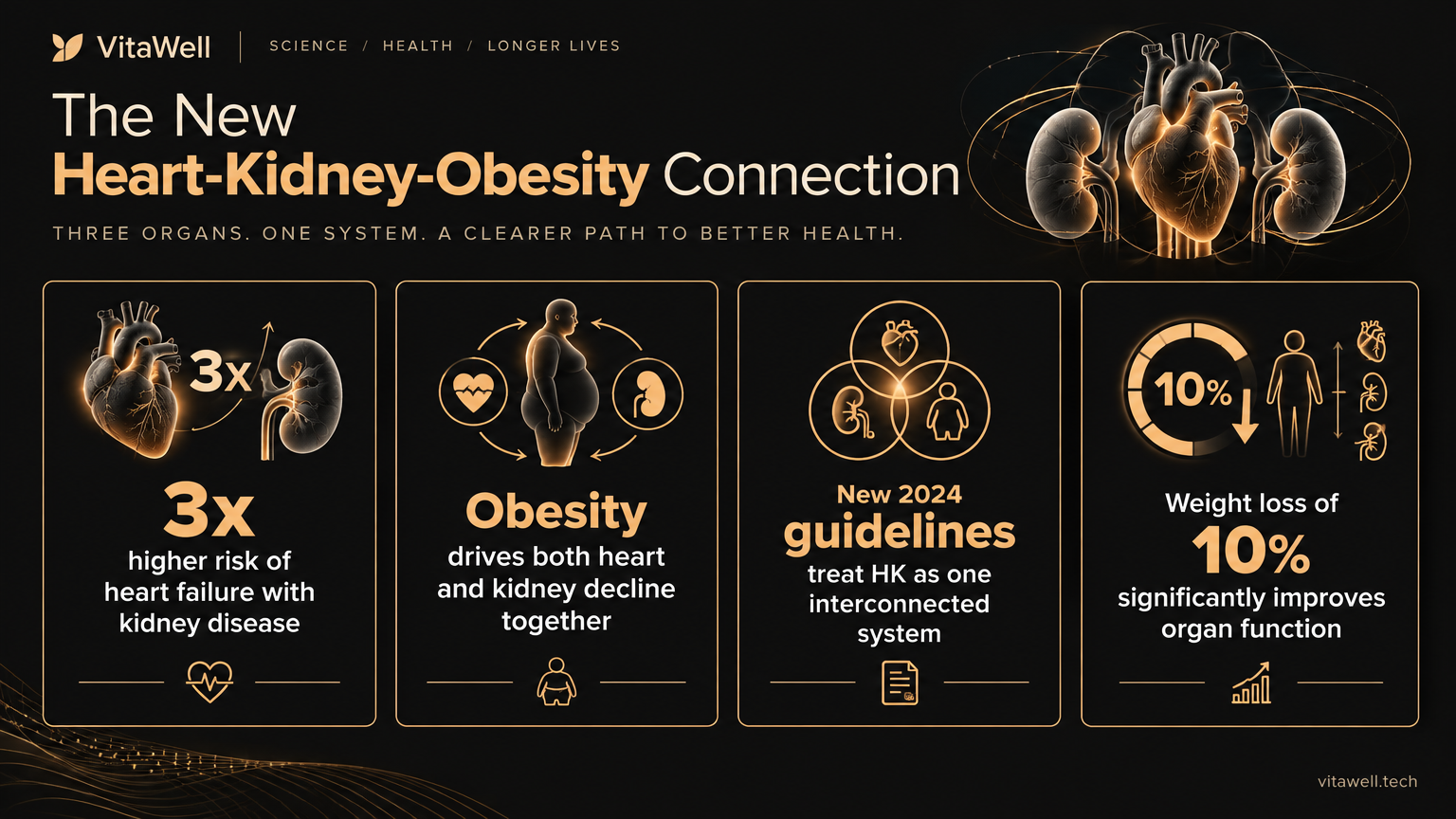
Most of us have been taught to think of our health problems in isolation. High blood pressure? See the cardiologist. Kidney disease? Visit the nephrologist. Weight issues? Talk to your primary care doctor. But groundbreaking new guidelines from the nation's top medical organizations say this fragmented approach has been missing the bigger picture for decades. In June 2026, the AHA, ACC, ADA, and ASN jointly released the first-ever clinical guideline on cardiovascular-kidney-metabolic (CKM) syndrome — fundamentally reframing how we understand and treat four of the most common and deadly conditions in America: cardiovascular disease, chronic kidney disease, obesity, and type 2 diabetes.
What Is CKM Syndrome? A New Way of Looking at Your Health
CKM syndrome stands for cardiovascular-kidney-metabolic syndrome. It is a medical framework that recognizes the deep biological interconnection among four conditions that tend to appear together and make each other worse over time: cardiovascular disease, chronic kidney disease, obesity, and type 2 diabetes. What makes this framework powerful is not just naming these conditions together, but understanding how deeply they influence each other at the biological level.
How the Four Conditions Feed Each Other
The root driver of CKM syndrome is excess body fat, particularly visceral fat stored around the abdominal organs. Adipose tissue is metabolically active and releases inflammatory substances that damage blood vessels, kidneys, and the heart. Here is the biological chain reaction:
- Excess body fat triggers chronic low-grade inflammation throughout the body
- Inflammation causes insulin resistance, making it harder for cells to absorb glucose
- Elevated blood sugar damages blood vessels and kidneys
- Damaged blood vessels accelerate plaque buildup in the arteries (atherosclerosis)
- Damaged kidneys lose their ability to filter blood and regulate blood pressure
- A struggling heart must work harder against damaged vessels and elevated fluid levels
- Each condition accelerates the progression of the others in a self-reinforcing cycle
Why This Guideline Is a Historic Shift in Medicine
The 2026 AHA/ACC/ADA/ASN CKM guideline is the first of its kind. It replaces and dramatically expands upon the 2013 Guideline for the Management of Overweight and Obesity in Adults. The new guideline positions obesity not merely as a risk factor but as a central biological driver of organ damage that must be addressed holistically. "Heart, kidney, and metabolic conditions don't occur in isolation — they are deeply connected," said Dr. Chiadi E. Ndumele, chair of the guideline writing committee. "This guideline calls for earlier screening and care, focusing on prevention and coordinated action to reduce the risk of cardiovascular disease before serious complications develop."
Key Statistics That Show How Common This Is
The scale of CKM syndrome in the United States is staggering:
- Nearly 90% of US adults have at least one CKM risk factor
- 40% of American adults have obesity
- 21% of children and adolescents have obesity
- 1 in 3 adults has at least three metabolic risk factors for CKM syndrome
The 5 Stages of CKM Syndrome
One of the most practical innovations in the new guideline is a staging system that helps clinicians and patients understand where they are in the CKM spectrum:
- Stage 0: No CKM risk factors. Normal weight, healthy blood pressure, normal blood sugar, no kidney disease.
- Stage 1: Excess body fat, especially around the waist. Lifestyle intervention is the primary focus.
- Stage 2: Presence of type 2 diabetes, elevated triglycerides, high blood pressure, or chronic kidney disease. Medications are often appropriate alongside lifestyle changes.
- Stage 3: Early or subclinical cardiovascular disease without symptoms, or high estimated cardiovascular risk. Intensive management of all risk factors is recommended.
- Stage 4: Clinical cardiovascular disease with symptoms — heart failure, heart attack history, or stroke — possibly with kidney failure. Comprehensive medical and surgical management.
The good news: people can and do improve their CKM stage through sustained lifestyle changes and appropriate medical treatment.
What the New Guidelines Actually Recommend
The 2026 guidelines provide specific, actionable recommendations. Here are the five most significant changes:
1. Better Risk Assessment with New PREVENT Equations
The guideline recommends the new PREVENT equations (Predicting Risk of Cardiovascular Disease Events), which factor in kidney health and metabolic conditions for a more accurate picture of an individual's 10-year and 30-year cardiovascular risk — far more personalized than previous tools.
2. GLP-1 Medications Enter the Official Guidelines
For the first time, GLP-1-based therapies — the class that includes semaglutide (Ozempic, Wegovy), liraglutide, and tirzepatide — are officially recommended by AHA and ACC guidelines for select individuals with obesity and/or type 2 diabetes along with other cardiovascular risk factors. This reflects growing evidence that GLP-1 drugs reduce cardiovascular events and may protect kidney function.
3. Coordinated Care Across Specialties
The guideline calls for a dedicated CKM care coordination point person — a clinician or care manager who connects cardiology, nephrology, endocrinology, and primary care into coherent, integrated treatment for the patient.
4. Screening for Social Factors That Affect Health
The 2026 guideline formally recommends screening for social determinants of health — including food insecurity, housing instability, and financial strain — acknowledging that these factors profoundly affect a patient's ability to exercise, eat well, and take medications consistently.
5. Lifestyle Remains the Foundation
Across all stages of CKM syndrome, healthy lifestyle behaviors remain central to both prevention and treatment. The guideline reinforces:
- At least 30 minutes of moderate physical activity most days of the week
- A heart-healthy dietary pattern (Mediterranean or DASH diet)
- Adequate sleep (7–9 hours for adults)
- Avoidance of tobacco products in all forms
- Regular monitoring of blood pressure, blood sugar, and cholesterol
- Achieving and maintaining a healthy body weight
What This Means for You — Practical Takeaways
Understanding CKM syndrome is not just for doctors. Here is what you can do right now:
- Know your numbers. Get your blood pressure, fasting blood glucose, kidney function (eGFR and urine albumin), and lipid panel tested — these are the key CKM markers.
- Ask about your CKM stage. Ask your doctor where you fall on the CKM staging scale and what you should be doing about it.
- Ask about your PREVENT score. The new cardiovascular risk equations offer a more personalized long-term risk estimate.
- Advocate for integrated care. If you see multiple specialists, ask for a care coordinator who connects all your providers.
- Take lifestyle seriously at any stage. Even at Stage 3 or 4, lifestyle improvements meaningfully slow progression. It is never too late.
The Future of CKM Care
The 2026 guidelines represent a major leap forward, but important gaps remain. There is still limited data on treating patients with both heart failure and advanced chronic kidney disease. More research is needed on how GLP-1 therapies perform across diverse populations. But the broader vision is clear: medicine is moving toward a model where these interconnected conditions are recognized, screened, and treated as one unified syndrome — preventing heart attacks, strokes, kidney failure, and diabetes complications before they happen. Your heart, your kidneys, and your metabolism are not separate problems. They are one body, and they deserve to be treated that way.