
GLP-1 Medications and Fertility: What New Research Says for Men and Women With Obesity

Over the past two years, something unexpected began appearing in medical literature and social media alike: people taking GLP-1 weight-loss medications like Ozempic and Mounjaro were reporting unplanned pregnancies. Some had struggled with fertility for years. The phenomenon was quickly dubbed "Ozempic babies" — but what the headlines missed was the science beneath the surprise.
GLP-1 receptor agonists are not fertility drugs. They were developed to treat obesity and type 2 diabetes. Yet new research presented at ENDO 2026 and data from the ongoing RESTORE clinical trial suggest these medications may significantly improve reproductive outcomes in both men and women with obesity — not through direct hormonal manipulation, but by correcting the metabolic dysfunction that was blocking fertility in the first place.
What Are GLP-1 Medications and How Do They Work?
GLP-1 stands for glucagon-like peptide-1, a hormone naturally released by the gut after eating. GLP-1 receptor agonists mimic this hormone's effects: they slow gastric emptying, suppress appetite, stimulate insulin secretion in response to glucose, and reduce glucagon release. The result is lower blood sugar, reduced hunger, and — for many people — significant weight loss.
The most widely prescribed GLP-1 medications include semaglutide (sold as Ozempic for diabetes and Wegovy for obesity) and tirzepatide (Mounjaro/Zepbound). These drugs have become among the most prescribed medications in the world over the past three years. Their effect on fertility is not their intended mechanism — but the metabolic changes they produce turn out to directly address some of the most common hormonal barriers to conception.
The Connection Between Metabolic Health and Fertility
Fertility is fundamentally hormonal. And hormones are, at their core, metabolic. The cascade of signals that regulates ovulation in women and sperm production in men — from the hypothalamus to the pituitary gland to the gonads — is exquisitely sensitive to the body's metabolic state.
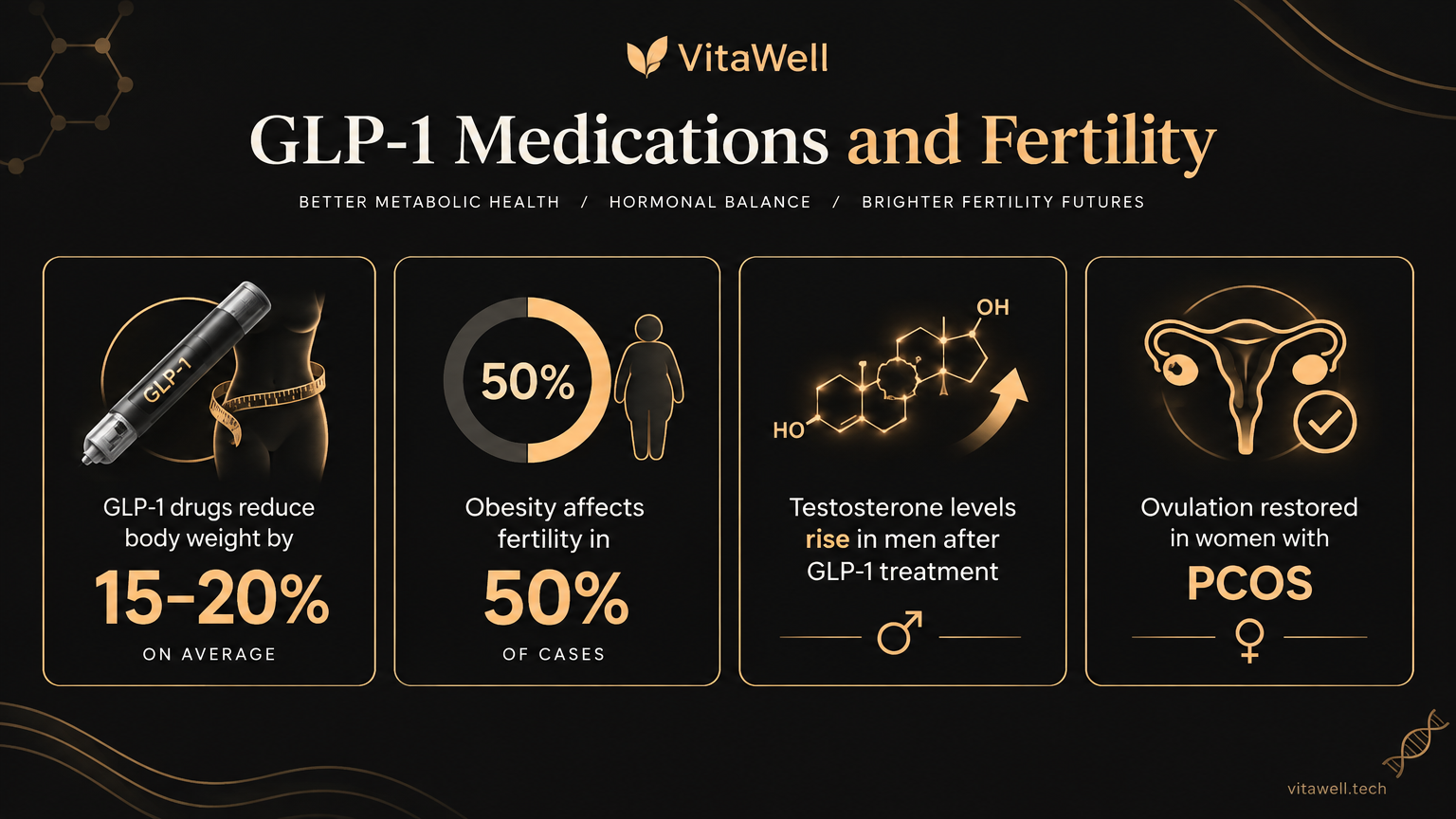
When the body is carrying excess adipose tissue, experiencing chronic insulin resistance, or sustaining low-grade systemic inflammation, that entire signaling chain is disrupted. The result can be irregular or absent ovulation in women, impaired sperm production in men, and reduced pregnancy rates in both. The logical implication: restore the metabolic environment, and reproductive function often follows.
How Obesity Impairs Female Fertility
The most common form of obesity-related female infertility is polycystic ovary syndrome — now increasingly referred to as PMOS (polyendocrine metabolic ovarian syndrome) to better reflect its metabolic character. PMOS affects an estimated 8–13% of women of reproductive age and is the leading cause of ovulatory infertility.
The core mechanism in PMOS is insulin resistance. When cells don't respond efficiently to insulin, the body compensates by producing more of it. Elevated insulin levels then overstimulate the ovaries and adrenal glands to produce androgens, which disrupts the hormonal balance needed for regular ovulation. The downstream effects include irregular or absent periods, poor egg quality, difficulty conceiving naturally, and higher rates of miscarriage.
How GLP-1 Medications May Improve Fertility in Women
The RESTORE Trial: Semaglutide and PMOS
The RESTORE trial, led by researchers at the University of Colorado Anschutz Medical Campus, is investigating whether semaglutide can restore ovulation and improve reproductive health in adolescents and adults with PMOS. Early findings presented at ENDO 2026 were notable: participants who achieved significant weight loss with semaglutide showed signs of improved ovulation and restored menstrual regularity sooner than expected. Researchers noted that the reproductive system appeared to respond to metabolic correction quickly — in some cases before participants reached their target weight loss goal. These are preliminary findings from an ongoing trial, not a completed study.
Evidence From Randomized Controlled Trials
A review published in Fertility and Sterility analyzed five randomized controlled trials examining GLP-1 medications and female fertility outcomes in women with PCOS/PMOS. Across those trials, improvements were observed in ovulation frequency, menstrual cycle regularity, and in some cases, clinical pregnancy rates. The primary mechanism driving these improvements was weight loss leading to reduced insulin resistance, which in turn restored more normal ovulatory signaling.
How Obesity Impairs Male Fertility
Adipose tissue contains high concentrations of an enzyme called aromatase, which converts testosterone into estradiol (a form of estrogen). In men with excess body fat, aromatase activity is elevated in proportion to fat mass. The result is a significant reduction in circulating testosterone and an increase in estradiol.
This hormonal shift feeds back to the hypothalamic-pituitary-testicular axis: elevated estradiol suppresses the release of LH (luteinizing hormone) and FSH (follicle-stimulating hormone) from the pituitary gland. Since LH and FSH are the signals the testes depend on to produce testosterone and generate sperm, their suppression directly impairs spermatogenesis. The measurable outcomes: lower sperm count, reduced sperm motility and morphology, and — in severe cases — clinically significant male factor infertility.
How GLP-1 Medications May Improve Male Fertility
Research presented at ENDO 2026 brought an important message: GLP-1 medications do not harm male hormones — and in obese men, they may significantly improve them.
As men lose body fat through GLP-1 treatment, aromatase activity in adipose tissue decreases. Less testosterone is converted to estradiol. Circulating testosterone rises. The suppression of LH and FSH is lifted. Studies in obese men who lost weight with GLP-1 medications have observed improvements in sperm motility, morphology, and testosterone levels.
Some researchers propose that these findings challenge the conventional clinical approach of starting with testosterone replacement therapy (TRT) for obese men with low testosterone. TRT artificially raises testosterone levels but suppresses the body's own sperm production — and can actually worsen fertility in men trying to conceive. GLP-1s, by contrast, improve testosterone by removing the metabolic obstruction causing the deficiency.
What the ENDO 2026 Research Summary Shows
At the ENDOCRINE 2026 conference, researchers presented a review of five randomized controlled trials examining GLP-1 drugs and reproductive outcomes in both men and women. The combined picture: early promise across both sexes, with consistent signals that metabolic improvement through GLP-1 treatment correlates with improvements in hormonal markers and, in some cases, reproductive outcomes. Researchers characterized these findings as promising but early — no large-scale trial has yet been designed with fertility as its primary endpoint.
Critical Cautions: What We Still Don't Know
- Semaglutide is not approved for use during pregnancy. Women who become pregnant while taking GLP-1 medications are advised to discontinue them immediately. Insufficient safety data exists for use during pregnancy.
- GLP-1 medications are not fertility treatments. They cannot replace assisted reproductive technology (IVF, IUI), and there is no evidence they improve outcomes for fertility challenges unrelated to obesity or metabolic dysfunction.
- The research is still early. No large, long-term clinical trial has been completed with fertility as the primary outcome measure. The existing evidence is promising, not definitive.
- Individual variation matters. Results depend on degree of metabolic dysfunction, the specific fertility challenge, and individual response to the medication.
- GLP-1 medications are prescription-only and require medical supervision, particularly in the context of reproductive planning.
Should You Ask Your Doctor About GLP-1 Medications for Fertility?
For people with obesity or metabolic dysfunction who are also experiencing fertility challenges, the emerging research makes GLP-1 medications a reasonable topic to raise with a reproductive endocrinologist or OB-GYN. Particularly relevant candidates include women with PMOS/PCOS who have not responded adequately to lifestyle changes alone, men with obesity and clinically low testosterone or confirmed poor sperm parameters, and couples with unexplained infertility where one or both partners have significant metabolic risk factors.
- Would treating my metabolic health first improve my fertility outcomes?
- Am I a candidate for GLP-1 therapy, and what would the timeline look like?
- When would I need to stop the medication if I become pregnant or before starting IVF?
- How does this fit with any fertility treatment I'm already doing or considering?
The Bottom Line: Metabolic Health and Reproductive Health Are Not Separate Systems
The most important insight from the 2026 fertility research on GLP-1 medications is not about the drugs themselves. It's about what they reveal: that metabolic health and reproductive health are deeply interconnected, and that correcting one often improves the other.
For the millions of people whose fertility challenges are rooted in obesity, insulin resistance, or hormonal disruption from excess adipose tissue, GLP-1 medications offer a scientifically grounded path to addressing the underlying problem — not just its symptoms. The research is not yet complete. But the direction is clear enough to start a conversation with your doctor.