
GLP-1 Drugs Like Ozempic Don't Just Shrink Your Waistline — New Study of 600,000 People Shows They Also Silence the Craving Behind Addiction
Millions of people started taking GLP-1 medications like Ozempic, Wegovy, Mounjaro, and Zepbound for weight loss or type 2 diabetes. But in clinics, something unexpected kept coming up. Patients would mention, almost in passing, that they had stopped drinking as much. That cigarettes had lost their appeal. That the pull toward substances they had struggled with for years had quietly faded. Now, a landmark study of more than 600,000 people has confirmed that this is not anecdote. It is data.
The Study That Changed Everything
Published in June 2026 in The BMJ, the study was conducted by researchers at Washington University School of Medicine in St. Louis. It analyzed electronic health records from 606,434 U.S. military veterans with type 2 diabetes, tracked for up to three years. Half took a GLP-1 receptor agonist (most commonly semaglutide, liraglutide, or dulaglutide). The other half took an SGLT2 inhibitor — a different class of diabetes medication with no known effect on the brain reward system — providing a crucial comparison group.
Who Was Studied and How
Participants were divided into two groups: 524,817 people with no substance use disorder at the start, and 81,617 people who already had a diagnosed substance use disorder. This design allowed researchers to examine both prevention and treatment effects in a single large dataset.
The Numbers That Stopped Researchers in Their Tracks
Among those without an existing substance use disorder, GLP-1 users were significantly less likely to develop one:
- Any substance use disorder: 14% lower risk
- Alcohol use disorder: 18% lower risk
- Cannabis use disorder: 14% lower risk
- Cocaine use disorder: 20% lower risk
- Nicotine dependence: 20% lower risk
- Opioid use disorder: 25% lower risk
This translated to approximately seven fewer new substance use disorder diagnoses per 1,000 GLP-1 users.
For People Already Living With Addiction — Even More Dramatic Results
The findings were even more striking among the 81,617 participants who already had a substance use disorder. Compared to SGLT2 inhibitor users, GLP-1 users experienced over three years:
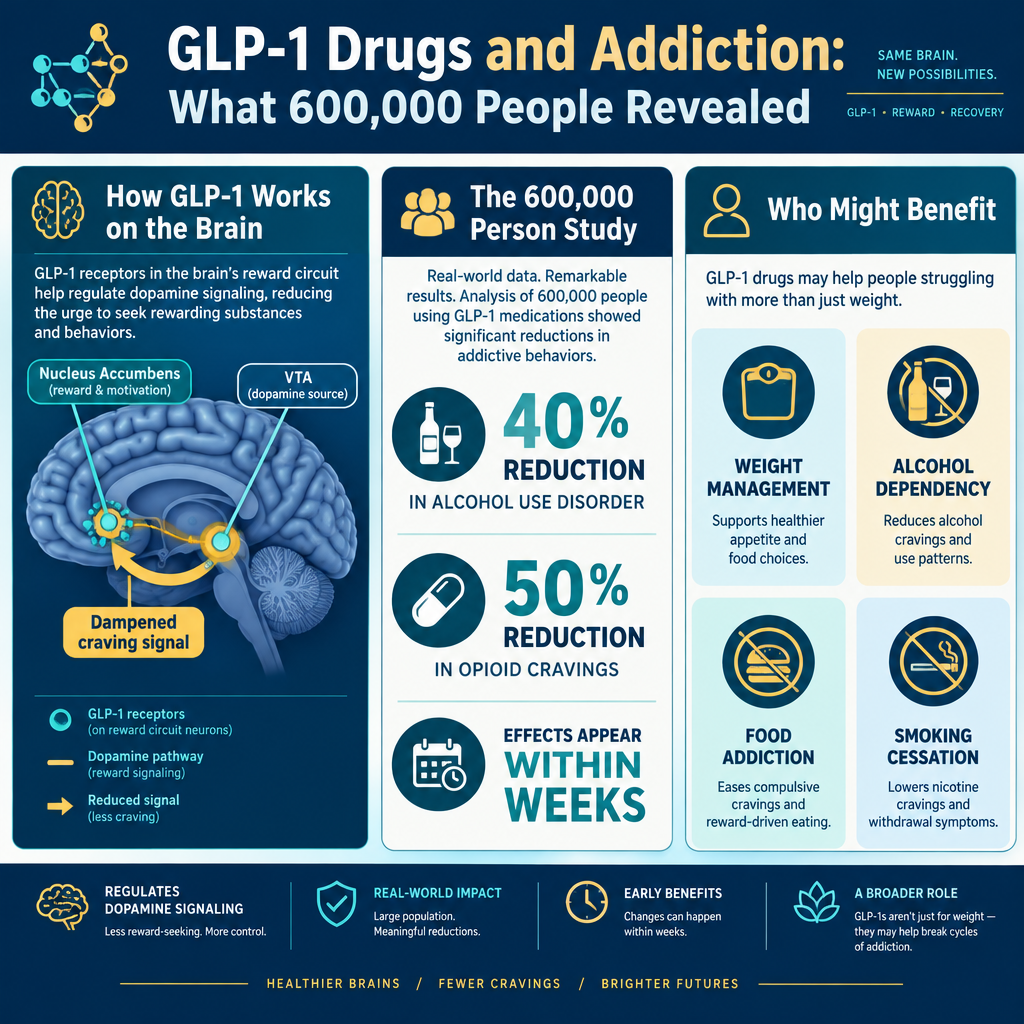
- 40% fewer overdoses
- 30% fewer emergency department visits
- 25% fewer hospitalizations
- 50% fewer drug-related deaths
- Overall: 12 fewer serious addiction-related events per 1,000 users
These are not marginal reductions. They represent dramatic differences in the most catastrophic outcomes of addiction: hospitalization, overdose, and death.
Why Would a Weight Loss Drug Affect Addiction?
The question at the center of this research is biological: why would a drug developed to manage blood sugar also reduce the pull of alcohol, cocaine, and opioids? The answer lies in how GLP-1 medications interact with the brain.
Your Brain on GLP-1s — The Reward Circuit Explained
GLP-1 receptors exist not only in the pancreas and gut, but in the brain — specifically in two regions central to reward, motivation, and craving. The ventral tegmental area (VTA) is the engine of the brain’s dopamine system. The nucleus accumbens is where dopamine signals translate into the feeling of wanting something. Together, these regions form the mesolimbic pathway: the circuit that drives motivation, reinforces behavior, and, when dysregulated, underlies addiction. GLP-1 receptors in these regions modulate the dopamine “wanting” signal, reducing the motivational pull toward rewarding stimuli without eliminating the experience of enjoyment itself.
Food Noise vs. Drug Noise — A New Framework
People taking GLP-1 medications commonly describe “food noise” going quiet — the relentless mental preoccupation with eating, the intrusive thoughts that drive consumption beyond genuine hunger. GLP-1s quiet it by reducing the compulsive preoccupation, not by making food joyless. Senior researcher Ziyad Al-Aly, MD of Washington University articulated the extension of this framework: “GLP-1 drugs may also quiet what I call ‘drug noise’ — the relentless craving that drives addiction across substances. That cross-substance signal points to a shared biology underlying addiction.”
Why This Works Across All Substances
Existing addiction treatments are substance-specific: methadone for opioids, naltrexone for alcohol, nicotine replacement for tobacco. There is no approved medication for cocaine or methamphetamine addiction at all. GLP-1 drugs appear to operate differently — not by targeting the pharmacology of any specific substance, but by modulating the shared neural circuitry of craving itself. If confirmed in clinical trials, this would represent a fundamentally new category of addiction treatment: not substance-specific, but craving-specific.
What This Means for People Currently Taking GLP-1 Drugs
Tens of millions of people around the world take GLP-1 medications for type 2 diabetes or obesity. Many also have histories of substance use. Current eligibility criteria for GLP-1 prescriptions include:
- Type 2 diabetes (with or without obesity)
- Obesity (BMI ≥ 30, or ≥ 27 with a weight-related health condition)
The dual-benefit opportunity is significant. For someone taking Ozempic for diabetes who also drinks too much, the medication may be addressing more than blood sugar. Patients report noticing changes in their relationship with alcohol or cigarettes unprompted — the effect is noticeable enough that they bring it up on their own.
Should You Ask Your Doctor About This?
Yes — with appropriate context. As of 2026, the FDA has not approved any GLP-1 medication for the treatment of addiction. If you already take a GLP-1 for an approved indication and also struggle with substance use, this is worth raising with your doctor. If your primary interest is addiction treatment, the evidence is not yet strong enough to support seeking a GLP-1 prescription for that purpose alone — but the conversation is legitimate and timely.
What We Still Don’t Know — Honest Limitations
The scientific community has responded to this study with significant interest and appropriate caution. Several important limitations must be understood.
The Study Population Problem
This study’s participants were U.S. military veterans: approximately 90% male, average age 65, all with type 2 diabetes. This does not represent the broader population of people with addiction, which includes women, younger adults, and people without metabolic conditions. Whether the findings hold in these groups is unknown.
Observational Design — Correlation vs. Causation
The study was observational, not randomized. The association between GLP-1 use and reduced addiction risk is statistically robust, but causation has not been established. Randomized controlled trials (RCTs) are needed before changes to clinical guidelines can be recommended.
The Opioid Question
Some preclinical animal studies have found that GLP-1 receptor stimulation does not attenuate the rewarding or reinforcing effects of opioid drugs, suggesting the mechanism for opioids may differ from that for alcohol and stimulants. This inconsistency requires resolution through dedicated human trials.
Individual Variability
Substance use disorders arise from different combinations of genetics, trauma, social environment, and neurobiology. No pharmacological treatment works for everyone. The proportion of people with addiction who benefit significantly, modestly, or not at all from GLP-1 medications remains to be determined.
What Comes Next — The Road to Clinical Trials
Clinical trials specifically designed to test GLP-1 medications as addiction treatments are already underway. A prominent example is a randomized, double-blind, placebo-controlled Phase 3 trial evaluating semaglutide for alcohol use disorder in U.S. veterans — results are expected within the next few years. If these trials confirm the observational data, addiction medicine could see its most significant pharmacological development in decades: a drug that addresses the neural architecture of craving itself, across substances.
Conclusion
GLP-1 drugs began as metabolic medications. They became a cultural phenomenon because of their weight loss effects. And now, they may be on the verge of a third identity: the first class of medications that reduces addiction risk across multiple substances simultaneously. The door that has opened here is genuinely new. For the millions of people already taking these medications — and for those who struggle with substance use — this research deserves honest conversation with physicians, and the urgency its potential warrants.