
Perinatal Mental Health: Why Depression and Anxiety During and After Pregnancy Are Still Going Undetected
In a study of nearly 30,000 pregnant and postpartum patients at a major urban medical center, only 11.1 percent received any formal mental health screening. This is not an outlier result. It reflects the reality of perinatal mental health care across most of the developed world: conditions that affect 1 in 5 people during the most emotionally demanding transition of their lives are routinely going undetected, unnamed, and untreated.
Perinatal depression and anxiety are not rare. They are not a sign of weakness, inadequate mothering, or ingratitude. They are medical conditions with identifiable risk factors, well-established symptoms, and effective treatments — and the most urgent obstacle to care is simply recognition.
What Is Perinatal Mental Health?
The term perinatal refers to the period that spans pregnancy and the first year after birth. Perinatal mental health conditions are mood and anxiety disorders that arise during this window. They include:
- Perinatal depression (antenatal and postnatal)
- Perinatal anxiety disorders
- Perinatal OCD
- Perinatal PTSD, particularly following difficult or traumatic births
- Postpartum psychosis (rare, occurring in approximately 1 in 1,000 births, but a medical emergency)
An important clarification: these conditions do not begin only after delivery. Many develop or intensify during pregnancy. The common framing of these issues as purely postpartum misses a significant portion of people who are struggling while still pregnant, often without any support system in place.
Baby Blues vs. Perinatal Depression: Knowing the Difference
Up to 80 percent of new mothers experience what is commonly called the baby blues in the days immediately following birth. This is characterized by weepiness, mood swings, heightened sensitivity, and fatigue. It is a normal, biologically driven response to the steep hormonal shifts — particularly the rapid decline in estrogen and progesterone — that occur after delivery. Baby blues typically resolve within one to two weeks as hormones stabilize.
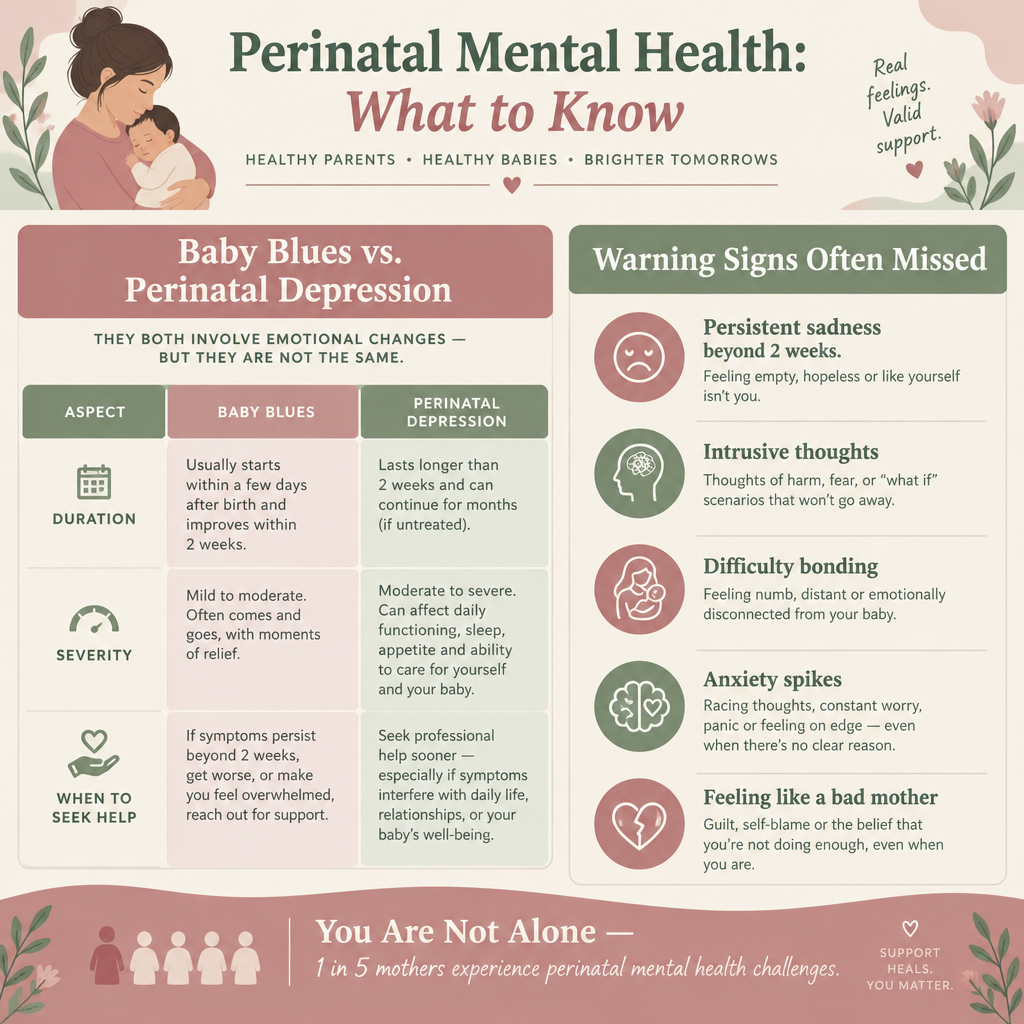
Perinatal depression is different in duration, severity, and trajectory. Rather than lifting, it persists or worsens. The sadness is heavier and less episodic. Feelings of inadequacy, worthlessness, or disconnection from the baby may emerge. It does not resolve without support or treatment.
The confusion between these two states is one of the most common reasons early warning signs go unaddressed. Women experiencing perinatal depression often wait, assuming they are just going through the baby blues. Weeks pass, and the symptoms do not lift. By the time it becomes clear that something more than adjustment is happening, significant suffering has accumulated — and the path to help feels harder to find.
How Common Is It Really?
The statistics on perinatal mental health are striking:
- 1 in 5 women experience depression or anxiety during the perinatal period, according to the American College of Obstetricians and Gynecologists (ACOG)
- 1 in 7 people will experience clinically significant perinatal depression specifically during pregnancy or within the first year after birth
- 1 in 10 men are also affected by perinatal depression or anxiety, according to Postpartum Support International — paternal perinatal mental health is significantly underrecognized
- Perinatal mental health conditions are the most common complication of pregnancy and the postpartum period
These numbers are almost certainly underestimates, given how few people are screened and how many never disclose their symptoms.
Who Is Most at Risk? Key Risk Factors
Perinatal depression and anxiety arise from a combination of biological, psychological, and social factors. No single risk factor is determinative, but several consistently emerge in the research as significant predictors.
Personal and Psychological History
The strongest predictor of perinatal mental health difficulties is a personal history of depression or anxiety, whether during a previous pregnancy or at any other point in life. Other psychological risk factors include personality disorders, previous pregnancy loss, infertility treatment history, and birth trauma in a prior delivery.
Social and Situational Factors
Social context plays a powerful role. Women with limited social support — whether due to geographical isolation, strained relationships, or the absence of an involved partner — are at substantially higher risk. Additional risk factors include relationship conflict or domestic violence, low socioeconomic status, financial stress, adolescent pregnancy, and unintended or ambivalently received pregnancies.
Biological and Perinatal Factors
Hormonal changes during and after pregnancy create significant biological vulnerability. The dramatic postpartum drop in estrogen and progesterone is one factor; thyroid dysfunction, a known contributor to mood disorders, is also more common in the perinatal period. Sleep deprivation, which is nearly universal in new parenthood, compounds all other vulnerabilities. Complications during pregnancy or delivery, difficulty breastfeeding, and a baby with health challenges or feeding difficulties also increase risk.
Symptoms to Watch For During and After Pregnancy
Recognizing symptoms early is the most effective intervention available. Here are the specific signs to watch for at two distinct stages.
During Pregnancy (Antenatal)
Perinatal depression and anxiety during pregnancy are often misattributed to normal pregnancy discomfort or hormonal shifts. Symptoms that warrant attention include:
- Persistent sadness or a feeling of emptiness that does not lift
- Excessive, uncontrollable worry about the health of the baby, the pregnancy, or the impending birth
- Difficulty concentrating, making decisions, or completing tasks
- Loss of interest in activities that previously brought enjoyment
- Sleep disturbances that exceed what is explained by physical discomfort
- Withdrawal from relationships or social contact
- Thoughts of self-harm or a sense that others would be better off without you
Research shows that anxiety during pregnancy is associated with adverse outcomes including preterm delivery, low birth weight, and elevated cortisol in the developing fetus. Early detection and support matter not only for the mother but for the baby’s development.
After Birth (Postnatal)
Postnatal symptoms often feel confusing because they can emerge alongside genuine love for the baby — making it harder to recognize them as symptoms at all. Watch for:
- Difficulty bonding with or feeling connected to the baby
- Overwhelming guilt, shame, or a sense of being a fundamentally inadequate parent
- Inability to sleep even when the baby sleeps, due to intrusive thoughts or anxiety
- Persistent irritability, anger, or rage (often underrecognized as a depression symptom)
- Feeling emotionally detached or disconnected, watching life from a distance
- Thoughts of harming yourself or, in rare cases, the baby
These are not signs of bad parenting. They are symptoms of a medical condition. The presence of dark or frightening thoughts is particularly important to disclose to a healthcare provider, because it is one of the most treated and resolved aspects of perinatal mental illness when addressed.
Why So Many Cases Go Undetected
The gap between how common perinatal mental health conditions are and how rarely they are identified is not an accident. Several forces converge to keep them invisible.
The Gratitude Trap
Pregnancy and new parenthood carry powerful social scripts about how people should feel: joyful, grateful, excited, fulfilled. When the actual experience diverges from this script, people often do not report it. The fear of being seen as ungrateful for a healthy pregnancy, or as not loving the baby enough, creates a powerful pressure toward silence. Many women describe months of suffering without mentioning it to anyone, including their closest family members.
Provider Gaps and Screening Failures
Despite clear recommendations from the American College of Obstetricians and Gynecologists (ACOG), the United States Preventive Services Task Force (USPSTF), and the American Academy of Pediatrics (AAP) for universal, repeated mental health screening throughout the perinatal period, implementation remains spotty. Obstetric appointments are time-pressured and focused on physical health metrics. Mental health screening is easily deprioritized. The result — documented in studies and clinical practice alike — is that most perinatal patients do not receive any formal assessment of their psychological wellbeing.
Stigma and Fear of Judgment
Many people do not disclose symptoms because they fear what disclosure might bring. Will a healthcare provider flag them to child protective services? Will a partner or family member view them differently? Will they be labeled mentally ill during a period when they are supposed to be competent and capable? This stigma is a real and documented barrier to care, and it falls disproportionately on people who already face social vulnerability.
How Partners, Family, and Friends Can Help
The people closest to someone in the perinatal period have a meaningful role in early recognition and support. Some practical approaches:
- Normalize struggling, not just celebrate milestones. Create space for honest answers to the question of how someone is really doing.
- Ask specific questions rather than open-ended ones: How have you been sleeping? Have you been able to eat? Are you feeling anxious? Specific questions are easier to answer honestly.
- Offer concrete help without waiting to be asked. Fatigue and overwhelm make it difficult to identify and articulate needs. Taking tasks over proactively is more useful than asking what is needed.
- Gently encourage professional support without judgment or pressure. Frame it as a normal part of perinatal care, not a sign that something has gone very wrong.
- Know that you may be affected too. Partners and fathers experience perinatal depression and anxiety at significant rates. If you are struggling, your experience is also valid and deserves support.
Getting Professional Help: What to Expect
The evidence for effective treatment of perinatal mental health conditions is strong. Several options are available, and many can be used in combination.
Cognitive Behavioral Therapy (CBT) has the largest and most consistent research base for perinatal depression and anxiety. A meta-analysis of 79 randomized trials found CBT significantly reduced depressive symptoms both in the short and long term. Online CBT is also effective, particularly in programs that are professionally guided and at least nine weeks in length.
Interpersonal Therapy (IPT) is a first-line option particularly suited to the relational and role-transition challenges that characterize the perinatal period. It addresses communication patterns, relationship conflict, grief, and the adjustment to new parenthood.
Medication is often safe and effective during pregnancy and postpartum. Many antidepressants, including SSRIs, have a well-established safety profile in the perinatal period. The risks of untreated depression — to both mother and baby — typically outweigh the risks of appropriately managed pharmacological treatment. A prescribing physician or psychiatrist specializing in women’s mental health can provide individualized guidance.
The Edinburgh Postnatal Depression Scale (EPDS) is a brief, validated 10-item questionnaire that can be completed in minutes and provides a reliable initial screen for depression during pregnancy and postpartum. It is widely available online and can be a useful first step in recognizing whether professional consultation is warranted.
Postpartum Support International (postpartum.net) maintains a helpline, a directory of trained providers, and peer support groups for people affected by perinatal mental health conditions — including partners and fathers.
Conclusion
Perinatal depression and anxiety are not rare edge cases. They are among the most common complications of pregnancy and early parenthood, affecting up to 1 in 5 people — and a significant proportion of their partners too. They are underreported, underscreened, and undertreated. And yet they are also, with proper recognition and support, highly treatable.
The most important thing anyone can do — as a person going through the perinatal period, a partner, a family member, a friend, or a healthcare provider — is to take psychological wellbeing as seriously as physical health during this transition. Ask the question. Notice the signs. And do not wait for the symptoms to become a crisis before reaching out for help.
Sources
Perinatal Mental Health Concerns Are Underreported — Psychology Today