Why the Life You Didn't Choose Always Looks Better — The Science of Counterfactual Thinking
Have you ever caught yourself thinking about the career you didn't pursue, the relationship you walked away from, or the city you never moved to — and felt, with quiet certainty, that life would have been better there? Most of us carry a vivid mental image of the life we didn't live, and that image tends to look remarkably appealing. But here's what psychology has to say: the life you didn't choose isn't better. It's simply untested. And that is a very different thing.
The Imagined Life That Was Never Tested by Reality
The unchosen life has an enormous unfair advantage over the one you're actually living: it has never had to face reality. It hasn't disappointed you, hurt you, exposed your limitations, become boring, or developed the ordinary difficulties that accompany every real existence. When you imagine the career you didn't pursue, you see it in its most idealized form — the creative freedom, the status, the sense of purpose. You don't see the difficult colleagues, the tedious tasks, the moments of self-doubt, the slow weeks, the burnout. That other career has been protected from all of that.
Positive psychologist Dr. Itai Ivtzan compares the imagined life to a honeymoon. A honeymoon is a beautiful, promise-filled experience — but it precedes the real work of marriage. When we romanticize the unchosen alternative, we are perpetually honeymooning with a relationship that never had to grow up. We compare our full, complex, sometimes messy lived reality to an idealized fantasy that was never put to the test. This is not a fair comparison — and it is not a contest our real life can win.
What Is Counterfactual Thinking? The Psychology Behind 'What If'
The psychological term for this pattern is counterfactual thinking — the mind's ability to imagine how the past might have unfolded differently. First formally described by psychologist Neal Roese in his landmark 1997 paper in Psychological Bulletin, counterfactual thinking refers to the mental simulations we run when we think 'if only' or 'what if.' These thoughts are not signs of weakness or irrationality. They are a natural feature of human cognition — one that evolved because imagining alternative outcomes helps us learn from the past and make better decisions in the future.
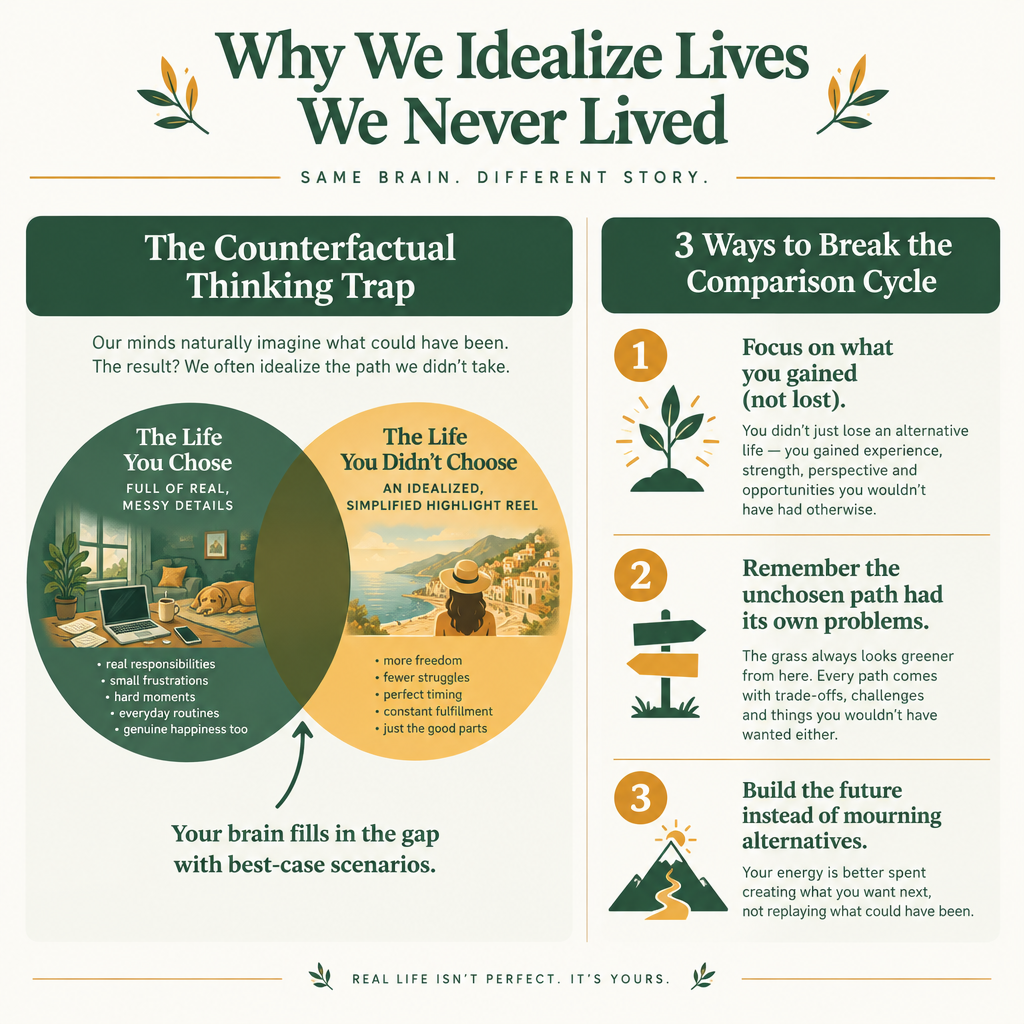
Psychologists distinguish between two types. Upward counterfactuals involve imagining a better alternative to what actually happened — and they typically produce regret and dissatisfaction. Downward counterfactuals involve imagining a worse alternative — and they produce relief and gratitude. Most of us default to upward counterfactual thinking: we imagine how things could have been better, not worse. Regret, research shows, is fundamentally a counterfactual emotion — it literally cannot exist without a prior mental image of an alternative that would have been better.
When 'What If' Becomes a Trap
Counterfactual thinking becomes problematic when it shifts from an occasional tool for reflection into a habitual mode of perception. Research shows that excessive upward counterfactual thinking is strongly linked to anxiety, depression, and chronic dissatisfaction. There is also a self-reinforcing quality: entertaining counterfactual alternatives actually changes our preferences over time. The more we imagine an unchosen alternative, the more attractive it becomes — and the more our actual choice suffers by comparison.
Why Unchosen Paths Always Seem to Lead Somewhere Better
The tendency to idealize what we don't have is so pervasive that psychologists have given it a name: Grass Is Greener Syndrome. It operates through several interlocking mechanisms. Leon Festinger's social comparison theory tells us that human beings evaluate their own situation in relation to perceived alternatives — when we see someone thriving in the career we didn't choose, we automatically benchmark our experience against theirs. Meanwhile, hedonic adaptation means that even genuinely good choices lose their novelty over time, while the imagined alternative stays perpetually fresh and exciting.
There are four key reasons the unchosen life always looks better:
- It has never been subjected to the test of reality
- Memory selectively preserves the appealing aspects of alternatives we've glimpsed
- Social comparison constantly primes us to notice others seeming to thrive
- Hedonic adaptation makes our current reality seem ordinary while the alternative seems fresh
None of these are reasons to conclude that the alternative would actually be better. They are cognitive mechanisms that systematically bias our perception — and awareness of them is the beginning of recalibration.
How Divided Commitment Quietly Drains Your Energy and Potential
Here is one of the most practically important insights in this area: you can make a decision without being genuinely committed to it. The decision and the commitment are not the same thing. Many of us have chosen our job, our partner, our city — but we hold that choice loosely. We keep one eye on the exit, maintain a mental escape route, and fantasize about alternatives. This internal division may feel harmless, but it has a real and significant cost.
When part of your psychological energy is directed toward an imagined alternative, it is not available for your actual life. The energy that could be building intimacy in your relationship, developing mastery in your career, or deepening your sense of belonging is instead directed toward a life that doesn't exist. Think of it as driving with one foot on the accelerator and one foot on the brake. The car moves, but slowly, and with friction. The problem isn't the car — it's the divided input.
The Hidden Cost of Keeping Your Options Open
There is a widely held belief that keeping your options open is always wise. But in long-term commitments — relationships, careers, creative projects — keeping all paths perpetually open prevents depth. Mastery in a skill, intimacy in a relationship, belonging in a community — these things only develop through sustained, focused investment. There is a beautiful paradox here: the people who seem freest are often those who have made the clearest commitments. Freedom does not come from keeping every option open. It comes from being so fully invested in what you have chosen that the alternatives simply stop mattering.
The Gardening Metaphor — What Happens When You Water the Wrong Garden
Dr. Ivtzan offers a metaphor that is as simple as it is illuminating. Imagine you have planted yourself in a garden. Every day, you carry water — the water of your attention, energy, care, and emotional investment. But instead of pouring all of it into the garden where you are planted, you carry half of it to gardens that exist only in your imagination. Over time, your real garden looks dry. You interpret this as confirmation that you planted yourself in the wrong place.
But look at the watering pattern. The real garden is dry not because it is the wrong garden — it is dry because you have been underwatering it. The imaginary gardens, meanwhile, stay forever lush and green in your mind, because imagination imposes no drought. The only way to know whether your garden is right for you is to water it fully. Not partially, not with one eye on the fence, but completely.
What Full Investment Actually Looks Like — and What It Reveals
Full investment is not the same as blind loyalty. It means bringing your complete self — your full attention, energy, and care — to the life you have actually chosen. Crucially, it includes consciously accepting the disadvantages of your choice as part of the package. Every real choice comes with trade-offs. The question is whether you have genuinely accepted those trade-offs or whether you are still fighting them internally.
Dr. Ivtzan writes about his own transition from academic psychology to entrepreneurship. The new path brought independence, creative freedom, and financial possibility. But it also brought real losses — distance from his community of colleagues and the end of research collaborations that had produced so much insight. The key was making a conscious choice to accept both the advantages and the disadvantages. Not to pretend the losses weren't real, but to consciously include them in what he was choosing.
Signs that you are fully invested in a choice:
- You bring your full attention without regularly drifting mentally to alternatives
- You have identified and consciously accepted the disadvantages of your choice
- When challenges arise, you approach them as problems to solve rather than evidence you chose wrong
- You feel a sense of ownership over both the successes and the difficulties
- You rarely wonder 'what if I had chosen differently' in a way that undermines your present engagement
Signs that you are mentally half-in:
- Frequent, absorbing fantasies about the unchosen alternative
- Interpreting ordinary difficulties as proof of the wrong choice
- Emotional detachment from the people or work in your current life
- A chronic sense that real life is happening somewhere else
How to Embrace Trade-offs Without Regret
Every real choice contains trade-offs. This is not a failure of the choice — it is the nature of reality. To choose one path is always to not choose the others. The unchosen paths appear trade-off-free only because they were never lived. There is an important distinction between making a decision and making a commitment. A decision is the act of choosing at a particular moment. A commitment is the ongoing, daily act of re-choosing — of pouring your water into the garden where you are planted, even when the imaginary gardens look appealing.
Practical Strategies to Stop Living in Imagined Alternatives
If you recognize yourself in the patterns described above, these strategies can help redirect your energy from imagined alternatives to your actual life:
- Name and specify your imagined life. Write it down in concrete detail. What would your ordinary Tuesday afternoons look like? What would the trade-offs be? Specificity often deflates the mystique of the alternative by making it real enough to be imperfect.
- Apply equal scrutiny to both paths. Ask yourself: if I had chosen the alternative, what would the difficulties have been? What would I have lost? Give the imagined path the same realistic treatment you give your real one.
- Catch and redirect the water. When you notice your attention drifting to imagined alternatives, acknowledge it — then deliberately redirect it. Ask: what in my actual life deserves this energy right now?
- Write a conscious acceptance of your trade-offs. List what you have consciously given up by making your current choice. Acknowledge these losses genuinely — then write that you accept them as part of what you have chosen.
- Pursue depth over novelty. Instead of seeking the excitement of a new alternative, invest in going deeper in what you already have. Depth in relationships, skills, and creative work produces a richer satisfaction than novelty.
- Use mindfulness to return to the present. Counterfactual thinking is always oriented toward the past or the imagined future. The present moment is the only place where your actual life is happening.
Why Closing a Door Can Be the Most Liberating Choice You Make
There is a counterintuitive truth at the heart of this: closing a door can be an act of liberation, not loss. When we keep all options open, we divide ourselves across possibilities. We are never fully anywhere. The accumulation of open doors does not produce freedom — it produces a particular kind of paralysis, the paralysis of the perpetually undecided.
Closing a door is not giving up. It is choosing depth over breadth, commitment over optionality, presence over fantasy. It is the act of saying: this is the garden where I am planting myself, and I will water it fully. And only when we do that can we discover what our actual life is truly capable of producing. As Dr. Ivtzan asks: 'If you don't offer your full energy, care, intimacy, and heart to the thing you have chosen, how will you ever know whether or not it is right for you?' The answer is that you won't. The only way to know is to fully commit — to stop carrying water to imaginary gardens and start pouring all of it into the real one.
Sources
The Life You Never Chose Always Looks Better — Psychology Today