How Perspective-Taking Makes Kids Better Friends — and Two Benefits Research Confirms
Summer changes the social landscape for children in ways that school doesn't. There are no assigned seats, no classroom rules, no structured group time. The friendships that form — and survive — over the next few months will be shaped almost entirely by how children navigate unscripted moments: who to play with, what to do when someone gets left out, how to handle a friend who says something hurtful.
The single most important social skill for navigating all of this is one that most children aren't directly taught: perspective-taking. You can't teach your child to make friends. But you can teach them to think like one. New research published in Psychology Today by Pamela D. Brown, Ph.D. identifies two specific friendship benefits that perspective-taking reliably produces — along with practical ways parents can build this skill through everyday conversations.
What Is Perspective-Taking and Why Does It Matter for Friendship?
Perspective-taking is the cognitive ability to understand that other people have different thoughts, feelings, beliefs, and intentions than your own. It's the mental act of stepping into someone else's shoes — not just emotionally, but intellectually.
Developmentally, children begin to show early forms of perspective-taking around age 4, when they start to understand that other people don't automatically know what they know or feel what they feel. This is connected to what psychologists call theory of mind — the recognition that other people have inner mental states that may differ from your own. This milestone is crucial for friendship: a child who doesn't yet understand that others have their own inner experiences will struggle to navigate the most basic social dynamics: sharing, cooperating, taking turns, repairing a conflict.
How Perspective-Taking Differs From Empathy
Perspective-taking and empathy are related but distinct. Perspective-taking is primarily cognitive: it's about understanding someone else's point of view. You can engage in perspective-taking analytically, even without feeling anything particularly strong. Empathy adds an emotional layer: it's the felt sense of connecting to someone else's experience.
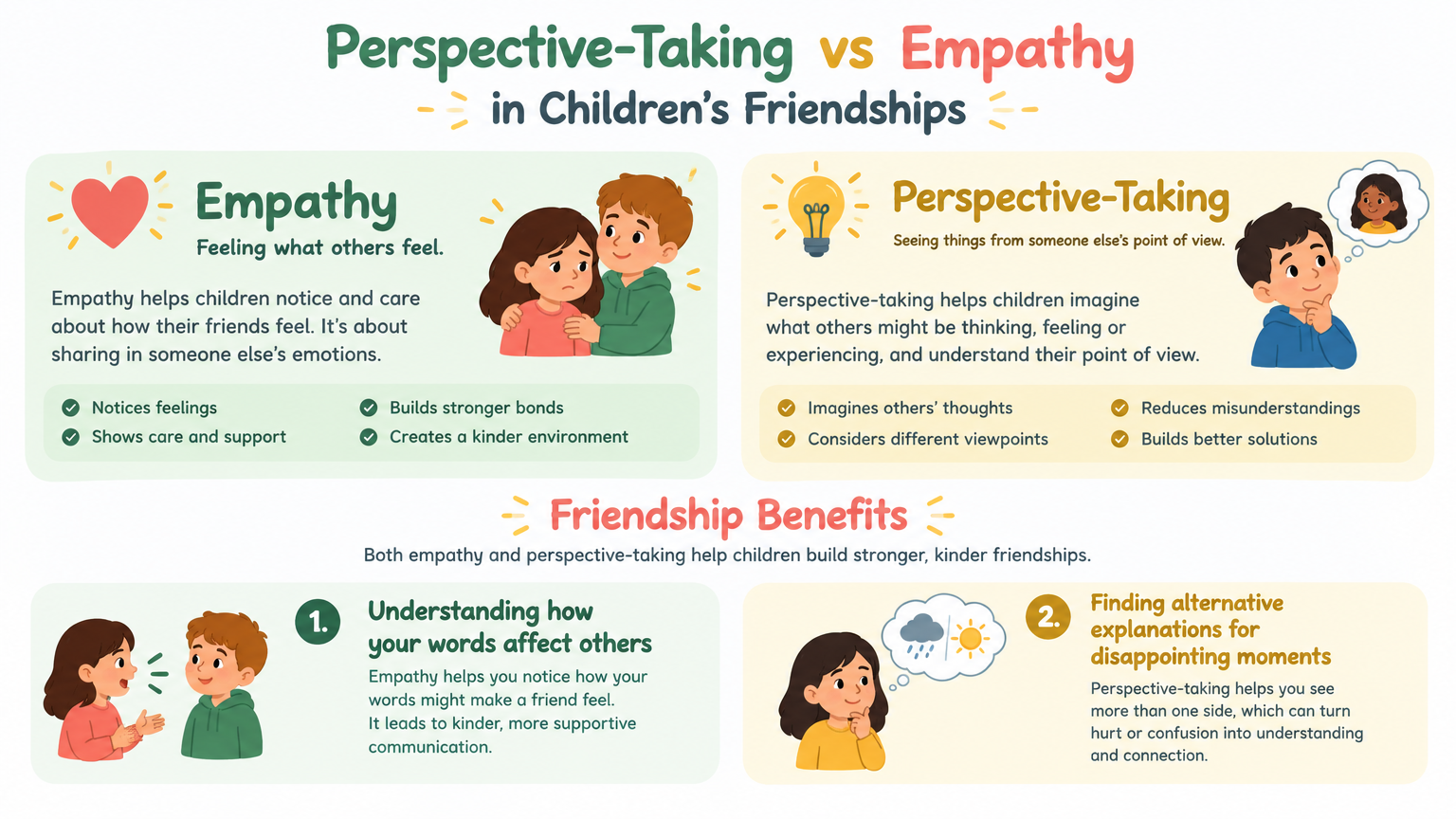
In practice, perspective-taking often leads to empathy — when you genuinely understand what another person is going through, you tend to feel something about it. But for teaching purposes, the cognitive route is more accessible, especially for children who are still developing emotional regulation. You're not asking them to feel something on command. You're asking them to think — which is a more tractable ask, and one that builds the cognitive infrastructure for empathy over time.
Friendship Benefit 1 — Understanding How Your Words and Actions Affect Others
The most common source of social conflict in childhood isn't cruelty. It's thoughtlessness. Children say things without thinking about how they'll land. They act on impulse without considering what someone else might need.
Perspective-taking introduces a mental pause in the social interaction loop. Before speaking or acting, a child who has practiced perspective-taking has a habit of briefly considering: how might this land for them? Children who develop this habit become measurably better friends. Research consistently shows that children with stronger perspective-taking skills have more positive peer interactions, cooperate more readily, help others more frequently, and form friendships that are more trusting and durable. They're also less likely to engage in reactive aggression — the kind of lashing out that happens when a child misreads a neutral situation as hostile.
Teaching This Skill Through Everyday Conversations
The most effective teaching moments aren't formal lessons — they're the comment you make after a basketball game, the question you ask at dinner after a conflict at school, the pause you take during a TV show to ask what a character might be feeling.
Dr. Brown uses the NBA Finals as an example: after watching a game together, a parent can ask, How do you think the losing team is feeling right now? What do you think the winning team is thinking? This isn't a moral lesson. It's a curiosity practice — an invitation to think about other people's inner experience as a natural part of observing the world.
Simple Questions That Build Perspective-Taking
- How do you think that made them feel?
- What do you think was going through their head when that happened?
- If you were them, what would you be thinking right now?
- What do you think they needed in that moment?
- Did they mean to do that, or might something else have been going on?
Friendship Benefit 2 — Considering Alternative Explanations for Disappointing Experiences
Children who have not developed perspective-taking tend to interpret social disappointments through what psychologists call the hostile attribution bias — the default assumption that when something bad happens to them, it was done intentionally and with negative intent.
- A friend didn't wave back in the hallway — she's ignoring me on purpose.
- A classmate didn't save them a seat — he doesn't want to sit with me.
- Someone laughed after they tripped — they were laughing at me.
Hostile attribution bias is developmentally normal in young children. But without intervention, it persists and causes enormous damage to friendships. Perspective-taking is the antidote: when a child can imagine the other person's internal state, they gain access to a wider range of explanations. Maybe she didn't see me. Maybe he was already sitting with someone. Maybe they were laughing at something they were already thinking about, not at me.
Helping Children Handle Disappointment Without Jumping to Conclusions
You can teach this process explicitly using a simple three-step conversation:
- What happened? — describe the event neutrally
- What's the first explanation that came to mind? — validate whatever they say
- What's another possible explanation — one where that person wasn't trying to hurt you?
When a child can generate even one alternative explanation, the emotional spike of reactive anger tends to soften. They don't disappear into denial — they just gain enough distance to choose a response rather than react automatically. A child who practices this at 8 will navigate social disappointment very differently at 13, and again at 23.
Why Small Conversations Lead to Big Changes in Friendships
Research in developmental psychology consistently finds that children whose caregivers regularly discuss emotions and encourage perspective-taking develop significantly stronger prosocial skills. A five-minute conversation after a basketball game is more valuable than a 30-minute structured lesson. The reason is context: when you help a child think about someone else's perspective in a real experience — not an abstract one — the learning sticks.
The compounding effect matters most. One conversation doesn't produce a fundamentally more empathetic child. But daily micro-conversations, over months, build a mental habit that rewires how a child interprets social situations. By the following school year, the child who has been having these conversations routinely will be noticeably different in how they navigate peer dynamics.
When to Use These Conversations
- After a social conflict or disappointment, once the child has calmed down
- When watching a sports event, movie, or TV show together
- During reading time: how do you think the character felt when...?
- After sibling conflicts, once everyone is regulated
- In the car on the way home from a playdate or activity
- During dinner, reflecting on something that happened that day
The Bottom Line: Perspective-Taking Is a Skill That Grows With Practice
The children who are easiest to be friends with aren't necessarily the most outgoing or popular. They're the ones who make other children feel seen. Who notice when someone is uncomfortable. Who can recover from a social disappointment without burning down the friendship. Who can hear something hurtful and wonder — at least for a moment — whether the other person meant it.
These are perspective-taking skills. And they're learnable — not through worksheets or formal programs, but through the steady practice of good questions in everyday moments. This summer, you don't need a curriculum. You need one question after the game. One question after the playdate. One question after the disappointment. The child who learns to think like a friend will find it much easier to keep one.