
Working Long Hours Is Making You Heavier — What New Research Reveals About Overwork and Obesity
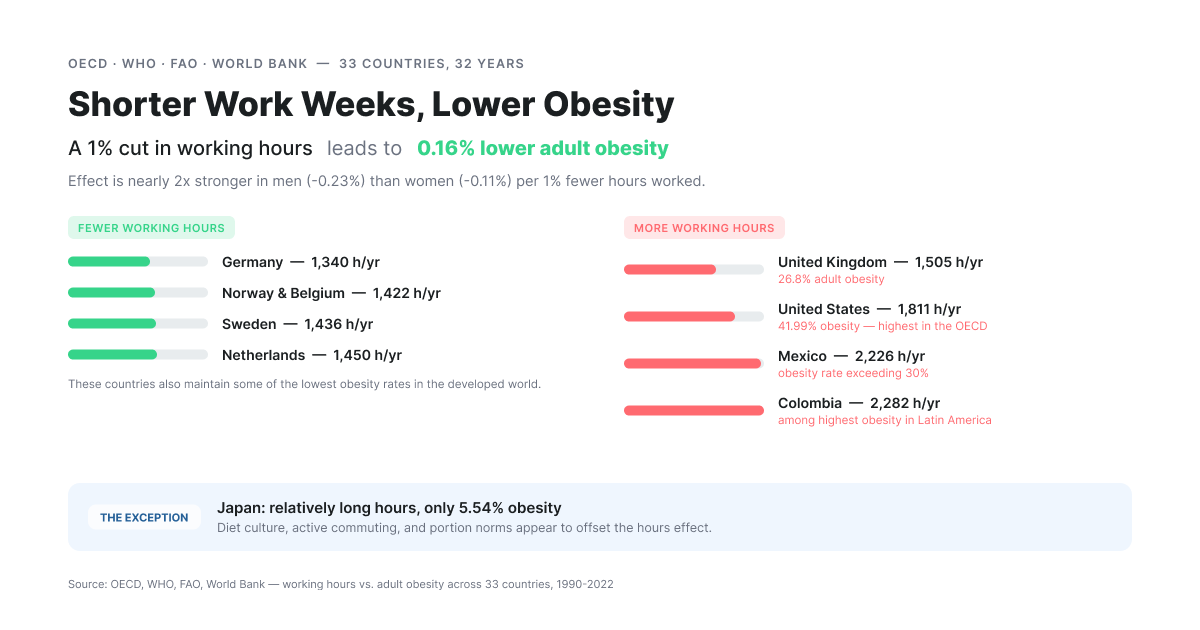
You already know that working too much is bad for your mental health, your relationships, and your sleep. But a major new study presented at the European Congress on Obesity (ECO 2026) reveals something that rarely comes up in conversations about overwork: long working hours are systematically linked to higher obesity rates — and the mechanism has nothing to do with individual willpower or what you choose to eat. Analyzing data from 33 OECD countries over three decades, researchers found that a 1% reduction in annual working hours is associated with a 0.16% decrease in obesity rates across whole populations. That is a structural connection, not a lifestyle one. And it changes what the conversation about weight should look like.
The Workplace Factor No One Is Talking About in the Obesity Crisis
Public health research on obesity has overwhelmingly focused on dietary patterns, calorie intake, and individual behaviour. But the new study, led by Dr. Pradeepa Korale-Gedara of the University of Queensland, Brisbane, highlights a striking paradox: at the national level, energy and fat intake are not well correlated with obesity rates.
Latin American OECD countries, for example, report far lower energy and fat intake than European nations such as Norway, Spain, France, Denmark, and Austria — yet the Latin American countries have significantly higher rates of obesity. If calories were the primary driver, this pattern would not exist. The study points instead to structural and time-based factors: how much people work, how much time they have left for movement and cooking, and how much chronic stress their jobs impose on their bodies.
The Data: How Working Hours Correlate With Obesity Across OECD Nations
Using data from the OECD, WHO, FAO, and the World Bank, the researchers found a clear, consistent relationship between working hours and obesity across 33 countries over 32 years. The headline figure: a 1% reduction in annual working hours is associated with a 0.16% decrease in adult obesity rates across whole populations.
The effect is stronger in men (0.23% reduction in obesity per 1% reduction in hours) than in women (0.11%), possibly reflecting differences in types of work, stress responses, and access to flexible arrangements.
In 2022, the countries with the lowest annual working hours were
- Germany (1,340),
- Norway (1,422),
- Belgium (1,422),
- Sweden (1,436),
- and the Netherlands (1,450).
These countries also maintain some of the lowest obesity rates in the developed world.
Meanwhile:
- United States: 1,811 hours/year — 41.99% adult obesity rate, the highest in the OECD
- Colombia: 2,282 hours/year — among the highest obesity rates in Latin America
- Mexico: 2,226 hours/year — obesity rate exceeding 30%
- Japan: Relatively long hours but low obesity (5.54%) — a notable exception driven by diet culture, active commuting, and portion norms
- UK: 1,505 hours/year — obesity rate of 26.8%, between European and US extremes
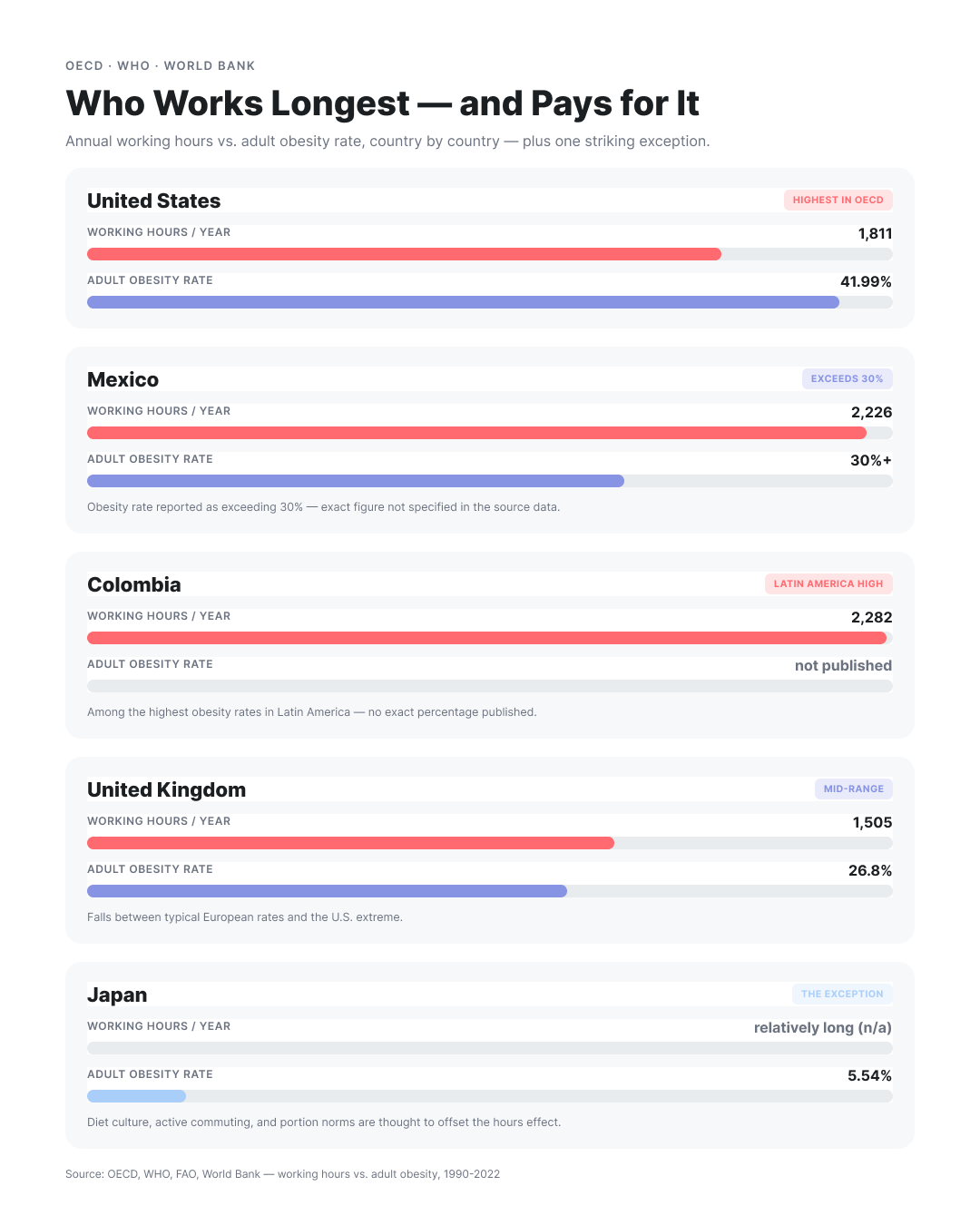
The researchers note this is correlation, not simple causation. GDP, urbanisation, and cultural food environments all play roles. But the working hours relationship is statistically robust across the full dataset and consistent across multiple time periods.
The Biological Mechanisms: What Overwork Does to Your Body
The Stress-Cortisol-Fat Triangle
Chronic work stress triggers the body's HPA (hypothalamic-pituitary-adrenal) axis, releasing cortisol as the primary stress hormone. In short bursts, cortisol is adaptive. Sustained over months and years of overwork, however, chronically elevated cortisol has profoundly damaging metabolic effects: it promotes abdominal fat storage, increases cravings for high-calorie foods, and disrupts insulin sensitivity. In people under sustained occupational stress, the HPA axis never fully resets — the stress system stays partially activated even during rest, continuously priming the body to store energy as fat rather than burn it.
No Time to Move
After a 10-hour workday, most people have no meaningful time or energy left for intentional exercise. Research consistently shows that overworked individuals accumulate significantly less NEAT (non-exercise activity thermogenesis) — the movement generated by everyday activities like walking, taking stairs, and doing household tasks. Add a long commute to a long workday, and total daily movement plummets to levels comparable to a sedentary lifestyle even for people who nominally value fitness.
The Convenience Food Trap
Time poverty — having too little discretionary time because work has consumed it — is one of the most consistent predictors of poor dietary quality. When there is no time to shop, cook, or eat slowly, ultra-processed, energy-dense convenience foods become the default. Fast food, delivery apps, and packaged snacks are engineered for time-starved people. Overworked people eat this way not because they lack nutritional knowledge but because their time has been used up.
Country-by-Country Comparison: Who Works the Most, Who Weighs the Most
Countries with the shortest working hours cluster in Northern and Western Europe, where adult obesity rates are generally well below 25%. The five lowest-hours countries in 2022 — Germany, Norway, Belgium, Sweden, and the Netherlands — all fall within this group. At the other extreme, the five highest-hours countries — Colombia, Mexico, Costa Rica, Chile, and Israel — several have obesity rates exceeding 30%, despite consuming fewer total calories and less dietary fat than European counterparts. Japan remains the most frequently cited exception: long working hours but 5.54% obesity, attributed to portion culture, traditional diet, and active commuting — systemic habits embedded in culture rather than individual choices.
The Role of GDP, Urbanisation, and Food Environment
The study found additional structural factors influencing national obesity rates. A 1% increase in GDP per capita was associated with a 0.112% reduction in obesity — higher income enables food choice, leisure time, and preventive healthcare. Urbanisation offers a small protective role: a 1% increase in urban population was associated with a 0.02% decrease in obesity, reflecting walkable cities, active transit, and food variety. Perhaps most counterintuitively, higher food prices were associated with lower obesity rates — because when ultra-processed foods are cheap and whole foods are expensive, processed food dominates. The study underlines that structural interventions outperform individual behaviour change campaigns.
What Employers Can Do: Evidence-Based Workplace Policies
The study's authors call for coordinated policy responses extending beyond individual behaviour change, with employers as a central actor. Here are six evidence-based interventions the research supports:
- Shorter working hours and four-day workweek pilots: Countries and companies that have trialled reduced hours consistently report improved health outcomes alongside maintained productivity.
- Flexible working arrangements: Flexibility creates time for active commuting, cooking, and movement that rigid hours eliminate.
- Enhanced leave entitlements: Mandatory minimum vacation use ensures workers actually recover. European countries with enforced leave show lower obesity rates than those where leave goes unused.
- On-site or subsidised healthy food: When the default workplace food is nutritious, employees eat better without decision fatigue. Replacing vending machines with healthier options shows measurable impact.
- Movement-integrated workplaces: Standing desks, walking meetings, cycling storage, and employer fitness subsidies increase daily activity without requiring extra time.
- Disconnection norms: After-hours email culture keeps cortisol elevated long after the workday ends. Setting and enforcing disconnection norms is a high-leverage, low-cost intervention.
Personal Strategies When You Cannot Change Your Work Hours
Not everyone can change their working hours. For individuals navigating high-demand jobs, here are evidence-based personal strategies:
- Weekend meal preparation: Two hours on Sunday can supply nutritious meals for four to five weeknights, eliminating the time pressure that drives convenience food reliance.
- Active commuting: Walking, cycling, or getting off transit early adds meaningful daily movement without additional time allocation.
- Hourly movement breaks: Five minutes of movement per hour adds over 40 minutes of daily activity and measurably improves metabolic outcomes versus prolonged sitting.
- Sleep prioritisation: Seven to eight hours is a metabolic requirement, not a luxury. Sleep deprivation directly disrupts leptin and ghrelin, driving hunger and slowing metabolism.
- Healthy default foods at home: If the easiest food available is nutritious, willpower is not needed. Stock ready-to-eat options: cut vegetables, boiled eggs, whole fruits, nuts.
- Movement during lunch breaks: A 15-minute walk reduces cortisol, improves afternoon focus, and adds meaningful activity to an otherwise sedentary workday.
The Systemic Problem: Why Individual Effort Is Not Enough
The ECO 2026 study explicitly states the findings underscore the need for policy responses that extend beyond individual behaviour change. If overwork is a structural driver of obesity — operating through time poverty, chronic stress, and food environment — then individual advice to eat less and move more addresses the symptom, not the cause. The policy agenda includes labour market reform, urban design supporting active transportation, food system governance making nutritious food the affordable default, and workplace cultures treating employee health as organisational responsibility. The business case is also clear: overworked employees cost more in healthcare, absenteeism, presenteeism, and turnover. Reasonable working hours are not just a health intervention — they are a sound investment.
Conclusion
The data from 33 countries over 32 years is clear: where people work fewer hours, fewer people are obese. Not because shorter hours make people choose salads over fast food — but because they create the time, reduce the stress, and restore the metabolic conditions that make healthy living structurally possible. Obesity is not simply a failure of individual discipline. It is, in significant part, an output of economic and labour systems that have prioritised productivity at the cost of human wellbeing. Whether you are an employee, a manager, or a policymaker, this research points in one direction: we need to build systems where healthy lives are not just individually possible, but structurally supported.
Sources
News-Medical.net — Longer working hours linked to rising obesity across OECD countries