GLP-1 Drugs and Vision Loss Risk: What the FDA's New Safety Warning Means for You
The FDA's new GLP-1 safety warning covers NAION, a rare but serious eye condition. Here's what the evidence shows, who is most at risk, and what to do if you're on one of these medications.
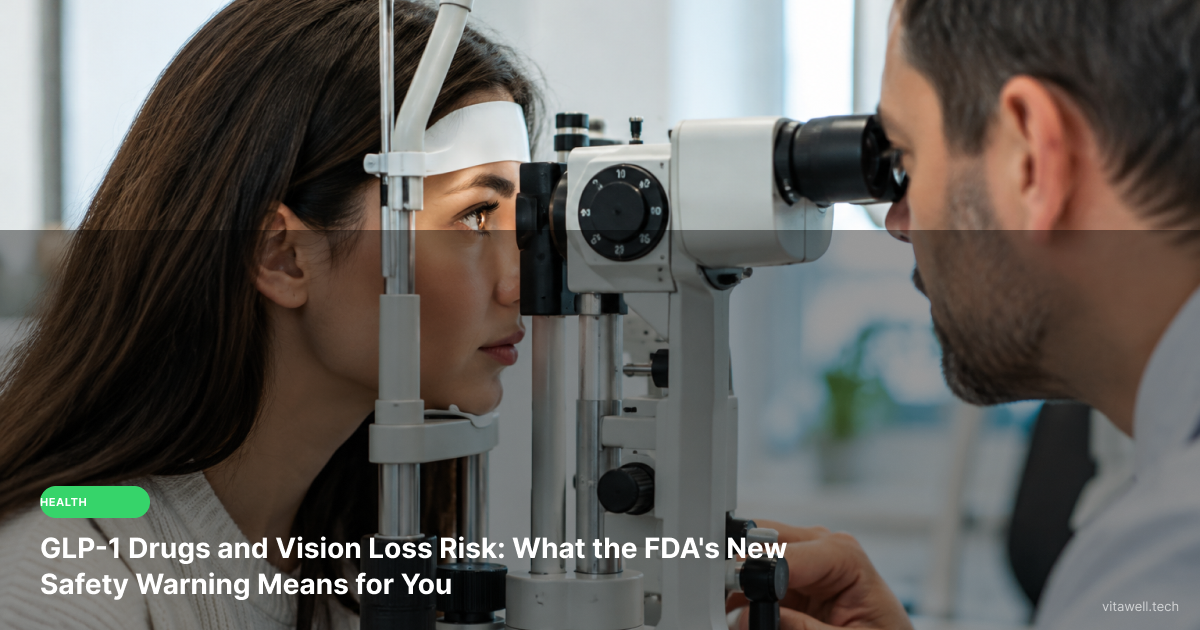
On November 9, 2026, the FDA required all GLP-1 receptor agonist medications — including Ozempic, Wegovy, Mounjaro, and Zepbound — to add a warning about nonarteritic anterior ischemic optic neuropathy (NAION), a rare but potentially permanent form of vision loss caused by insufficient blood flow to the optic nerve. A meta-analysis of 126 randomized controlled trials covering 134,253 patients found GLP-1 users face approximately 6.4 NAION events per 100,000 person-years versus 3.8 per 100,000 on placebo — an increase that is real but rare, per Ophthalmology Times' report on the FDA's decision. The FDA's conclusion is that the benefits of these medications continue to outweigh their risks when used as directed; however, knowing who faces the greatest risk and what symptoms demand immediate action is now essential for every GLP-1 user.
Key Takeaways
- FDA mandated NAION warning on all GLP-1 drugs after reviewing 126 clinical trials (134,253 patients) and multiple large observational studies
- NAION causes sudden, painless vision loss from optic nerve ischemia; 70–80% of patients first notice it upon waking
- Clinical trial meta-analysis found 6.4 NAION cases per 100,000 person-years on GLP-1s versus 3.8 per 100,000 on placebo
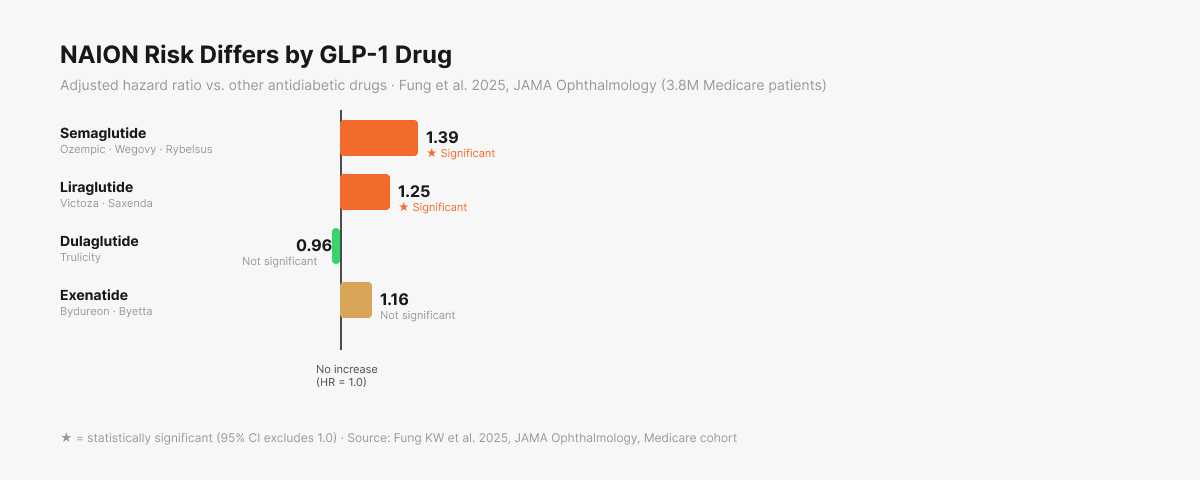
- Risk is not equal across all GLP-1 drugs: semaglutide showed a statistically significant hazard ratio of 1.39; dulaglutide showed no significant increase (HR 0.96)
- Sudden vision changes while on a GLP-1 require same-day ophthalmology care — NAION has no proven treatment once established
What Just Changed: The FDA's November 2026 Decision
The FDA Drug Safety Communication dated November 9, 2026 mandates that every manufacturer of a GLP-1 receptor agonist update its Warnings and Precautions section to include the possibility of NAION. The affected drugs span the entire class: semaglutide (Ozempic, Wegovy, Rybelsus), liraglutide (Victoza, Saxenda), dulaglutide (Trulicity), exenatide (Bydureon), tirzepatide (Mounjaro, Zepbound), and orforglipron (Foundayo, approved earlier in 2026).
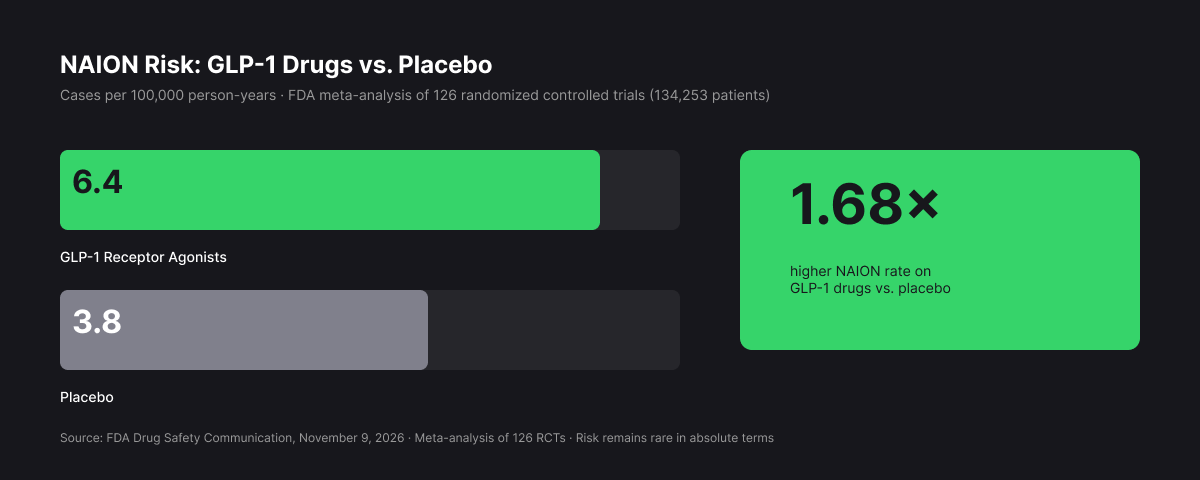
The decision followed what the FDA described as a totality-of-evidence review across six data streams, the largest of which was a meta-analysis of 126 randomized controlled trials encompassing 134,253 patients and 288,879 person-years of exposure. That analysis found 10 NAION events in GLP-1-treated patients, 5 in the placebo arm, and zero in patients on other glucose-lowering agents — yielding rates of 6.4 versus 3.8 per 100,000 person-years. The formal review was triggered by a 2024 retrospective study from Mass Eye and Ear published in JAMA Ophthalmology. This signal had already reached regulators worldwide: the European Medicines Agency's Pharmacovigilance Risk Assessment Committee labeled semaglutide-associated NAION "very rare" (up to 1 in 10,000 users) in June 2025, the UK's MHRA followed in February 2026, and Australia's TGA acted similarly.
Approximately 15 million Americans currently use GLP-1 medications (Healthline), making this one of the most consequential drug-safety updates in recent memory, even if the absolute risk remains small. To understand the other known benefits and risks of GLP-1 medications, GLP-1 medications and reproductive health reviews the research on how these drugs affect fertility.
What Is NAION — and Why GLP-1 Users Should Know
NAION stands for nonarteritic anterior ischemic optic neuropathy. It occurs when inadequate blood flow reaches the optic nerve head — the point where the optic nerve exits the eye — causing ischemic damage and permanent loss of nerve fibers. Unlike glaucoma or macular degeneration, NAION arrives abruptly, without pain, and without warning.
The hallmark symptoms include sudden vision loss in one eye (rarely both simultaneously), an inferior visual field defect (the lower portion of vision goes dark first), blind spots, and blurred or dimmed vision. According to StatPearls, 70–80% of people first notice the vision loss upon waking in the morning, when blood pressure is at its lowest overnight nadir and optic nerve perfusion is most vulnerable.
The natural history is sobering: no proven treatment reverses established NAION. Approximately 40% of patients remain stable; a portion experience modest spontaneous recovery, while some deteriorate further. Because each optic nerve fiber lost is permanent, early recognition and ophthalmology referral matter — not to treat what has already occurred, but to protect the other eye and address modifiable risk factors.
The FDA places background NAION incidence at 2.3 to 10.2 cases per 100,000 persons per year in adults over 50. The GLP-1 signal sits above that background but within the same general order of magnitude — context that matters when weighing treatment decisions.
The Evidence Behind the Warning: What Studies Actually Found
The Study That Started It — Hathaway et al. 2024, JAMA Ophthalmology
The study that set the FDA's review in motion was a retrospective cohort analysis by researchers at Massachusetts Eye and Ear, published in JAMA Ophthalmology in 2024. It compared patients with type 2 diabetes or overweight/obesity who were prescribed semaglutide against those prescribed non-GLP-1 diabetes or weight-loss medications. Among patients with type 2 diabetes, the hazard ratio for NAION was 4.28 versus the comparator group; among those who were overweight or obese, the hazard ratio reached 7.64. These are striking figures, though the study was limited by relatively small case numbers and by the inherent difficulty of fully controlling for the metabolic conditions that themselves raise NAION risk. Those limitations are precisely why the FDA reviewed multiple additional data streams before reaching a regulatory decision.
The Largest Dataset Yet — Fung et al. 2025, NIH/Medicare Cohort
The most comprehensive observational analysis to date came from a team at the National Library of Medicine, NIH, using Medicare data on 3,845,171 adults aged 65 or older with type 2 diabetes followed from 2007 to 2021. The study, published in Fung et al. 2025, JAMA Ophthalmology, found that among the 579,589 patients prescribed any GLP-1 receptor agonist, the adjusted hazard ratio for NAION was 1.15 (95% CI 1.04–1.27) compared to other second-line antidiabetic drugs. At the individual-drug level, the picture diverged: semaglutide users (n=188,922) experienced a hazard ratio of 1.39 (95% CI 1.13–1.72) with 168 NAION cases, while dulaglutide users showed a hazard ratio of 0.96 (95% CI 0.81–1.14) — statistically indistinguishable from baseline risk. This drug-to-drug differentiation within the GLP-1 class is a finding most news coverage has not highlighted.
FDA's Sentinel Real-World Analysis
The FDA's Sentinel database analysis followed adults with type 2 diabetes who started a GLP-1 receptor agonist, an SGLT-2 inhibitor (a different class of diabetes medication), or a DPP-4 inhibitor between 2019 and 2024. The crude NAION incidence ranged from roughly 26 to 32 per 100,000 person-years across all three groups — higher than the FDA's background rate because this was an older, more metabolically complex population. Compared to DPP-4 inhibitors, GLP-1 use was associated with a hazard ratio of 1.43 (95% CI 1.02–2.01); compared to SGLT-2 inhibitors, the hazard ratio of 1.19 (95% CI 0.91–1.54) did not reach statistical significance.
| Drug (Generic) | Brand Names | NAION Hazard Ratio | Statistically Significant | Key Note |
|---|---|---|---|---|
| Semaglutide | Ozempic, Wegovy, Rybelsus | 1.39 (1.13–1.72) | Yes | Highest risk in class |
| Liraglutide | Victoza, Saxenda | 1.25 (1.08–1.45) | Yes | Established older GLP-1 |
| Dulaglutide | Trulicity | 0.96 (0.81–1.14) | No | No significant increase |
| Exenatide | Bydureon, Byetta | 1.16 (0.95–1.41) | No | Not significant |
| Tirzepatide | Mounjaro, Zepbound | Included in class label | — | GIP/GLP-1 dual agonist |
| Orforglipron | Foundayo | Included in class label | — | New oral agent (2026) |
Source: Fung et al. 2025, JAMA Ophthalmology (data for first four drugs). Tirzepatide and orforglipron carry the class-wide label; drug-specific observational data are not yet available.
Who Is Most at Risk? Your Personal Risk Profile
NAION is not equally likely in everyone on a GLP-1 drug. Certain anatomical and medical characteristics substantially raise the baseline risk, independent of medication use, and GLP-1s appear to compound rather than create this risk.
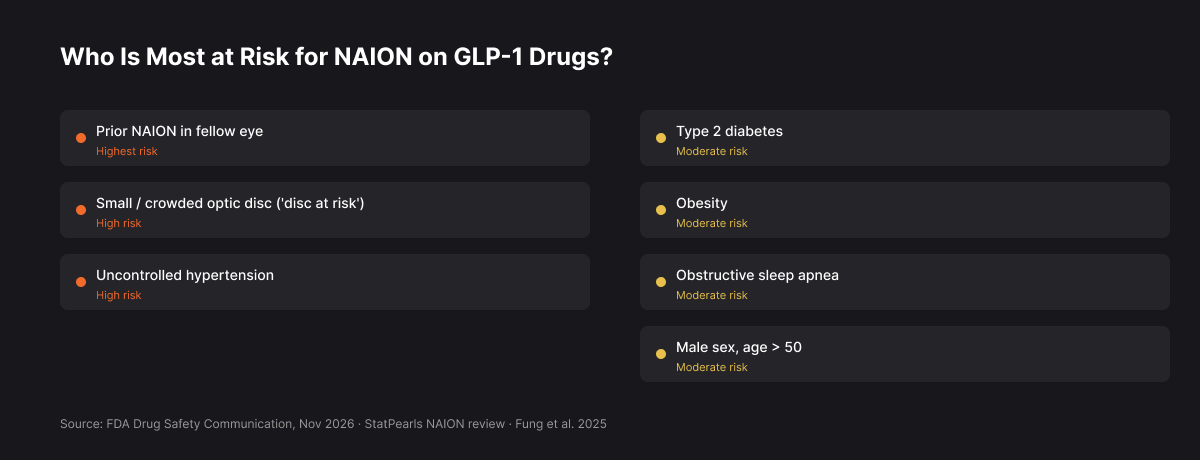
The strongest risk factors are: a prior episode of NAION in the fellow eye (the single biggest predictor of a second event), a small or crowded optic disc with limited space in the scleral canal (a structural "disc at risk"), and uncontrolled hypertension. Metabolic and systemic factors that raise risk include type 2 diabetes, obesity, obstructive sleep apnea, smoking, chronic kidney disease, and anemia. Most patients who develop NAION are male, over 50, and carry at least one of these vascular risk conditions. Underlying metabolic and cardiovascular risk factors — including those covered in that VitaWell guide — may represent the shared pathway through which GLP-1 drug use and NAION risk both travel.
One modifiable factor worth addressing: hypertension. Lowering blood pressure to target is well supported by evidence, and the two exercise types shown in a 31-trial meta-analysis to be most effective are outlined in a dedicated VitaWell article.
What You Should Do — A Practical Decision Guide
The FDA is not recommending that people stop taking GLP-1 medications. What it is recommending is that NAION risk be discussed as part of prescribing conversations, and that patients know which symptoms warrant immediate attention.
| Your Situation | Recommended Action |
|---|---|
| No personal risk factors, no current symptoms | Continue medication; mention GLP-1 use at your next scheduled eye exam |
| 1–2 risk factors (hypertension, diabetes, obesity) | Continue; report any sudden unexplained vision change to your doctor or ophthalmologist the same day it occurs |
| Prior NAION in one eye | Discuss risk-benefit with your prescriber before starting or continuing; arrange ophthalmology review to assess your disc anatomy |
| Structural "disc at risk" (crowded optic disc on imaging) | Discuss risk-benefit with ophthalmologist; baseline documentation is valuable |
| Sudden painless vision loss right now | Seek emergency ophthalmology care today — do not wait; bring your medication list |
| Starting a GLP-1 for the first time + multiple risk factors | Consider a baseline dilated eye exam before or shortly after starting |
A key practical point: once NAION occurs, the window to protect vision has largely passed. The goal of this awareness is earlier recognition in the other eye or in a new episode, not treatment of an established event.
When to Talk to a Professional
If you experience any sudden, painless change in your vision — particularly one you notice first thing in the morning — seek same-day ophthalmology care regardless of whether you are on a GLP-1 drug. Do not wait to see if it resolves.
If you are considering starting a GLP-1 drug and you have a known history of NAION, a "disc at risk" identified on a previous eye exam, or multiple vascular risk factors, raise this with your prescriber before you begin. An ophthalmology consultation to document your optic disc anatomy is a reasonable precaution.
For patients already taking a GLP-1 drug without prior eye concerns: continue taking your medication as directed, let your eye-care provider know you are on a GLP-1, and do not discontinue without discussing it with your prescribing physician. The FDA's conclusion — that benefits outweigh risks — reflects the cardiovascular and metabolic benefits of these drugs, which are substantial.
Frequently Asked Questions
Can GLP-1 drugs cause permanent vision loss?
They can be associated with NAION, which causes permanent vision loss in most cases. However, the risk is rare: clinical trial data show roughly 6.4 events per 100,000 person-years on GLP-1 drugs versus 3.8 on placebo. Most GLP-1 users never develop NAION, and established NAION can occur without any drug exposure.
Should I stop taking Ozempic because of this warning?
The FDA does not recommend routine discontinuation. The agency's position is that GLP-1 drug benefits — including cardiovascular risk reduction, weight loss, and blood sugar control — continue to outweigh the risks. If you have a prior NAION history or multiple risk factors, discuss with your prescriber whether the risk-benefit profile applies to your specific situation.
What are the first signs of NAION?
The classic presentation is sudden, painless vision loss in one eye, often noticed upon waking. Many patients describe a dark or blurred patch in the lower half of their visual field. Because the onset is abrupt and there is no pain, it can be confused with something transient. It is not: same-day ophthalmology evaluation is essential.
How common is NAION on GLP-1 drugs?
Based on the FDA's 126-trial meta-analysis, the incidence is roughly 6.4 per 100,000 person-years — meaning roughly 6–7 cases would be expected per year in every 100,000 patients taking GLP-1 medications. By comparison, the general background rate in adults over 50 is 2.3 to 10.2 per 100,000 per year.
Does the FDA recommend everyone on a GLP-1 see an eye doctor?
The FDA does not mandate universal screening. Its guidance is to refer patients to an ophthalmologist promptly if NAION is suspected, and to consider discontinuing the GLP-1 drug in patients who develop NAION unless the benefits clearly outweigh the risk. Talk to your doctor about whether a baseline eye exam makes sense for your individual risk profile.
Conclusion
The FDA's November 2026 safety update on GLP-1 drugs and NAION is not a signal to panic — but it is a signal to pay attention. The absolute risk remains low, the evidence base is growing more precise, and the drugs themselves continue to deliver meaningful health benefits for millions of people managing diabetes, obesity, and cardiovascular risk. What this update changes is the conversation: GLP-1 users and their healthcare providers should now factor eye health into the shared decision-making process, know the symptoms that demand same-day care, and document any structural eye risk before or shortly after starting treatment.
For the latest evidence-based health guidance across all eight life areas, explore VitaWell's Health section — where new research is translated into practical action every week.
Related on VitaWell
- New WHO Dementia Guidelines: Prevent Up to 45% of Cases — Companion guide to the latest WHO guidance on modifiable risk factors for cognitive decline, relevant to the same vascular health factors that underlie NAION risk.
- Working Long Hours Is Making You Heavier — New Research on Overwork and Obesity — Obesity is one of the documented risk factors for NAION; this article examines the overlooked connection between work schedules and metabolic health.
- Can a Daily Supplement Strengthen Your Blood Vessels? — Research on vascular health interventions, relevant to those managing hypertension and vascular risk alongside GLP-1 therapy.
This article is for informational purposes only and does not constitute medical advice. If you have concerns about medications, vision changes, or your personal risk factors, consult a qualified healthcare professional.
Sources
- Healthline — FDA requires safety labeling changes for GLP-1 receptor agonists due to NAION risk
- FDA Drug Safety Communication, November 9, 2026 — GLP-1 RA safety labeling changes
- Ophthalmology Times, November 9, 2026 — FDA Requires NAION Warning Across the GLP-1 RA Class
- Healio, November 9, 2026 — FDA to require NAION risk warning for GLP-1 therapies
- Fung KW et al. 2025, JAMA Ophthalmology — GLP-1 RAs and Risk of NAION in Older Patients With Diabetes
- StatPearls — Nonarteritic Anterior Ischemic Optic Neuropathy