AI Is Saving Us Time Everywhere Except One Place: What New Gallup Data Reveals About Meetings
New Gallup data shows AI is saving time on writing and research — but leaving meetings completely untouched. Here's why, and what to do instead.
AI is cutting time spent on emails, research, and writing — but not on meetings. A new Gallup study of 21,648 U.S. workers found that 83% of frequent AI users say their meeting time has not changed at all. At the same time, 36% say output expectations have risen. The productivity math isn't working the way most people expected.
Key Takeaways
- Gallup Q3 2026 (n=21,648): 83% of frequent AI users say their meeting load is completely unchanged
- AI saves time on information gathering (52%) and writing (47%), but meetings are untouched
- 36% of frequent AI users say output expectations have risen since adopting AI
- 21% spend MORE time reviewing/correcting AI outputs — a net time cost many overlook
- Workers lose approximately 26 working days per year to unnecessary meetings (Jabra 2026)
What Gallup's 2026 Data Actually Shows
The clearest picture of how AI is reshaping — and not reshaping — work comes from Gallup's Q3 2026 Workforce Study, conducted August 5–19, 2026 among 21,648 U.S. employees (margin of error ±0.9% at 95% confidence). It is the most statistically rigorous large-scale snapshot of AI adoption at work available.
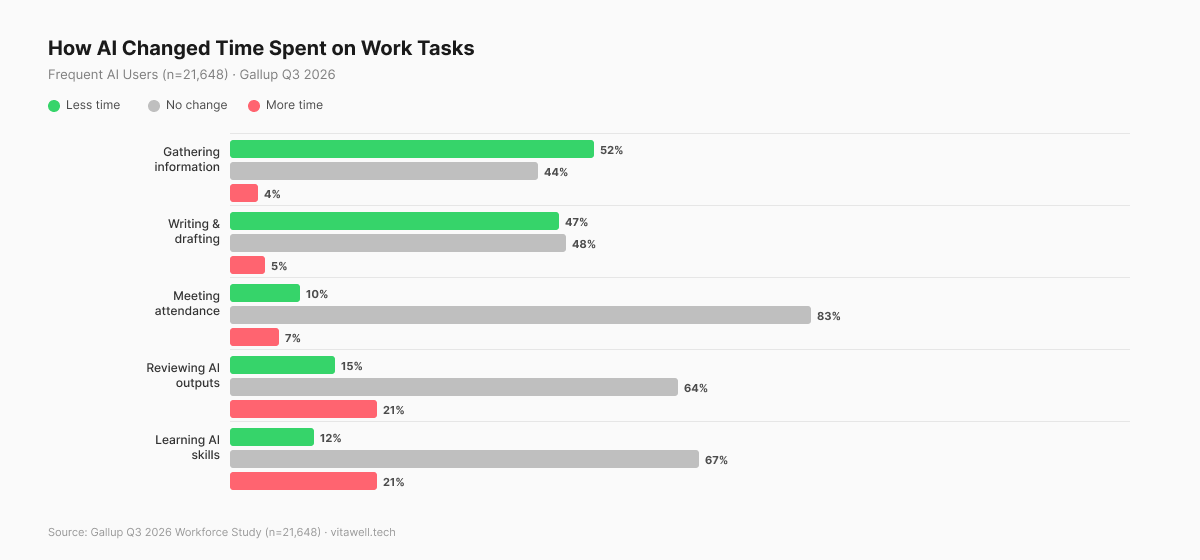
Thirty-two percent of U.S. employees now qualify as frequent AI users — meaning they use AI tools multiple times per week. For that group, AI is saving real time on specific task categories: 52% say they spend less time gathering information, and 47% say they spend less time on writing and drafting. These are meaningful gains, and they align with what AI tools are good at: retrieving, synthesizing, and generating text at scale.
But meetings? Eighty-three percent of frequent AI users say their meeting time is completely unchanged. That is not a rounding error or a data artifact — it is a structural result. AI is good at asynchronous, text-based tasks. Meetings are synchronous, social, and coordination-heavy. The tools that have transformed how people process information have not touched the calendar.
| Work Category | % Spending Less Time | % No Change | % Spending More Time |
|---|---|---|---|
| Gathering information | 52% | 44% | 4% |
| Writing and drafting | 47% | 48% | 5% |
| Meeting attendance | 10% | 83% | 7% |
| Reviewing/correcting AI outputs | 15% | 64% | 21% |
| Learning new AI skills | 12% | 67% | 21% |
Source: Gallup Q3 2026 Workforce Study, August 2026, n=21,648 U.S. employees
The table above reveals the asymmetry at the core of AI's impact on work. The savings are real and concentrated in specific task types. The gains do not transfer to meetings, and for a significant minority — 21% — AI is actually generating new time demands through output review and skill development.
The Rising Expectations Trap
Saving time on tasks would be unambiguously good — except that those gains are being consumed by two countervailing forces: rising expectations and AI overhead.
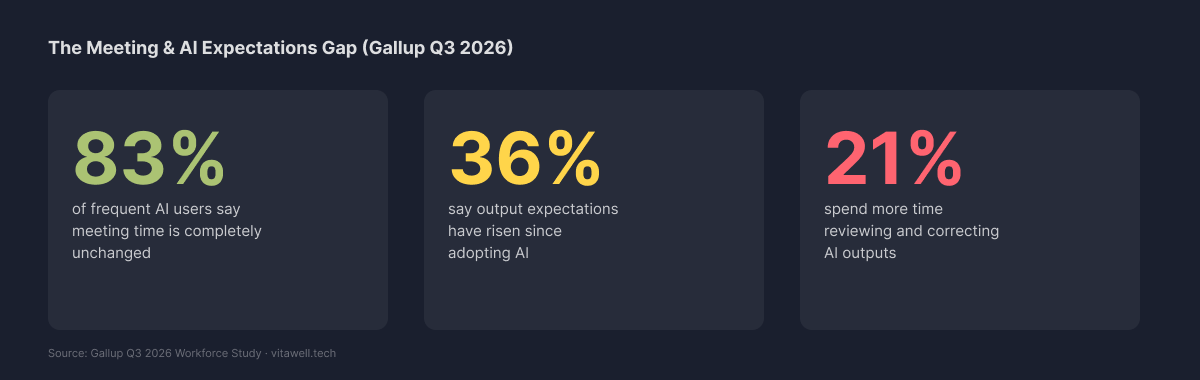
Thirty-six percent of frequent AI users say their output expectations have risen since adopting AI. When a person can produce a first draft in minutes instead of hours, managers and organizations tend to adjust their expectations upward. The saved time does not become free time — it becomes the new baseline. This dynamic, which research on why AI makes you work more, not less has named "productivity absorption," is not unique to AI, but AI accelerates it faster than previous tools.
Thirty-three percent of frequent AI users also report feeling pressure to use AI at work. This matters because using AI isn't free: it requires evaluating outputs, correcting errors, and iterating. Twenty-one percent of frequent AI users spend more time reviewing and correcting AI outputs than they did before — and 21% spend more time learning the new skills those tools require (Gallup Q3 2026). That's a nontrivial overhead for more than one in five adopters.
The net picture: AI saves time for most people on specific tasks, but those savings are partly offset by higher throughput expectations and the hidden maintenance cost of using AI tools responsibly.
Why Meetings Are AI-Resistant
The average worker spends 11.8 hours per week in meetings — roughly 30% of a standard workweek — according to a 2026 survey by Archie (Reclaim AI). Jabra's 2026 research found that 58% of that time is considered unnecessary by the workers sitting through it, adding up to approximately 26 working days lost per year per person. This is not a new problem — but AI has made it more visible by contrast.
Why haven't AI tools touched this? Three structural reasons:
Synchronous coordination overhead. Meetings exist largely to synchronize decisions and information across people in real time. AI can generate a transcript and a summary after the fact, but it cannot substitute for the moment when people align, clarify ambiguity, or negotiate in real time. The bottleneck is not information — it is coordination.
Social accountability norms. Presence in a meeting signals engagement, commitment, and status. These are social functions that have nothing to do with information transfer. Many meetings persist not because they are the best way to share information, but because skipping them carries a social cost.
Decision legitimacy. Organizations are more comfortable making consequential decisions in a room than in a Slack thread. AI can prepare the analysis, but the meeting is where decisions get legitimized through shared witness. Tools that destroy team trust in remote contexts often do so by bypassing exactly these legitimacy rituals.
This means meeting reduction is not primarily an AI problem — it is a cultural and structural problem that people have to solve themselves.
5 Steps to Actually Reduce Your Meeting Load
If AI isn't going to fix this, the alternative is deliberate meeting hygiene. Here is a five-step approach grounded in what actually reduces meeting time without damaging team coordination.
- Run a one-week meeting audit. For every meeting on your calendar this week, write one sentence: what decision or coordination outcome required this to be synchronous? If you can't write that sentence, the meeting is a candidate for elimination or conversion.
- Convert status meetings to async updates. A weekly team status meeting is the most common candidate for replacement. A short Loom video, a Notion page, or a Slack thread shared asynchronously gives the same information with no one's calendar blocked. Reserve synchronous time for decisions, not updates.
- Establish a no-meeting block. Protect at least two hours of your workday — ideally in your peak cognitive window — from meeting requests. Use time blocking to anchor that protected time visibly on your calendar.
- Use AI on the edges, not in the middle. AI is excellent for pre-meeting preparation (generating an agenda, pre-reading a background doc) and post-meeting output (summarizing decisions, drafting action items). Use it there. But the meeting itself — if it needs to happen — still requires human presence and judgment.
- Propose a team meeting budget. A meeting budget is a cap on total weekly meeting hours for a team, agreed upon collectively. This turns meeting reduction from an individual preference into a shared constraint. Teams that use this approach tend to become much more selective about what actually needs to be synchronous — and developing strong asynchronous communication skills is increasingly one of the most AI-proof career competencies a person can build.
FAQ
Why hasn't AI reduced meeting time for most workers?
Meetings serve coordination, social accountability, and decision-legitimacy functions that AI tools cannot replace. AI is effective on asynchronous, text-based tasks (research, writing, summarizing), but meetings are synchronous and social by design. Gallup's Q3 2026 data confirms this: 83% of frequent AI users say their meeting time is completely unchanged.
How much time do workers spend in meetings per week in 2026?
According to a 2026 survey by Archie (Reclaim AI), the average worker spends 11.8 hours per week in meetings — roughly 30% of a standard workweek. Jabra's 2026 research found that 58% of that time is considered unnecessary by employees.
What tasks has AI actually saved time on at work?
Gallup's Q3 2026 data shows the clearest savings are in information gathering (52% of frequent AI users spend less time on this) and writing and drafting (47% spend less time). Administrative tasks like scheduling and email summarization are also commonly cited.
How can I reduce unnecessary meetings at work?
Run a one-week meeting audit to identify which meetings lack a clear synchronous purpose. Convert status updates to async formats (Loom, Slack, Notion). Establish a protected no-meeting block each day. Propose a team meeting budget — a weekly cap on meeting hours — to make reduction a shared team commitment.
Is AI increasing work expectations for employees?
Yes, for a significant share of workers. Gallup's Q3 2026 data found that 36% of frequent AI users say their output expectations have risen since adopting AI, and 33% feel pressure to use AI at work. This "productivity absorption" effect means time saved on tasks tends to get absorbed by higher throughput expectations rather than converted to free time.
Conclusion
The Gallup data draws a clear line between where AI helps and where it doesn't. Meetings remain structurally outside AI's reach — not because the technology fails, but because meetings serve coordination, accountability, and social functions that asynchronous tools haven't replaced. The productivity gains AI creates are real, but they're being absorbed by higher throughput expectations and AI-maintenance overhead.
The practical move is to treat meetings as the remaining frontier — not to wait for AI to fix them, but to audit and reduce them yourself. The tools are on you. Explore VitaWell's Career and Growth areas for more research-backed strategies to protect your time and build the skills that matter most in an AI-augmented workplace.
Related on VitaWell
- Is AI Making Your Writing Blander? What New Research Reveals About LLMs and Your Voice — Extends the AI-at-work lens to creative productivity: what happens when AI handles your drafts.
- Get Things Done: Simple Habits to Stay Focused and Productive Every Day — The practical productivity complement to meeting reduction: how to protect and use the time you reclaim.
- Burnout Recovery and the Nervous System — Rising AI-driven expectations and meeting overload contribute directly to burnout; this post covers the physiological recovery path.