Science Proves Hugs Reduce Anxiety and Pain: What a New Randomized Controlled Trial Reveals About the Power of Touch
A 2026 randomized controlled trial shows family hugs reduce anxiety and post-op pain. Here is what the science reveals and how to get more beneficial touch.
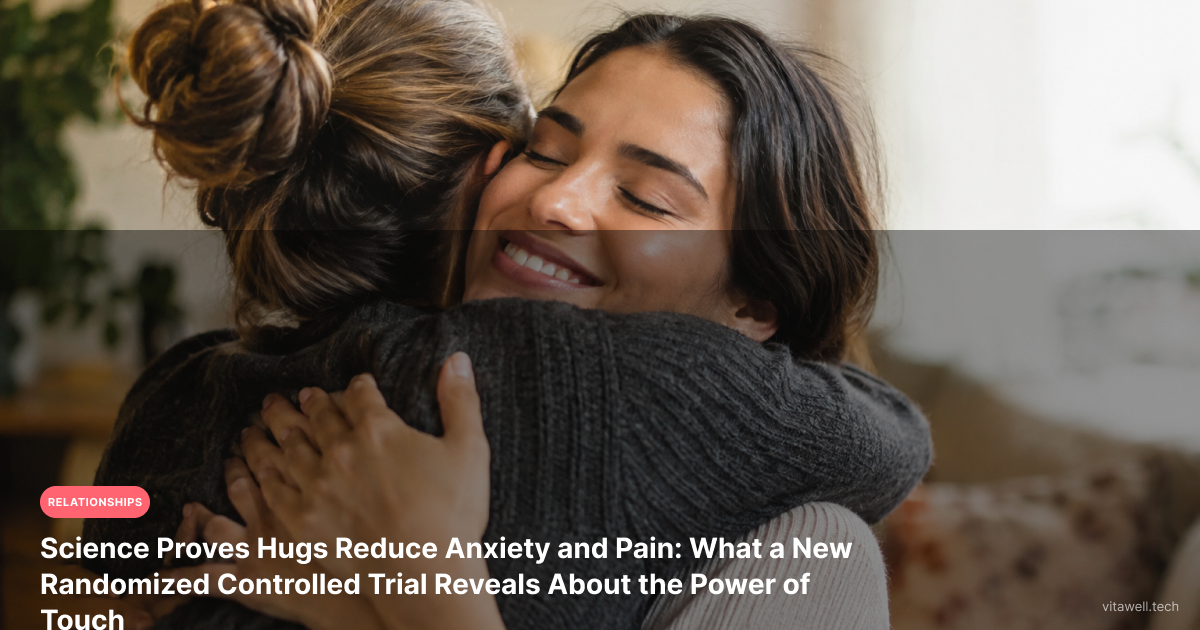
A family member's hug before surgery cuts pre-operative anxiety and reduces post-operative pain — not as a comforting intuition, but as a measured, statistically significant result from a randomized controlled trial published in 2026. The science of human touch has moved from the margins of wellness research to controlled clinical settings, and the findings are specific enough to act on.
Key Takeaways
- A 2026 RCT (n=150) found that patients who received a ≥20-second family hug 30 minutes before surgery had significantly lower pre-operative anxiety and significantly lower pain 30 minutes post-surgery
- A 2024 meta-analysis of 212 studies (~10,000 participants) confirms touch reliably reduces pain, anxiety, and depression
- Short hugs are as effective as long massages for mental health benefits — duration is not the decisive variable
- Object touch (weighted blankets, robot touch) can support physical comfort but has no measurable effect on mental health
- 36% of adults experience loneliness regularly (Ad Council/Beiersdorf, n=6,413, 2020); regular human touch is a direct protective factor against that trend
A 2026 RCT: What Happened When 75 Patients Hugged Their Family Before Surgery
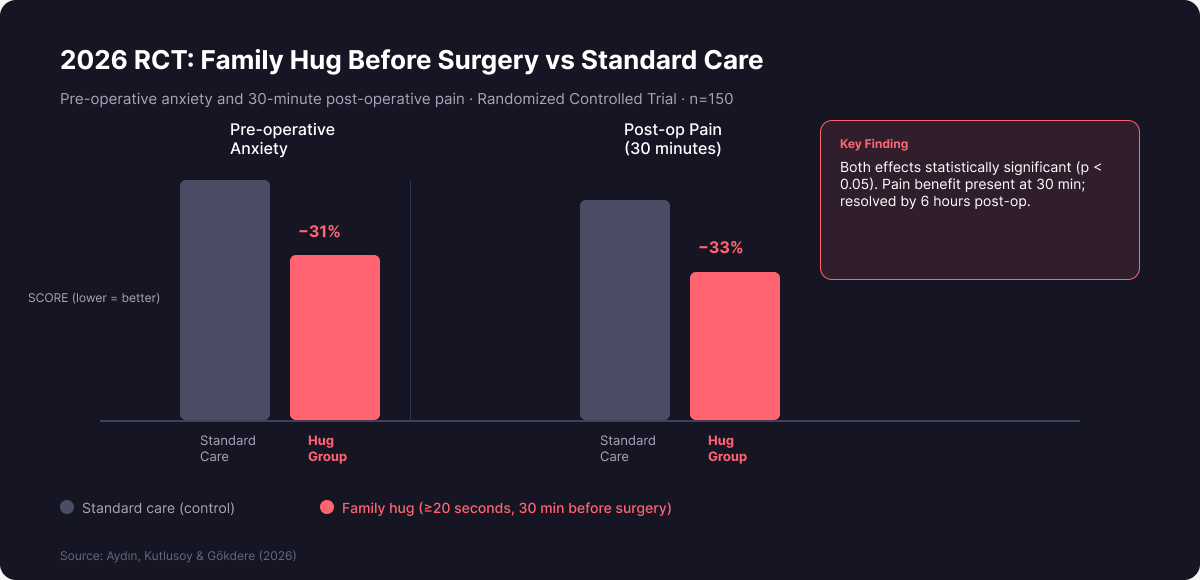
The clearest evidence in the recent literature comes from a randomized controlled trial published in 2026 by Aydın, Kutlusoy, and Gökdere. The study enrolled 150 surgical patients in Turkey and randomly assigned them to two groups: standard pre-operative care, or standard care plus a hug of at least 20 seconds from a family member 30 minutes before the procedure.
The results were specific and statistically significant in two ways. The hug group showed significantly lower state anxiety scores before entering the operating room — a critical window when pre-operative anxiety peaks. The hug group also reported significantly lower pain intensity 30 minutes after surgery. By the six-hour post-operative mark, the pain difference between groups had dissolved, suggesting the analgesic effect is acute and concentrated in the immediate post-surgical period.
The proposed mechanism is oxytocin — a neuropeptide released during physical touch that activates the parasympathetic nervous system, suppresses cortisol, and modulates pain signaling. This is not speculative: the oxytocin pathway in touch-induced analgesia has been documented across multiple independent lines of research, though direct measurement was not part of this trial's design.
Why Hugs Work — The Physiology of Touch
Skin contains C-tactile (CT) afferent nerve fibers — specialized slow-conducting nerve endings that respond specifically to gentle, stroking touch at a preferred velocity of roughly 1–10 cm/sec, which is the natural speed of a hug or stroke. When activated, CT fibers send signals to the insular cortex rather than the somatosensory cortex, connecting touch directly to emotional processing rather than pure sensation. This is why a hug feels categorically different from pressing your arm against a wall.
The resulting cascade is measurable. Touch activates the vagus nerve and shifts the autonomic nervous system toward parasympathetic (rest-and-digest) tone — slowing heart rate, lowering blood pressure, and reducing cortisol output. Research on nervous system recovery after burnout consistently identifies this parasympathetic shift as the core mechanism by which the body down-regulates its stress response after acute activation.
This physiology is also why the duration threshold matters. A hug of roughly 20 seconds allows enough time for the full oxytocin response cycle to initiate. Shorter contacts still activate CT fibers, but the hormonal and autonomic effects are weaker. The 20-second mark appears repeatedly across both clinical and experimental studies, including the 2026 RCT above.
212 Studies Later: The Largest Evidence Review on Touch
The most comprehensive summary of this research is a 2024 meta-analysis by Packheiser and colleagues, published in Nature Human Behaviour. The review synthesized 212 studies covering approximately 10,000 participants and produced several findings that challenge common assumptions about touch.
Packheiser summarized the core finding plainly: "Short hugs can be helpful to the same extent as a long massage." The variable that matters most is not duration but whether contact happens at all. The analysis found that touch reliably reduces pain, anxiety, and depression across diverse populations and settings — consistent across both clinical and non-clinical contexts.
The analysis also identified three important boundary conditions. First, skin-on-skin contact is more effective than clothed touch, likely because it more directly stimulates CT afferents. Second, toucher familiarity does not moderate the benefits of touch for adults — contact from a stranger produced benefits comparable to contact from a partner. Only for infants did parental familiarity significantly increase effectiveness. Third, object touch (weighted blankets, body pillows, therapeutic robots) produced improvements in physical health measures but showed no significant effect on anxiety, depression, or psychological wellbeing.
| Type of Touch | Key Benefits | Evidence Strength | Duration Guidance |
|---|---|---|---|
| Family/partner hug | Anxiety↓, pain↓, cortisol↓, blood pressure↓ | Strong (RCT + meta-analysis) | ≥20 seconds |
| Self-hug | Anxiety↓, cortisol response↓ after stress | Moderate (RCT) | Brief |
| Professional massage | Pain↓, anxiety↓, depression↓ | Strong (212-study meta-analysis) | Short sessions effective |
| Hand-holding | Anxiety↓, pain↓ during medical procedures | Moderate (RCT) | Variable |
| Weighted blanket/body pillow | Physical comfort↑ | Moderate | Variable |
| Robot/object touch | Physical health benefits only — no mental health effect | Moderate | N/A |
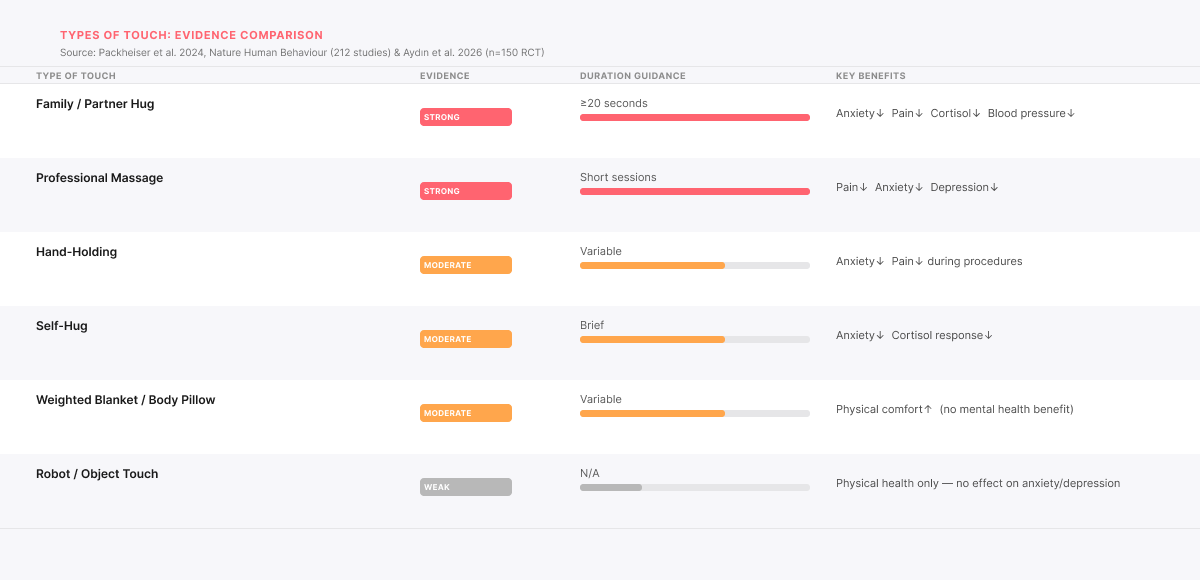
Source: Synthesized from Packheiser et al. 2024 (Nature Human Behaviour) and Aydın et al. 2026
Touch Deprivation — When the Body Goes Without
The same physiological systems that respond to touch also degrade without it. Regular human contact maintains parasympathetic tone, keeps cortisol baselines lower, and reduces inflammatory markers over time. Remove that input, and the body's stress regulation becomes less stable.
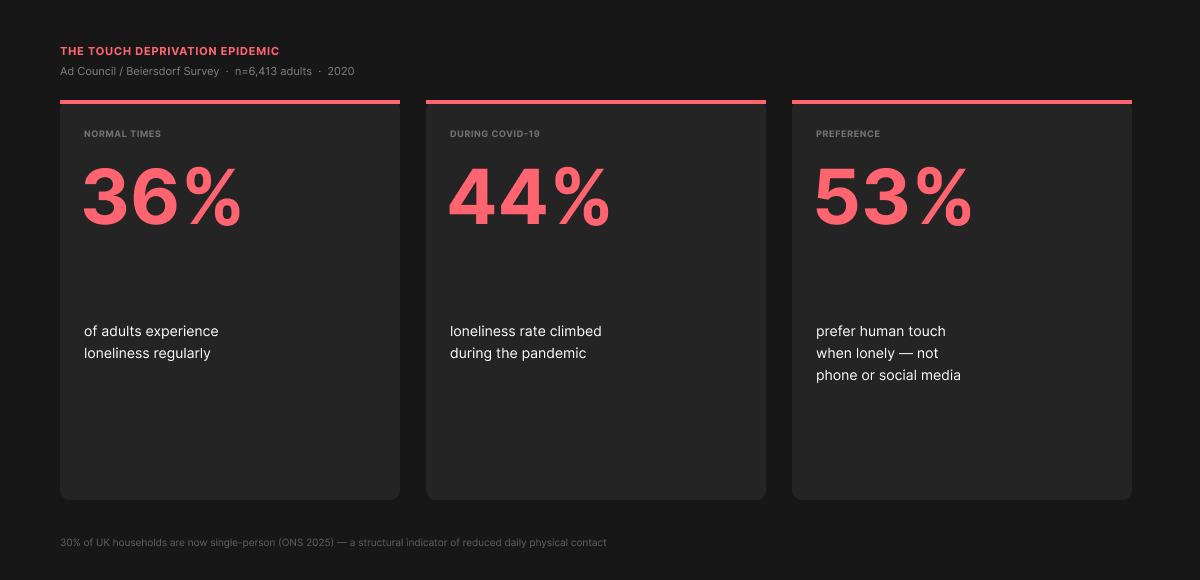
The scale of touch deprivation is not trivial. A 2020 survey by the Ad Council and Beiersdorf (n=6,413) found that 36% of adults experience loneliness regularly, and that 53% specifically prefer human touch when lonely — not phone calls, not social media. During the COVID-19 period, that loneliness rate climbed to 44%. The UK Office for National Statistics reported in 2025 that single-person households now constitute nearly 30% of all UK households — a structural indicator of how many people may have limited daily physical contact.
A 2025 German study by Hajek and colleagues (n=3,200+) confirmed the longitudinal direction: people who reported receiving hugs daily showed significantly lower rates of depression and anxiety compared to those who rarely or never received them. This held after controlling for general social contact — suggesting that touch is an independent protective factor, not merely a marker of having close relationships.
The growing isolation driven by excessive digital engagement has made this research more urgent. Online connection does not substitute for the physiological effects of physical touch, however frequently or deeply it occurs. The CT fiber system has no digital analog.
How Much Touch Do You Need? A Practical Guide
The research does not establish a precise prescription — nobody can tell you exactly how many hugs per day produces the optimal physiological effect. What it does establish is a set of conditions under which touch is most likely to be effective.
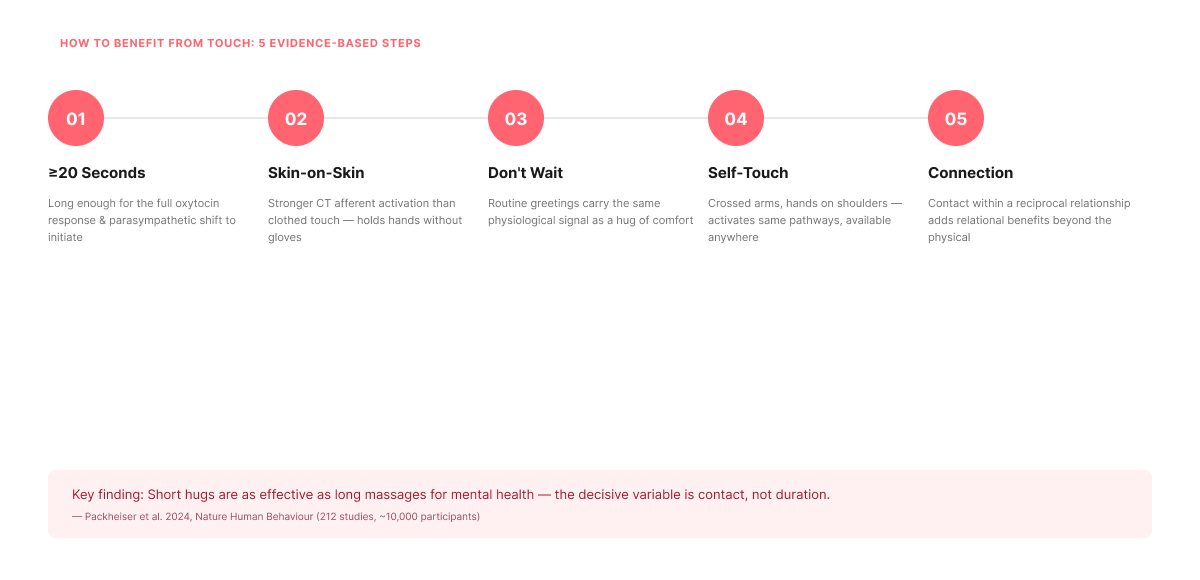
Step 1: Aim for ≥20-second contact. The duration threshold that consistently appears in clinical trials is roughly 20 seconds — enough time for the oxytocin response to initiate and the parasympathetic shift to begin. A quick goodbye hug does not meet this threshold; a full embrace does.
Step 2: Prioritize skin-on-skin when possible. The Packheiser meta-analysis found skin contact produces stronger effects than clothed touch. Holding hands without gloves, a hand on a bare shoulder, or a hug in light clothing all qualify. This does not require behavioral overhaul.
Step 3: Don't wait for an occasion. Most people hug in greeting, farewell, or consolation. The research does not show that touch is effective only in emotionally significant contexts. A routine physical greeting carries the same physiological signal as a hug of comfort.
Step 4: Use self-touch as a supplement, not a replacement. A 2025 study by Susanti and colleagues in the Journal of Nursing Practice found that self-hugging reduced anxiety, with cortisol effects measurable after acute stress exposure. Self-touch is not equivalent to interpersonal contact, but it activates some of the same pathways and is available anywhere.
Step 5: Look for connection, not performance. Physical contact that is part of a genuinely reciprocal relationship carries additional relational benefits beyond the physiological ones. The goal is not to maximize touch as a health intervention — it is to maintain closeness in ways that naturally include touch. The regular physical rituals of family life — a hand on the shoulder at breakfast, a hug at the door — create this in its most sustainable form.
When to seek professional support. If anxiety, depression, or loneliness is persistent, disproportionate to your circumstances, or significantly affecting daily functioning, those are reasons to speak with a therapist, physician, or counselor — not to try more hugs. The benefits documented here are preventive and supplemental, not therapeutic substitutes for clinical care.
FAQ
Does the length of a hug matter?
Yes, but not in the way most people assume. The 20-second threshold appears repeatedly in clinical research as the point at which the full physiological response — oxytocin release, parasympathetic activation — initiates. Brief contacts still activate CT fibers, but the hormonal effects are weaker. For everyday greetings, length matters less; for intentional stress relief, the 20-second mark is worth reaching.
Can you get the same benefits from hugging a pet instead of a person?
Animal-assisted touch does produce measurable reductions in cortisol and blood pressure. However, the Nature Human Behaviour meta-analysis (Packheiser et al. 2024) found that benefits specific to mental health — anxiety, depression — appear reliably only with human touch. Pet interaction has real benefits; it is not a one-to-one substitute for human contact on psychological outcomes.
What if you don't have people to hug regularly?
Self-hugging (crossed arms, hands on shoulders, brief pressure) activates some of the same pathways and was shown in a 2025 RCT to reduce anxiety and cortisol response. Object touch — weighted blankets, body pillows — provides physical comfort but shows no effect on psychological wellbeing in the meta-analysis evidence. For people with limited social contact, investing in the depth of existing close relationships tends to produce more sustained benefits than breadth of contact.
Is it really true that touch from a stranger works as well as touch from a partner?
Among adults, yes — the Packheiser et al. 2024 meta-analysis found that toucher familiarity did not significantly moderate the physiological benefits of touch. The CT fiber system does not appear to discriminate between familiar and unfamiliar humans. Only for infants was parental familiarity a significant moderating factor. This is one of the clearest points of divergence between the science of touch and common intuition.
Why did the pain benefit of the pre-surgery hug disappear by six hours post-op?
The 2026 Aydın et al. RCT found significantly lower pain 30 minutes after surgery in the hug group, but no significant difference at six hours. This is consistent with the acute, short-duration action of oxytocin as an analgesic — it works in an immediate window but does not persist as a sustained post-operative pain management strategy. The findings remain clinically meaningful for the pre- and immediately post-operative period, but do not support hugging as a replacement for post-surgical pain management.
Conclusion
The evidence for the physiological benefits of human touch is no longer soft or ambiguous. A randomized controlled trial, a 212-study meta-analysis, and multiple longitudinal cohorts all converge on a consistent finding: regular human contact reduces anxiety, lowers pain perception, and protects against depression — through measurable biological mechanisms, not through wishful interpretation of correlational data.
The practical implication is straightforward. Touch is not a supplement to connection; it is a component of it, with effects that neither digital contact nor physical proxies can replicate. Longer, more intentional physical contact — particularly in close relationships — produces the most reliable benefits. If those relationships are present in your life, the barrier to this benefit is mostly habit. Explore VitaWell's Relationships area for more evidence-based strategies for the connections that matter most.
This article is for informational purposes only and does not constitute medical advice. For concerns about anxiety, pain, depression, or loneliness, consult a qualified healthcare professional.
Related on VitaWell
- What Makes Lifelong Friendships Last — The science of durable connection: what makes close relationships persist and deepen over time, and what erodes them.
- Balancing Independence and Togetherness — A practical look at the tension between closeness and autonomy in relationships — and how to navigate it.
- Burnout Recovery and the Nervous System — Touch activates the parasympathetic system; this post covers the broader recovery arc for nervous system restoration after burnout.
Sources
- Aydın, Kutlusoy, Gökdere (2026) — Effects of family hugging before surgery on preoperative anxiety and postoperative pain
- Packheiser et al. (2024) — A systematic review and multivariate meta-analysis of the physical and mental health benefits of touch interventions (Nature Human Behaviour)
- Hajek et al. (2025) — Hugging and mental health in a population-based sample (Health Psychology)
- Susanti et al. (2025) — Effect of self-hugging on anxiety (Journal of Nursing Practice)
- Ad Council / Beiersdorf (2020) — World Hugging Day Survey: Touch Deprivation (n=6,413)
- Office for National Statistics (2025) — Families and Households, UK: 2024