How Self-Determination Theory Can Help You Handle Conflict Without Eroding Your Relationship
When conflict erupts, what matters most isn't the topic of the argument — it's why each partner is in the relationship. Here's what SDT research reveals.
When conflict erupts in a relationship, what determines whether it draws you closer or drives you apart is not the topic of the argument — it is why each person is in the relationship in the first place. Self-determination theory (SDT), developed by psychologists Edward Deci and Richard Ryan, identifies three basic psychological needs whose frustration or satisfaction shapes how partners regulate emotions and repair after disagreement. Research across four studies and more than 300 couples shows that the single strongest predictor of conflict behavior is relationship autonomy: freely choosing to be in this relationship, for your own reasons, rather than out of guilt, obligation, or fear of being alone.
Key Takeaways
- Partners who freely choose to be in their relationship (high autonomy motivation) show significantly more understanding and less defensiveness during conflict — in both self-report and blind behavioral coding
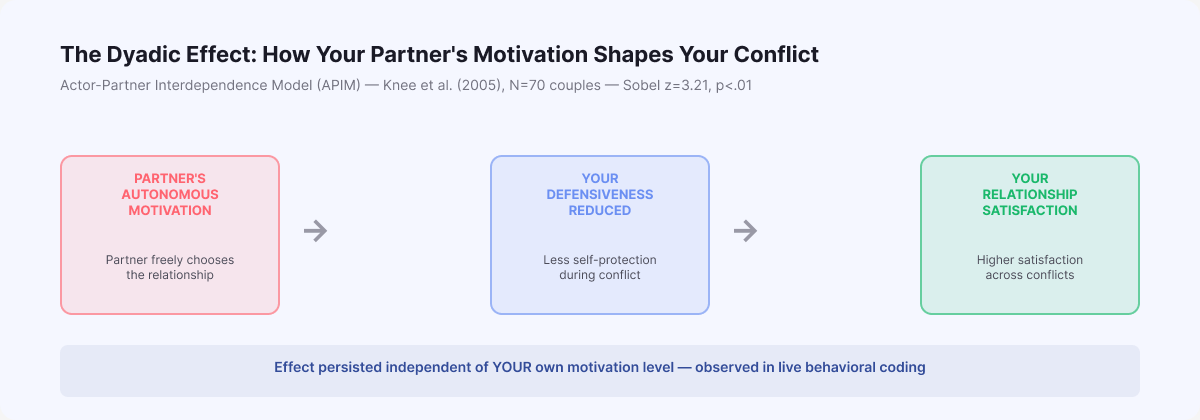
- Your partner's autonomous motivation predicts YOUR own conflict behavior — not just theirs. In a dyadic study of 70 couples, partner autonomy predicted one's own relationship satisfaction through defensiveness (Sobel z=3.21 p<.01)
- Autonomy frustration produces anger and withdrawal (disengaging emotions); relatedness frustration produces hurt and sadness (engaging emotions) — and each type requires a different response
- Emotion regulation during recalled conflicts matters as much as during live ones: a 2026 study found that how you process conflict memories predicts your current relationship satisfaction
- Building relationship autonomy before conflicts arise is more effective than trying to regulate in the heat of the moment
What Self-Determination Theory Says About Relationships
Self-determination theory, first articulated by Deci and Ryan in decades of research, holds that all humans share three innate psychological needs: autonomy (the experience of choosing your actions freely), competence (feeling effective and capable), and relatedness (feeling genuinely connected to others). When these needs are satisfied, people function well. When they are chronically frustrated, psychological functioning deteriorates.
Applied to romantic relationships, the most studied construct is relationship autonomy — the degree to which you freely and genuinely endorse being in your relationship. High relationship autonomy means you are with this person because you want to be, because it aligns with your values, and because the relationship is genuinely meaningful to you. Low relationship autonomy means you stay because leaving feels dangerous, because you feel guilty about wanting to leave, or because you have been with this person so long that the relationship feels like a habit rather than a choice. The Couple Motivation Questionnaire, a validated research instrument, measures exactly this distinction across a spectrum from fully autonomous to fully controlled motivation.
The theory predicts — and research confirms — that this single dimension reshapes the entire conflict experience.
Why You Fight the Way You Do — The SDT Mechanism
In a landmark four-study program published in the Journal of Personality and Social Psychology, Knee, Lonsbary, Canevello, and Patrick (2005) tested whether relationship autonomy explains individual differences in how people experience and behave during conflict.
Study 1 followed 128 undergraduates for 10 days and recorded 908 conflict-related incidents. Relationship autonomy measured at baseline mediated post-conflict relationship satisfaction across all incidents (Sobel z=2.14, p<.05) — meaning that autonomy was not just correlated with better conflict outcomes, it statistically explained the link between conflict occurrence and satisfaction change.
Study 2 tested the mechanism directly in 203 participants. Autonomous motivation predicted both understanding — the tendency to try to see the partner's perspective (F(1, 197)=12.51, p<.001) — and reduced defensiveness — the tendency to protect the self rather than engage (F(1, 197)=17.80, p<.001). The correlations were robust: relationship autonomy correlated with defensiveness at r=.40 and with understanding at r=.33.
What this means practically is that two people entering the same argument with different levels of relationship autonomy will not just feel differently about the argument — they will behave differently in ways that are observable to both their partner and to outside observers.
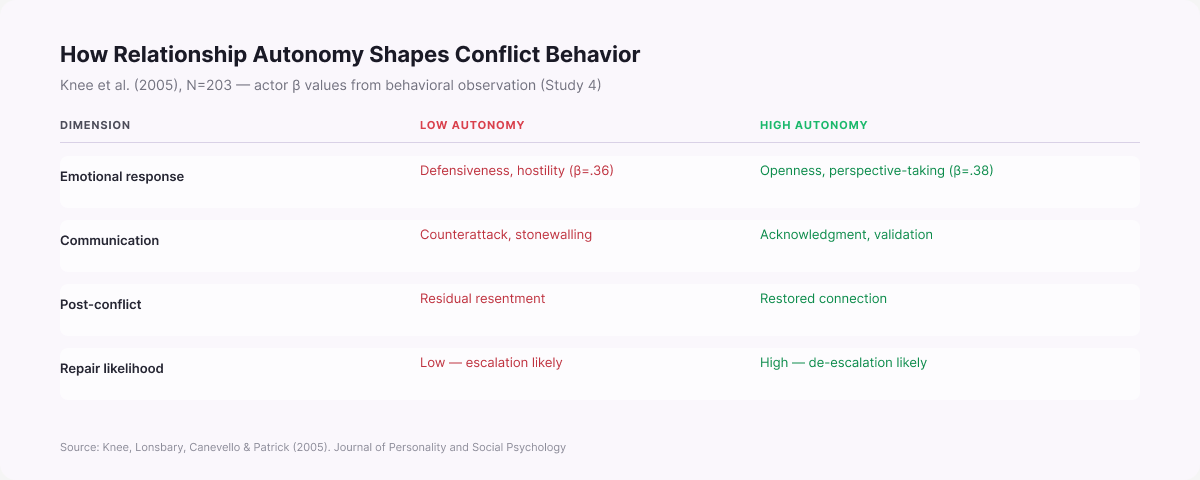
| Dimension | Low Autonomy Motivation | High Autonomy Motivation |
|---|---|---|
| Emotional response | Defensiveness, self-protection, hostility | Openness, curiosity about partner's perspective |
| Communication pattern | Counterattack, minimizing, stonewalling | Acknowledgment, validation, perspective-taking |
| Post-conflict outcome | Residual resentment, unresolved tension | Restored connection, clearer understanding |
| Repair likelihood | Low — escalation more probable | High — de-escalation more probable |
The Dyadic Effect — Why Your Partner's Motivation Shapes Your Behavior
The most striking finding in the Knee et al. 2005 program is what happens when you study couples together rather than individuals in isolation.
Study 3 recruited 70 couples and analyzed the data using the Actor-Partner Interdependence Model (APIM), a statistical method that captures how each partner's characteristics influence the other's outcomes. The results showed that your partner's autonomous relationship motivation predicts your own conflict outcomes — independent of your own motivation. Specifically, the partner's autonomy level predicted your relationship satisfaction, with defensiveness mediating this effect (Sobel z=3.21, p<.01). In plain terms: a partner who freely chooses to be with you actively reduces your defensive responses during conflict, even when your own motivation level is held constant.
Study 4 brought 75 couples into a videotaped laboratory conflict. Eight blind coders, achieving reliability of .94, rated observed understanding and defensiveness. The results confirmed the diary findings: autonomous motivation predicted observed understanding (actor β=.38, p<.05; partner β=.38, p<.01) and observed defensiveness (actor β=.36, p<.05) in independent behavioral assessment. This means that the effect is not just about how people report feeling — it is visible in their actual behavior to trained outside observers.
The practical implication is counterintuitive but important: investing in your own reasons for being in the relationship does not only change your own conflict behavior. It changes your partner's experience of conflict with you. Research on balancing independence and togetherness in lasting relationships has examined how individual autonomy within partnerships shapes the relationship itself; the SDT conflict data suggests that freely chosen commitment is not just good for you — it is a form of protection you extend to your partner.
Two Types of Conflict Emotions — And Why the Difference Matters
Not all conflict emotions signal the same thing, and treating them as identical is a common and costly mistake.
A 2023 study by Pirrone and colleagues published in Frontiers in Psychology recruited 141 Belgian couples (282 partners; mean age 36.34 years, range 19–76) and examined how frustration of each of SDT's three basic needs during conflict produced different emotional responses. The findings drew a sharp distinction.
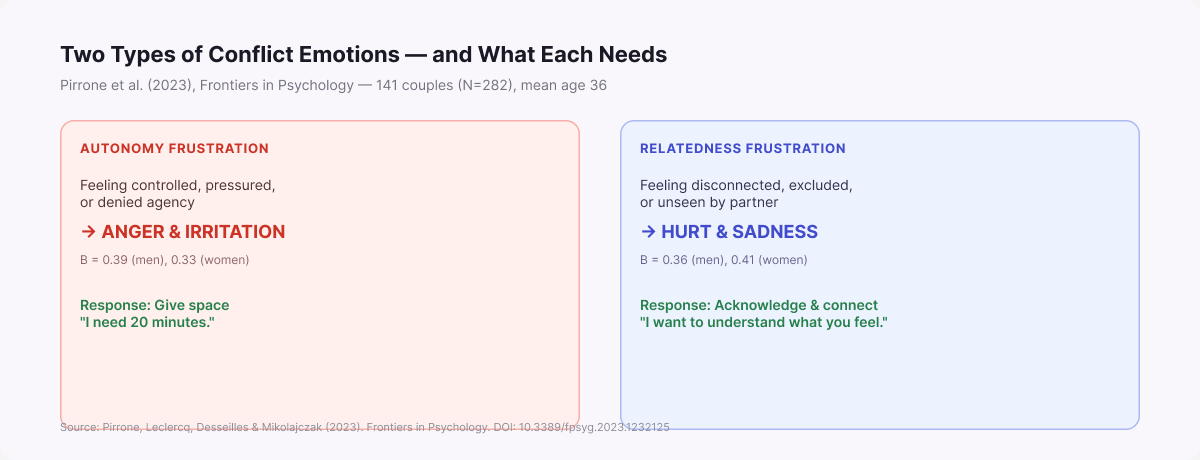
Autonomy frustration — feeling controlled, pressured, or denied agency in the relationship — predicted disengaging emotions: anger and irritation (B=0.39 for men, B=0.33 for women, p<.001). Relatedness frustration — feeling disconnected, excluded, or unseen by one's partner — predicted engaging emotions: hurt and sadness (B=0.36 for men, B=0.41 for women, p<.001). The two emotion types were themselves correlated (r=.63 for men, r=.68 for women), so they often co-occur — but they point in different directions.
Disengaging emotions, like anger and irritation, function as signals that the person wants to exit the interaction. Attempting to pursue connection during this state typically escalates the conflict. The more effective response is distance: a brief time-out that removes the coercive pressure and allows the autonomy need to settle.
Engaging emotions, like hurt and sadness, function as signals that the person wants repair and connection. Responding with distance in this state backfires; what works is acknowledgment, validation, and direct relatedness. Research on how you relate to your thoughts and feelings — a metacognitive dimension — applies directly here: the ability to notice and name which emotional state you are in before responding is what allows you to match your response to the actual need.
Why Even Remembered Conflicts Shape Your Relationship
A 2026 study by Thuot-Jolicoeur and colleagues published in the Journal of Family Psychology introduced a dimension of conflict that most practical advice ignores: the role of how partners regulate their emotions when recalling past conflicts, not just during active ones.
Using a dyadic design, the researchers found that integrative emotion regulation during conflict recall — processing the memory in a way that acknowledges both partners' perspectives and generates understanding — predicted higher current relationship satisfaction. Dysfunctional regulation during recall — including hostility, withdrawal, and rumination — predicted worse relationship outcomes. The dyadic element is important: each partner's post-conflict processing independently contributed to the couple's shared relationship quality.
This finding reframes what happens after an argument ends. The conflict does not close when the conversation stops. The emotional memory of that conflict continues to be processed — sometimes for hours or days — and how that processing unfolds matters as much as how the live argument went. Partners who can revisit a conflict with curiosity rather than re-activating defensiveness are building relationship quality in the spaces between arguments.
A Four-Step Protocol to Build Conflict-Resistant Autonomy
Translating the SDT conflict research into a practical protocol requires targeting two separate windows: the baseline state of autonomous motivation (which shapes all conflicts in advance) and the in-conflict and post-conflict responses to need frustration.
- Audit your relationship motivation. Without judgment, ask: why am I in this relationship? If the dominant answers involve avoiding guilt, fear of being alone, sunk costs, or external pressure, that is controlled motivation — and it is a risk factor for defensive conflict behavior. If the dominant answers involve genuine desire, shared values, and freely chosen commitment, that is autonomous motivation. The Couple Motivation Questionnaire items can be approximated by this reflection: "I am in this relationship because I want to be, and I would still choose this person if starting from zero today."
- Before conflict, strengthen your autonomous reasons. Autonomous motivation is not static; it is maintained by deliberate attention. Regularly revisiting what you genuinely value about your partner and your relationship — not in a forced way, but as a reflective practice — sustains the motivational foundation that protects both of you during disagreement.
- During conflict, name the frustrated need. When you notice escalation, ask: is this anger or hurt? Anger and irritation signal autonomy frustration — that you feel controlled or denied agency. The appropriate response is a brief, explicit time-out: "I need 20 minutes before we continue this." Hurt and sadness signal relatedness frustration — that you feel disconnected or unseen. The appropriate response is direct acknowledgment: "I want to understand what you're feeling." Matching the response to the need reduces escalation.
- After conflict, practice integrative recall. Rather than replaying what you should have said or what your partner did wrong, revisit the conflict with the specific goal of understanding both sides: what need was your partner trying to protect? What would you do differently? This is not capitulation — it is the form of post-conflict processing that Thuot-Jolicoeur 2026 identifies as protective of relationship quality. As the research on why imperfection and difficulty are part of growth shows, the ability to process difficult experiences without self-punishment is itself a learnable skill.
Limitations: What SDT Research Cannot Yet Tell Us
The Knee et al. 2005 program, while rigorous, relies primarily on undergraduate samples — a population that skews young, often less committed, and may not generalize to long-term partnerships or marriages with children. The diary and lab designs measure conflict episodes but cannot track how conflict patterns evolve across years or whether autonomy-building interventions produce durable behavior change.
The Thuot-Jolicoeur 2026 study examines recalled conflict, not live conflict — which introduces the possibility that recall quality itself is confounded with relationship satisfaction rather than causing it. The dyadic design strengthens causal inference, but longitudinal intervention data remain absent.
The Pirrone 2023 findings on emotion type (disengaging vs. engaging) are associational; the specific pathways from need frustration to emotion to behavior are not yet established in experimental designs. And the need frustration literature as a whole presents a mixed picture for autonomy specifically: in a study of 230 couples, relatedness frustration was the strongest predictor of conflict initiation and destructive communication, with autonomy and competence frustration showing more limited independent effects.
What is consistent across all four research programs is the direction: needs matter for how conflict unfolds, autonomous motivation protects against the most destructive patterns, and what happens after a conflict is as important as what happens during it.
When to Talk to a Professional
Consider speaking with a couples therapist or relationship psychologist if:
- Conflict in your relationship has become frequent, intense, or follows a fixed pattern of escalation that neither partner can interrupt
- You notice that your motivations for staying in the relationship are primarily fear-based, obligation-based, or habit-based — and you want support in evaluating what that means for you
- One or both partners consistently experience emotions during conflict that feel disproportionate or uncontrollable
- Post-conflict rumination is persistent and disruptive to daily functioning
Emotionally Focused Therapy (EFT) and Integrative Behavioral Couple Therapy (IBCT) both address the need frustration patterns SDT research identifies. A trained couples therapist can administer structured versions of the Couple Motivation Questionnaire and design interventions tailored to your specific need frustration profile.
FAQ
What is self-determination theory and how does it apply to relationships?
Self-determination theory (SDT) is a framework developed by Edward Deci and Richard Ryan that identifies three innate psychological needs: autonomy, competence, and relatedness. In romantic relationships, it predicts that how those needs are satisfied or frustrated shapes emotional experience, communication, and conflict behavior. Research across multiple studies shows that relationship autonomy — the degree to which you freely choose to be in your relationship — is a particularly strong predictor of how partners behave during and after disagreements.
What is relationship autonomy and why does it matter for conflict?
Relationship autonomy is the degree to which you are in your relationship because you genuinely want to be, rather than because of guilt, obligation, or fear. Research by Knee et al. (2005) across 203 and 70 couples found that higher relationship autonomy predicts more understanding (F=12.51, p<.001) and less defensiveness (F=17.80, p<.001) during conflict — effects visible in both self-report and blind behavioral coding.
How does my partner's motivation affect my behavior during arguments?
In a study of 70 couples using the Actor-Partner Interdependence Model, Knee et al. (2005) found that your partner's autonomous relationship motivation predicts your own conflict outcomes — not just theirs. Specifically, your partner's autonomy level predicts your relationship satisfaction, with defensiveness mediating the effect (Sobel z=3.21, p<.01). This means choosing to invest in your partner's sense of freedom and genuine belonging in the relationship is not just good for them — it changes how you experience conflict with them.
What is the difference between autonomy frustration and relatedness frustration in conflict?
Pirrone et al. (2023) found that frustration of different psychological needs produces different emotional responses during conflict. Autonomy frustration (feeling controlled, pressured, or denied agency) produces disengaging emotions: anger and irritation. Relatedness frustration (feeling disconnected or unseen) produces engaging emotions: hurt and sadness. Each type calls for a different response — space and autonomy restoration for disengaging emotions; connection and acknowledgment for engaging ones.
Can improving relationship autonomy change conflict outcomes?
The research evidence is consistent: higher relationship autonomy correlates with better conflict behavior across diary, survey, and behavioral observation designs. However, there are no controlled intervention trials specifically testing whether autonomy-building practices produce measurable conflict behavior change over time. The research is correlational and cross-sectional, not yet causal in the clinical trial sense.
Conclusion
Self-determination theory offers something most conflict advice cannot: a mechanistic account of why the same argument plays out so differently in different couples. The key variable is not communication skill, not emotional intelligence as a trait, and not attachment history alone — it is the degree to which each person freely and genuinely endorses being in the relationship they are in.
The practical consequences follow from the mechanism. Autonomous motivation predicts understanding rather than defensiveness, and that effect operates across both partners through the dyadic pathway Knee and colleagues documented across four studies. The type of emotional frustration — autonomy vs. relatedness — signals which response will help and which will escalate. And the process continues after the argument ends: how partners process conflict memories is as consequential as how they behave in real time.
Conflict is not an interruption of a good relationship. It is the terrain on which relationship quality is built or eroded, over time, by patterns that begin well before any particular argument starts. Structure your relationship to serve your autonomy, your partner's autonomy, and your shared need for genuine connection — and the conflicts that arise will have a different shape.
For more on building the habits and relationship practices that support long-term wellbeing, explore VitaWell.
Related on VitaWell
- Balancing Independence and Togetherness — examines how the tension between individual autonomy and closeness operates in lasting relationships, providing the structural context for the SDT conflict findings.
- Adult Sibling Estrangement: Why It Happens and How to Repair the Relationship — explores how need frustration and relationship history interact in family relationships, paralleling the dynamics SDT identifies in romantic conflict.
- The Arrival Fallacy: Why Achieving Your Goals Can Leave You Feeling Empty — connects SDT's autonomous motivation framework to the broader question of what genuinely fulfilling relationships and goals look like.
This article is for informational purposes only and does not constitute medical or professional advice. Consult a qualified professional before making decisions based on research findings.
Sources
- Knee, C.R., Lonsbary, C., Canevello, A., & Patrick, H. (2005). Self-determination and conflict in romantic relationships. Journal of Personality and Social Psychology, 89(6), 997–1009
- Thuot-Jolicoeur, A. et al. (2026). Integrative vs. dysfunctional emotion regulation during recalled conflict and relationship satisfaction. Journal of Family Psychology. DOI: 10.1037/fam0001555
- Pirrone, D., Leclercq, V., Desseilles, M., & Mikolajczak, M. (2023). Basic psychological need frustration and emotions experienced during conflict in romantic relationships. Frontiers in Psychology, 14. DOI: 10.3389/fpsyg.2023.1232125