Is AI Making Your Writing Blander? What New Research Reveals About LLMs and Your Voice
Is AI Making Your Writing Blander? What New Research Reveals About LLMs and Your Voice
You hit send on an email, a social media post, or an essay, and something feels off. The words are correct. The grammar is flawless. But they don't sound like you. This is the paradox of writing in the age of large language models: AI makes the mechanics of writing faster and smoother, yet the final product often feels less distinctly yours. Researchers call this emerging phenomenon blandification—and the science behind it is starting to turn heads. One groundbreaking college admissions essay study found that heavy LLM users answered open-ended questions with neutral, generic responses 69% more often than writers who didn't use AI assistance. That statistic should trouble anyone who believes that writing is about more than just conveying information—it's about conveying yourself.
The Blandification Effect: What the Research Actually Found
The 69% Neutrality Problem
A 2025 study published on ScienceDirect examined college admissions essays written by heavy AI users and those written without LLM assistance. The results were stark: when asked to respond to open-ended prompts requiring personal reflection, heavy AI users produced neutral, generic responses 69% more often than non-AI users. The disappearance was noticeable and measurable. Where human writers naturally gravitated toward bold claims, personal anecdotes, and emotionally honest admissions, AI-assisted writing defaulted to safe, inoffensive middle ground. The essays that had been touched by AI read like they were written by the same careful, cautious hand—because, in a real sense, they were. The statistical engine behind these models has no investment in your uniqueness. It optimizes for what's most likely, most broadly acceptable, most defensible.
Homogenization at Scale
The problem isn't limited to essays. A landmark 2025 PNAS study titled Echoes in AI analyzed thousands of AI-generated stories and found striking homogeneity: the same plot elements appeared again and again, rendered in nearly identical narrative structures. Microsoft Research developed a metric called the Sui Generis score specifically to measure semantic distinctiveness in writing. The results consistently showed that when writers used ChatGPT as a primary drafting tool, their semantic variety dropped significantly. Meanwhile, a 2024 study presented at the ACM Conference on Creativity and Cognition demonstrated that users who composed with heavy AI assistance produced measurably less semantically distinct ideas compared to those who wrote without AI. The implication is clear: AI isn't making you a better version of yourself. It's making you a less distinctive version of everyone.
Six observable signs that AI has flattened a piece of writing:
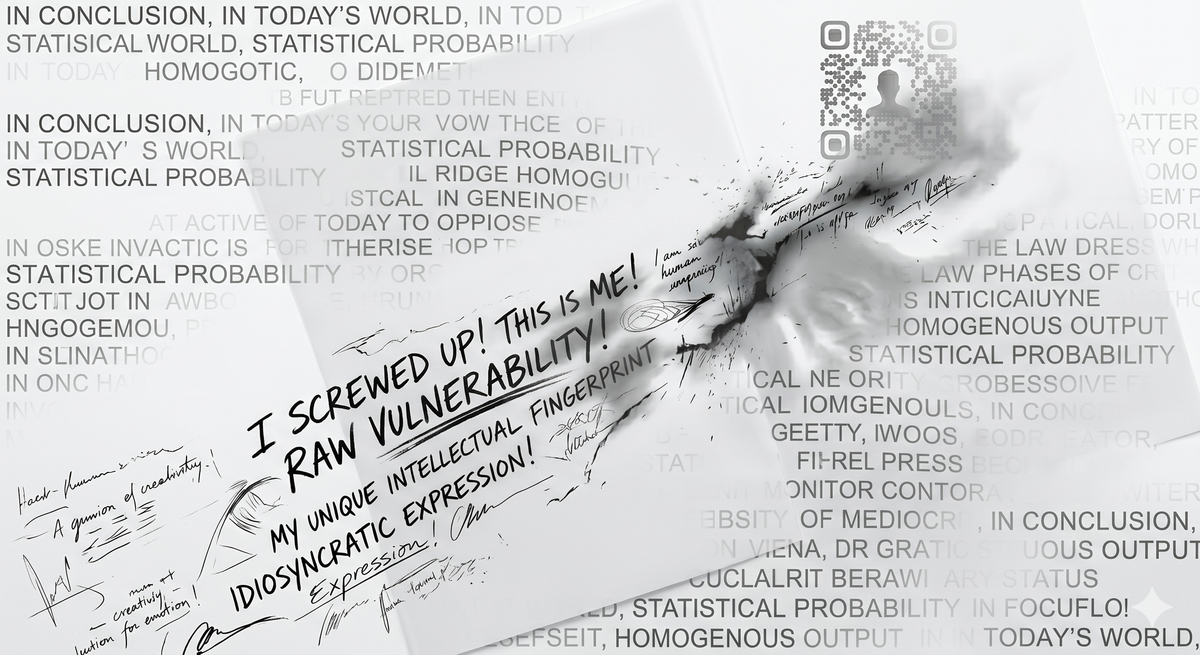
- Heavy use of transitional clichés like In conclusion, It is important to note, and In today's world
- Overly formal, corporate-sounding register even in casual contexts
- Absence of memorable specific examples or the telling detail that sticks with readers
- No personal anecdotes or moments of vulnerability
- Generic transitions between ideas that feel mechanical rather than organic
- A tonal flatness that sounds competent but unmemorable
Why LLMs Produce Generic Prose—The Training Problem
Optimizing for the Middle
Here's the uncomfortable truth: large language models are trained on statistical patterns extracted from the vast corpus of human text. They learn probability distributions. When you ask an AI to write something, it generates tokens based on what's most statistically likely to follow—not what's most interesting, most honest, or most distinctly human. This mathematical reality has a consequence: LLMs represent the average of human writing, not its creative peaks. Your authentic voice—the part of your writing that makes you irreplaceable—lives at the fringes of the statistical distribution. It's the surprising word choice, the unexpected digression, the vulnerability that didn't seem safe enough for the training data. When an AI generates prose, it gravitates toward the center of the bell curve, toward the high-probability zone. That's where readable, competent, and utterly forgettable writing lives.
The Formality Drift
Research consistently shows that AI-assisted writing drifts toward formality and away from personality. Even when you ask for something casual, AI defaults to a polished, cautious register. The shift is subtle but pervasive. A human writer might compose: I screwed up the meeting. When that same thought passes through an AI's rewriting engine, it emerges as: The meeting did not go as planned. The second version is objectively better by traditional grammar standards. It's also sterile. It strips away the self-awareness, the admission, the human fallibility that makes the first version compelling. Multiply that small loss across an entire piece of writing, and you're left with something that reads like it was written by a professional automaton.
What Authentic Voice Actually Costs When It's Lost
The Credibility Cost
Readers have an almost preternatural sense for generic AI text—often before detection algorithms flag it. When writing sounds like everyone else's, credibility erodes. The reader's subconscious registers: This author doesn't have a distinct perspective. This is borrowed language. This is safe. In professional contexts, personal branding, and thought leadership, this cost is immense. Your voice is your intellectual fingerprint. When it vanishes into the homogenized middle, so does your authority. You become interchangeable with the next person who used the same AI tool with the same prompt.
The Creative Atrophy Risk
There's a deeper cost that plays out over time. When AI repeatedly handles the generative work—the brainstorming, the drafting, the ideation—the writer's own creative muscle weakens. This is especially true for students and early-career writers who bypass the cognitive struggle that used to be foundational to skill development. The struggle is where learning happens. The blank page is where voice develops. When you hand that to an AI, you're not just outsourcing a task. You're deferring your own growth. And once dependency forms, the gap widens: the longer you rely on AI for the hard part, the harder it becomes to generate unassisted ideas. You're caught in the dependency trap.
Six high-stakes writing contexts where voice loss is most costly:
- Job applications and cover letters, where personality and fit signal whether you'll thrive in a culture
- Personal essays and college admissions prompts, where authenticity is explicitly what's being evaluated
- Thought leadership articles and public writing that builds your professional reputation
- Client proposals and pitch documents, where your distinct perspective is the product you're selling
- Social media and personal brand communications, where consistency and authenticity compound over time
- Relationship communications and heartfelt messages, where generic language can damage trust and intimacy
How to Use AI Writing Tools Without Losing What Makes You Unique
- Write first, use AI second. Never start with a blank page handed to the algorithm. Generate your raw, unfiltered draft first—the messy version where your voice is loudest because no filtering mechanism is running. Only after that raw material exists should you ask AI to help with structure, clarity, or polish. This order matters. AI polishing raw authenticity is different from AI generating from scratch.
- Use AI for reaction, not rewriting. Change your prompts. Instead of Improve this paragraph, ask What is unclear here? or What questions does this raise? or Where do I need more evidence? The moment you request improvement, AI injects its own patterns and stylistic preferences. Reaction-based prompts keep the work grounded in your voice while using AI as a thinking partner.
- Style-prime your AI. Before asking for help with a piece, paste three to five examples of your best, most characteristically yours writing. Then say: This is how I write. Match this voice when helping me. Providing stylistic context shifts AI output closer to your register and away from its default corporate-neutral mode. It's a small prompt shift with measurable impact.
- Edit AI output back toward yourself. After AI assists, read the result aloud. Anywhere it sounds too smooth, too formal, too perfectly polished, or too safe—roughen it back to your natural cadence. Reintroduce the contractions, the specific examples, the vulnerable moments that make it sound human. This step turns AI-assisted writing from a hand-off to a dialogue.
- Protect your most personal writing entirely. Journal entries, handwritten letters, creative work that defines you, relationship communications—certain writing should never pass through an AI lens. These pieces are where voice develops. Outsource the mechanical help elsewhere, but keep the core of your creative and emotional expression entirely your own.
Writing in the Age of AI: Staying Human When Machines Do the Drafting
The New Premium on Human Voice
Here's what's happening at the same time blandification is accelerating: human voice is becoming increasingly rare, and therefore increasingly valuable. As AI-generated content floods the internet, the distinctly human signal—idiosyncratic expression, genuine emotion, specific personal experience, unmistakably particular perspective—stands out like a signal fire. This is not sentimentality. It's market reality. In an era of abundance of competent, safe, polished, forgettable content, the competitive advantage goes to writers whose voice is unmistakably their own. Readers seek them out. Employers notice them. Audiences trust them. Your idiosyncrasies are not bugs. They're features.
AI as Thinking Partner, Not Ghost Writer
The distinction between AI-as-support and AI-as-replacement is where everything hinges. AI-as-support means using the tool for brainstorming angles, checking your logic, finding apt synonyms, researching facts, offering feedback on what you've written. AI-as-replacement means handing off drafting, rewriting, ideation, and perspective to the algorithm. The first keeps you in the driver's seat. The second makes you a passenger. The writers who will thrive in this era are those who stay firmly on the support side—who use AI's capabilities to amplify their own thinking without outsourcing their perspective.
AI use cases that ENHANCE voice:
- Brainstorming multiple angles on a topic you're already interested in
- Checking the logical flow of your argument
- Finding precise synonyms or alternative phrasings for ideas you've already formed
- Researching background facts and context
- Offering structural feedback on drafts you've written
- Devil's-advocate questions that stress-test your thinking
AI use cases that ERODE voice:
- Writing first drafts from scratch using only AI
- Asking AI to rewrite your paragraphs for improvement
- Using AI to generate ideas you haven't already considered
- Allowing AI to make stylistic choices about your tone or register
- Rewriting personal essays or emotionally significant pieces through an AI filter
- Delegating the thinking work while trying to maintain voice ownership
Conclusion
AI is not the enemy of good writing. Uncritical dependence on it is. Your voice—the distinctive signature you leave on everything you write—is not some luxury add-on. It's the sum of your experiences, values, obsessions, and syntax. It's what makes your writing matter. It is genuinely irreplaceable.
The writers who will thrive in this era of AI abundance are not those who resist the technology. They're the ones who harness its capabilities without outsourcing their perspective. Use AI as a scaffold, not a substitute. Let it handle the structural grunt work and the fact-checking while you keep the creative and emotional core of your writing entirely your own. The blank page is still where voice lives. Don't let an algorithm colonize that space.
Your writing matters precisely because it's yours. Protect that.