How AI Is Affecting Your Brain Differently Than Your Child's — and What You Can Do About It
Most public conversations about artificial intelligence and human cognition treat all users as roughly equivalent. You use AI, your skills may decline — end of story. But this framing misses something critically important: what AI does to a 45-year-old brain is categorically different from what it does to a 14-year-old brain. Understanding that difference isn't just intellectually interesting — it may be one of the most important things you can know as an adult navigating this technology, or as a parent raising a child inside it.
What Is Cognitive Offloading — and Why Does It Matter?
Cognitive offloading refers to the practice of using external tools to reduce the amount of mental processing we have to do ourselves. This is not new. When humans invented writing, they offloaded memory. When we built calculators, we offloaded arithmetic. When GPS became standard, we offloaded navigation. AI is simply the newest — and most powerful — form of this ancient habit. You ask a language model to summarize a document, draft an email, analyze a problem, or generate a plan, and you bypass the cognitive effort those tasks would normally require. The question is not whether this is happening — clearly it is. The question is: what are we gaining, and what are we losing — and does the answer differ by age?
The Spectrum from Productive to Harmful Offloading
Not all offloading is equal. At one end, you use AI to handle genuinely repetitive or low-stakes tasks — formatting a spreadsheet, looking up a train schedule — freeing your attention for higher-order thinking. This is productive offloading. At the other end, you use AI to generate the first draft of every report, form every opinion based on AI summaries, and resolve every ambiguous situation by asking the algorithm what to do. At this end, you are not enhancing your thinking — you are replacing it. The key variable is active engagement. When you use AI output as raw material that you evaluate and build upon, offloading can free cognitive capacity for more sophisticated analysis. When you use AI output as the final answer, you bypass the very process that keeps cognition strong.
What AI Is Actually Doing to the Adult Brain
For adults, the primary cognitive risk of AI overuse is atrophy — the weakening of skills that do exist, through disuse. A landmark study published in MDPI by researcher Michael Gerlich (2025), surveying 319 knowledge workers, found a significant negative correlation of r = -0.49 between frequency of AI tool use and critical thinking scores. Frequent AI users showed diminished ability to critically evaluate information and engage in reflective problem-solving. An MIT study reported by the Harvard Gazette found that participants who used ChatGPT for writing tasks showed significantly reduced cognitive engagement compared to those who worked without AI assistance. Specifically, AI use reduced what researchers call relevant cognitive load — the effortful processing that transforms information into genuine knowledge. ChatGPT helped people finish tasks faster. It did not help them understand more, retain more, or think more deeply.
The Tradeoff Adults Are Making — and Often Don't Realize
Think of it like GPS navigation. When you rely on GPS for every journey, you get where you're going efficiently. But after years of GPS dependence, many people find they have lost the ability to navigate intuitively or build a mental map of their city. The skill still exists somewhere — but it has weakened through disuse. If you put the GPS away for a month, you would likely rebuild it. The atrophy is real, but it is reversible. This is the situation most adults are in with AI. You are making a tradeoff: efficiency now, in exchange for some degree of cognitive sharpness over time. This is not necessarily the wrong choice — but it should be a conscious one.
Signs Your AI Use May Be Affecting Your Cognitive Sharpness
- You feel reluctant or uncomfortable starting a writing task without first consulting an AI tool
- You find it harder than you used to to form an opinion before researching what others think
- You experience reduced tolerance for ambiguity — the discomfort of not knowing yet feels harder to sit with
- You notice yourself reaching for AI to resolve decisions that, a few years ago, you would have handled through your own reasoning
- Your attention span for reading long, complex material feels shorter
- You feel less practiced at structuring arguments or explaining complex ideas in your own words
Why It's a Completely Different Story for Children and Teenagers
Here is where the stakes change dramatically. Adults who overuse AI risk losing skills they already built. Children who overuse AI risk never building those skills at all. During childhood and adolescence, the brain is in a period of intense construction. Neural pathways form through repeated activation — through the experience of struggling with a problem, evaluating sources, constructing an argument, and arriving at a conclusion through effort. This process is not a side effect of learning; it is the mechanism of learning. The struggle is the point. When a child asks AI to summarize, evaluate, and conclude on their behalf, they skip this process. They get the output — but they do not get the neural pathway that the process would have built.
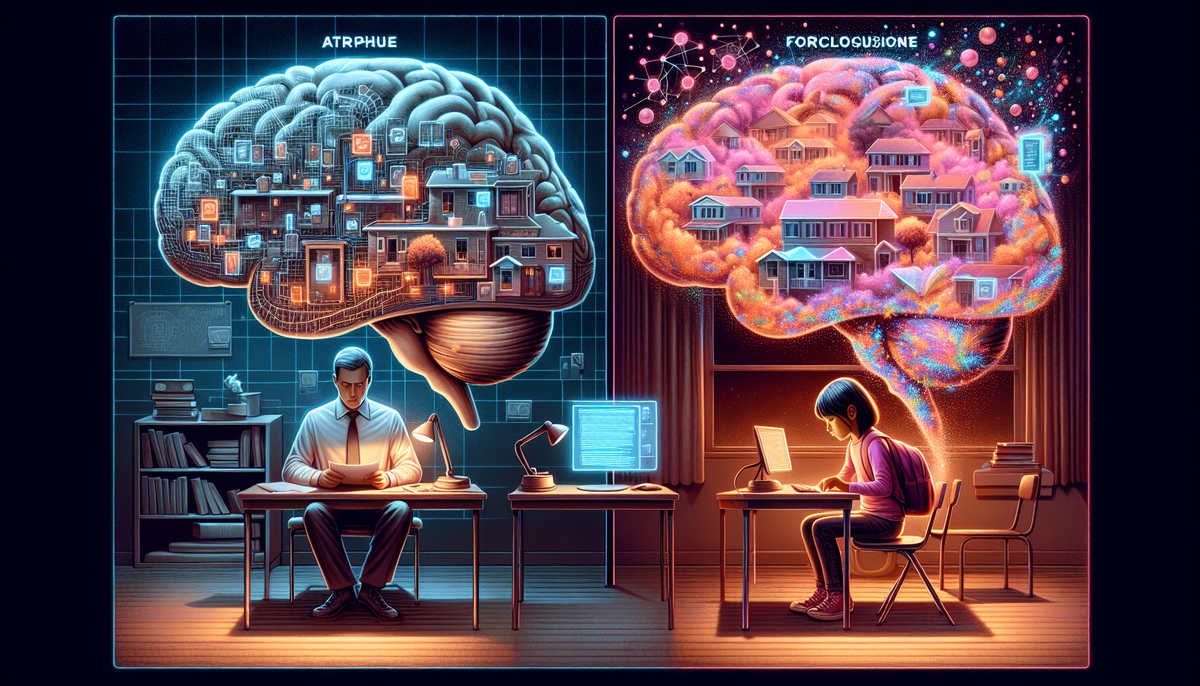
Atrophy vs. Foreclosure — the Most Important Distinction in This Debate
Adults experience atrophy. Children experience foreclosure. Foreclosure is not a weakened skill. It is a skill that never forms. You cannot atrophy a muscle you never built. If a child grows up outsourcing source evaluation to AI, the neural architecture for critical evaluation of information may simply never develop. Research published in PMC adds a sobering dimension: large language models homogenize not just language, but perspective and reasoning strategies. The model's statistical biases become the child's default framing for the world. If a child's primary cognitive input during formative years is AI-generated content, the patterns of that AI become the patterns of their thinking.
What Research Shows About Children's AI Use
- Harvard Graduate School of Education research finds that AI can support children's learning — but only when designed with learning principles in mind. AI companions that ask children questions rather than give them answers can improve comprehension and vocabulary significantly.
- A PMC study warns that AI-induced cognitive effects disproportionately affect those who have not yet achieved mastery — precisely the population that includes all children.
- Early childhood, from birth to age six, represents a particularly critical cognitive window. Experiences during this period may have lasting implications for executive function, emotional regulation, and abstract reasoning.
- Frontiers in Psychology (2026) confirms that individuals without foundational knowledge cannot meaningfully evaluate or filter AI outputs — making children the most vulnerable AI users of all.
Practical Strategies for Adults to Stay Cognitively Sharp While Using AI
The goal is not to abandon AI. It is to use it in ways that preserve — and even strengthen — cognitive capacity. Research points clearly to active engagement as the antidote to passive consumption.
- Use the attempt first rule. Before asking AI to help with a task, attempt it yourself first — even partially. Write the first paragraph before asking AI to finish it. Form your own view before asking AI to summarize the literature. The effort of attempting, even imperfectly, activates the neural circuits that need exercise.
- Reframe AI as a sparring partner, not an answer machine. Instead of asking what should I do, ask here is what I'm thinking — what are the weaknesses in my reasoning? This keeps your cognition in the driver's seat.
- Designate AI-free zones. Choose specific tasks to protect from AI involvement: personal journaling, first-draft writing, strategic planning, casual correspondence. Research on interleaved practice suggests that mixing assisted and unassisted work improves both performance and long-term retention.
- Audit your AI habits periodically. Every month, honestly assess which cognitive tasks you have stopped doing yourself. Deliberate tradeoffs, made with awareness, are recoverable. Unconscious drift is harder to notice and reverse.
- Stay in the loop on your AI-assisted work. When AI helps you draft, summarize, or analyze, read, understand, and be able to defend the output in your own words. This is a minimum bar for cognitive engagement.
What Parents and Educators Should Know to Protect Children's Developing Minds
The goal is not to eliminate AI from children's lives. The goal is to ensure that AI use scaffolds cognitive development rather than substituting for it.
Choose AI That Teaches, Not AI That Answers
There is a meaningful difference between AI tools designed with learning principles and AI tools designed for adult productivity. Learning AI asks questions, prompts reflection, and requires the child to engage in order to move forward. Harvard GSE research confirms that AI companions designed to ask children questions improve comprehension and vocabulary significantly. When choosing AI tools for children, look for tools that require thinking, not tools that eliminate it.
Preserve the Struggle — Deliberately
Productive struggle is essential for skill formation. The discomfort of not-yet-knowing is precisely where neural pathway construction happens. Parents and teachers who rush to provide answers — or allow AI to provide answers immediately — are shortcutting the process that builds capability. This does not mean making children suffer unnecessarily. It means giving them enough time to genuinely engage before offering help.
Talk to Your Children About How AI Works
Children who understand, at an age-appropriate level, that AI is a statistical prediction engine — not a knowledgeable, authoritative source of truth — are better equipped to engage critically with its outputs. Even a simple explanation — AI makes educated guesses based on patterns in a lot of text, and it can be wrong — plants a seed of appropriate skepticism that will serve them throughout their lives.
Practice Joint AI Use
Research consistently shows that joint parent-child technology use produces better outcomes than solo use. When a parent sits alongside a child and models active engagement — let's check whether this is accurate, what do you think the answer is before we ask — they teach a cognitive stance toward AI that will serve the child throughout their life.
Parent and Educator Action Steps
- Ensure children have at least one daily cognitive task done entirely without AI: writing, math, reading comprehension
- Ask children to explain AI-generated content in their own words before accepting it
- Model critical engagement yourself: let children see you verify, question, and occasionally disagree with AI outputs
- Choose age-appropriate AI tools designed for learning rather than productivity
- Discuss AI limitations openly and regularly — treat it as an ongoing conversation, not a single talk
Conclusion
The most important insight emerging from research on AI and cognition is not that AI is dangerous — it is that it affects different brains differently, and the most vulnerable users are those least equipped to recognize the effects. For adults, the risk is real but manageable. Cognitive atrophy is recoverable. For children, the stakes are higher. Cognitive foreclosure — the non-formation of skills that should develop — may not be reversible in the same way. AI is one of the most powerful cognitive tools humans have ever created. The question is not whether to use it. The question is whether we use it in ways that serve human development — or in ways that quietly substitute for it. This week: try the attempt first rule on one task you would normally hand to AI. If you have children, have one conversation with them about how AI actually works. Small, consistent changes in how we relate to our tools are how both the relationship and the brain evolve.