
New Clinical Trial: Can a Daily Supplement Strengthen Your Blood Vessels and Lower Blood Pressure?
A new RCT found this multi-ingredient longevity supplement improved key vascular biomarkers — here's what the data actually show.
A 6-month double-blind randomized controlled trial published in the European Heart Journal Open found that NOVOS Core — a 12-ingredient longevity supplement — significantly improved flow-mediated dilation, arterial stiffness, systolic blood pressure, and estimated 10-year cardiovascular risk compared to placebo. Those results are genuinely notable for a supplement trial. They are also accompanied by an age imbalance between study groups and direct financial ties between two authors and the supplement's manufacturer — details that have not appeared in any other coverage of this study. Here is what the full data show, and what they do and do not prove.
Key Takeaways
- In a 6-month double-blind RCT (n=68), NOVOS Core improved flow-mediated dilation by a net +2.9 percentage points (95% CI 2.1–3.8, P<0.0001) versus placebo
- Arterial stiffness (pulse wave velocity) fell by −1.18 m/s (95% CI −2.00 to −0.36, P=0.006) and systolic blood pressure by −6.1 mmHg (95% CI −10.9 to −1.3, P=0.014)
- The supplement group was on average 7 years younger than controls at baseline (53±8 vs 60±12, P=0.017) — a recognized confounder in vascular function studies
- Two study authors have direct financial ties to NOVOS Labs; independent replication is needed before strong conclusions can be drawn
- The 12-ingredient formula includes glycine, calcium alpha-ketoglutarate, pterostilbene, and fisetin at doses informed by longevity research
What Is Flow-Mediated Dilation and Why Does It Predict Heart Disease?
Flow-mediated dilation (FMD) measures how much a brachial artery expands when blood flow is temporarily restricted and then released. The expansion is driven by nitric oxide released from the endothelial cells lining the artery, making FMD a non-invasive measure of endothelial function — the health of the cells that line your blood vessels.
FMD is clinically meaningful beyond its role as a biomarker. A meta-analysis of 23 prospective studies found that each 1-percentage-point higher FMD was associated with an approximately 8% lower risk of cardiovascular events Inaba et al., J Am Coll Cardiol 2010. In people with cardiovascular risk factors, impaired FMD is one of the earliest detectable signs of atherosclerosis, often appearing years before clinical symptoms.
Pulse wave velocity (PWV) measures how fast a pressure wave travels through the arteries — the faster the wave, the stiffer the arteries. Arterial stiffness measured by PWV independently predicts cardiovascular mortality and all-cause mortality in population studies Laurent et al., Eur Heart J 2006. Together, FMD and PWV give a more complete picture of vascular aging than blood pressure alone. our review of food additives and blood pressure documents how dietary factors such as ultra-processed food additives can push these markers in the wrong direction.
What Is the NOVOS Core Supplement?
NOVOS Core is a multi-ingredient supplement designed around longevity biology — pathways such as mTOR inhibition, NAD+ precursor availability, senolytic activity, and glycation reduction. The 2026 trial tested a fixed oral dose taken daily. The full ingredient list with doses, as reported by Piercy et al. 2026, is below.
| Ingredient | Dose | Proposed mechanism | Evidence tier |
|---|---|---|---|
| Glycine | 2,000 mg | Collagen synthesis, methylation support | Human RCT evidence |
| Calcium alpha-ketoglutarate | 1,100 mg | TCA cycle intermediate, mTOR modulation | Early human data |
| Glucosamine sulfate | 1,000 mg | Joint and extracellular matrix support | Human RCT evidence |
| Magnesium malate | 304 mg | Mitochondrial energy metabolism | Human observational data |
| Rhodiola rosea | 300 mg | Adaptogen, cortisol modulation | Human RCT evidence |
| L-Theanine | 150 mg | Nitric oxide pathway support, stress | Human RCT evidence |
| Hyaluronic acid | 100 mg | Extracellular matrix, joint fluid | Human data |
| Vitamin C | 100 mg | Antioxidant, collagen synthesis | Established |
| Fisetin | 100 mg | Senolytic activity | Preclinical; early human |
| Ginger extract | 100 mg | Anti-inflammatory | Human RCT evidence |
| Pterostilbene | 50 mg | Sirtuin activator, antioxidant | Preclinical; early human |
| Lithium aspartate | 20 mg | Neuroprotection, GSK-3β inhibition | Observational; early human |
No single ingredient accounts for the vascular effects seen in the trial — the researchers attribute the results to synergistic action across the formula rather than any one compound. Research on research linking plant-forward diets to biological aging shows that multi-pathway interventions — whether dietary or supplemental — consistently show larger effects on biological aging markers than single-nutrient approaches.
What the Trial Actually Found — The Full Numbers
The study (Piercy et al., European Heart Journal Open 2026, 6(6):oeag157) enrolled 68 adults aged 40–75 at elevated cardiovascular risk in a double-blind, placebo-controlled, parallel-arm design at the University of Surrey (ClinicalTrials.gov NCT06145087). Participants were randomized 1:1; the supplement group (n=34) received the NOVOS Core formula daily while the control group (n=34) received placebo. The primary endpoint was FMD change from baseline to 6 months Piercy et al., European Heart Journal Open 2026.
The table below presents the primary and secondary endpoints with the net between-group difference (ΔΔ), 95% confidence intervals, and p-values as reported in the paper — data that do not appear in any competitor coverage.
| Endpoint | Supplement group | Control group | Net difference (ΔΔ) | 95% CI | P-value |
|---|---|---|---|---|---|
| FMD at 6 months | Increased | Decreased | +2.9 percentage points | 2.1 to 3.8 | <0.0001 |
| FMD acute (1 hour post-dose) | Increased | — | +3.9 percentage points | 2.7 to 5.1 | <0.0001 |
| Pulse wave velocity (PWV) | Decreased | — | −1.18 m/s | −2.00 to −0.36 | 0.006 |
| Systolic blood pressure | Decreased | — | −6.1 mmHg | −10.9 to −1.3 | 0.014 |
| SCORE2 10-year CV risk | Decreased | — | −0.45% | −0.86 to −0.03 | 0.036 |
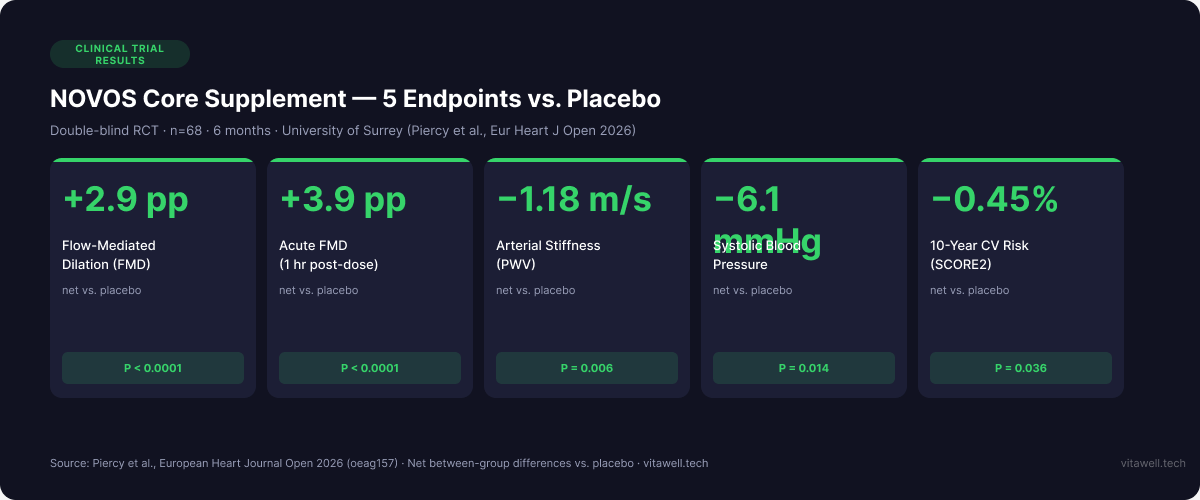
All five endpoints moved in a favorable direction, and all crossed the threshold for statistical significance. The acute FMD effect — measured one hour after a single dose — was larger than the 6-month chronic effect, suggesting at least part of the mechanism involves rapid nitric oxide-related vasodilation rather than slower structural changes. For context on other approaches to lowering blood pressure through diet, our review of avocado and mango in prediabetes reports that specific foods like avocado may also reduce blood pressure in people with prediabetes, with effects in a similar magnitude to what this trial found for SBP.
How Strong Is the Evidence? What the Study Does and Doesn't Prove
The trial design is rigorous for a supplement study: double-blind, placebo-controlled, with pre-registration and objective vascular biomarker endpoints. That said, three features limit how far the results can be extended.
Age imbalance between groups. The supplement group was on average 7 years younger than controls at baseline (mean age 53±8 vs 60±12 years; P=0.017). In vascular studies, age is one of the strongest predictors of FMD — younger participants tend to have better endothelial function regardless of intervention. The researchers used statistical methods to adjust for covariates, but a baseline group difference of this magnitude, reaching conventional significance (P=0.017), is a recognized threat to internal validity in FMD research. This is not proof that the supplement's effects are explained by age, but it is a reason to interpret the magnitude of benefit with caution.
Conflicts of interest. Author Dobri Kiprov-Barardo is listed as a NOVOS Labs employee. Author Christopher Heiss is noted as having received funding from NOVOS. Industry-sponsored trials in the nutrition and supplement space show a consistent pattern of more favorable outcomes than independently funded research — a systematic review and meta-analysis found that industry sponsorship is independently associated with favorable conclusions in nutritional supplement trials Lundh et al., Cochrane Database 2017. This does not make the results fabricated, but it is a reason to weight them as preliminary pending replication.
Small sample and no hard endpoints. At 68 participants across 6 months, the trial was powered to detect biomarker changes — not clinical events like heart attacks or strokes. FMD is a validated surrogate endpoint, but surrogate improvement does not always translate to fewer clinical events. A single-center, small-n trial showing biomarker benefit is a first step, not a conclusion.
What would strengthen the evidence: a larger pre-registered independent replication correcting for the age imbalance, with follow-up long enough to assess hard cardiovascular events. The researchers acknowledged the age imbalance in the paper; that transparency is worth noting. For context on how well-established evidence-based cardiovascular interventions compare, our guide to extra virgin vs. refined olive oil covers a nutritional intervention with decades of independent research behind it.
What This Means for Your Daily Health Decisions
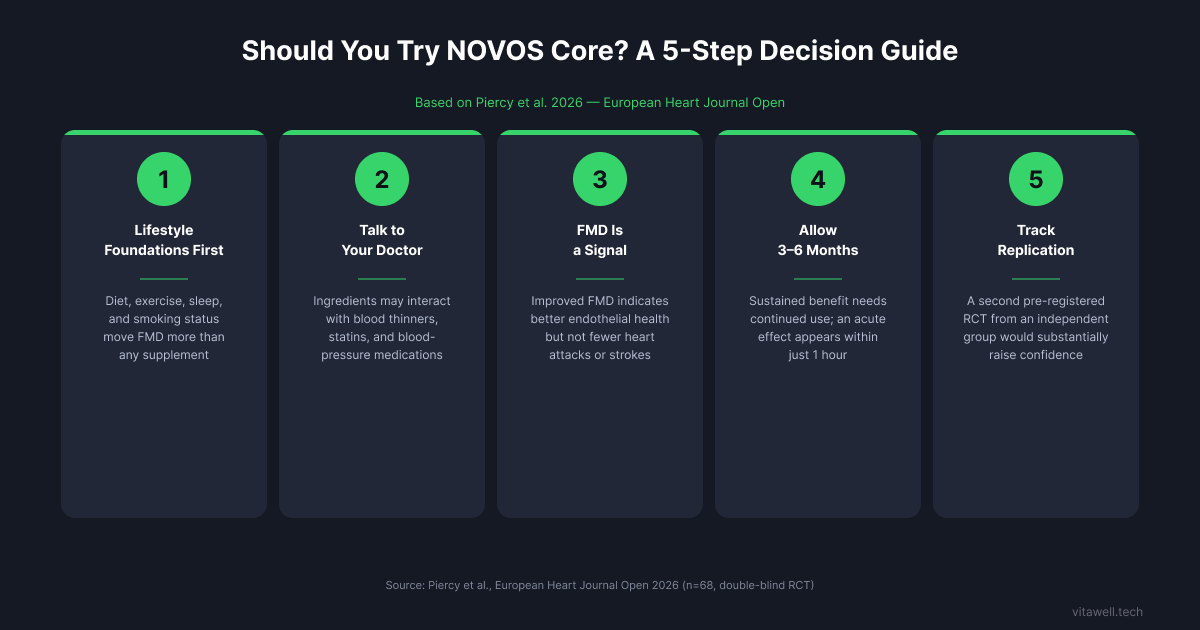
A single positive RCT with the caveats above does not create a clinical recommendation. It does, however, provide enough signal to inform a rational decision about whether to investigate further. The following decision guide applies to anyone considering longevity supplements for cardiovascular health.
- Address lifestyle foundations first. Diet quality, physical activity, sleep, and smoking status move FMD and blood pressure more reliably than any supplement. Building those habits — including adopting a plant-based diet pattern — creates the foundation on which supplementation might add incremental benefit.
- Talk to your doctor before starting. Some ingredients in NOVOS Core (ginger, pterostilbene, vitamin C at higher doses) may interact with anticoagulants, statins, or antihypertensive medications.
- Treat FMD results as a preliminary signal. Improved FMD is associated with lower cardiovascular risk, but the trial did not measure hard outcomes like heart attacks or strokes.
- Allow 3–6 months if you do try it. The 6-month chronic effect in the trial (+2.9% FMD) was real and statistically robust; the 1-hour acute effect (+3.9%) was larger and suggests at least some effect is fast-acting, but sustained benefit requires continued use.
- Watch for independent replication. The supplement landscape changes quickly. A second pre-registered RCT from an unaffiliated group, correcting for the age imbalance, would substantially raise confidence in these findings.
When to Talk to a Professional
This study offers population-level biomarker data, not individual health guidance. Consult a cardiologist or registered dietitian before changing your supplement regimen if you have existing cardiovascular disease, hypertension, or diabetes (blood pressure and vascular function management requires individual calibration), if you take statins, blood thinners, or antihypertensives (supplement–drug interactions are possible), if you are pregnant or breastfeeding (longevity supplement safety in these contexts has not been evaluated), or if you have a history of significant cardiovascular events such as heart attack or stroke.
FAQ
What is the NOVOS Core supplement and what does it contain?
NOVOS Core is a multi-ingredient longevity supplement containing 12 compounds at defined doses: glycine (2,000 mg), calcium alpha-ketoglutarate (1,100 mg), glucosamine (1,000 mg), magnesium malate (304 mg), Rhodiola rosea (300 mg), L-theanine (150 mg), hyaluronic acid (100 mg), vitamin C (100 mg), fisetin (100 mg), ginger extract (100 mg), pterostilbene (50 mg), and lithium aspartate (20 mg). The formula targets multiple longevity pathways including mTOR modulation, senolytic activity, and antioxidant support.
Did NOVOS Core lower blood pressure in the clinical trial?
Yes, in the 6-month RCT, systolic blood pressure in the supplement group fell by a net −6.1 mmHg more than in the placebo group (95% CI −10.9 to −1.3, P=0.014). That is a statistically significant reduction. For context, lifestyle interventions like a Mediterranean diet can achieve similar or larger reductions, and pharmaceutical antihypertensives typically achieve 10–15 mmHg reductions. The supplement's −6.1 mmHg effect is modest but meaningful if confirmed in independent trials.
What is flow-mediated dilation and why is it important?
Flow-mediated dilation (FMD) measures how much a blood vessel dilates in response to increased blood flow — a proxy for endothelial health. Each 1 percentage-point increase in FMD is associated with roughly 8% lower risk of a cardiovascular event in meta-analyses. NOVOS Core increased FMD by a net +2.9 percentage points over 6 months in this trial, suggesting improved endothelial function.
Are there any conflicts of interest in the NOVOS Core study?
Yes. One author (Dobri Kiprov-Barardo) is a NOVOS Labs employee, and another (Christopher Heiss) received funding from NOVOS. These disclosures appear in the paper but have not been reported in any media coverage of the study. Industry financial ties are associated with more favorable trial outcomes in supplement research; this does not invalidate the findings but is a reason to treat them as preliminary pending independent replication.
Is one clinical trial enough to trust a longevity supplement?
No. A single small RCT — even a rigorous double-blind one — is a starting point, not proof. The scientific consensus on any intervention is built from multiple independent trials across different populations. This trial provides a credible signal that NOVOS Core affects vascular biomarkers. It does not prove long-term clinical benefit, and the age imbalance between groups and industry COI add uncertainty. The appropriate response is to track independent replication, not to adopt the supplement as a proven therapy.
Conclusion
The NOVOS Core trial is one of the more rigorous supplement RCTs published in recent years, with four pre-specified vascular endpoints all moving in the right direction and statistically significant results on FMD, PWV, blood pressure, and 10-year cardiovascular risk. The age imbalance between groups and the author COI are real limitations that the data alone cannot fully resolve. The study adds to a growing body of evidence that multi-pathway longevity formulas can produce measurable effects on cardiovascular biomarkers — but independent replication is the next required step before this translates into a clinical recommendation. For more evidence-based guides on what actually moves the needle on cardiovascular health, explore the VitaWell Health section.
Related on VitaWell
- Can a Daily Multivitamin Slow Your Biological Aging? — Another large supplement RCT (COSMOS trial) tested whether a daily multivitamin affects biological aging markers — a companion question to what the NOVOS trial raises about longevity supplements.
- Best Time to Work Out — Exercise is the most reliably documented intervention for improving FMD and reducing arterial stiffness; this guide covers how exercise timing affects cardiovascular outcomes.
- Fructose Metabolism and Liver Fat — Excess fructose impairs endothelial function through the same pathways NOVOS Core aims to protect, making dietary sugar quality a key variable in any cardiovascular supplement discussion.
This article is for informational purposes only and does not constitute medical or nutritional advice. Consult a qualified healthcare provider before making changes to your supplement regimen, especially if you have cardiovascular disease, hypertension, or take prescription medications.