Fructose Metabolism: What This Sugar Really Does to Your Liver and Appetite
Fructose follows a different path than glucose, and human trials link sugary drinks to more liver fat production. Here is what is proven, what is still hypothesis, and what to change.
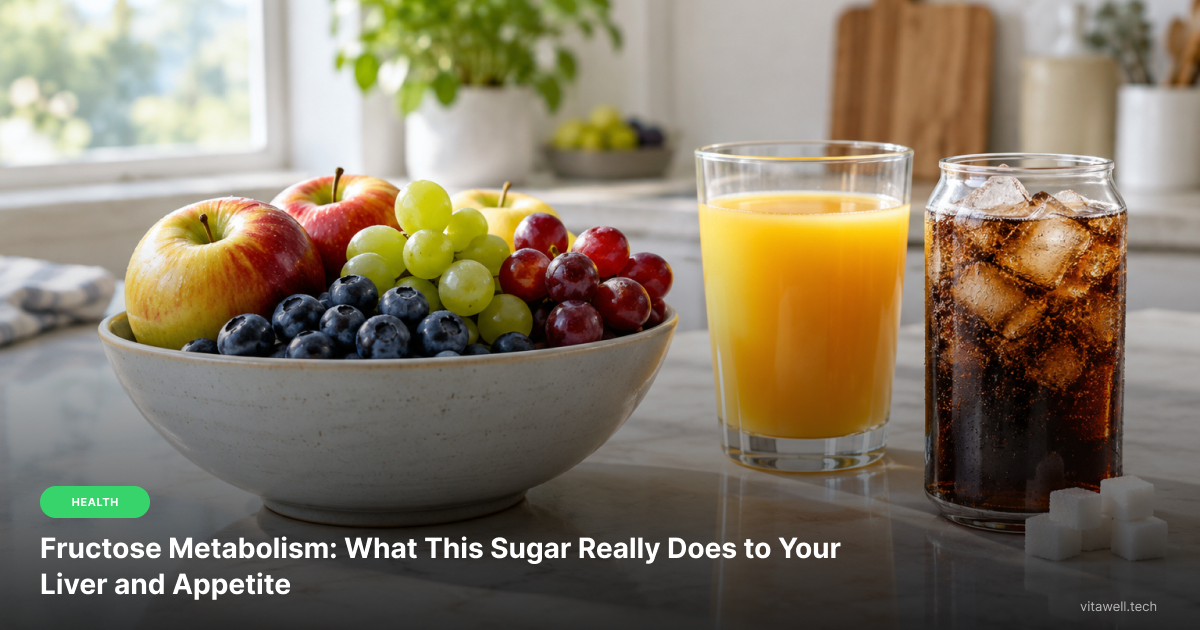
Fructose is a sugar the body handles mainly in the liver, and it skips a control step that slows glucose down. That makes it easier for the liver to turn excess fructose into fat: in a randomized trial, drinking 80 g a day of fructose or table sugar for 7 weeks roughly doubled the liver's fat production, while the same amount of glucose did not. The concern is excess fructose from sugary drinks and processed foods, not the fructose in whole fruit.
Key Takeaways
- Fructose metabolism happens mostly in the liver and is less tightly regulated than glucose metabolism.
- In a 2021 trial of 94 men, fructose- and sucrose-sweetened drinks roughly doubled liver fat production; glucose drinks did not.
- A 2026 review in Nature Metabolism argues fructose acts as a "metabolic signal" for fat storage. Parts of that model still rest mainly on animal studies.
- US adults eat about 17 teaspoons of added sugar a day, well above the WHO limit of 10% of energy.
- Whole fruit is linked to lower type 2 diabetes risk; fruit juice is linked to higher risk.
Where Fructose Hides in Your Diet
Pure fructose is rare in food labels, but it is half of most added sugar. Table sugar (sucrose) is 50% glucose and 50% fructose bonded together. High-fructose corn syrup (HFCS), used in many sodas and packaged foods, is most often 42% or 55% fructose, according to the US Food and Drug Administration.
Beyond obvious sweets, fructose turns up in sauces, dressings, flavored yogurts, breakfast cereals, bars and juices. Many of these are ultra-processed foods, a category VitaWell covers in its piece on ultra-processed foods and heart disease.
Fructose vs. Glucose: Why Your Body Treats Them Completely Differently
Glucose is the body's main fuel. It enters the blood, triggers insulin, and is taken up by muscles, brain and other organs. An enzyme step early in glucose processing acts as a brake: when cells have enough energy, the flow slows down.
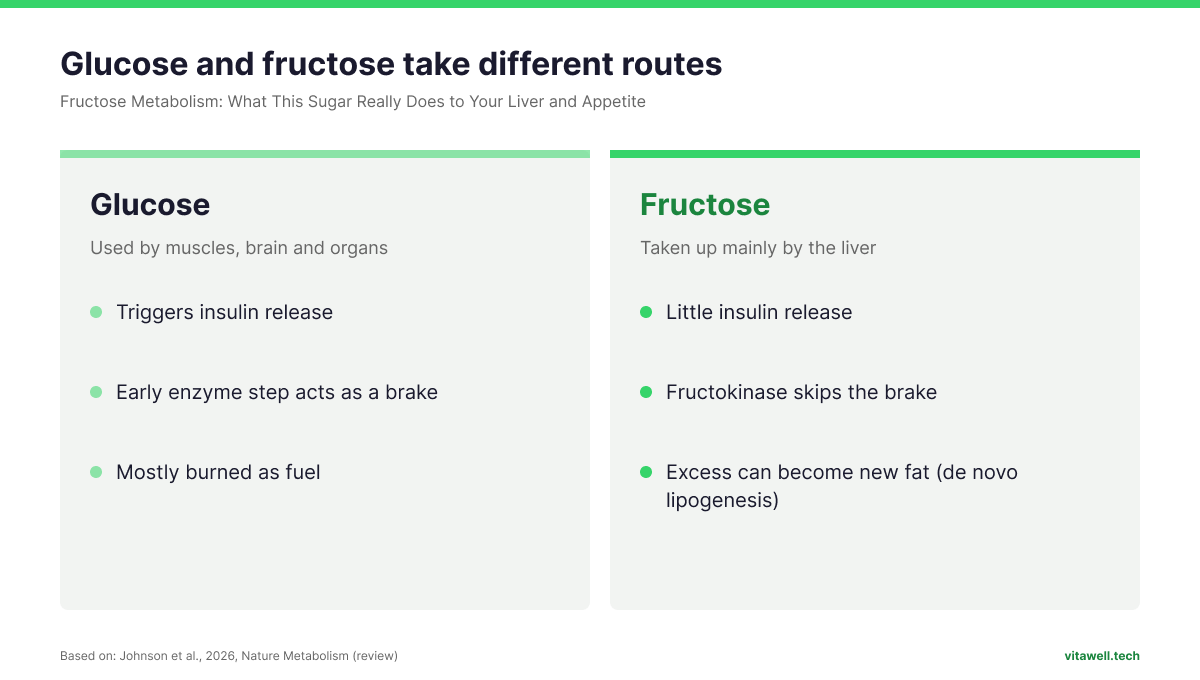
Fructose takes another route. Most of it is absorbed by the liver, where an enzyme called fructokinase processes it quickly and bypasses that brake. Fructose also triggers little insulin release. When more fructose arrives than the liver needs, a larger share can be channeled into de novo lipogenesis, the liver's process of making new fat from sugar.
"Fructose is not just another calorie," says Richard Johnson of the University of Colorado Anschutz, lead author of a 2026 review in Nature Metabolism. The review describes fructose as a signal that promotes fat production and storage in ways that differ from glucose.
What Human Trials Show About Fructose and Liver Fat
The clearest human evidence comes from controlled feeding trials. In a double-blind randomized trial by Bettina Geidl-Flueck and colleagues (Journal of Hepatology, 2021), 94 healthy men drank 80 g a day of fructose, sucrose or glucose in beverages for 7 weeks, or avoided sugary drinks.
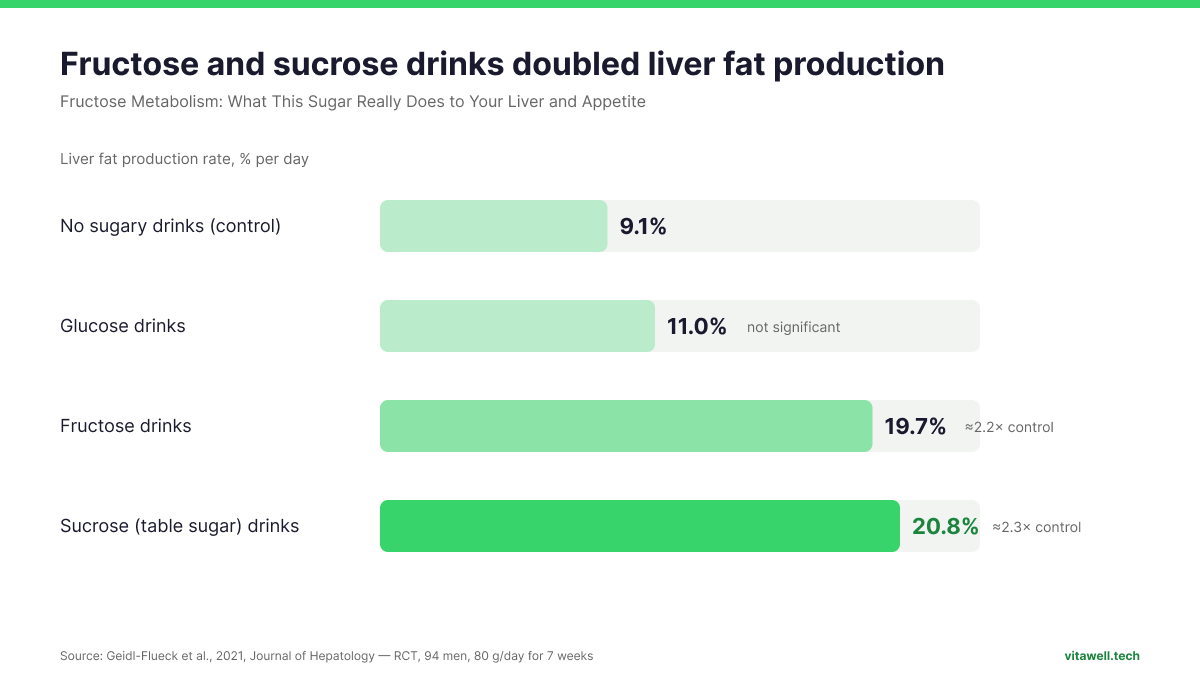
- Control (no sugary drinks): liver fat production rate of 9.1% a day.
- Glucose drinks: 11.0% a day, not a significant change.
- Fructose drinks: 19.7% a day, about 2.2 times control.
- Sucrose drinks: 20.8% a day, about 2.3 times control.
Table sugar raised fat production as much as pure fructose, which matters because sucrose is what most people actually eat. An earlier trial by Kimber Stanhope and colleagues (Journal of Clinical Investigation, 2009) gave overweight and obese adults drinks providing 25% of their energy for 10 weeks. Only the fructose group gained visceral fat, the fat around the organs, and became less sensitive to insulin. Visceral fat carries more risk than fat elsewhere, as VitaWell explains in its article on why waist size predicts heart failure risk.
Both trials used high doses in drinks, so they show what excess does, not what a piece of fruit does.
Why Fructose May Leave You Hungrier
The Nature Metabolism review highlights a second effect. Fast fructose processing uses up ATP, the cell's energy currency, faster than it is replaced. In the model the authors describe, that temporary energy dip in the liver may signal the brain to eat more, even after a high-calorie meal.
Fructose also triggers less insulin and leptin response than glucose, and both hormones help signal fullness. Much of the ATP evidence comes from animal and cell studies, so treat the hunger link as a strong hypothesis rather than a settled fact in humans.
Your Body Can Make Fructose Too
The review also points to endogenous fructose: the body can convert glucose into fructose through a route called the polyol pathway. In animal studies, high blood sugar, high salt intake and alcohol have been shown to switch this pathway on.
If the same holds in people, cutting added fructose would not be the whole answer. Lowering refined carbohydrates and excess salt would matter too. Human data on this pathway are still limited.
The Survival Switch Hypothesis
Johnson's group has long proposed that fructose once helped animals and early humans survive. Ripe fruit appeared in late summer, and responding to fructose by storing fat and eating more would have built reserves for winter.
Today that signal is on all year, because concentrated fructose is in drinks and packaged food at every meal. The idea fits the wider pattern of old instincts meeting new environments described in VitaWell's article on evolutionary mismatch. It is a useful hypothesis, not something experiments can fully test.
How Much Sugar Is Too Much?
The World Health Organization (2015) recommends keeping free sugars below 10% of daily energy, and suggests below 5%, about 25 g or 6 teaspoons, for extra benefit. On a 2,000-calorie diet, 10% is about 50 g.
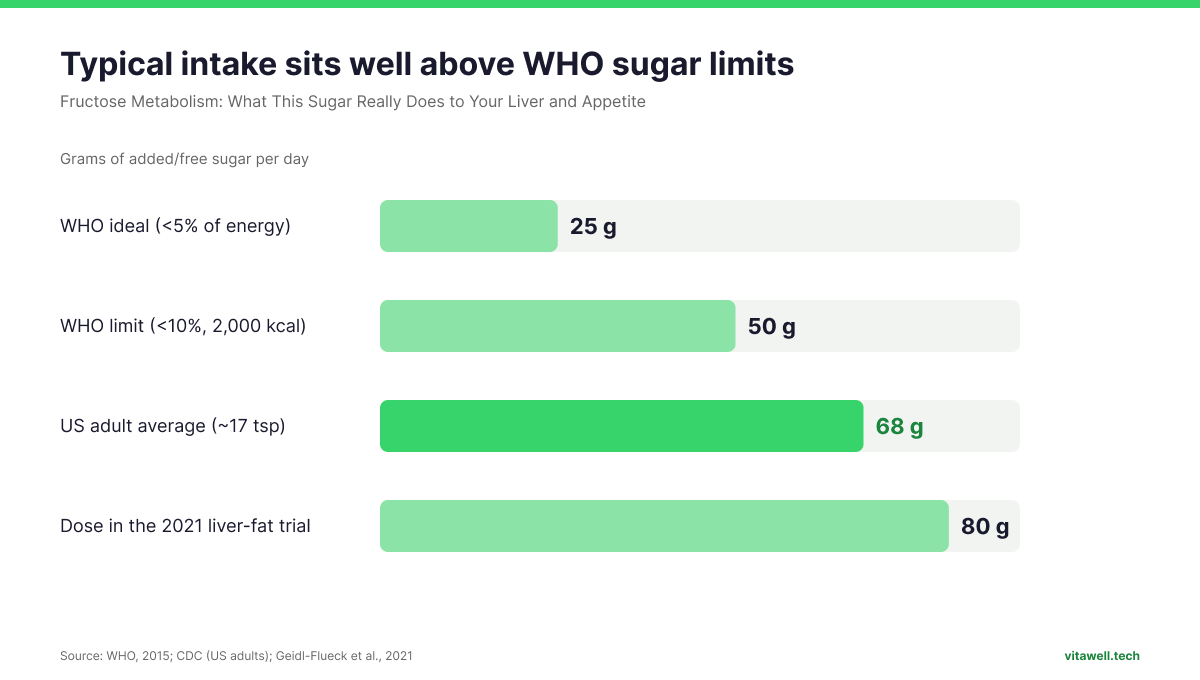
Actual intake is higher. According to the US Centers for Disease Control and Prevention, adults eat about 17 teaspoons of added sugar a day, roughly 68 g, with men at 19 teaspoons and women at 15. Sugar-sweetened drinks are the top source. The 80 g daily dose that doubled liver fat production in the 2021 trial is not far above that average.
Whole Fruit vs. Fruit Juice
Fruit contains fructose, but whole fruit also brings fiber and water, which slow eating and absorption. Population data point the same way. In a study of 187,382 adults followed for about 24 years, Isao Muraki and colleagues (BMJ, 2013) found:
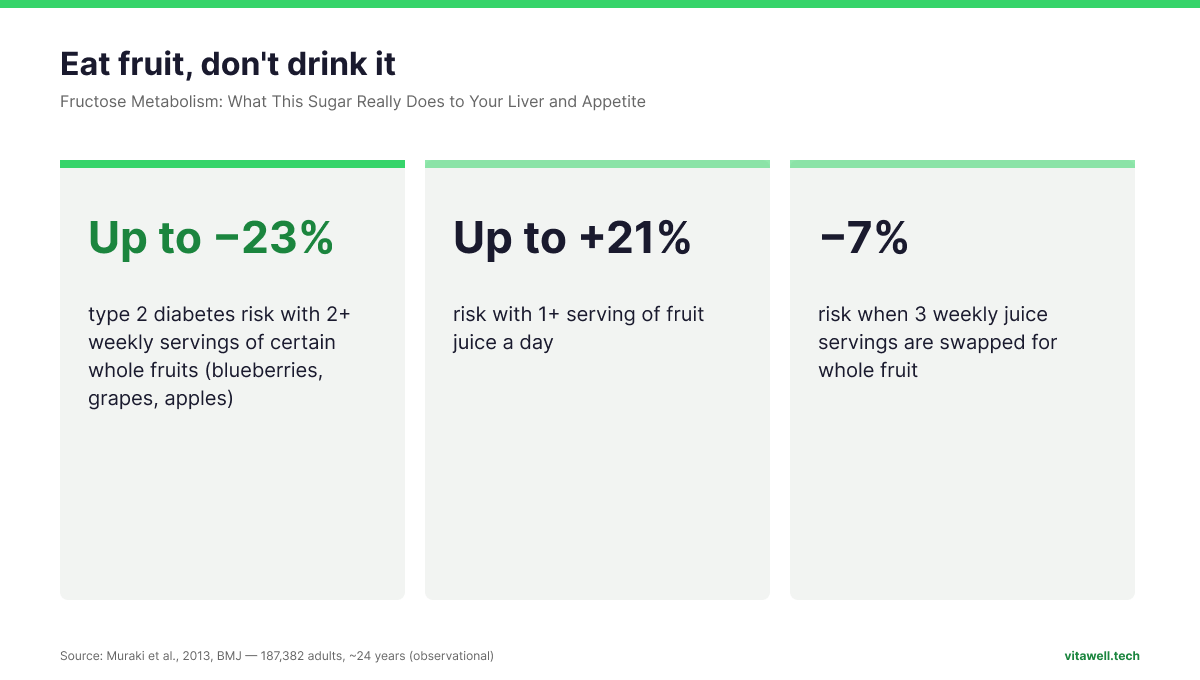
- Two or more servings a week of certain whole fruits, such as blueberries, grapes and apples, were linked to up to 23% lower type 2 diabetes risk.
- One or more servings of fruit juice a day was linked to up to 21% higher risk.
- Swapping three servings of juice a week for whole fruit was linked to 7% lower risk.
These are observational findings, so they show association, not cause. They still support a simple rule: eat fruit, do not drink it.
High-Fructose Corn Syrup vs. Table Sugar
Sucrose must be split in the gut before absorption, while HFCS arrives already split. In practice the difference is small: both deliver similar amounts of fructose, and in the 2021 trial sucrose raised liver fat production as much as pure fructose. Switching from HFCS-sweetened drinks to "made with real sugar" versions does not solve the problem. Cutting total added sugar does.
Fructose Metabolism: What Is Proven and What Is Still a Hypothesis
Coverage of fructose often mixes solid findings with early ideas. This table grades the main claims by the strength of their evidence.
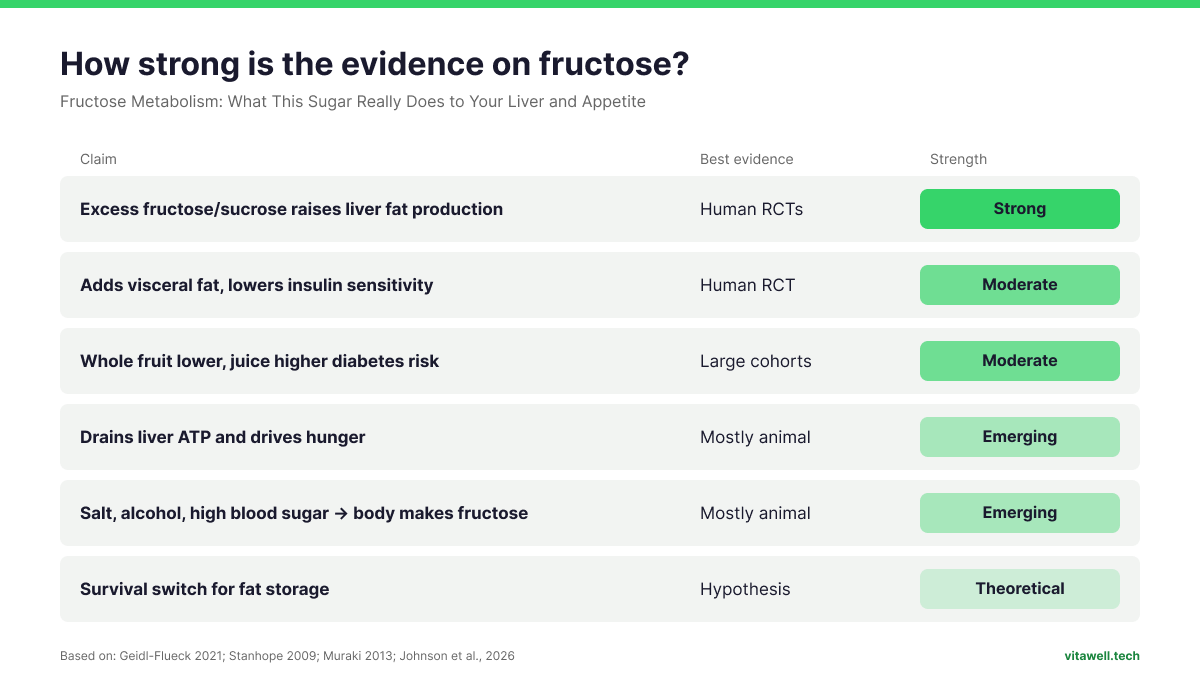
| Claim | Best evidence so far | Strength | What it means for you |
|---|---|---|---|
| Excess fructose and sucrose raise liver fat production | Randomized trials in humans (2009, 2021) | Strong | Cut sugary drinks first |
| Excess fructose adds visceral fat and lowers insulin sensitivity | Randomized trial in overweight adults (2009) | Moderate | Matters most if you carry weight around the waist |
| Whole fruit is linked to lower diabetes risk, juice to higher | Large cohort studies (2013) | Moderate | Eat fruit, limit juice |
| Fructose drains liver ATP and drives hunger | Mostly animal and mechanistic studies | Emerging | Plausible, not yet confirmed in people |
| Salt, alcohol and high blood sugar make the body produce fructose | Mostly animal studies | Emerging | Another reason to limit refined carbs and salt |
| Fructose evolved as a survival switch for fat storage | Evolutionary hypothesis | Theoretical | Explains the pattern, not a basis for diet rules |
6 Practical Steps to Cut Excess Fructose
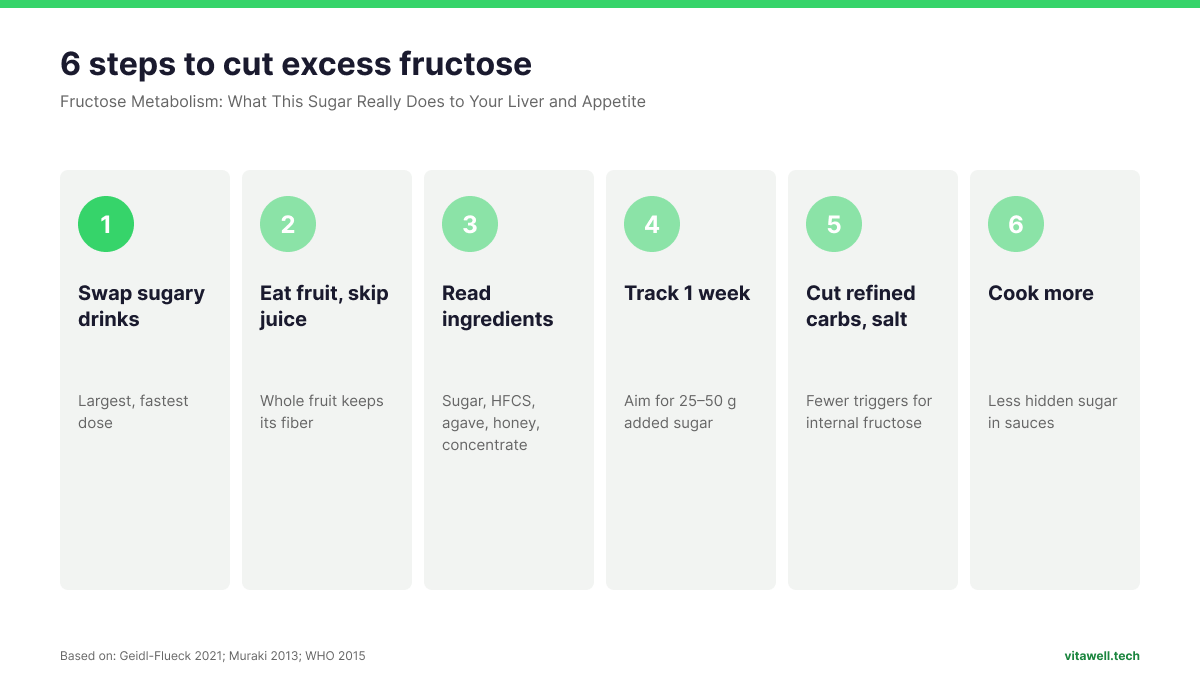
- Replace sugary drinks first. They deliver the largest, fastest doses. Water, sparkling water or unsweetened tea work; VitaWell's article on whether diet drinks help weight loss covers a middle step.
- Eat fruit, do not drink it. Keep whole fruit and cap juice at a small glass, if any.
- Read the ingredient list. Look for sugar, HFCS, fructose, agave, honey and fruit juice concentrate near the top.
- Track grams for one week. Add up added sugar from labels and compare with the WHO range of 25–50 g a day.
- Lower refined carbs and excess salt. This reduces the triggers for the body's own fructose production suggested in animal work.
- Cook more of your meals. Sauces, dressings and baked goods made at home contain far less added sugar.
When to Talk to a Professional
- You have been told you have fatty liver disease, now called MASLD, or have raised liver enzymes.
- You have prediabetes, type 2 diabetes, high triglycerides or a large waist measurement.
- You have gout, which is linked to high fructose intake.
- You plan a major diet change while taking diabetes or blood pressure medication.
A doctor or registered dietitian can check liver markers and set a sugar target that fits your health.
Frequently Asked Questions
Is fructose worse than glucose?
In excess, fructose appears more likely to be turned into liver fat. In a 2021 randomized trial, 80 g a day of fructose in drinks roughly doubled liver fat production, while the same amount of glucose did not. Both sugars add calories, so the practical goal is to cut total added sugar, especially from drinks.
Is fruit bad for you because of fructose?
No. Whole fruit contains modest amounts of fructose along with fiber and water. A study of more than 187,000 adults linked two or more weekly servings of fruits such as blueberries, grapes and apples to up to 23% lower diabetes risk. Fruit juice is different and was linked to higher risk.
Is high-fructose corn syrup worse than sugar?
Not by much. HFCS is usually 42% or 55% fructose, and table sugar is 50%. In a 2021 trial, sucrose drinks raised liver fat production as much as pure fructose drinks. Switching from HFCS to "real sugar" products changes little; reducing total added sugar is what matters for metabolic health.
How much fructose per day is safe?
There is no official fructose limit. The WHO advises keeping all free sugars below 10% of energy, about 50 g on a 2,000-calorie diet, and ideally below 5%, about 25 g. Since added sugars are roughly half fructose, staying within those limits keeps fructose low. Fructose in whole fruit is not counted as free sugar.
Does fructose cause fatty liver?
Excess fructose is one contributor, not the only cause. Trials show it raises the liver's fat production, and high intake from sugary drinks is linked to fatty liver disease. Overall calorie surplus, weight, alcohol, genetics and inactivity also play major roles. Cutting sugary drinks is one of the most direct steps.
Conclusion
Fructose is not toxic in small amounts, and whole fruit remains a healthy food. The problem is the steady flow of added sugar, half of it fructose, from drinks and packaged foods. Human trials show that this excess pushes the liver toward making fat, and newer research suggests it may also affect hunger. Start with the highest-impact change: replace one sugary drink a day this week. VitaWell's AI life planner can help you track the habit in your Health area.
Related on VitaWell
- Keto Diet May Be the Best Way to Reverse Type 2 Diabetes — what cutting sugar and starch does for blood sugar control.
- How Many Steps a Day to Keep Weight Off? — pairs well with lower sugar intake for long-term weight maintenance.
- The Real Superfood Is a Pattern, Not a Product — why overall eating patterns matter more than single ingredients.
This article is for informational purposes only and is not a substitute for professional medical advice.
Sources
- ScienceDaily — Scientists say this common sweetener may be quietly rewiring your metabolism
- Johnson et al., 2026 — Fructose: metabolic signal and modern hazard (Nature Metabolism)
- University of Colorado Anschutz, 2026 — New report highlights fructose as a key driver of metabolic disease
- Geidl-Flueck et al., 2021 — Fructose- and sucrose- but not glucose-sweetened beverages promote hepatic de novo lipogenesis (Journal of Hepatology)
- Stanhope et al., 2009 — Fructose-sweetened, not glucose-sweetened, beverages increase visceral adiposity (Journal of Clinical Investigation)
- Muraki et al., 2013 — Fruit consumption and risk of type 2 diabetes (BMJ)
- World Health Organization, 2015 — Guideline on sugars intake for adults and children
- CDC — Get the Facts: Added Sugars
- US FDA — High Fructose Corn Syrup Questions and Answers