
How Many Steps a Day to Keep Weight Off? What the 8,500-Step Study Shows
A 2026 meta-analysis links about 8,500 daily steps to keeping lost weight off. Here is what the data shows, its limits, and how to turn your step gap into minutes.

To keep lost weight off, aim for about 8,500 steps a day. In a 2026 meta-analysis of 14 trials with 3,758 adults, people in lifestyle programs who rose to roughly 8,500 steps a day while dieting, and held about 8,200 afterwards, kept most of their weight loss. Control groups that did not add steps kept off much less. The number is an average from those trials, not a tested threshold, but it gives a realistic daily step count to work toward.
Key Takeaways
- A 2026 meta-analysis of 14 randomized trials linked about 8,500 daily steps with keeping weight off after a diet.
- Participants started near 7,280 steps a day, so the target meant adding roughly 1,200 steps, about 12 minutes of brisk walking.
- During maintenance, each extra 1,000 steps a day was linked to 1.1% more of the lost weight being kept off.
- Steps seem to matter most after the diet ends. While losing weight, eating less does most of the work.
- 10,000 steps has no special evidence behind it. Large reviews show broad health benefits from around 7,000 steps.
Why Keeping Weight Off Is Harder Than Losing It
Professor Marwan El Ghoch of the University of Modena and Reggio Emilia, who led the 2026 study, says that around 80% of people with overweight or obesity who lose weight regain some or all of it within three to five years. That figure is his summary of the field, not a result of this study, but it matches long-standing clinical experience.
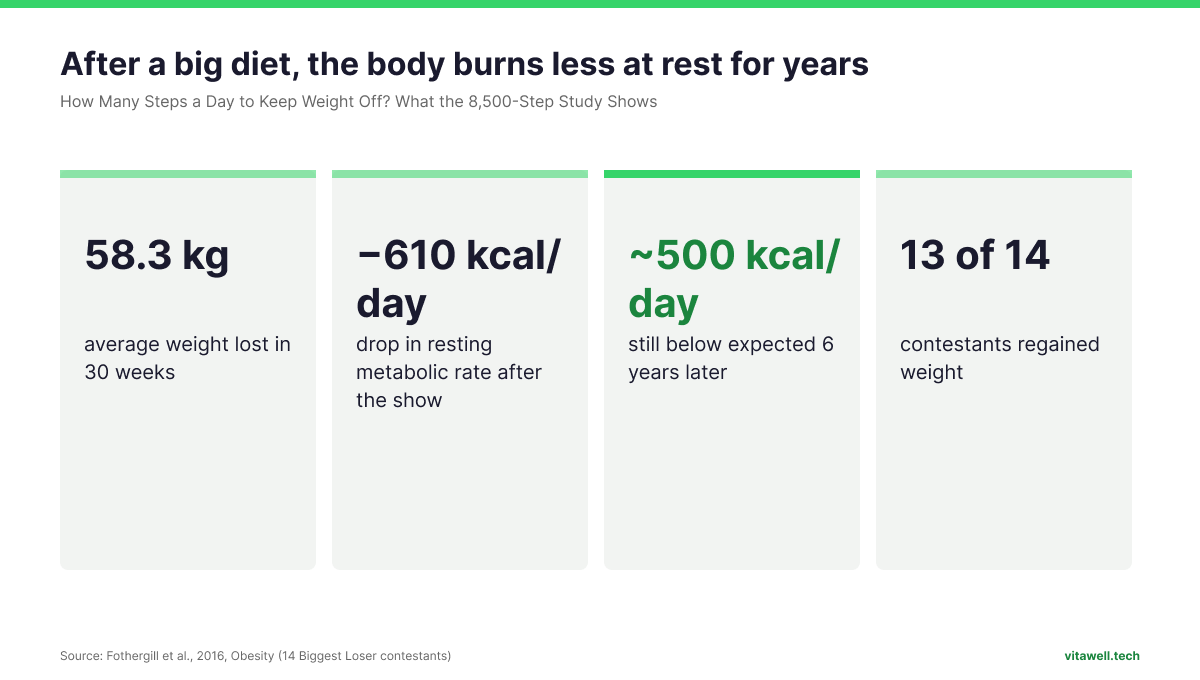
Part of the reason is metabolic adaptation: after weight loss, the body burns fewer calories at rest than its new size would predict. The most extreme measured case comes from Erin Fothergill and colleagues (Obesity, 2016), who followed 14 contestants from the TV show The Biggest Loser. They lost 58.3 kg on average in 30 weeks, and their resting metabolic rate fell by 610 kcal a day. Six years later it was still about 500 kcal a day lower than expected for their size, and 13 of the 14 had regained weight.
Most diets are far less extreme, so the gap is usually smaller. The direction is the same, though: after a diet, the body pushes back. That is why the maintenance phase needs its own strategy, not just "keep doing what worked."
What the 8,500-Steps Study Actually Found
The study is a systematic review and meta-analysis, a method that pools results from many trials. El Ghoch's team reviewed 18 randomized controlled trials of lifestyle programs for obesity and pooled 14 of them, with 3,758 adults (average age 53, average BMI 31) from countries including the UK, US, Australia and Japan. It was presented at the European Congress on Obesity in May 2026, as described in the official press release (EurekAlert, 2026), and published in the International Journal of Environmental Research and Public Health (Saadeddine et al., 2026).
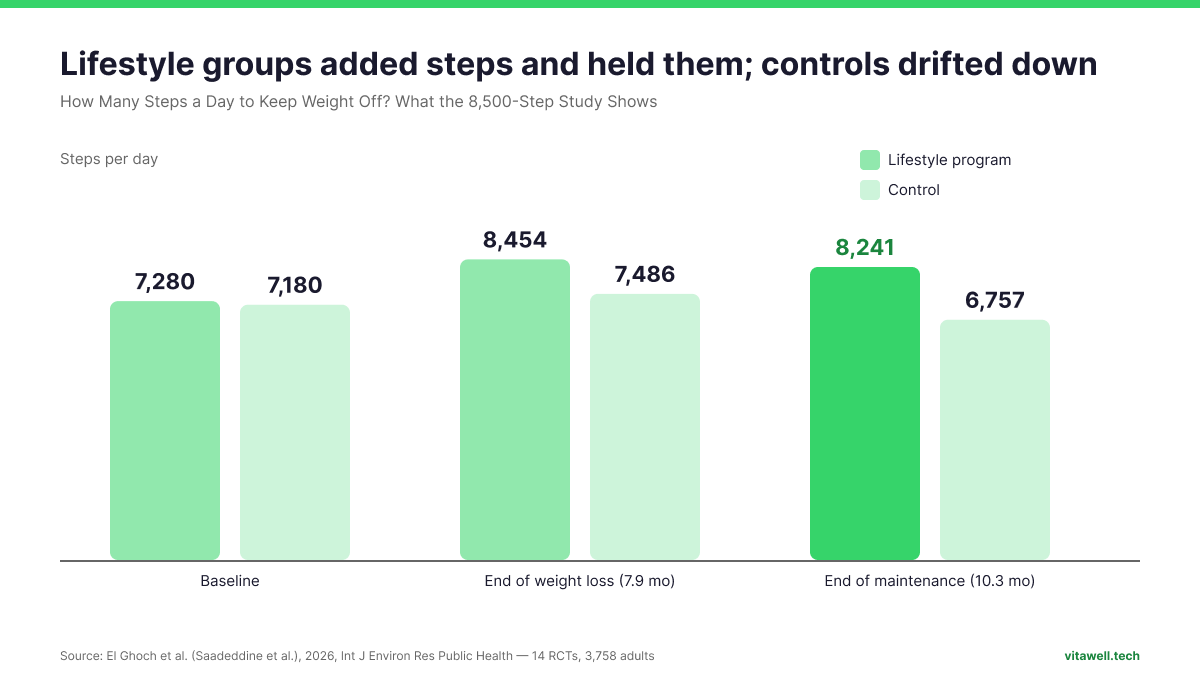
- Start: 7,280 steps a day in the lifestyle groups (1,987 people) and 7,180 in the control groups (1,771 people).
- Weight loss phase (about 7.9 months): lifestyle groups rose to 8,454 steps a day and lost 4.39% of body weight, about 4 kg.
- Maintenance phase (about 10.3 months): lifestyle groups held 8,241 steps a day and stayed 3.28% below their starting weight, about 3 kg.
- Controls: 7,486 steps at the end of the loss phase and 6,757 at the end of maintenance.
According to a Healio summary of the journal paper (2026), the lifestyle groups ended maintenance 2.29 percentage points further below their starting weight than controls.
Limits worth knowing: 8,500 is the rounded average participants reached, not a cut-off the trials tested. The maintenance average was slightly lower, at 8,241. The step-weight links come from meta-regression, which shows association rather than proof that steps caused the result, and the programs also changed diet.
Why 8,500 Steps, Not 10,000
The 10,000-step goal is usually traced to a 1960s Japanese pedometer marketed as manpo-kei, meaning "10,000-step meter." It was a slogan, not a clinical finding, and it has stuck for decades.
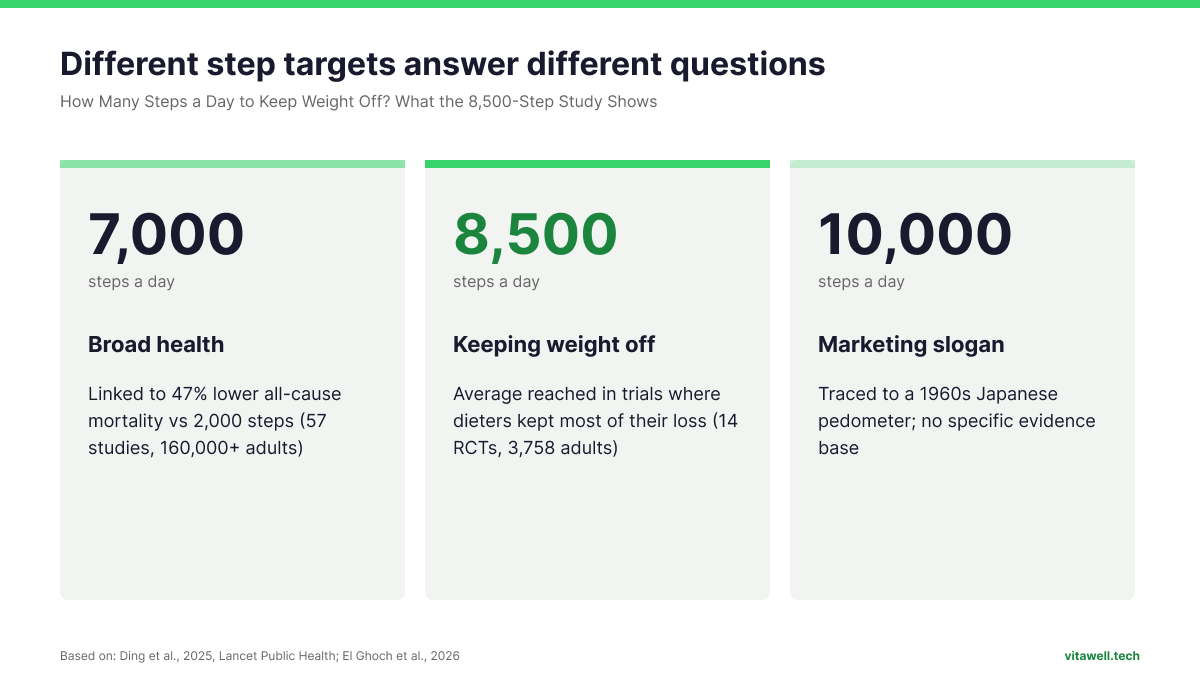
Newer evidence points lower. A review by Ding Ding and colleagues (The Lancet Public Health, 2025) pooled 57 studies covering more than 160,000 adults. Compared with 2,000 steps a day, 7,000 steps was linked to 47% lower risk of death from any cause, 25% lower cardiovascular disease, 38% lower dementia and 22% lower depression. The authors called 7,000 "a more realistic target" than 10,000.
The two numbers answer different questions. About 7,000 steps covers broad health. About 8,500 is the level that tracked with keeping lost weight off. More is fine if you enjoy it, but 10,000 is not a line you need to cross.
How Walking Works Differently for Maintenance vs. Weight Loss
While people were actively losing weight, extra steps were not clearly linked to extra loss. The press release says step increases were not associated with greater loss in that phase, while the Healio summary reports a modest association. Either way, the calorie deficit from eating less is the main driver of loss, which is why diet comes first in VitaWell's guide on simple and effective approaches to losing weight.
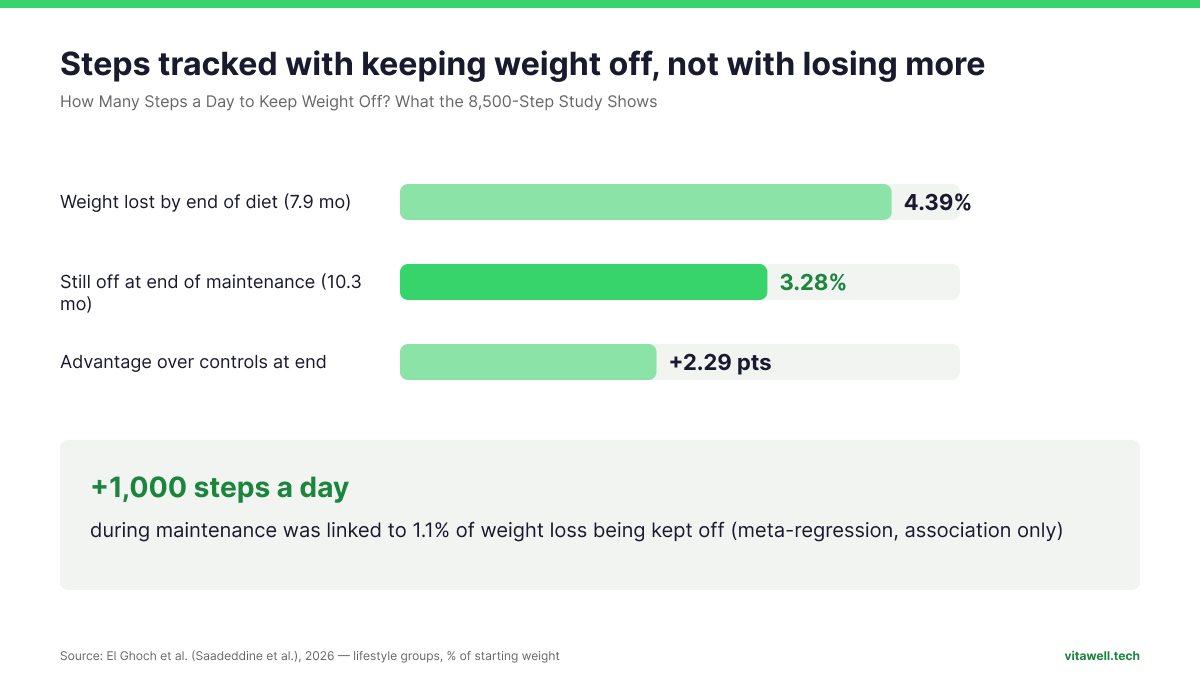
Maintenance is where steps matter more clearly. In the meta-regression, every additional 1,000 steps a day during maintenance was linked to 1.1% of weight loss being kept off. A plausible reason is that walking adds steady daily energy use without the hunger spike that hard workouts can bring, which helps offset the slower metabolism after a diet. That mechanism is reasonable but was not tested directly in these trials.
The practical rule: build steps during the diet, then protect them once the diet ends. That is when most people drift back to old routines.
Your Step Gap in Minutes
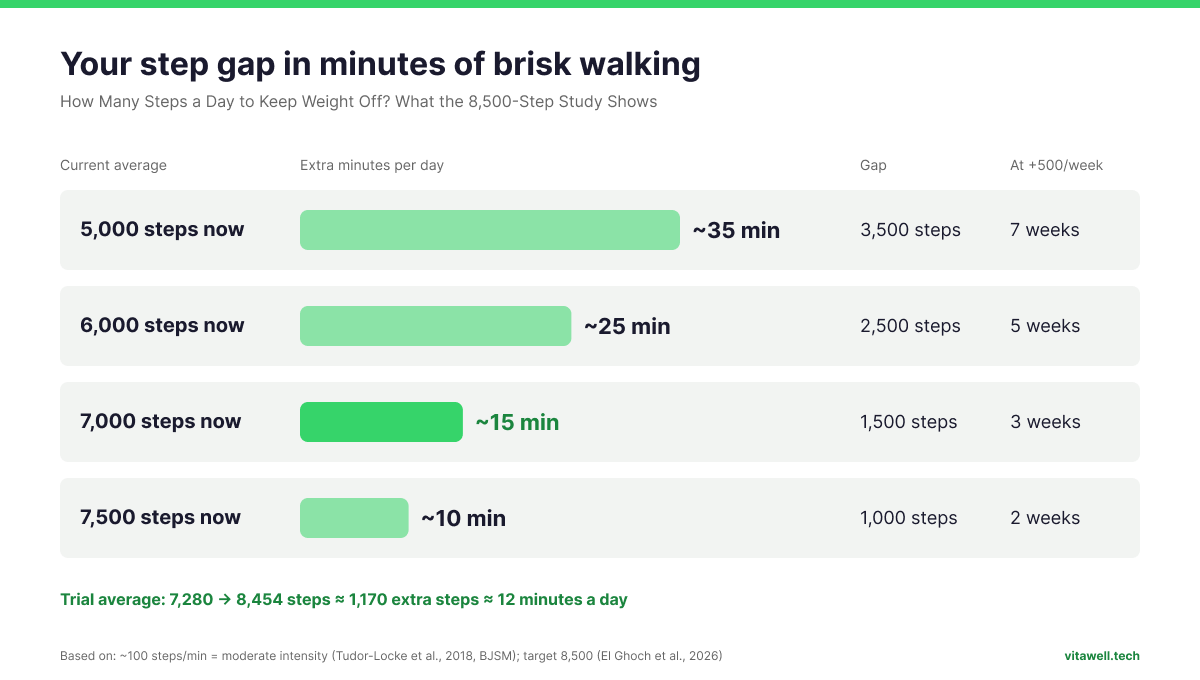
Step counts are easier to plan as time. A review by Catrine Tudor-Locke and colleagues (British Journal of Sports Medicine, 2018) of 38 studies found that about 100 steps a minute marks moderate-intensity walking for healthy adults. At that pace, every 1,000 extra steps is about 10 minutes of brisk walking.
| Your current daily average | Gap to 8,500 | Extra brisk walking per day | Weeks to get there at +500 steps a week |
|---|---|---|---|
| 5,000 steps | 3,500 steps | About 35 minutes | 7 weeks |
| 6,000 steps | 2,500 steps | About 25 minutes | 5 weeks |
| 7,000 steps | 1,500 steps | About 15 minutes | 3 weeks |
| 7,500 steps | 1,000 steps | About 10 minutes | 2 weeks |
| 8,500 steps or more | None | Hold your current routine | Already there |
For the average trial participant, going from 7,280 to 8,454 steps meant about 1,170 extra steps, roughly 12 minutes a day. In maintenance, the gap between the lifestyle groups and controls was about 1,480 steps, roughly 15 minutes. The difference between regaining and holding weight in these trials came down to about a quarter of an hour of walking a day.
A 5-Step Plan to Keep Weight Off With 8,500 Steps a Day
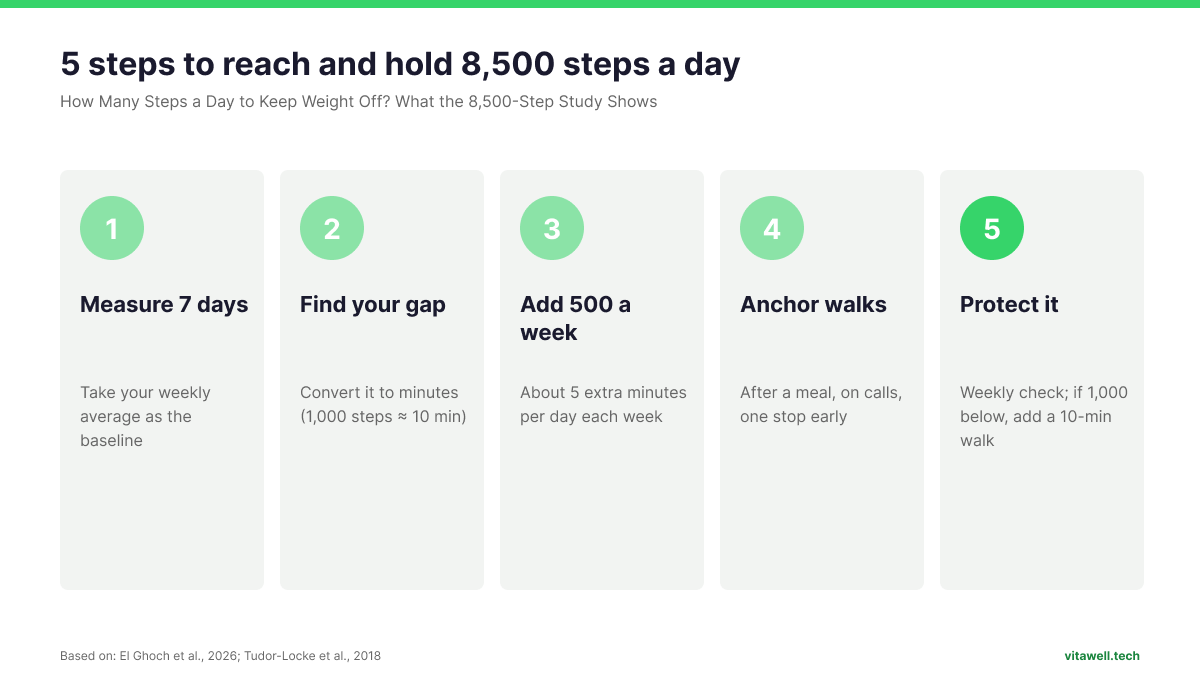
- Measure your baseline for 7 days. Wear your phone or tracker as usual and take the weekly average. One day says little.
- Find your gap in the table above. Turn it into minutes so it fits your calendar.
- Add about 500 steps a day each week. That is roughly 5 extra minutes of walking per day per week, small enough to keep.
- Anchor walks to things you already do. Walk after one meal, take calls on foot, or get off transit one stop early. Desk workers can use short hourly breaks, as covered in VitaWell's guide to daily movement for desk workers.
- Protect the number after the diet ends. Check your weekly average every Sunday. If it slips more than 1,000 steps below target, add one planned 10-minute walk a day until it recovers.
Combining Steps With Other Lifestyle Factors
Steps are one lever. The trials in this meta-analysis were full lifestyle programs, so walking worked alongside other changes.
- Consistent eating: the habits that created the loss need a sustainable version, not a return to old portions.
- Strength training: it helps preserve muscle, which supports resting energy use. VitaWell's article on 90 minutes of strength training a week covers a realistic dose.
- Sleep: short or irregular sleep makes appetite harder to manage. See VitaWell's piece on the sleep window linked to healthier aging.
- Support and tracking: regular self-checks, such as weekly step averages and weigh-ins, help catch drift early.
Tracking Your Steps Accurately
Any phone or wearable that counts steps is enough. Built-in apps (Apple Health, Google Fit, Samsung Health), fitness bands and basic clip-on pedometers all work. The trials in the meta-analysis used pedometers or accelerometers.
- Use the same device every day so your numbers stay comparable.
- Carry or wear it from morning to evening; steps left on a desk do not count.
- Judge progress by the 7-day average, not single days.
When to Talk to a Professional
- You have heart, lung, joint or balance problems, or you have been mostly inactive, and want to raise your activity quickly.
- Walking causes chest pain, unusual breathlessness, dizziness or joint pain that does not settle.
- You are regaining weight despite steady habits, which can have medical causes worth checking.
- You use weight-loss medication and plan to stop or change it.
A doctor, physiotherapist or registered dietitian can adjust the target to your health and history.
Frequently Asked Questions
How many steps a day do I need to keep weight off?
About 8,500 steps a day is the best current estimate. In a 2026 meta-analysis of 14 trials with 3,758 adults, people who reached roughly that level while dieting and kept it up afterwards held most of their weight loss. It is an average from the trials, so treat it as a target rather than a strict threshold.
Is 10,000 steps a day necessary?
No. The 10,000 figure is usually traced to a 1960s Japanese pedometer slogan rather than research. A 2025 review of 57 studies linked 7,000 steps a day with 47% lower risk of death than 2,000 steps. For weight maintenance, about 8,500 steps tracked with keeping weight off. More steps are fine, but not required.
How long does it take to walk 8,500 steps?
If every step came from brisk walking at about 100 steps a minute, 8,500 steps would take roughly 85 minutes. In practice, most people already get several thousand steps from daily life. Someone at 7,000 steps needs only about 15 extra minutes of brisk walking a day to reach 8,500.
Can walking alone prevent weight regain?
Probably not on its own. The trials behind the 8,500-step figure were full lifestyle programs that also changed eating habits, and the step-weight link is an association. Walking is a strong, low-cost part of a maintenance plan, best combined with consistent eating, strength training, good sleep and regular self-monitoring.
Do everyday steps count, or only walks?
All steps count toward the daily total, including errands, stairs and moving around at home. The trials measured total daily steps with pedometers or accelerometers. Brisk walks add steps fastest and also bring moderate-intensity activity, so a mix of planned walks and more movement during the day works well.
Conclusion
The hardest part of weight loss is keeping it, and the evidence now offers a concrete, modest target: about 8,500 steps a day, held after the diet ends. For most people that means 10 to 35 extra minutes of brisk walking, built up 500 steps at a time. Measure your baseline this week, find your gap in the table, and add your first 500 steps. VitaWell's AI life planner can help you track the habit in your Health area.
Related on VitaWell
- Walking: The Simplest Habit That Improves Your Life — the wider health case for daily walking beyond weight.
- How to Build a Sustainable Fitness Habit — how to make a new step target stick past the first month.
- Semaglutide Helps People Eat 24% Fewer Calories Over a Full Year — the eating side of weight management, for readers using GLP-1 medication.
This article is for informational purposes only and is not a substitute for professional medical advice.
Sources
- ScienceDaily — Scientists say 8,500 steps a day could stop weight from creeping back
- Saadeddine et al., 2026 — Daily steps and weight maintenance meta-analysis (International Journal of Environmental Research and Public Health)
- European Association for the Study of Obesity, 2026 — ECO 2026 press release
- Healio, 2026 — Walking 8,500 steps per day may help maintain weight loss
- Ding et al., 2025 — Daily steps and health outcomes in adults (The Lancet Public Health)
- Fothergill et al., 2016 — Persistent metabolic adaptation 6 years after The Biggest Loser (Obesity)
- Tudor-Locke et al., 2018 — Walking cadence as a practical estimate of intensity (British Journal of Sports Medicine)