
Just 90 Minutes of Strength Training Per Week Can Lower Your Risk of Death — What a 30-Year Study Found

Most people assume that making a real difference to their long-term health requires serious commitment: hours at the gym, daily workouts, and a willingness to push hard every session. A landmark study published in June 2026 challenges that assumption in the most compelling way possible. According to three decades of data from nearly 150,000 participants, just 90 minutes of strength training per week is associated with a 13% lower risk of dying from any cause. The research, published in the British Journal of Sports Medicine, is one of the most comprehensive investigations into resistance training and mortality ever conducted — and it adds a surprising new dimension: strength training may protect not just your heart, but your brain.
The Study That Changed How We Think About Strength Training
30 Years of Data, 147,374 Participants
The study is built on an extraordinary foundation of longitudinal data. Researchers drew from three large, well-established cohort studies: the Health Professionals Follow-up Study (1992–2022), the Nurses’ Health Study (2002–2021), and the Nurses’ Health Study II (2003–2021). Together, these encompassed 147,374 participants with an average age of 54 at enrollment — 31,540 men and 115,834 women. Every two years for up to 30 years, participants reported how much time they spent on both aerobic exercise and strength training. By the end of the study period, 35,798 participants had died, providing researchers with a vast dataset for analysis.
What the Researchers Were Trying to Find
While the cardiovascular benefits of aerobic exercise have been well established for decades, the relationship between resistance training and long-term mortality had received considerably less scientific attention. “Physical activity is not one single behavior,” explained Yiwen Zhang, PhD, the study’s first author and a postdoctoral research fellow at the Harvard T.H. Chan School of Public Health. “Aerobic activity and resistance training may benefit health through different pathways, so it is important to study them separately and together.” Corresponding author Edward Giovannucci, MD, ScD, professor of nutrition and epidemiology at Harvard, confirmed that the goal was to clarify how resistance training relates to long-term mortality risk at different volumes and in combination with aerobic activity.
What the Numbers Actually Mean
13% Lower Risk of Death From Any Cause
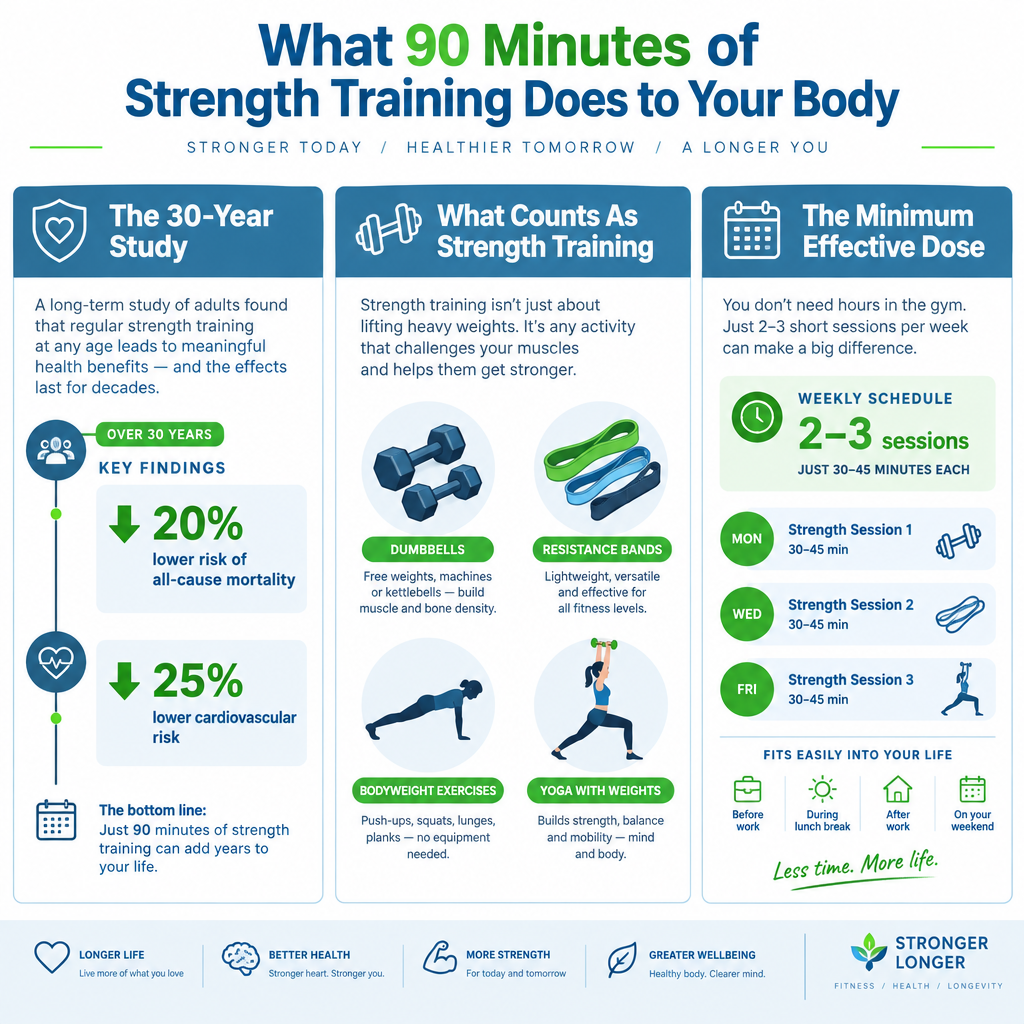
The headline finding: participants who performed 90 to 119 minutes of strength training per week had a 13% lower risk of dying from any cause during the study period, compared to those who did no strength training at all. No additional benefit was observed above 120 minutes per week — meaning more is not necessarily better. In practical terms, 90 minutes across a week works out to three 30-minute sessions, or two 45-minute workouts. For most people, that is entirely feasible.
19% Lower Cardiovascular Disease Mortality
Participants who trained at the 90–120 minute per week range showed a 19% lower risk of dying from cardiovascular disease. This aligns with decades of prior evidence: resistance training improves blood pressure, cholesterol levels, insulin sensitivity, and overall cardiovascular function. As Dr. Mary Greene of Manhattan Cardiology explained, “By training and growing your muscle mass, you can improve your metabolic health and help reduce cardiovascular risk.” Strength training does not merely make muscles stronger — it fundamentally improves the biological environment in which the heart and circulatory system operate.
The Surprising Finding: 27% Lower Neurological Disease Mortality
Perhaps the most striking — and underreported — finding of the study is the association between regular strength training and neurological disease mortality. Participants who trained 90–120 minutes per week showed a 27% lower risk of dying from neurological conditions, including dementia and other neurodegenerative diseases. “For neurological disease mortality, there has been growing evidence suggesting that strength training may help preserve cognitive function,” said Giovannucci, while also urging caution in interpretation. Neurodegenerative diseases can begin years before diagnosis, and early symptoms may reduce motivation to exercise, making the causal direction difficult to establish. More research is needed, but the implication is significant: as the global population ages, strength training may be a meaningful tool for protecting brain health.
- Strength training may preserve cognitive function by increasing cerebral blood flow and reducing neuroinflammation
- The 27% lower neurological mortality is a correlation, not confirmed causation — more research is needed
- Conditions such as Alzheimer’s may reduce exercise capacity before diagnosis, potentially confounding the data
The Ceiling Effect — Why More Is Not Always Better
One of the most practically useful findings is the dose-response plateau. Beyond 120 minutes of strength training per week, no additional reduction in mortality risk was observed. This “ceiling effect” removes the pressure to train excessively. For cancer mortality specifically, risk reductions were observed even at lower volumes — 9% lower at 1–29 minutes per week, and 12% lower at 30–59 minutes per week — suggesting that even modest resistance training carries meaningful benefits.
The Power Combination — Aerobic + Resistance Training
Different Exercise Types, Different Biological Pathways
The study also examined the combination of aerobic exercise and resistance training, and the findings were clear: the combination produces the lowest overall mortality risk. The reason lies in the different biological pathways each type activates:
- Aerobic exercise: improves hemodynamics (blood flow and pressure regulation), optimizes lipid profiles, and enhances cardiorespiratory fitness
- Resistance training: improves glucose metabolism, increases lean muscle mass, preserves functional strength, and reduces frailty
As Dr. Swapnil Patel, MD, of Hackensack Meridian Jersey Shore University Medical Center put it: “Aerobic exercise is generally linked to improved hemodynamics, lipid profiles, and cardio-respiratory fitness, whereas resistance training helps preserve muscle mass, improve functional strength, enhance glucose metabolism, and reduce frailty.”
What the Optimal Weekly Mix Looks Like
The lowest mortality risks were observed among participants who combined high levels of aerobic activity with 60 to 119 minutes of resistance training per week. A practical interpretation: the goal is not to choose between cardio and weights, but to fit both into your weekly routine. A balanced week might include 150 minutes of moderate aerobic activity (the US guideline standard) distributed across several days, combined with two to three 30–45 minute strength training sessions — a sustainable, health-forward plan.
What Counts as Strength Training? (More Than You Think)
One of the most encouraging aspects of this research is the broad definition of what qualifies as strength training. Many people assume it requires a gym membership or heavy barbells. The reality is far more accessible. All of the following count:
- Free weights (dumbbells, barbells)
- Weight machines
- Bodyweight exercises — push-ups, squats, lunges, dips, planks
- Resistance bands
- Yoga (many poses build significant muscle strength)
- Pilates
- Gardening and strenuous yard work
- Core exercises — crunches, leg raises, bird dogs
This broad scope means that many people are already doing more strength training than they realize — and those who are not have a wide variety of accessible, low-cost options available to them.
Beyond Longevity — The Other Benefits of Regular Strength Training
The mortality data is compelling on its own, but the benefits of consistent strength training extend well beyond lifespan. The evidence supports a wide range of positive health outcomes:
- Increased bone density and reduced risk of osteoporosis
- Lower blood pressure and improved cardiovascular risk profile
- Better cholesterol levels and improved insulin sensitivity
- Significantly reduced risk of developing type 2 diabetes
- Improved mental health — resistance training is consistently linked to reduced anxiety and depression
- Better sleep quality
- Improved body composition — more lean muscle, less body fat
- Reduced frailty and improved functional independence as we age
How to Start — A Practical Guide for Beginners
Start Small and Progress Gradually
If you are not currently doing any strength training, the most important step is to begin — and to begin modestly. Even 1–29 minutes per week is associated with reduced cancer mortality risk. The goal is to build a habit first, then increase volume progressively. A sensible starting point is two sessions per week of 30 minutes each, focusing on major muscle groups: legs, back, chest, shoulders, and core. Over four to six weeks, extend each session to 40–45 minutes, working toward the 90-minute weekly target.
Getting Professional Guidance
For beginners, professional guidance is a worthwhile investment. As Dr. David Cutler, a board-certified family medicine physician at Providence Saint John’s Health Center, noted: “There are some dangers in strength training exercise regarding injury, and I think getting some guidance from a trainer is actually a very good idea and money that’s very well spent to avoid injury.” A single session with a certified personal trainer can teach you proper form on key compound movements — squats, deadlifts, rows, and presses — and significantly reduce injury risk from the outset.
Sample Weekly Plan to Hit 90 Minutes
The following schedule reaches the 90-minute strength training target while also including aerobic activity:
- Monday: 30-minute strength training (lower body) + 30-minute brisk walk
- Tuesday: 30-minute moderate aerobic exercise (cycling or swimming)
- Wednesday: 30-minute strength training (upper body)
- Thursday: Active rest or light yoga
- Friday: 30-minute strength training (full body compound movements)
- Saturday: 45–60 minute aerobic activity (running, hiking, or cycling)
- Sunday: Rest
Study Limitations — What We Still Don’t Know
Transparency about the limits of this research matters. The study carries several important caveats:
- Data was self-reported — exercise amounts were based on participants’ own recollections, not objective measurement
- Some strength-training activities, including calisthenics and Pilates, were not captured in the data
- The study did not capture information on session intensity or load, both of which influence outcomes
- As an observational study, it establishes correlation, not causation — healthier individuals may naturally be more active
- The study population was predominantly healthcare professionals, limiting generalizability
- The neurological findings, in particular, require significantly more research before firm conclusions can be drawn
Conclusion
The message from this 30-year, nearly 150,000-person study is both powerful and reassuring: you do not need to spend hours lifting weights to meaningfully extend your life. Just 90 to 120 minutes of strength training per week — achievable in two or three short sessions — is associated with a 13% lower risk of all-cause mortality, a 19% lower risk of cardiovascular disease death, and a 27% lower risk of neurological disease mortality. And when combined with regular aerobic activity, the protective effect is amplified further. Start where you are, build gradually, and make resistance training a consistent part of your week. Your future self will thank you.
Sources
Just 2 Hours of Strength Training a Week May Help You Live Longer — Healthline