3 Science-Backed Daily Habits That Protect You From Burnout — Before It Starts
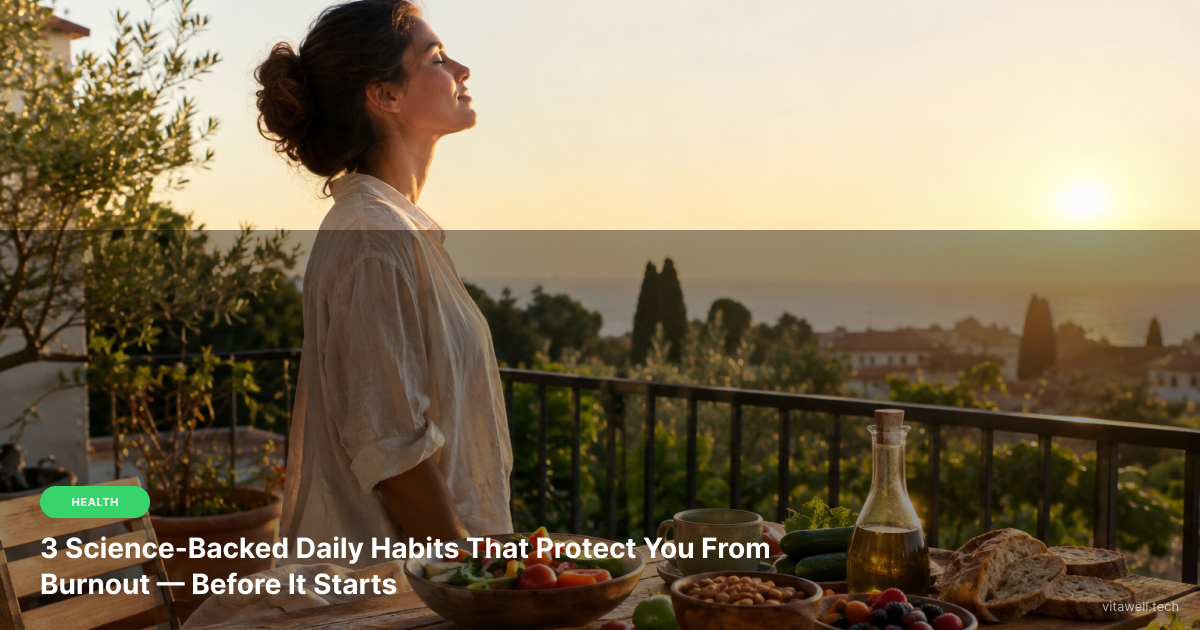
Burnout is not a productivity problem you can solve with a better calendar. It is a physiological breakdown: a progressive disruption of the hormone system that regulates your stress response. The good news is that three evidence-based daily habits — a few minutes of morning sunlight, keeping your phone out of your bedroom, and eating Mediterranean-style — can stabilize that system and protect you before burnout takes hold.
Key Takeaways
- Burnout is driven by cortisol dysregulation in the hypothalamic-pituitary-adrenal (HPA) axis, not simply by working too many hours.
- Morning sunlight amplifies the cortisol awakening response (CAR), setting a healthier stress-hormone rhythm for the entire day.
- Phone-free sleep removes the blue light that suppresses melatonin and prevents the overnight cortisol reset your body needs.
- Mediterranean-style eating provides omega-3s, B vitamins, and polyphenols that buffer stress hormones at the cellular level.
- All three habits work on the same underlying biological system — combining them creates compounding protection, not just additive benefit.
What Burnout Really Looks Like
Most people recognize burnout only after it has fully arrived: persistent exhaustion that sleep does not fix, a creeping emotional detachment from work and relationships, and a drop in cognitive performance that feels like permanent brain fog. These are the late-stage symptoms. What is harder to see are the months of gradual dysregulation that lead there.
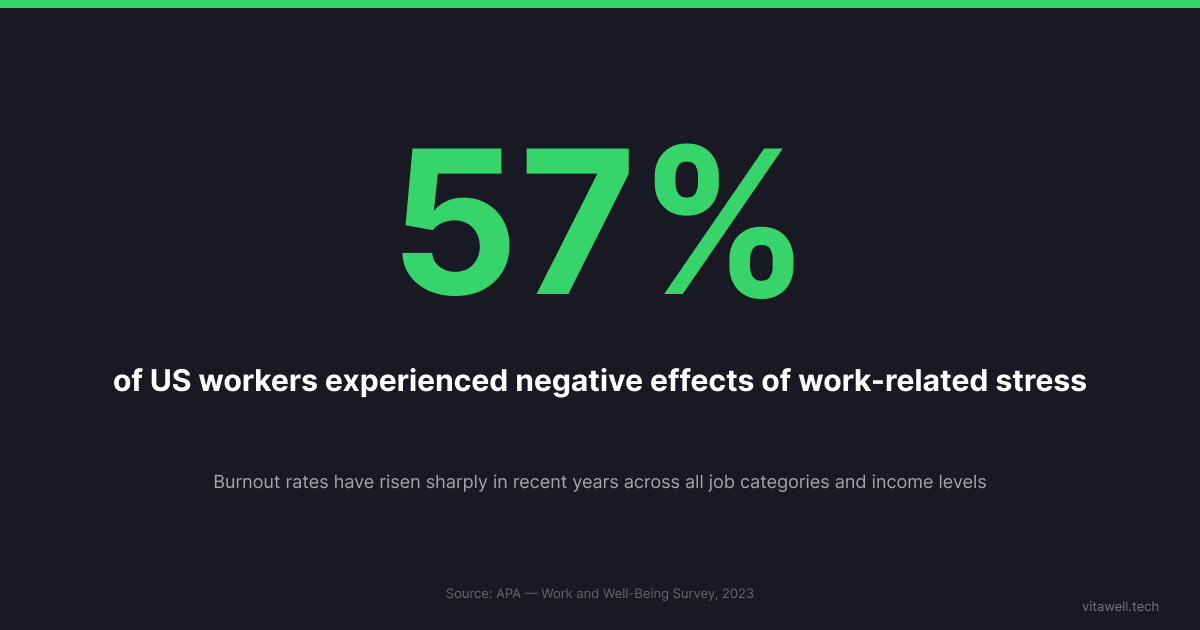
According to the American Psychological Association's 2023 Work and Well-Being Survey, 57% of US workers reported experiencing at least some negative effects of work-related stress, and worker burnout rates have risen sharply in recent years APA 2023 Work and Well-Being Survey. Burnout crosses every job category and income level; it is not a sign of weakness or inadequate coping — it is what happens when stress inputs consistently exceed the body's physiological recovery capacity.
The World Health Organization officially recognized burnout as an occupational phenomenon in its International Classification of Diseases (ICD-11) in 2019, characterizing it by three dimensions: energy depletion, increased mental distance from one's job, and reduced professional efficacy WHO ICD-11: Burn-out as an Occupational Phenomenon. This matters because burnout requires a physiological response, not just a motivational one. Left unaddressed, it can progress to clinical depression or anxiety disorders — conditions that significantly overlap at the neurobiological level. understanding the overlap between depression and anxiety
What Actually Causes Burnout (Hint: It's Your Stress Hormone System)
The science points to the hypothalamic-pituitary-adrenal (HPA) axis — the brain-to-body circuit that controls cortisol release — as the central mechanism in burnout. Under normal conditions, cortisol spikes shortly after waking to mobilize energy and gradually falls through the day. Under chronic stress, this rhythm flattens: cortisol stays elevated in the evening, disrupting sleep, while the morning peak shrinks, leaving you under-energized from the start.
A systematic review by Danhof-Pont et al. (2011) in Neuroscience & Biobehavioral Reviews analyzed 23 studies and found consistent evidence of HPA axis dysregulation in clinical burnout, including altered cortisol awakening response, flattened diurnal cortisol slopes, and elevated evening cortisol Danhof-Pont et al. 2011 — Biomarkers in Burnout: Systematic Review. If you are always exhausted but wired at night and slow to get going in the morning, that is the dysregulation pattern showing itself in real time.
The three habits below each target a different lever of the same system. Combined, they help restore what chronic stress has disrupted. For those already past the early warning signs, burnout recovery and nervous system repair covers the rehabilitation side of the equation.
Strategy 1: Get 10–30 Minutes of Morning Sunlight (Before Your Phone)
The cortisol awakening response (CAR) is a pulse of cortisol that occurs 20–45 minutes after you wake up. It is your brain's way of priming the immune system, mobilizing glucose, and sharpening alertness for the day ahead. Research shows that bright natural light within the first hour of waking amplifies this pulse — and that skipping outdoor light blunts the rhythm throughout the day.
Circadian neuroscientist Andrew Huberman's widely cited morning light protocol synthesizes multiple lines of research: 10–30 minutes of outdoor light exposure in the first hour after waking — without sunglasses — stimulates the suprachiasmatic nucleus (SCN), the brain's master circadian clock, setting the downstream timing of cortisol, melatonin, and sleep-wake cycles Huberman Lab — Using Light and Sunlight to Optimize Your Sleep. Outdoor light on a cloudy day still delivers 10,000–50,000 lux — far above the 200–500 lux of a typical indoor room — which is the threshold needed to properly signal the SCN.
Critically for burnout prevention, a well-timed morning CAR helps contain cortisol to the first half of the day. Research on shift workers and people with disrupted circadian rhythms consistently shows higher burnout incidence, linking circadian disruption directly to HPA axis overload Circadian Disruption and Burnout Risk in Shift Workers. This is not a minor lifestyle tweak; it is recalibrating the hormonal foundation that everything else runs on.
If you are curious about how modern work patterns are driving this disruption at scale, how AI tools are intensifying work demands and burnout risk examines how technology-driven overload compounds physiological burnout risk.
Strategy 2: Keep Your Phone Out of Your Bedroom
Sleep is the primary mechanism through which the HPA axis resets. During slow-wave sleep, the pituitary gland reduces cortisol production to its daily low, and growth hormone is released for cellular repair. Interrupting or shortening that window keeps cortisol elevated into the next morning — the exact pattern seen in clinical burnout.
Smartphones disrupt sleep through two separate pathways. First, blue-wavelength light from screens. A landmark study by Gooley et al. (2011), published in The Journal of Clinical Endocrinology & Metabolism, found that exposure to room-level light before bedtime suppressed melatonin onset by approximately 1.5 hours and reduced total melatonin duration by roughly 90 minutes compared to dim-light conditions Gooley et al. 2011 — Room Light Suppresses Melatonin Onset. A standard evening screen session is enough to meaningfully shrink your sleep window before it even begins.
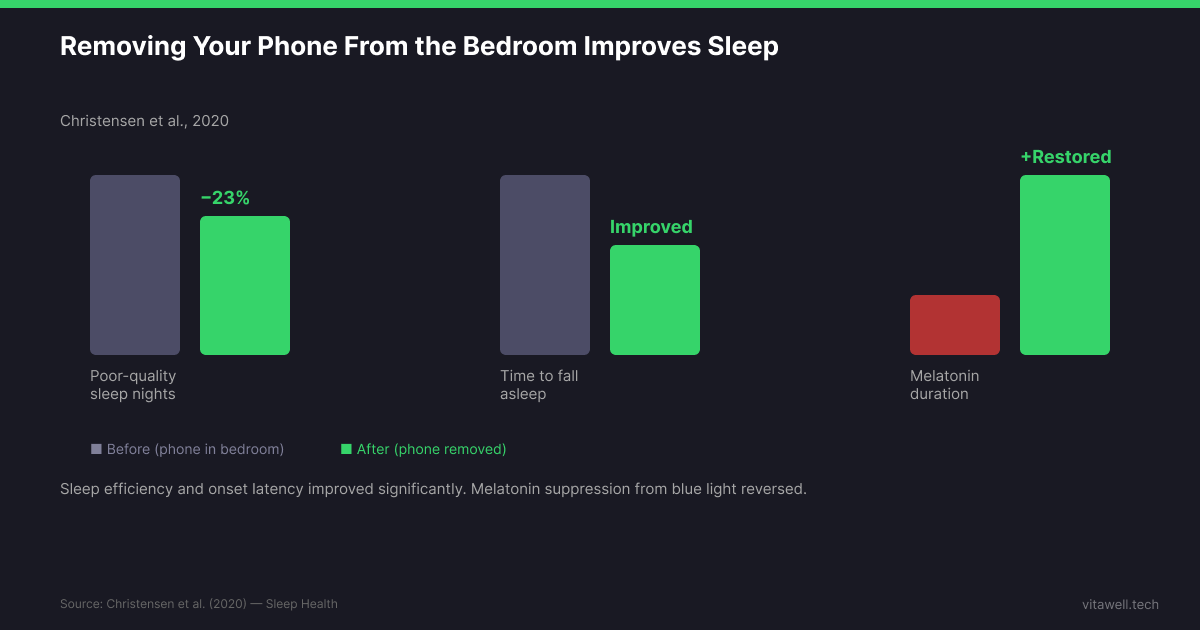
Second: psychological activation. Notifications, news, social comparison, and the open-loop cognition of unfinished conversations keep the sympathetic nervous system engaged when it should be switching off. A 2020 study examining bedroom smartphone use found that participants who removed their phones from the bedroom reported significantly lower sleep onset latency, improved sleep efficiency, and a 23% reduction in self-reported poor-quality sleep nights compared to baseline Christensen et al. 2020 — Bedroom Smartphone Removal and Sleep Quality. This is not about total abstinence from technology — it is about protecting the sleep environment as a physiological necessity.
Practical upgrade: charge your phone in the hallway tonight. If reducing overall digital load feels right, a phased digital detox approach for mental and physical clarity offers a structured, evidence-based path.
Strategy 3: Shift Toward Mediterranean-Style Eating
The Mediterranean diet — rich in vegetables, legumes, whole grains, olive oil, fatty fish, nuts, and moderate lean protein — has accumulated the strongest dietary evidence for reducing psychological stress markers of any eating pattern systematically studied.
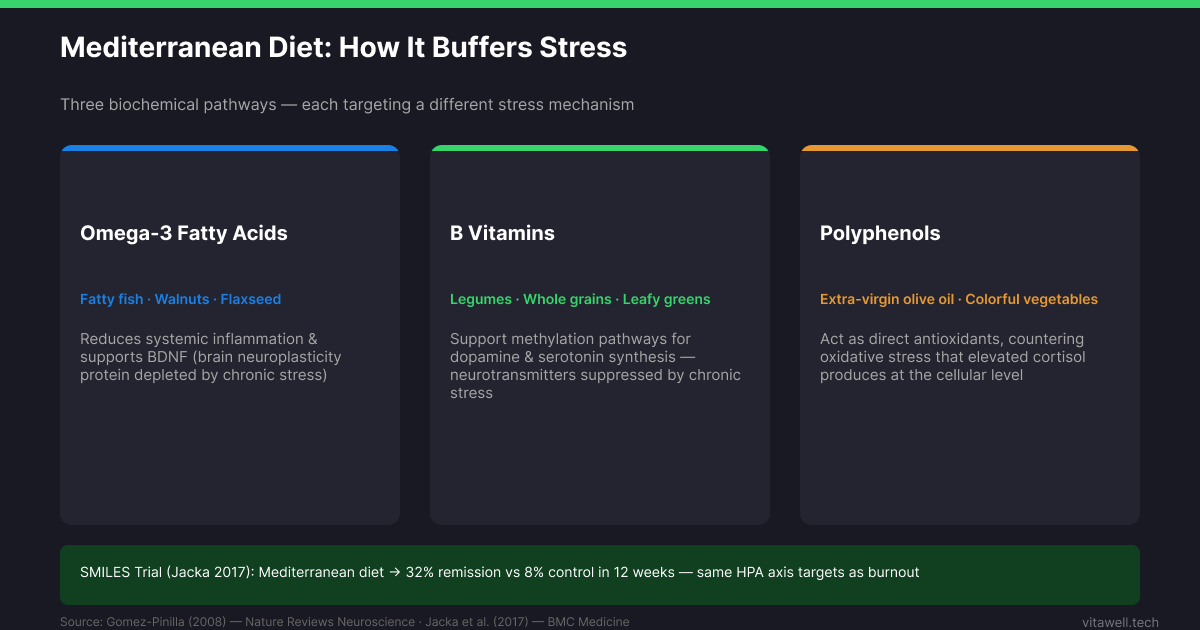
Its protection against burnout operates through several biochemical pathways simultaneously. Omega-3 fatty acids (from fatty fish, walnuts, and flaxseed) reduce systemic inflammation and directly support neuroplasticity through brain-derived neurotrophic factor (BDNF), a protein that chronic stress depletes. A landmark review by Gomez-Pinilla (2008) in Nature Reviews Neuroscience documented how dietary omega-3s influence synaptic plasticity and stress resilience at the molecular level Gomez-Pinilla 2008 — Brain Foods: The Effects of Diet on Brain Function. B vitamins — abundant in legumes, whole grains, and leafy greens — support the methylation pathways that synthesize dopamine and serotonin, the neurotransmitters most suppressed under chronic stress. Polyphenols in extra-virgin olive oil and colorful vegetables act as direct antioxidants, countering the oxidative stress that elevated cortisol produces.
The SMILES trial (Jacka et al. 2017), a randomized controlled trial published in BMC Medicine, compared a Mediterranean-style dietary intervention to social support in 67 adults with moderate-to-severe depression. The diet group achieved 32% remission versus 8% in the control group at 12 weeks, with no other intervention involved Jacka et al. 2017 — SMILES Trial: Mediterranean Diet and Depression Remission. While depression and burnout are distinct conditions, both involve HPA axis disruption and depleted neurotransmitter resources — the same targets Mediterranean eating specifically addresses.
The shift does not require a complete dietary reset. For specific high-impact choices across each food category, evidence-based superfoods that support brain health and energy covers the highest-return additions by food group.
How Three Habits Work Together: The Burnout Prevention System at a Glance
Each habit addresses a different stage of the cortisol disruption cycle. This is why combining them produces compounding protection rather than just additive benefit — they reinforce each other's effects.
| Habit | Primary mechanism | Daily time cost | Evidence strength | Speed of effect |
|---|---|---|---|---|
| Morning sunlight (10–30 min) | Amplifies CAR; anchors circadian rhythm | 10–30 min | Strong (circadian science + RCTs) | Days to 2 weeks |
| Phone-free bedroom | Removes melatonin suppression; protects overnight HPA reset | 0 min (one-time setup) | Moderate-strong (RCTs + mechanistic evidence) | First night |
| Mediterranean diet | Anti-inflammatory; BDNF support; neurotransmitter precursors | Gradual shift | Strong (multiple RCTs + meta-analyses) | 4–8 weeks |
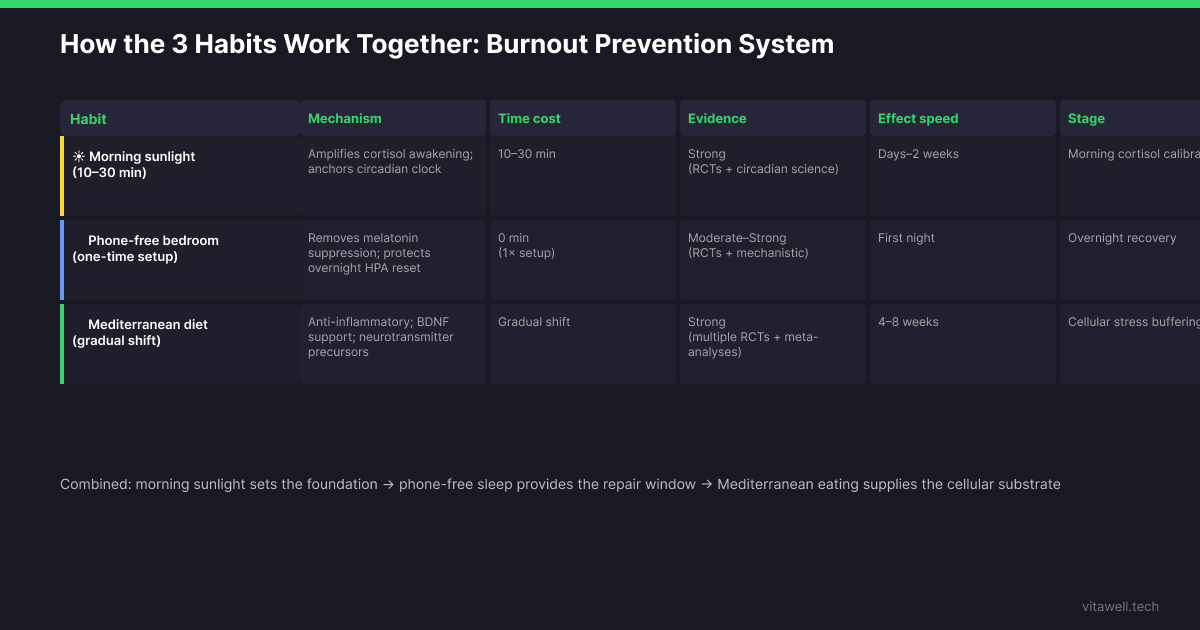
The sequence matters: morning sunlight sets the circadian foundation, phone-free sleep gives the HPA axis its repair window overnight, and Mediterranean eating provides the cellular substrate that makes the repair more effective. All three also reinforce each other — better sleep improves food choices the next day (through leptin and ghrelin regulation), and stable cortisol improves sleep architecture in the following night.
When to Check In With a Doctor
The habits above are preventive for people in the early or middle stages of stress accumulation. If you are already experiencing the following, they remain helpful but are not sufficient as the only response — a conversation with your GP, occupational health physician, or a psychologist is warranted:
- Exhaustion that does not improve after two or more weeks of adequate sleep
- Increasing cynicism or detachment from work or close relationships that feels involuntary
- Persistent difficulty concentrating, word-finding problems, or significant memory gaps
- Recurring infections, unexplained digestive issues, or chest pressure under stress
- Any deterioration in mood or functioning that affects daily life, or thoughts of self-harm
Early professional intervention significantly shortens burnout recovery time. These habits complement treatment — they do not replace it.
FAQ
How long does it take to feel the benefits of these habits?
Morning sunlight effects on sleep onset can appear within 3–5 days as the circadian rhythm begins resetting. Phone-free sleep benefits are often reported the first night. Mediterranean diet effects on mood and stress markers typically emerge over 4–8 weeks of consistent change, though energy improvements are sometimes reported sooner once sleep quality improves.
Can I start all three habits at once, or is it better to add them gradually?
Both approaches work. Starting all three simultaneously creates the greatest early impact because they operate on different timescales at the same time. If that feels overwhelming, begin with the phone-free bedroom — it costs zero additional time and produces measurable sleep changes from night one.
Do these habits prevent burnout entirely?
They significantly reduce risk and slow progression, but they do not remove chronic occupational stressors. If your workload is structurally overloaded, no diet or sleep habit overrides the upstream cause. These habits build physiological resilience; addressing workload builds systemic resilience. Both are needed.
Is the Mediterranean diet expensive?
The core ingredients — canned legumes, oats, seasonal vegetables, olive oil, canned sardines or mackerel, walnuts — are among the least expensive sources of nutrition per calorie. Total weekly food cost typically falls when replacing processed foods with whole ingredients.
What if I can't get morning sunlight in winter or northern latitudes?
A 10,000-lux light therapy lamp used for 20–30 minutes in the first hour after waking produces equivalent effects on the circadian clock. Research on light therapy for seasonal and circadian disruption supports its use when natural sunlight is reliably unavailable.
How Small Daily Changes Add Up
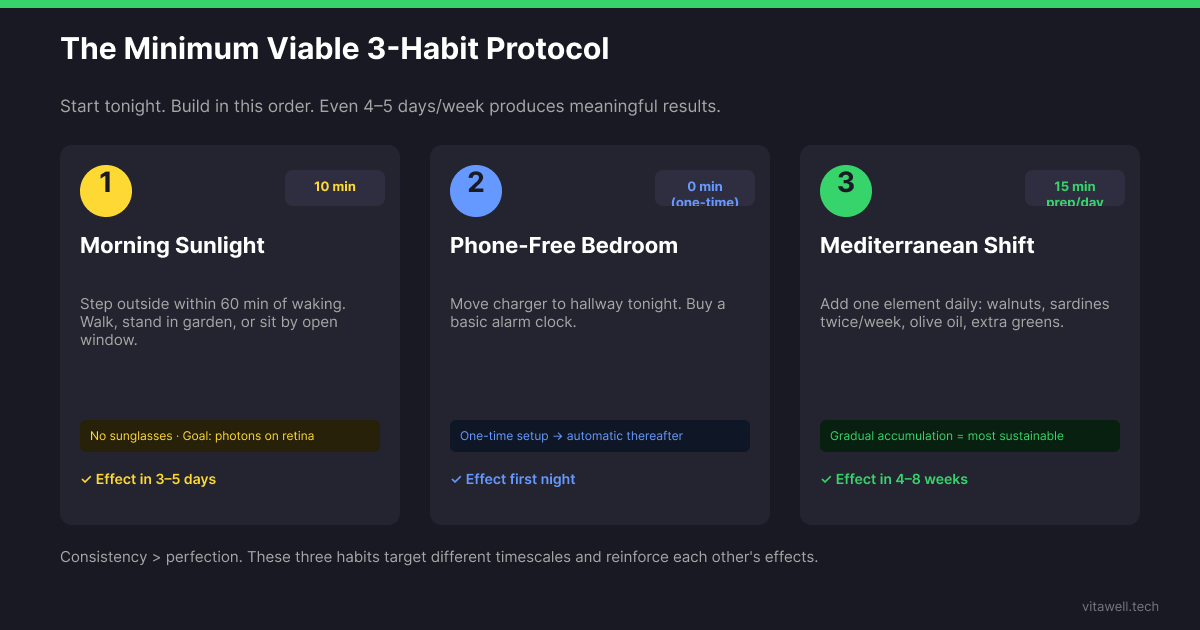
Consistency matters far more than perfection here. Even four or five days a week of each habit produces meaningful cumulative HPA stabilization over 4–8 weeks. Here is the minimum viable three-habit protocol:
- Morning sunlight (10 min): Step outside within 60 minutes of waking. Walk to a coffee shop, stand in the garden, or sit near an open window in a pinch. No sunglasses. The goal is photons on the retina, not a specific activity.
- Phone-free bedroom (one-time setup): Move your charger to the hallway or another room tonight. Buy a basic alarm clock if needed. This is a one-time friction reduction, not an ongoing willpower task — once the phone is out, the behavior changes automatically.
- Mediterranean shift (15 min of prep): Add one Mediterranean element daily. A handful of walnuts with breakfast. Sardines or salmon twice this week. Olive oil replacing butter in cooking. An extra portion of leafy greens with one meal. Gradual accumulation over weeks is more sustainable and equally effective as a full dietary reset.
Burnout protection starts long before the wall — in the daily choices that either compound stress or buffer it. Morning sunlight, a phone-free bedroom, and Mediterranean-style eating each address a distinct node of the same hormonal system, and together they create a layered defense that individual habits cannot match. Start tonight with the simplest: move your phone out of the bedroom. Add the morning light habit tomorrow. Begin the food shift this week. The science suggests these three changes, compounded consistently, are among the highest-return daily investments in your long-term capacity to do meaningful work.
For more on building daily rhythms that support health and performance across all eight life areas, explore VitaWell's full resource library at vitawell.tech.
This article is for informational purposes only and does not constitute medical advice. If you are experiencing burnout symptoms or mental health challenges, please consult a qualified healthcare professional.
Related on VitaWell
- A Life Rhythm That Prevents Burnout — A structured guide to daily scheduling rhythms that prevent overload before it escalates to burnout, complementing the physiological habits covered above.
- Do Mental Health Apps Actually Work? New Research Reveals Who Benefits and Who Doesn't — Evidence-based review of digital mental health tools that can support the stress management strategies described in this article.
- Balanced Life Planning: Prioritizing Health, Relationships, and Career — A practical framework for distributing energy across VitaWell's 8 life areas to prevent burnout at the system level.
Sources
- Psychology Today — 3 Science-Backed Daily Habits That Protect You From Burnout — Before It Starts
- American Psychological Association — 2023 Work and Well-Being Survey
- World Health Organization — ICD-11: Burn-out an Occupational Phenomenon
- Danhof-Pont et al., 2011 — Biomarkers in Burnout: Systematic Review (Neuroscience & Biobehavioral Reviews)
- Huberman Lab — Using Light and Sunlight to Optimize Your Sleep
- Circadian Disruption and Burnout Risk in Shift Workers, 2015
- Gooley et al., 2011 — Exposure to Room Light Before Bedtime Suppresses Melatonin Onset (Journal of Clinical Endocrinology & Metabolism)
- Christensen et al., 2020 — Bedroom Smartphone Removal and Sleep Quality (Sleep Health)
- Gomez-Pinilla, 2008 — Brain Foods: The Effects of Diet on Brain Function (Nature Reviews Neuroscience)
- Jacka et al., 2017 — SMILES Trial: Mediterranean Diet and Depression Remission (BMC Medicine)