What the New Plant-Based Food Pyramid Means for Your Daily Diet
Twenty-two international nutrition scientists redesigned the food pyramid to put plant foods at the base. Here is what the new hierarchy means for your plate and long-term health.
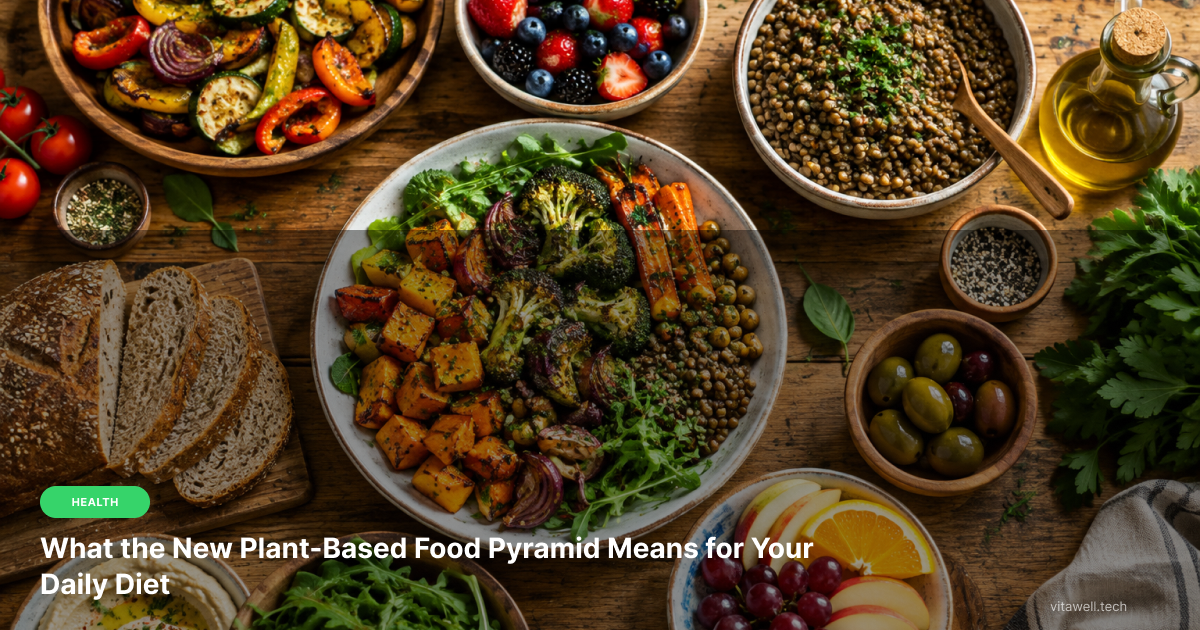
A team of 22 international nutrition scientists just published a new food pyramid in Advances in Nutrition — one that puts plants, legumes, and whole grains at the foundation instead of protein or refined carbs. Unlike the US Dietary Guidelines for Americans 2025-2030, this international framework synthesized more than 250 scientific publications and seven national dietary guidelines to build a consensus around what the evidence actually shows. For your daily plate, it means vegetables, fruits, low-glycemic grains, and beans form the base of every meal, with fish, poultry, yogurt, and plant oils as preferred protein and fat sources — and red and processed meats moved to the "limit" category.
Key Takeaways
- 22 nutrition scientists from Europe, North America, and Australia agreed: plant foods should be the foundation of a healthy diet
- Carbohydrate quality — not just quantity — is a primary focus; whole, low-glycemic-index grains outperform refined ones
- The pyramid favors beans, lentils, fish, poultry, and yogurt over red and processed meats as protein sources
- A Mediterranean-style, plant-rich eating pattern is associated with roughly 30% lower heart disease risk
- The framework is designed to align with both individual health and planetary sustainability goals
What Is the New International Food Pyramid?
Published in September 2026 in Advances in Nutrition, the new food guide was developed by 22 nutrition scientists from Europe, North America, and Australia — including Karen Della Corte of Brigham Young University and the International Carbohydrate Quality Consortium (ICQC) BYU News. The team compared seven national and regional dietary guidelines (from Canada, Germany, Australia, China, the Netherlands, the United States, and the Nordic countries) and synthesized findings from more than 250 scientific publications.
The result is a pyramid built on three principles: (1) make plant foods the foundation of a healthy diet, (2) choose healthier sources of fat and protein, and (3) prioritize carbohydrate quality over quantity. "Despite what people often hear, there's actually substantial agreement in nutrition science about the foundations of healthy eating," Della Corte said. "We wanted to bring those shared principles together and translate an extensive body of scientific evidence into a coherent and practical food guide pyramid."
This pyramid can be adapted across vegetarian, vegan, and omnivore diets and across cultures — it does not exclude animal foods; it simply repositions them. Research on plant-forward diets and biological aging suggests that plant-forward eating may also slow biological aging at the cellular level, adding another dimension to why this shift carries significance beyond weight management.
How It Compares to the US Food Pyramid
The US Dietary Guidelines for Americans 2025-2030 follows a different hierarchy, placing protein foods alongside grains rather than beneath plant-based foundations. Here is how the two frameworks compare:
| Feature | US DGA 2025-2030 | International Plant-Based Pyramid |
|---|---|---|
| Base of pyramid | Grains and protein foods equally emphasized | Vegetables, fruits, whole/low-GI grains, legumes |
| Protein focus | Lean meat, poultry, seafood, eggs, dairy, beans | Beans, lentils, fish, poultry, yogurt first; red/processed meat limited |
| Fat guidance | Vegetable oils preferred; limit saturated fat | Plant oils explicitly preferred; replace saturated fats |
| Carbohydrate approach | Whole grains preferred; limit added sugar | Low glycemic index as explicit criterion; sugar below 10% of calories |
| Red meat | Allowed in moderation | Moved to "limit" tier |
| Planetary health | Mentioned as secondary consideration | Integrated into the core framework |
| Evidence base | US cohort studies, national expert consensus | More than 250 publications, 7 international guideline sets |
The key distinction is that the international pyramid elevates carbohydrate quality — specifically the glycemic index — as a first-tier criterion, something the US guidelines address only partially.
Why Plant Foods Belong at the Foundation
The placement of plant foods at the base of the pyramid reflects decades of large-scale observational evidence. A 2023 systematic review and dose-response meta-analysis of 32 prospective cohort studies involving 1,141,793 participants found that higher legume consumption was associated with a 6% lower risk of all-cause mortality per 50 grams per day increase (HR: 0.94; 95% CI: 0.89, 0.99), evidence the authors rated as low-to-moderate certainty that nonetheless supports existing dietary recommendations to eat more beans, lentils, and peas Zargarzadeh et al., Advances in Nutrition 2023.
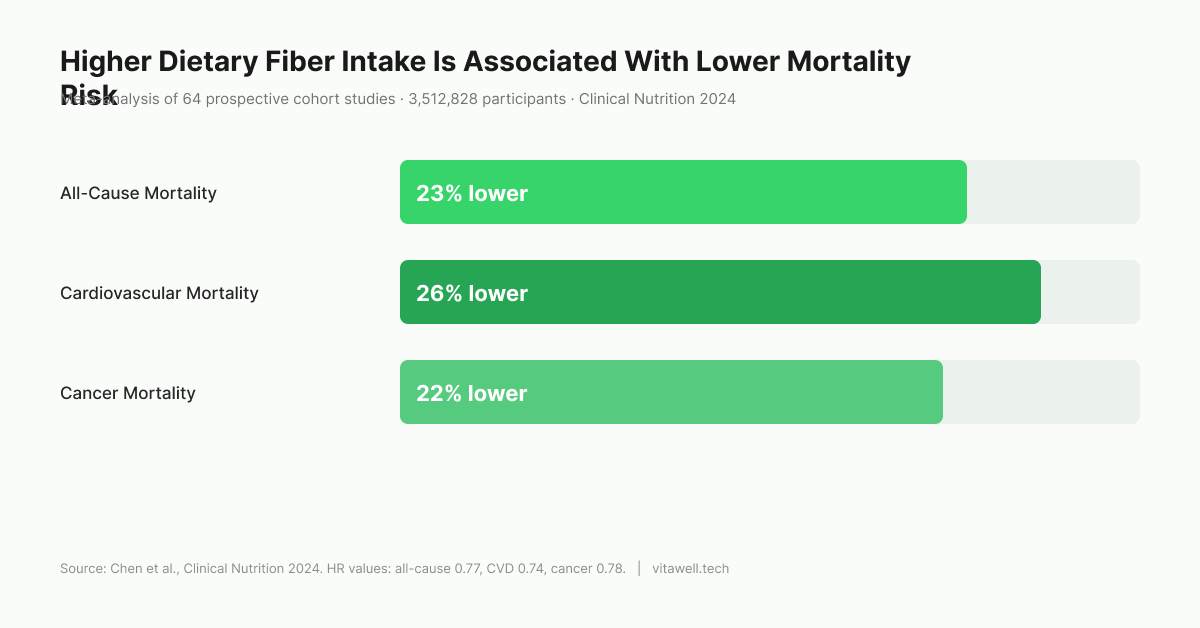
The benefits of plant-rich eating extend further through dietary fiber. A 2024 systematic review and meta-analysis of 64 prospective cohort studies covering 3,512,828 subjects found that higher total dietary fiber intake was associated with 23% lower all-cause mortality (HR: 0.77; 95% CI: 0.73, 0.82), 26% lower cardiovascular mortality (HR: 0.74; 95% CI: 0.71, 0.77), and 22% lower cancer mortality (HR: 0.78; 95% CI: 0.68, 0.87) dietary fiber meta-analysis, Clinical Nutrition 2024. Whole grains contribute substantially to that fiber intake: a dose-response meta-analysis of 20 prospective cohorts (2,282,603 participants) found that each additional three servings of whole grains per day was associated with 25% lower cardiovascular mortality risk (RR: 0.75; 95% CI: 0.68, 0.83), based on a follow-up period of 5.5 to 26 years Benisi-Kohansal et al., Advances in Nutrition 2016.
Fruits and vegetables are also associated with reduced blood pressure and cardiovascular risk. research on avocado and blood pressure in prediabetes shows that specific plant foods like avocado may also reduce blood pressure in people with prediabetes, reinforcing the benefits of plant food variety rather than relying on a single type. These are observational associations, not proof of causation; the strength and consistency of the evidence across dozens of cohorts and millions of participants is part of what drove the 22 scientists toward this consensus.
Carb Quality, Not Carb Quantity
The third principle — prioritize carbohydrate quality — may be the most practically useful shift for many people. "Not all carbohydrates are created equal," Della Corte noted. The pyramid specifically highlights low-glycemic-index (GI) grains: basmati rice, durum pasta, bulgur, lentils, and whole rye bread all qualify, while white bread and ultra-processed grain products do not.
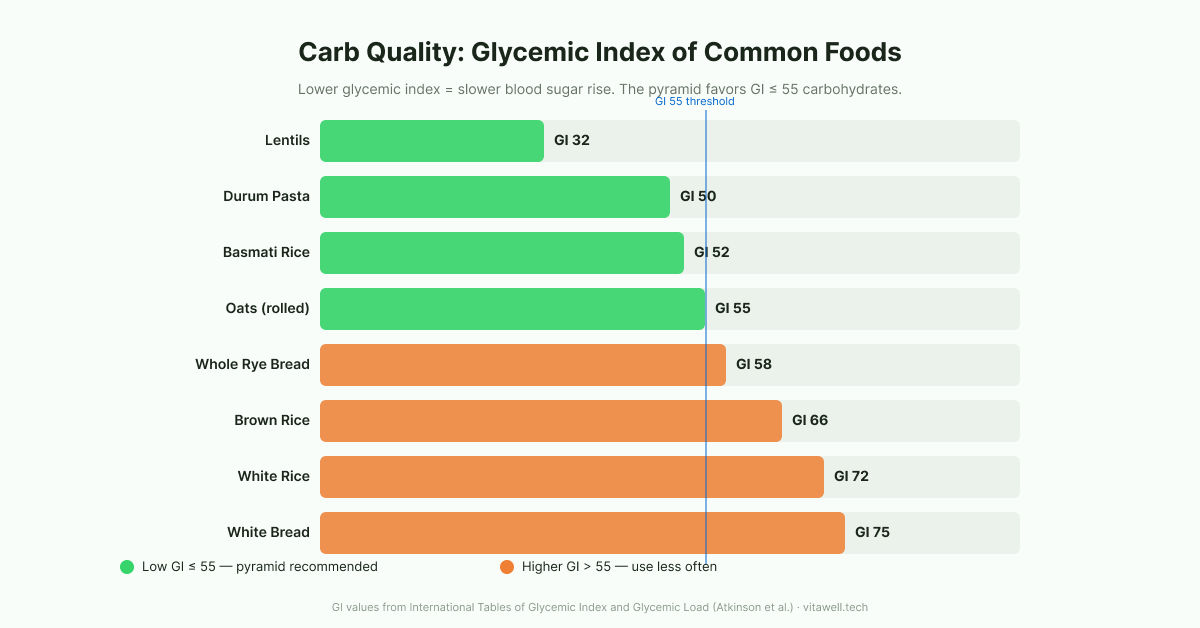
"For both health and sustainability reasons, carbohydrate-rich foods should provide a substantial share of our energy, so their quality is particularly important," said Anette Buyken of Paderborn University, one of the collaborating scientists. The practical implication: quantity-focused approaches to carbs miss the point. A cup of lentils and a slice of white bread both contain carbohydrates; their metabolic effects are substantially different. Most major dietary guidelines also recommend keeping added sugar below 10% of total calorie intake — roughly 50 grams on a 2,000-calorie diet — a threshold the new pyramid explicitly endorses.
Protein and Fats — What the Evidence Actually Says
The pyramid recommends choosing "beans, peas, lentils, fish, poultry or yogurt more often than red and processed meats." For people concerned about meeting protein needs on a more plant-forward diet, a 2025 meta-analysis of 43 randomized controlled trials found that soy protein was equivalent to milk protein for muscle mass outcomes, and that plant and animal protein produced no significant difference in strength or physical performance Reid-McCann et al., Nutrition Reviews 2025. Non-soy plant proteins showed slightly lower muscle mass gains compared to animal proteins, but the difference was not large enough to be practically significant for most healthy adults, according to this systematic review.
For fats, the consensus is clear: replacing saturated fats with unsaturated fats — particularly those from plant oils — improves long-term cardiovascular health. The Mediterranean pattern, which shares the plant-first, olive oil-centered logic of this pyramid, was associated with approximately 30% lower heart disease risk in the landmark PREDIMED trial PREDIMED / FoodNavigator 2013. our guide to extra virgin vs. refined olive oil explains why the type of olive oil matters for cardiovascular protection, while our review of food additives linked to high blood pressure documents how ultra-processed foods are linked to higher blood pressure, undermining even a theoretically healthy dietary pattern.
What to Eat Each Day — A Practical Guide
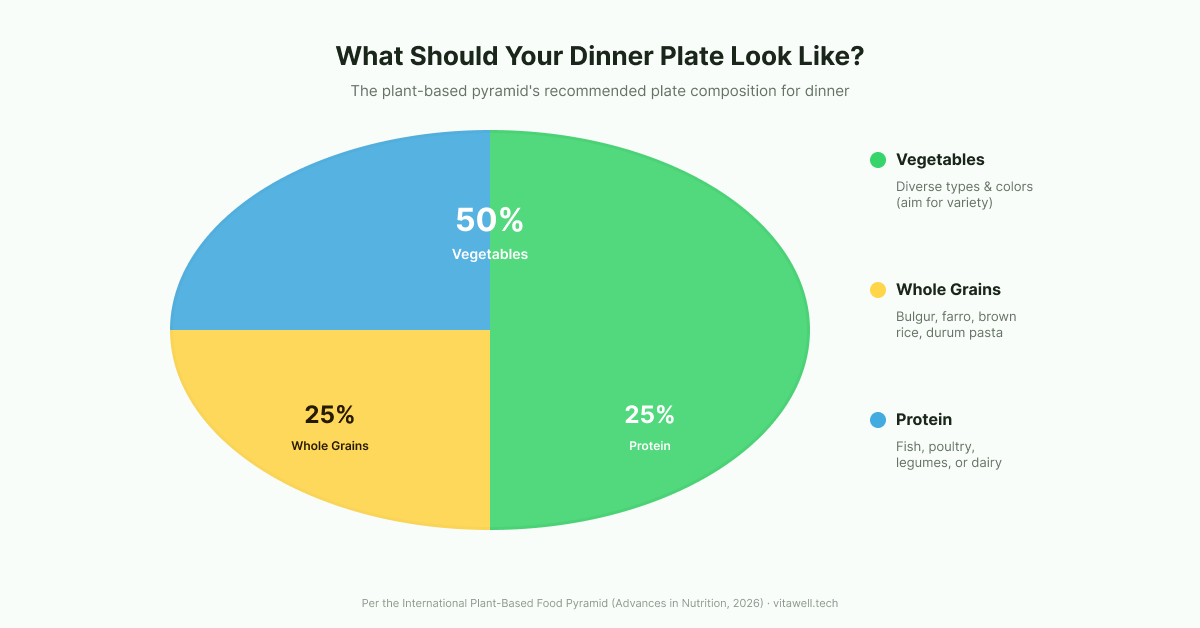
Della Corte's advice for designing meals: "Start by thinking about the plant foods you want to emphasize. What vegetables, whole or lower-GI grains, beans or lentils could you include?" The pyramid does not prescribe a single rigid plate model, but the following framework aligns with its three principles:
Breakfast:
- Oats, whole rye toast, or low-GI grain cereal
- Fruit, nuts, or plain yogurt
- Avoid ultra-processed breakfast items with high added sugar
Lunch:
- Build around legumes (lentil soup, chickpea salad, bean bowl) or vegetables
- Add a whole grain such as bulgur, farro, brown rice, or durum pasta
- Use olive oil as the primary fat; skip processed sauces
Dinner:
- 50% of the plate: vegetables (diverse types and colors)
- 25%: whole or low-GI grain
- 25%: protein — fish, poultry, legumes, or dairy (red meat is not banned; it simply should not be the daily default)
Snacks:
- Nuts, seeds, fresh fruit, or hummus with vegetables
This is not a prescription to eliminate meat or dairy — the pyramid includes them. It is a hierarchy that makes plant foods the daily default, not the occasional addition.
Beyond Your Plate — The Planetary Health Angle
The EAT-Lancet Commission has estimated that a planetary health diet aligned with these principles could prevent approximately 15 million premature deaths per year globally. "Our diet has to be not only for our own health but also for the health of our planet," said David Jenkins of the University of Toronto, who pioneered the glycemic index concept and contributed to the new framework.
Della Corte notes that the pyramid is explicitly designed for global applicability: "A healthy diet won't look exactly the same for everyone around the world. Durum pasta, basmati rice, tortillas, rice noodles, bulgur and many other staples with a low to moderate glycemic index can all fit into a healthy diet." The pyramid's adaptability makes it a framework rather than a rigid menu. research on lifestyle changes and chronic disease risk documents how diet is one of the most impactful lifestyle choices for reducing chronic disease risk, reinforcing that this pyramid operates within a wider pattern of health-supporting behaviors.
FAQ
What is the new international food pyramid 2026?
It is a food guide published in Advances in Nutrition by 22 nutrition scientists from 7 countries. It synthesizes more than 250 scientific publications and seven national dietary guidelines into a pyramid that places plant foods (vegetables, fruits, whole grains, legumes) at the foundation, with fish, poultry, yogurt, and plant oils as preferred protein and fat sources, and red and processed meats in the "limit" tier.
What foods are at the base of the plant-based food pyramid?
The base includes vegetables, fruits, whole and low-glycemic-index grains (such as basmati rice, bulgur, durum pasta, and oats), and legumes (beans, lentils, peas). These form the daily dietary foundation. Other food groups are layered above based on how often they should be consumed.
How is the new food pyramid different from MyPlate or the US food pyramid?
MyPlate and the US DGA 2025-2030 treat protein foods and grains as co-equal daily priorities without explicitly ranking plant foods above animal foods. The new international pyramid places plant foods at the foundation and moves red and processed meats to the "limit" category — a more explicit hierarchy than US guidance currently offers.
Can you still eat meat on the new plant-based food pyramid?
Yes. The pyramid does not exclude meat or dairy; it repositions them. Fish, poultry, and yogurt appear in the mid-tier alongside legumes as preferred protein sources. Red and processed meats are not banned, but they are moved to the top "limit" tier, meaning they should be occasional rather than daily choices.
What does carb quality mean and why does it matter for health?
Carb quality refers primarily to a food's glycemic index (GI) — how quickly it raises blood sugar — along with its fiber content and degree of processing. Low-GI carbohydrates (lentils, basmati rice, whole rye, oats) produce a slower, more stable blood sugar response than refined grains. Higher dietary fiber from these sources is associated with 23% lower all-cause mortality in large meta-analyses, making carb quality a clinically meaningful distinction.
When to Talk to a Professional
This pyramid offers general population guidance, but individual needs vary significantly. Talk to a registered dietitian or your doctor before making major dietary changes if you have heart disease, kidney disease, or diabetes (protein and potassium needs may differ), if you take medications that interact with diet (statins, blood thinners, immunosuppressants), if you are pregnant or breastfeeding (specific micronutrient requirements may need individual planning), or if you have a history of disordered eating or significant weight management challenges.
Conclusion
The new international food pyramid does not ask you to overhaul your life overnight. It asks you to default to plants: start with the vegetable, the grain, the bean — then add the protein and fat on top. That shift, backed by evidence from millions of people across dozens of cohort studies, may be the most effective single dietary move most people can make for long-term health. For more evidence-based guides on what to eat and why, explore the VitaWell Health section.
Related on VitaWell
- Can a Daily Multivitamin Slow Your Biological Aging? — Explores how everyday supplements interact with the same cellular aging pathways that a plant-rich diet may influence.
- Fructose Metabolism and Liver Fat — Explains why where your carbohydrate calories come from (sugar vs. whole grains) has distinct metabolic effects.
- Best Time to Work Out — Diet and exercise timing interact; this guide covers the exercise side of the equation.
This article is for informational purposes only and does not constitute medical or nutritional advice. Consult a registered dietitian or healthcare provider before making significant dietary changes, especially if you have a chronic health condition.