Evolutionary Mismatch: Why Your Stone Age Brain Struggles With Modern Life — and How to Work With It
Cravings, endless scrolling and constant worry are old survival instincts in a new world. What evolutionary mismatch explains — and the research-backed fixes that help.
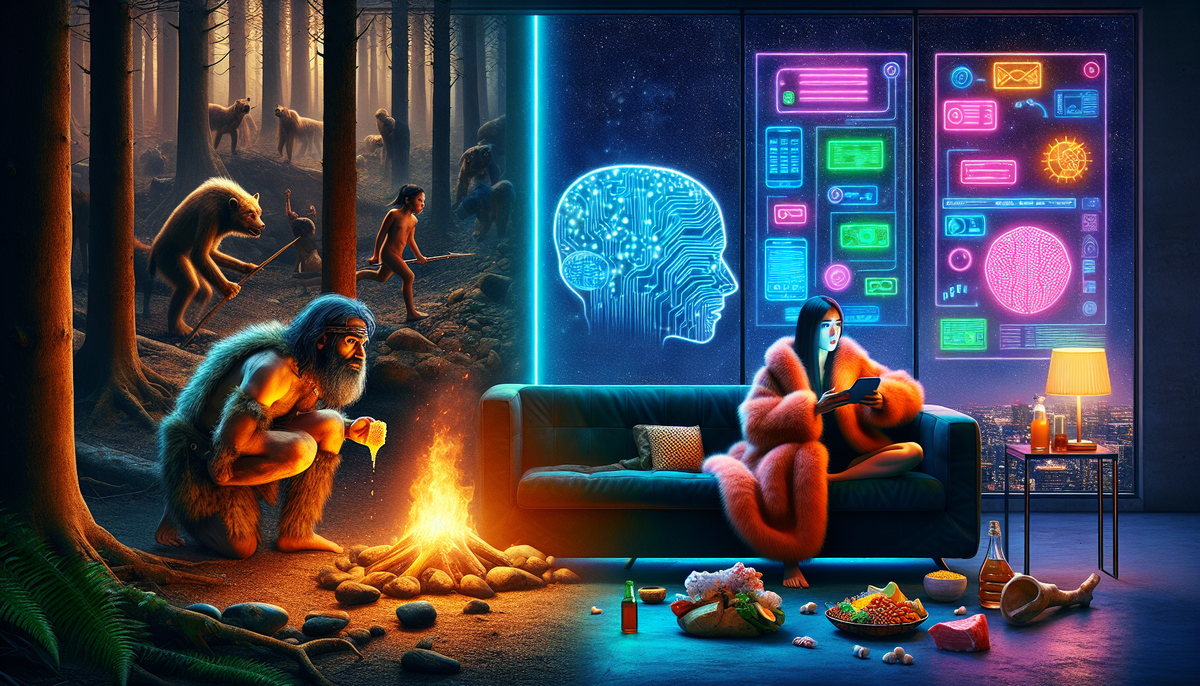
Evolutionary mismatch is the gap between the environment our brains evolved for and the one we live in now. Instincts that once kept people alive, such as craving calorie-dense food, tracking social status, grabbing rewards now and scanning for threats, misfire in a world of ultra-processed snacks, social feeds and abstract worries. You cannot delete these instincts, but you can work with them: change the cues around you where possible, and change how you respond where you cannot.
Key Takeaways
- Evolution selects for survival and reproduction, not happiness, so many "flaws" are old survival settings running in a new environment.
- In a 2019 NIH trial, people ate about 500 more calories a day on an ultra-processed diet than on an unprocessed one, and ultra-processed foods now supply 53% of US adults' calories.
- Losses weigh about twice as much as equal gains: a 2024 meta-analysis of 607 estimates put loss aversion at 1.955.
- Limiting social media to about 30 minutes a day for three weeks reduced loneliness and depression in a 143-student trial.
- The most reliable fixes change the environment first (friction, if-then plans), then the response (reframing, acceptance, breathing, movement).
What Is Evolutionary Mismatch?
Evolutionary psychologists describe the conditions that shaped the human mind as the environment of evolutionary adaptedness (EEA): small groups, scarce food, physical danger and threats that were immediate and concrete. Traits that helped people survive and reproduce there spread, whether or not they made anyone happy. Mismatch happens when those traits meet conditions they were never tuned for.
A common assumption is that modern people simply move less and burn fewer calories. The evidence is more interesting. When Herman Pontzer and colleagues measured Hadza hunter-gatherers in Tanzania (PLoS ONE, 2012) with doubly labeled water, the Hadza were more active, yet their total daily energy use was no different from Westerners' after adjusting for body size. That points to the food environment, not just activity, as a key part of the mismatch.
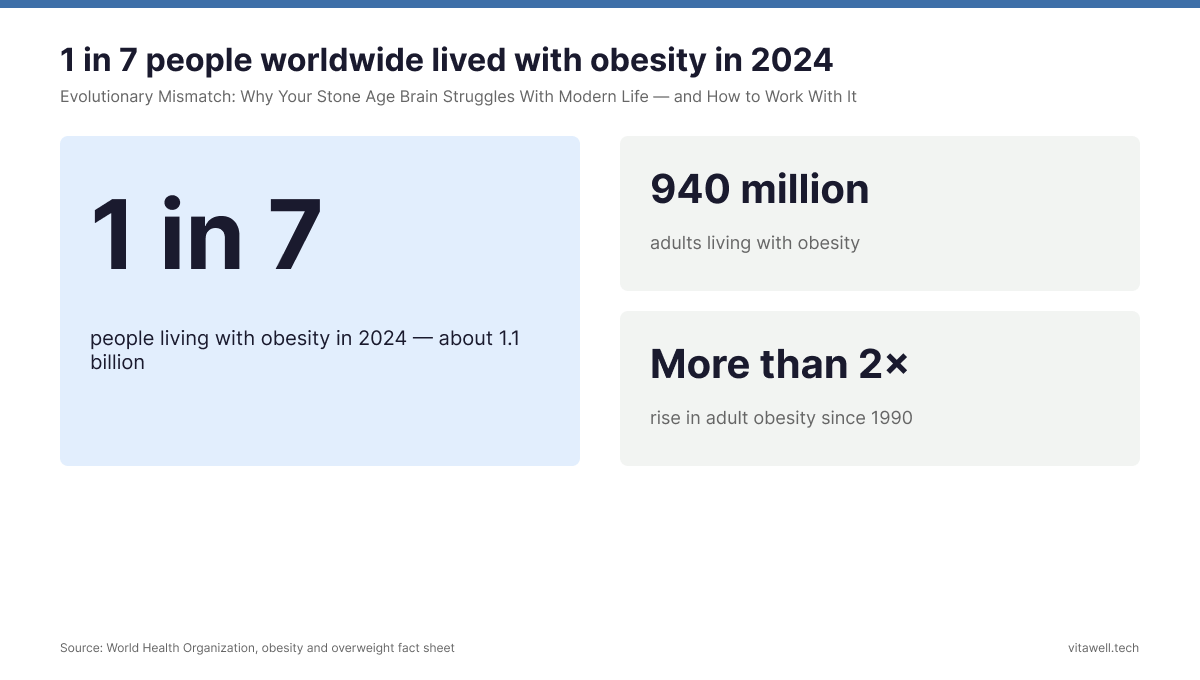
The scale of that shift is visible in global data. According to the World Health Organization, 1 in 7 people (1.1 billion) were living with obesity in 2024, including 940 million adults, and adult obesity has more than doubled since 1990.
The Four Mismatches Behind Modern Unhappiness
Four mismatches account for much of everyday struggle. Each one made sense in the EEA and backfires now.
1. Food cravings in a world of engineered food
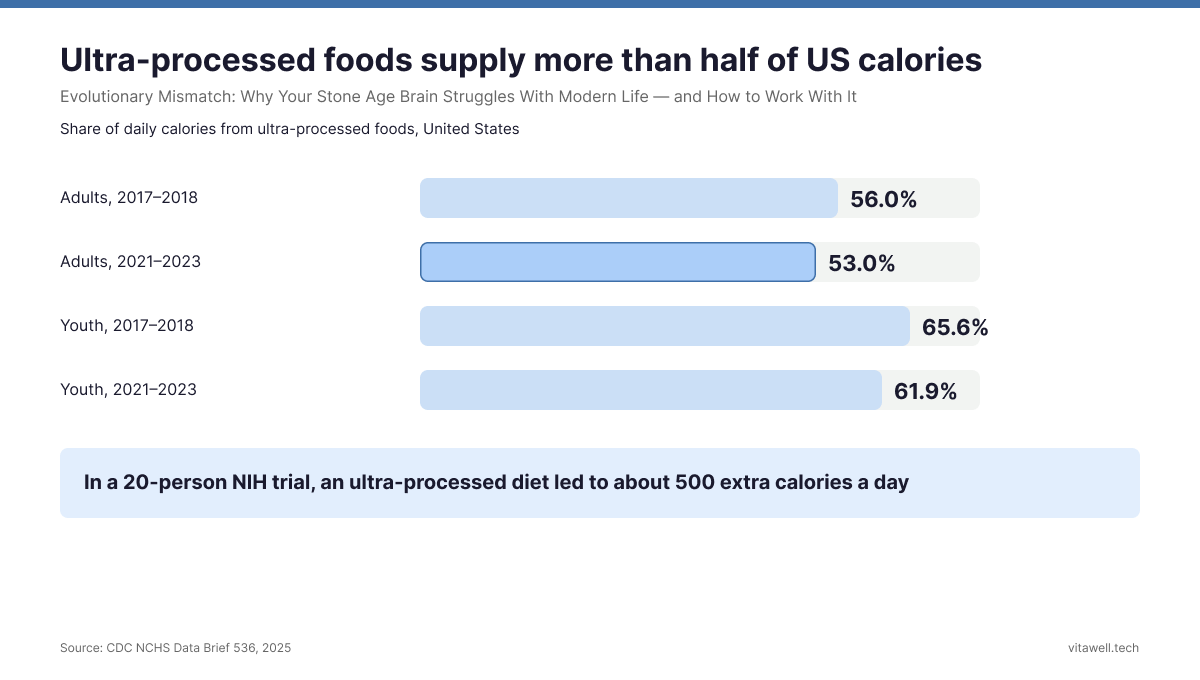
When sweet and fatty food was rare, a strong pull toward it helped people survive lean seasons. Today that pull meets products designed to be eaten quickly and easily. In a controlled inpatient trial, Kevin Hall and colleagues at the NIH (Cell Metabolism, 2019) gave 20 adults an ultra-processed diet and an unprocessed diet for two weeks each. On the ultra-processed diet they ate about 500 more calories a day and gained about 0.9 kg; on the unprocessed diet they lost about the same.
That environment is now the default. A 2025 CDC data brief found that ultra-processed foods supplied 53.0% of adults' calories and 61.9% of young people's calories in 2021–2023, slightly down from 56.0% and 65.6% in 2017–2018.
2. Status tracking in an endless feed
In a band of a few dozen people, your standing affected access to food, help and partners, so the brain learned to monitor comparison closely. Social feeds now supply comparison with thousands of curated lives every day. In a randomized trial, Melissa Hunt and colleagues at the University of Pennsylvania (2018) limited 143 students to 10 minutes per platform per day on Facebook, Instagram and Snapchat for three weeks. Loneliness and depression fell in the limited group, most clearly in students who started out more depressed.
The sample was small and young, so the result is a signal rather than a rule. VitaWell's piece on how the endless feed captures attention covers practical limits.
3. Reward-now thinking in a long-term world
When the future was uncertain, taking the reward in front of you was sensible. Psychologists call the resulting preference for smaller, sooner rewards hyperbolic discounting. Today it shows up as procrastination, skipped workouts and under-saving, because most modern payoffs arrive months or years later. VitaWell's article on why the brain treats your future self like a stranger explores this in depth.
4. Negativity bias in a safe but noisy world
Missing a threat could be fatal; missing a reward usually was not. So the brain weights bad news more heavily than good, a pattern called negativity bias. One measurable form is loss aversion: the tendency to feel losses more than equal gains. A 2024 meta-analysis by Alexander Brown, Colin Camerer and colleagues in the Journal of Economic Literature pooled 607 estimates from 150 articles and found an average loss aversion of 1.955, meaning a loss feels roughly twice as heavy as a gain of the same size.
In daily life the same bias fuels rumination and replaying of small setbacks. VitaWell's guide on how to tell if you are overthinking covers the signs.
The Evolutionary Mismatch Map
The table links each instinct to what it did then, what triggers it now and the counter-move with the best evidence behind it.
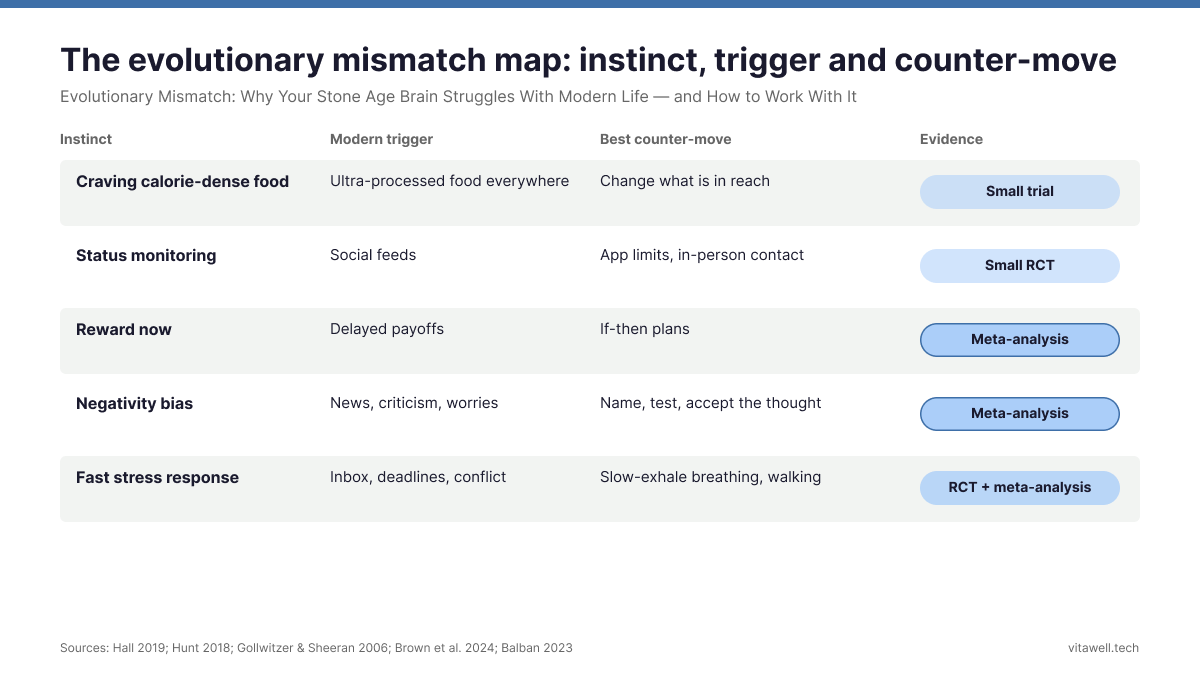
| Instinct | Ancestral payoff | Modern trigger | Measured effect today | Best counter-move | Evidence strength |
|---|---|---|---|---|---|
| Craving calorie-dense food | Survive lean seasons | Ultra-processed food everywhere | About 500 extra calories a day on an ultra-processed diet | Change what is in reach: stock minimally processed defaults | Small controlled trial (20 adults) |
| Status monitoring | Keep your place in the group | Social feeds | Less loneliness and depression with about 30 minutes a day | Set app time limits and protect in-person contact | Small randomized trial (143 students) |
| Reward now | Take sure gains in an uncertain world | Delayed payoffs: health, savings, skills | Procrastination and under-saving | If-then plans for the exact when and where | Meta-analysis (94 studies) |
| Negativity bias | Never miss a threat | News, criticism, abstract worries | Losses feel about 1.955 times as heavy as gains | Name the thought, test the evidence, accept the feeling | Meta-analysis (607 estimates) |
| Fast stress response | Fight or flee physical danger | Inbox, deadlines, conflict | Better mood with 5 minutes of cyclic sighing a day | Daily slow-exhale breathing and regular walking | Randomized trial (108 adults); network meta-analysis |
Change the Environment or Change the Response?
Not every mismatch needs the same tool. A simple decision rule helps.
- Change the environment when the trigger is physical and controllable: food in the house, apps on the phone, notifications. Removing or adding friction works without relying on willpower in the moment.
- Change the response when the trigger cannot be removed: a critical colleague, uncertain news, your own worried thoughts. Here reframing, acceptance and calming the body do the work.
- Use both for the strongest pulls. For late-night snacking, keep the snacks out of sight and plan what you will do when the craving arrives.
Science-Backed Tools That Work With Your Instincts
Reframe survival thoughts (CBT)
Cognitive behavioral therapy (CBT) teaches people to notice an automatic thought, check the evidence and choose a more accurate version. Applied to mismatch, it adds one step: name the old function. "No reply for two days means they are angry" becomes "my status alarm is firing; what else could explain the silence?"
Accept the impulse, act on values (ACT)
Acceptance and commitment therapy (ACT) does not argue with thoughts. It teaches you to notice them as passing events and act on your values anyway. VitaWell's piece on how you relate to your thoughts explains this shift, often called decentering.
Pre-decide with if-then plans
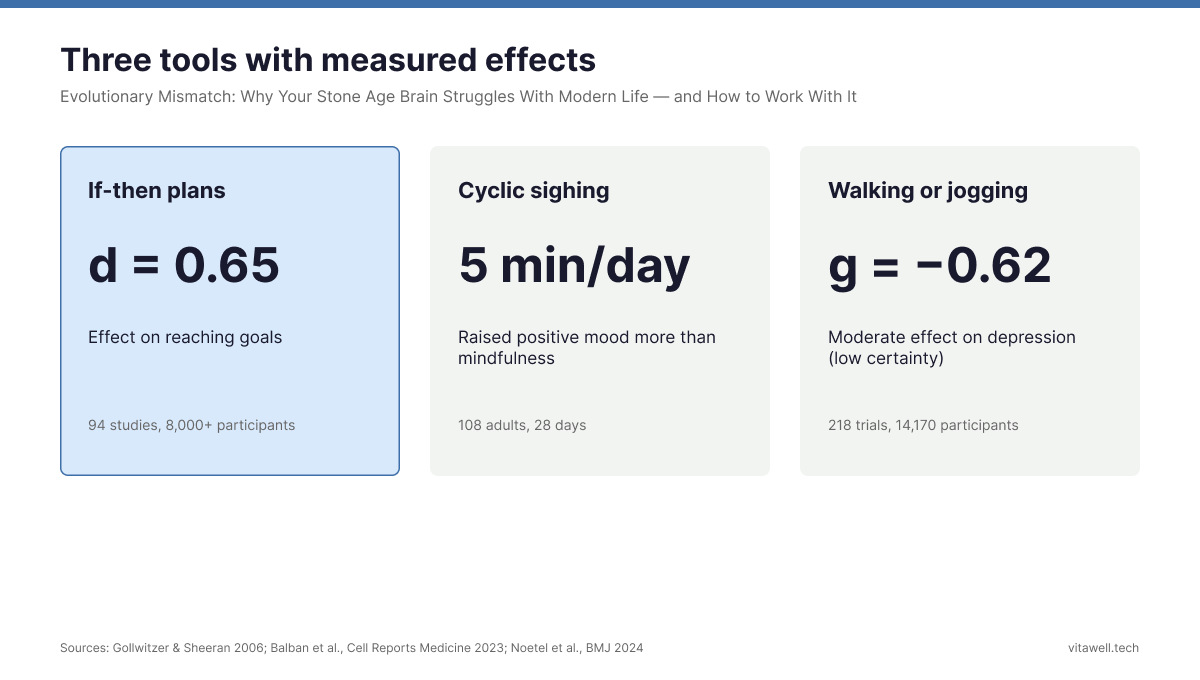
An implementation intention is a plan in the form "if situation X, then I will do Y." A meta-analysis by Peter Gollwitzer and Paschal Sheeran, summarized in a Frontiers in Human Neuroscience review, covered 94 studies and more than 8,000 participants and found a medium-to-large effect on reaching goals (d = 0.65). If-then plans move the decision away from the moment when the reward-now instinct is strongest.
Calm the alarm with a long exhale
In a remote randomized study, Melis Yilmaz Balban, David Spiegel, Andrew Huberman and colleagues at Stanford (Cell Reports Medicine, 2023) assigned 108 adults to 5 minutes a day of breathwork or mindfulness for 28 days. Cyclic sighing, a double inhale through the nose followed by a long exhale, raised positive mood more than mindfulness meditation. Most participants were young students, so treat it as a promising, low-cost tool.
Move like the body expects
Regular movement remains one of the best-supported ways to steady mood. A network meta-analysis by Michael Noetel and colleagues (BMJ, 2024) pooled 218 randomized trials with 14,170 participants with depression and found a moderate effect for walking or jogging (g = −0.62), though the certainty of evidence was rated low.
A 7-Day Mismatch Reset Plan
Each day targets one instinct with one small change. Keep the changes that help.
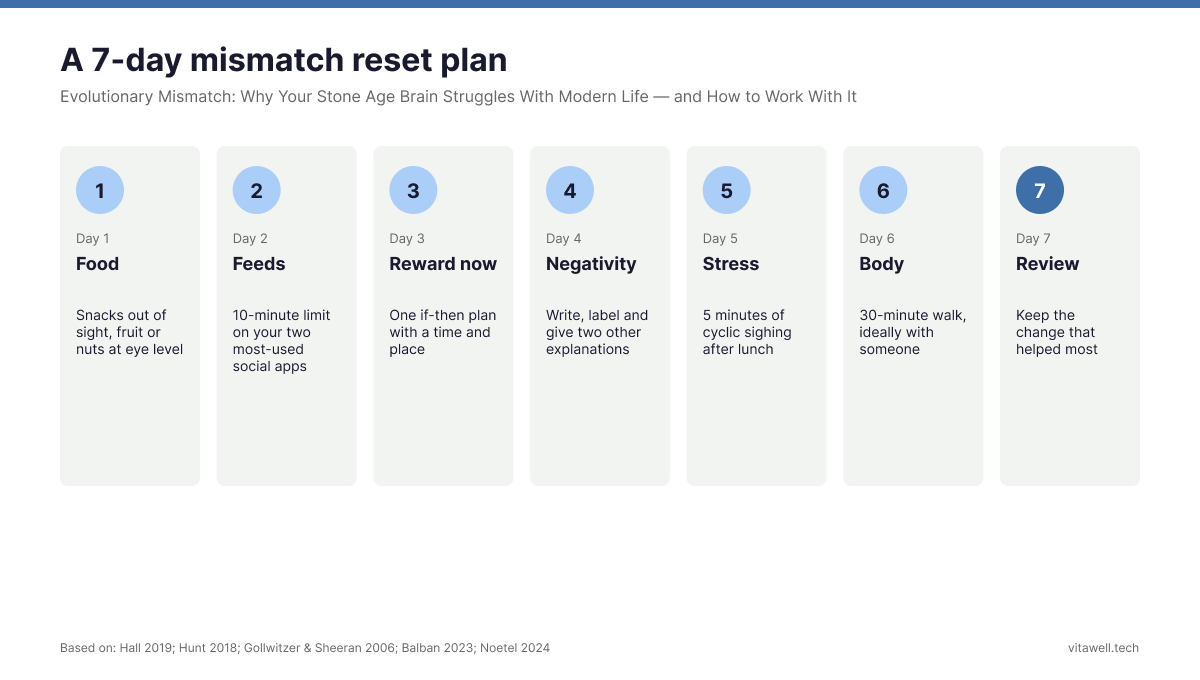
- Day 1 (food): Move ultra-processed snacks out of sight and put fruit or nuts at eye level.
- Day 2 (feeds): Set a 10-minute daily limit on your two most-used social apps.
- Day 3 (reward now): Write one if-then plan for a goal you keep postponing, with a time and place.
- Day 4 (negativity): When a worry repeats, write it down, label it ("threat alarm"), and list two other explanations.
- Day 5 (stress): Do 5 minutes of cyclic sighing after lunch.
- Day 6 (body): Take a 30-minute walk, ideally with someone.
- Day 7 (review): Note which change made the biggest difference and plan it for next week.
When to Talk to a Professional
- Anxiety, low mood or worry has lasted more than two weeks and affects sleep, work or relationships.
- Eating feels out of control, or weight changes quickly without a clear reason.
- Social media use or other habits keep escalating despite clear harm.
- You have thoughts of harming yourself; in that case contact local emergency services or a crisis line right away.
A psychologist trained in CBT or ACT can tailor these tools, and a doctor can check physical causes of fatigue, mood or appetite changes.
Frequently Asked Questions
What is evolutionary mismatch?
Evolutionary mismatch is when a trait that helped our ancestors survive becomes unhelpful or harmful in a modern environment. Common examples include cravings for calorie-dense food in a world of ultra-processed products, and status anxiety amplified by social media. The trait is not broken; the environment has changed faster than biology.
What are examples of evolutionary mismatch?
Typical examples are overeating ultra-processed food, compulsive social comparison online, preferring small rewards now over larger rewards later, and worrying about abstract threats. Each reflects an instinct tuned for scarcity, small groups and physical danger that now meets abundance, huge networks and constant information.
Why is the brain wired for negativity?
Ancestors who overreacted to threats usually survived, while those who missed threats often did not, so the brain learned to weight bad news heavily. Economists see this as loss aversion: a 2024 meta-analysis found losses feel about twice as heavy as equal gains, with an average coefficient of 1.955.
Can you rewire your Stone Age brain?
You cannot remove evolved instincts, but you can change how often they are triggered and how you respond. Adjusting your environment, using if-then plans, reframing thoughts, practicing acceptance and moving regularly all have research support. Consistent small changes work better than relying on willpower in the moment.
Is anxiety an evolutionary mismatch?
Partly. Anxiety evolved as a useful alarm, but modern life sets it off with abstract, ongoing threats it cannot resolve, such as deadlines or online criticism. That makes anxiety easy to trigger and hard to switch off. Persistent anxiety that disrupts daily life deserves professional assessment rather than self-help alone.
Conclusion
Your Stone Age brain is not a design flaw; it is a survival system running in an environment it never expected. The research points to a practical strategy: reshape the cues you control, and train calmer responses to the ones you cannot. Pick one mismatch from the map, try one counter-move this week, and track how it feels. VitaWell's AI life planner can turn the 7-day reset into recurring habits across your Health and Growth areas.
Related on VitaWell
- Why Relationships Are So Hard: What Evolutionary Science Reveals — the same mismatch lens applied to love and pair bonding.
- Atomic Habits: Practical Takeaways — environment design and friction, the core of changing cues rather than willpower.
- How 20 Minutes of Exercise Boosts Your Memory — more on what movement does for the brain.
This article is for informational purposes only and is not a substitute for professional medical or mental health advice.
Sources
- Psychology Today — Outsmart Stone Age Instincts That Make You Unhappy
- Pontzer et al., 2012 — Hunter-gatherer energetics and human obesity (PLoS ONE)
- World Health Organization — Obesity and overweight fact sheet
- Hall et al., 2019 — Ultra-processed diets cause excess calorie intake and weight gain (Cell Metabolism)
- CDC NCHS, 2025 — Ultra-processed food consumption in youth and adults, 2021–2023
- Hunt et al., 2018 — No more FOMO: limiting social media decreases loneliness and depression
- Brown, Imai, Vieider and Camerer, 2024 — Meta-analysis of empirical estimates of loss aversion
- Frontiers in Human Neuroscience, 2015 — review citing Gollwitzer and Sheeran's implementation intentions meta-analysis
- Balban et al., 2023 — Brief structured respiration practices enhance mood (Cell Reports Medicine)
- Noetel et al., 2024 — Effect of exercise for depression (BMJ)