Why Relationships Are So Hard: What Evolutionary Science Reveals — and How to Build One That Lasts
Humans evolved competing drives for deep bonding and novelty. Here is what evolutionary science and recent data reveal about why relationships are hard, and what helps them last.
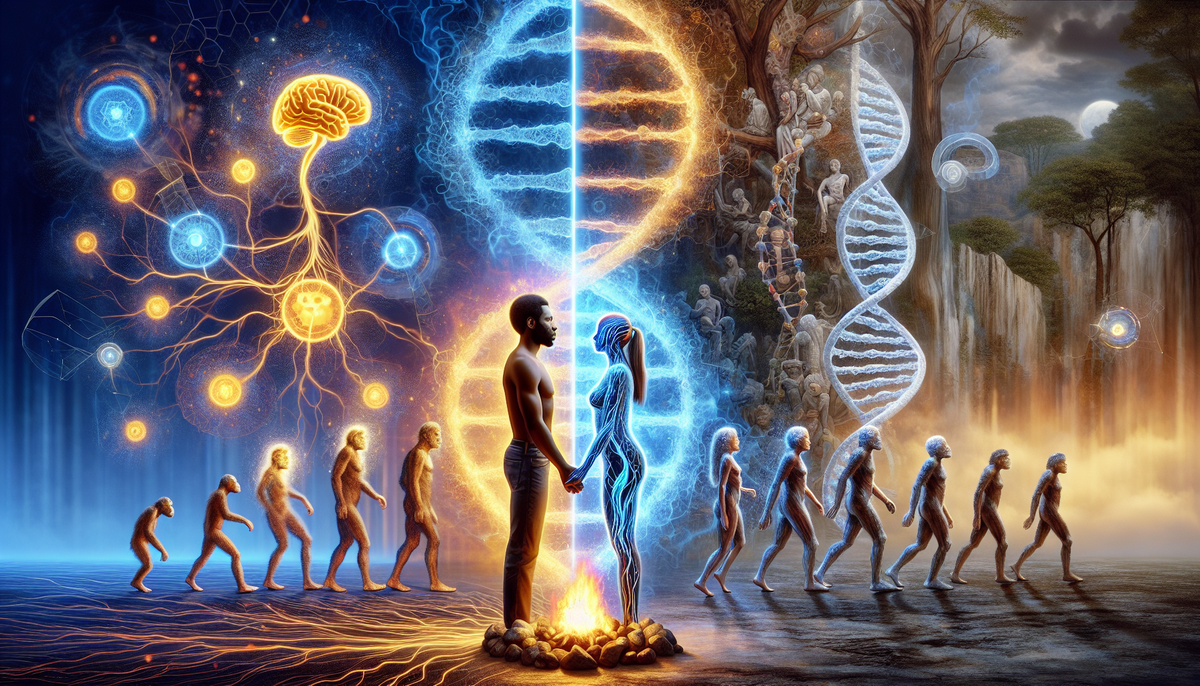
Relationships are so hard partly because humans evolved two drives that pull in different directions: a strong need for one deep, lasting bond, and a pull toward novelty. Modern life adds a mismatch our brains never evolved for, from endless dating-app choice to the expectation that one partner meets every need. The research also shows what helps: prioritizing emotional safety, adding shared novelty, and treating early infatuation and breakup pain as brain states rather than verdicts.
Key Takeaways
- Evolutionary researchers such as Justin Garcia of the Kinsey Institute describe intimacy as a biological drive, shaped because pair-bonded parents raised more surviving children.
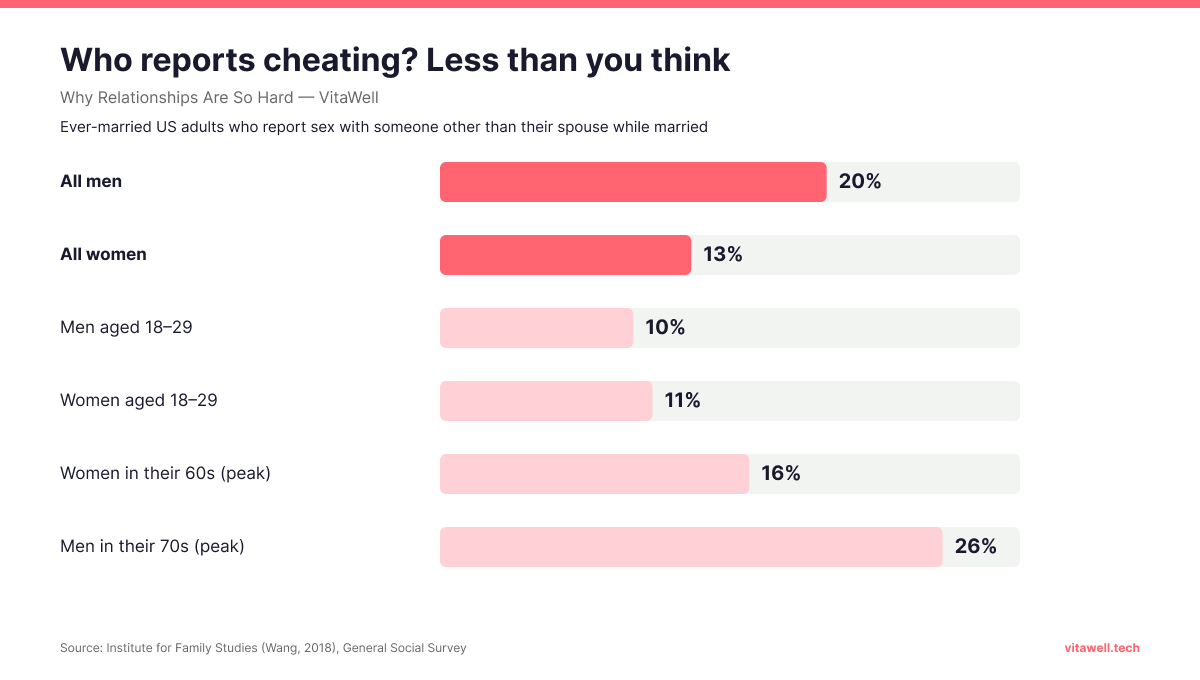
- Infidelity is less common than headlines suggest: 20% of ever-married US men and 13% of women report cheating, and under age 30 the rates are nearly equal (10% and 11%).
- The widely quoted "1 in 5 Americans have tried non-monogamy" comes from surveys of single adults; another national survey put open relationships at 12%.
- In 2026, 34% of US singles said they would choose peace and emotional safety over passion, versus 14% who chose passion.
- Seeing an ex after rejection activates the same reward and craving circuits involved in addiction, which helps explain why nearly half of young adults get back together with a partner after breaking up.
Intimacy Is Not Just an Emotion — It Is a Biological Drive
Justin Garcia, executive director of the Kinsey Institute and author of The Intimate Animal, argues that intimacy is a biological drive comparable to hunger. Natural selection shaped our desire for close, sustained partnership because it helped our ancestors survive and raise children. This explanation is a theory built from comparative biology and human data, not something any single experiment proves.
The Role of Oxytocin and Dopamine in Forming Bonds
Several brain systems work together in love. Oxytocin, often called the bonding hormone, is released during touch, sex and close social contact and supports trust and closeness. Vasopressin is linked to long-term attachment and partner preference, mostly based on animal research. Dopamine, the brain's reward signal, makes being with a loved one feel rewarding and motivates us to seek them out.
Why Our Ancestors Who Bonded Survived
Human infants are unusually helpless and need years of care. Two adults sharing childcare, food and protection were more likely to raise surviving offspring than one adult alone. Over many generations, that favored people who could form selective, durable bonds.
The Hidden Tension at the Heart of Every Relationship
Humans appear wired for a strong drive toward deep partnership and, separately, a pull toward novelty and variety. These systems do not always reinforce each other, which creates much of the friction people feel in long relationships.
Social Monogamy vs. Sexual Monogamy — What Science Actually Says
Social monogamy means pair bonding: sharing a home, raising children and building a life together. Sexual monogamy means sexual exclusivity. In many species the two do not always overlap, and humans show a mix of both tendencies across cultures.
Actual infidelity rates are lower than many people assume. Using the General Social Survey, the Institute for Family Studies (Wang, 2018) found that 20% of ever-married men and 13% of ever-married women reported having sex with someone other than their spouse while married. Rates vary by age: men in their 70s had the highest rate at 26%, while women peaked in their 60s at 16%. These are self-reports, so true rates may be somewhat higher.
Men and Women Are More Similar Than You Think
Popular culture often says men and women want fundamentally different things. Psychologist Janet Hyde's Gender Similarities Hypothesis reviewed 46 meta-analyses and found that 78% of measured gender differences were small or close to zero, as summarized by Psi Chi (Hyde). The infidelity data echoes this among younger adults: in the same GSS analysis, 11% of ever-married women and 10% of men aged 18–29 reported cheating.
Open Relationships: What the Numbers Really Show
Consensual non-monogamy (CNM) means relationships where all partners agree that sexual or romantic involvement with others is allowed. A widely shared estimate comes from Kinsey Institute researchers (Haupert et al., 2016), who found that 21.9% and 21.2% of single US adults in two Singles in America samples had ever engaged in CNM.
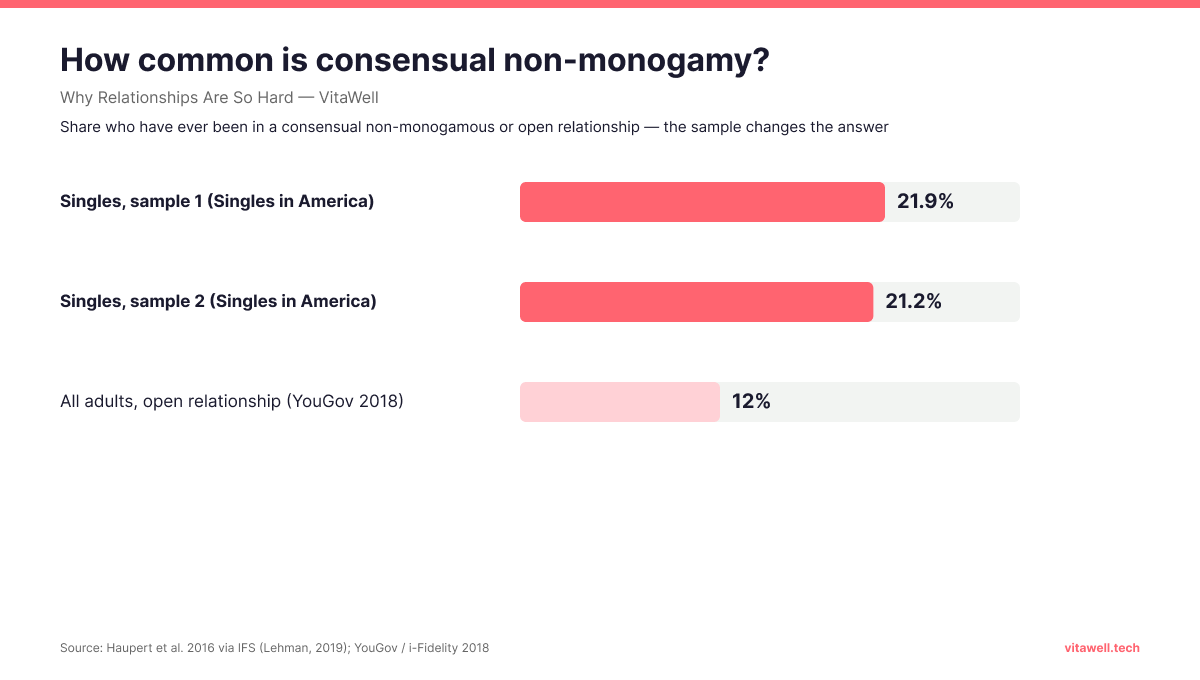
Context matters. As the Institute for Family Studies (Lehman, 2019) notes, those samples included only singles, used a broad definition that may capture casual dating, and oversampled some groups. A 2018 YouGov survey for the i-Fidelity project found 12% had ever been in an open sexual relationship. Either way, CNM is a minority choice that works for some people and requires continuous, honest negotiation about jealousy, time and boundaries.
Why Modern Dating Feels So Much Harder Than It Should
Evolutionary mismatch is the gap between the environment our brains evolved in and the one we live in now. Ancestral humans chose partners from small groups; today, apps present a seemingly endless supply of options, which can make every choice feel provisional.
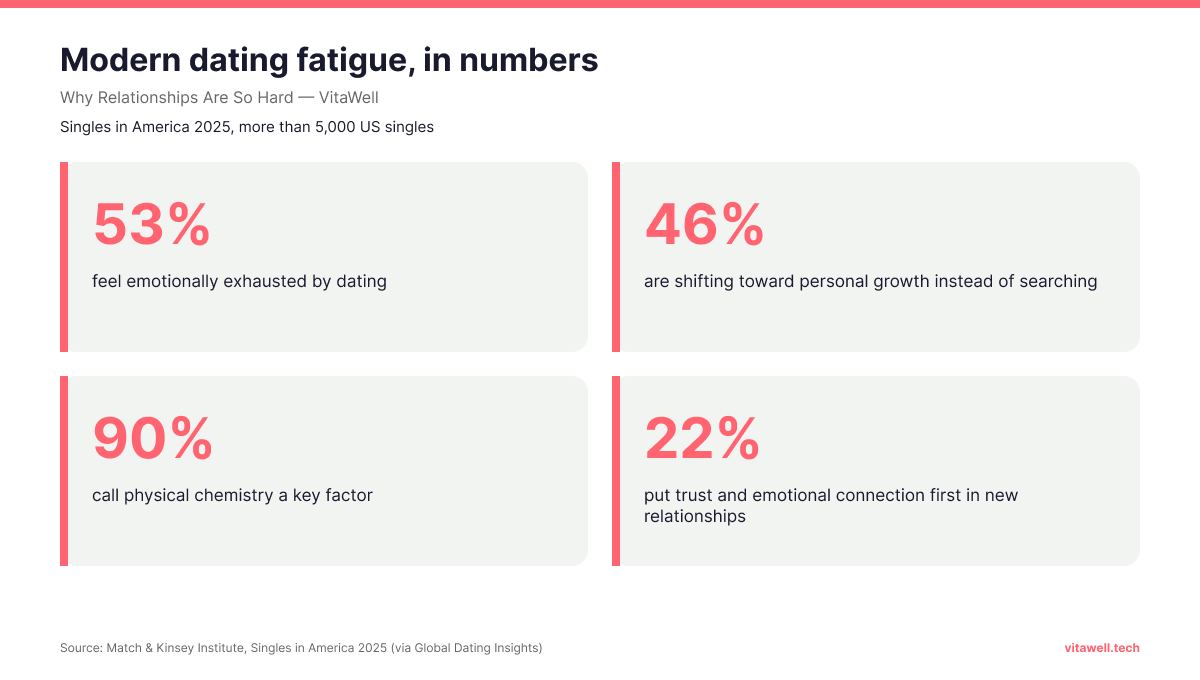
The fatigue is measurable. Match's 2025 Singles in America study with the Kinsey Institute, covering more than 5,000 US singles, found that 53% felt emotionally exhausted by dating, and 46% said they were shifting toward personal growth instead of actively searching. Ninety percent called physical chemistry a key factor, while 22% said trust and emotional connection were their top priority in new relationships. VitaWell's guide to dating in the digital age covers practical ways to use apps without burning out.
What People Actually Want in a Partner
The 2026 Singles in America study, summarized by Global Dating Insights (2026), surveyed about 5,000 US singles and found a clear shift toward stability:
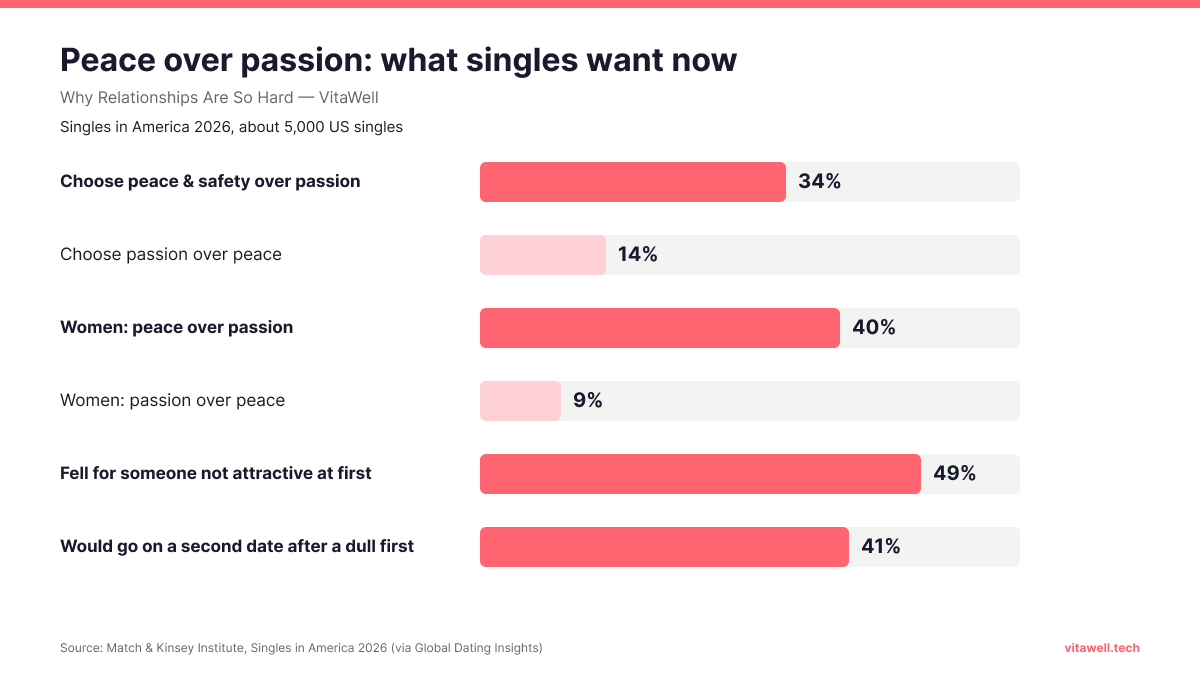
- 34% would prioritize peace and emotional safety over passion, versus 14% who chose passion; among women the split was 40% versus 9%.
- 49% had fallen for someone they were not attracted to at first.
- 46% of people with a checklist of must-haves had fallen for someone who did not meet it.
- 41% would consider a second date even after an unexciting first date.
A practical decision rule follows: if someone feels safe and interesting but the spark is quiet, a second or third date is a reasonable test rather than a waste of time. Trust also has to be maintained, not just found; VitaWell's piece on rebuilding trust after a conflict covers the repair side.
The Limerence Trap — Why Early Love Distorts Everything
Limerence is the intense early infatuation phase: intrusive thoughts about a person, euphoric highs and strong anxiety about whether the feeling is returned. It is driven largely by the brain's reward system and can make a new partner seem uniquely perfect. Warning signs that it may be distorting judgment:
- Overlooking significant red flags because the attraction feels overwhelming.
- Making major life decisions on the basis of a very new connection.
- Feeling that this person alone can complete you.
- Strong anxiety at any sign of distance.
Early excitement is not a problem in itself. It works best balanced with time, observation and honest talk about long-term values. Strong anxiety about closeness can also reflect attachment patterns, explained in VitaWell's guide to attachment styles in love.
Breakup Grief Is Real — And That's Why Endings Are So Hard
Rejection hits the brain like withdrawal. In an fMRI study of 15 people who had recently been rejected but were still in love, Fisher and colleagues (Journal of Neurophysiology, 2010) found that viewing a photo of the ex activated reward and craving areas linked to cocaine addiction, along with regions tied to physical pain. Activity in an area linked to attachment faded as time passed.
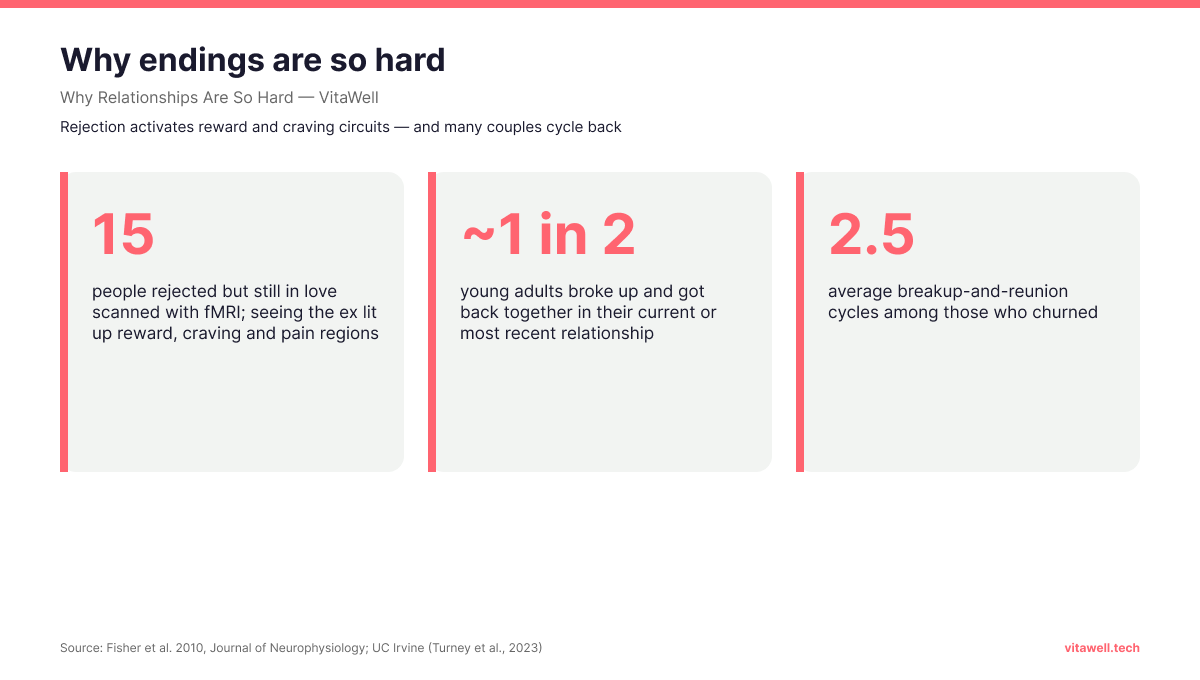
That pull helps explain why so many couples reunite. According to UC Irvine sociologist Kristin Turney and colleagues (2023), nearly half of young adults have broken up and gotten back together in their current or most recent relationship, averaging 2.5 such cycles. Knowing the craving is temporary makes it easier to decide about getting back together when calm rather than in the first painful weeks.
How to Build a Relationship That Lasts — Practical Science-Backed Strategies
The table maps each ancient drive to the modern mismatch it runs into and a move that works with your biology rather than against it.
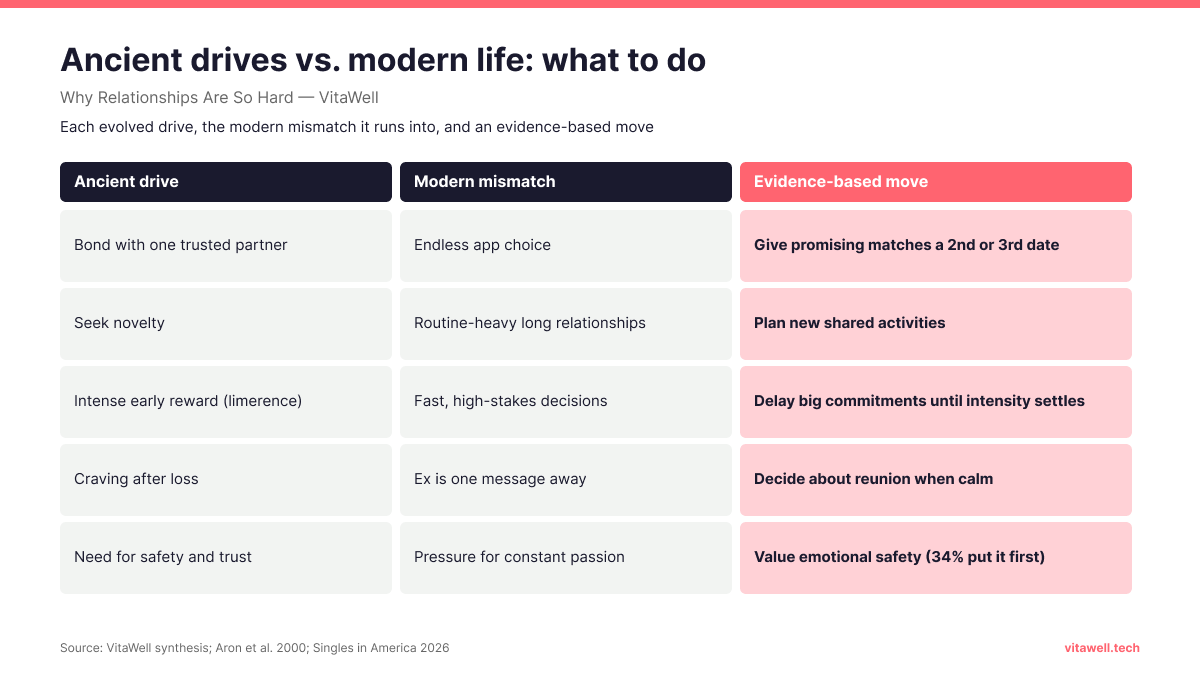
| Ancient drive | Modern mismatch | What it feels like | Evidence-based move |
|---|---|---|---|
| Bond with one trusted partner | Endless app choice | Every match feels replaceable | Give promising matches a second or third date before judging |
| Seek novelty | Routine-heavy long relationships | Boredom, wandering attention | Plan new shared activities; novelty raised relationship quality in experiments |
| Intense early reward (limerence) | Fast, high-stakes decisions | "This person is perfect" | Delay big commitments until the intensity settles |
| Craving after loss | Ex is one message away | Urge to reconnect | Decide about reunion when calm, not in the first weeks |
| Need for safety and trust | Pressure for constant passion | Worry that calm means "no spark" | Value emotional safety; 34% of singles now put it first |
Putting it into practice:
- Prioritize trustworthiness, not just attraction. Consistency and honesty are what make long-term bonds feel safe.
- Focus on deal-makers, not deal-breakers. Know what matters most and stay open on the rest.
- Add shared novelty regularly. In experiments by Aron and colleagues (2000), couples doing novel, exciting activities together reported higher relationship quality; see also VitaWell's piece on growing together through self-expansion.
- Talk early about relationship structure. Expectations about exclusivity are easier to discuss before they become a crisis.
- Let infatuation point, not decide. Let behavior over time confirm what early feelings suggest.
- Give endings time. Treat breakup craving as a phase to wait out, and build habits that support you, as outlined in VitaWell's guide to building a healthy relationship from day one.
When to Talk to a Professional
- Jealousy, mistrust or conflict keeps escalating despite effort from both partners.
- Infidelity has happened and you are deciding whether and how to rebuild.
- You are considering opening a relationship and want help negotiating it fairly.
- Breakup grief lasts for months and affects sleep, work or mood.
- You feel unsafe or controlled in a relationship; contact a domestic violence service or emergency services.
Frequently Asked Questions
Why are relationships so hard?
Humans evolved a strong drive to bond with one partner alongside a pull toward novelty, and those drives can conflict. Modern life adds mismatches such as endless dating-app choice and high expectations. Understanding these forces makes it easier to work with them instead of blaming yourself or your partner.
Are humans naturally monogamous?
Humans show strong tendencies toward social monogamy, meaning pair bonding and shared parenting, but sexual exclusivity varies across people and cultures. Most married Americans report never cheating: in General Social Survey data, 20% of men and 13% of women said they had. Monogamy is a common and workable choice, not an automatic one.
Do men cheat more than women?
Overall, slightly more men than women report infidelity: 20% versus 13% of ever-married US adults in General Social Survey data. Among adults under 30 the gap disappears, with 10% of men and 11% of women reporting cheating. Age and opportunity matter more than simple gender stereotypes suggest.
Why is it so hard to get over a breakup?
Brain imaging shows that seeing an ex after rejection activates reward and craving regions similar to those involved in addiction, plus regions linked to pain. That craving fades with time. Knowing it is temporary helps you avoid reacting impulsively and get through the hardest weeks with support.
How do you make a relationship last?
Prioritize trust and emotional safety, keep adding shared novelty, repair conflicts quickly and talk openly about expectations, including exclusivity. Let early infatuation guide you toward someone, but judge long-term fit by their behavior over time. Many singles now value peace over constant passion, and that shift supports lasting bonds.
Conclusion
Relationships are not hard because people are broken. They are hard because humans evolved competing drives for deep bonding and novelty, and now live in an environment those drives were never built for. The evidence points to a few reliable moves: choose and protect emotional safety, bring novelty into the relationship you have, and give strong feelings, at the start and at the end, time to settle before acting on them. VitaWell's AI life planner can help you turn these moves into small, recurring goals in your Relationships area.
Related on VitaWell
- Signs Your Relationship Is Drifting Apart — and What Research Says Helps — the everyday signals that a long relationship needs attention.
- You're Not "Too Needy" in Your Relationship: What Science Says About Expressing Your Needs — how to voice the need for closeness the bonding drive creates.
- Emotional Holding in Relationships: The Science-Backed Key to Deep Intimacy — building the emotional safety partners increasingly value.
This article is for informational purposes only and is not a substitute for professional counseling or therapy.
Sources
- What Evolution Can Teach Us About Stronger Relationships — Greater Good Science Center
- Institute for Family Studies, 2018 — Who cheats more? The demographics of infidelity in America (Wang)
- Psi Chi — Janet Hyde and the Gender Similarities Hypothesis
- Institute for Family Studies, 2019 — Have 1 in 5 Americans been in a consensual non-monogamous relationship? (Lehman)
- Global Dating Insights, 2025 — Singles in America study (Match and Kinsey Institute)
- Global Dating Insights, 2026 — Singles in America: stability and compatibility
- Fisher et al., 2010 — Reward, addiction and emotion regulation systems associated with rejection in love (Journal of Neurophysiology)
- UC Irvine, 2023 — Getting back together, again (Turney and Halpern-Meekin)
- Aron et al., 2000 — Couples' shared participation in novel and arousing activities (JPSP)