You're Not "Too Needy" in Your Relationship: What Science Says About Expressing Your Needs
Being told you are "too needy" in a relationship is one of the most quietly damaging things that can happen to a person. It implies something is fundamentally wrong with you for wanting closeness, reassurance, or presence from your partner. You start to wonder whether your desires for connection are a burden, whether your feelings are too much, whether you should simply want less. But decades of relationship science — including the landmark research from the Gottman Institute — tells a very different story about what it means to have emotional needs in relationships.
Where the 'Too Needy' Label Comes From
The idea that a healthy, independent adult should not need much from a romantic partner is a cultural myth, and a damaging one. It conflates self-sufficiency with emotional health, and it misunderstands what intimate relationships are actually for. Romantic partnerships are, at their biological and psychological core, attachment relationships — bonds in which two people serve as a secure base and safe haven for each other. Wanting to feel understood, valued, and emotionally present with a partner is not a design flaw. It is the entire point.
Often, the "too needy" label says more about the person using it than the person it is directed at. It may reflect the speaker's own discomfort with intimacy, their avoidant attachment style, or an attempt to avoid accountability for consistently not showing up. When a partner repeatedly calls your legitimate needs "too much," the problem is not the needs themselves — it is the dynamic that has formed around meeting them.
What Emotions Are Actually Telling You
One of the most important reframes in modern relationship psychology is this: emotions are not character flaws. They are information. Each emotion serves as an internal signal pointing toward something meaningful about your experience. Anxiety signals threat or uncertainty. Sadness signals loss or disconnection. Anger signals boundary violations or unmet expectations. Loneliness signals a need for connection. When you suppress these signals — when you tell yourself "I shouldn't need this" or "I'm being too sensitive" — you don't eliminate the need. You lose your access to the data your inner world is trying to give you.
This suppression has a particular cost for men, who are frequently socialized to distrust emotional responses as signs of weakness. Research consistently shows that men who shut down emotional expression experience reduced relationship satisfaction, increased physical stress markers, and — ultimately — the same unmet needs, now invisible and unaddressed.
What Are 'Needs' in a Relationship?
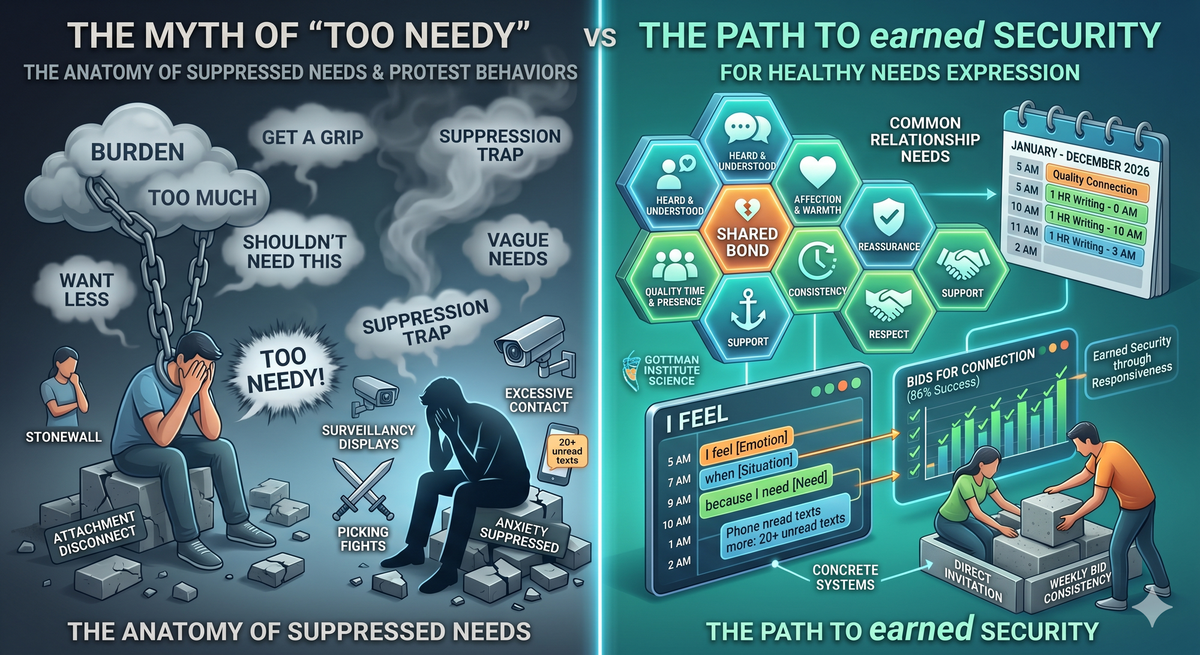
Relationship needs are the basic requirements for feeling emotionally safe and genuinely connected with your partner. They are not demands. They are not manipulations. They are the conditions under which two people can build trust, intimacy, and a shared life. Common relationship needs include:
- Feeling heard and understood, not just listened to
- Affection and physical warmth
- Reassurance during uncertainty or conflict
- Quality time and genuine presence (not just physical proximity)
- Consistency — knowing your partner will show up reliably
- Support when things are hard, without having to earn it
- Respect for your feelings and perspective
Everyone in every relationship has these needs. The only variable is whether those needs are expressed openly, expressed indirectly through behavior, or suppressed until they explode. The healthier the relationship, the more safely and directly these needs can be named.
How to Express Needs Without It Becoming Criticism
The most common reason need expression breaks down is that it gets delivered through the wrong vehicle. Instead of naming a need, people name a grievance. Instead of saying "I need more connection with you," they say "You never pay attention to me." The content is related, but the form is completely different — and the outcome is completely different too.
The 'I Feel' Framework
The most evidence-backed approach to expressing needs in relationships is the "I feel" format, a cornerstone of Gottman-trained couples therapy and Emotionally Focused Therapy (EFT). The structure is simple: "I feel [emotion] when [specific situation] because I need [underlying need]." For example:
- Instead of: "You're always on your phone when I'm talking to you." Try: "I feel disconnected when we eat together and you're on your phone, because I really value our time together."
- Instead of: "You never ask about my day." Try: "I feel unseen when I come home and we don't check in, because being known by you matters a lot to me."
This reframe shifts the conversation from attack to invitation. It gives your partner information they can actually act on, rather than a verdict that triggers defensiveness.
Inviting Connection vs. Demanding It
The tone and timing of need expression shapes its outcome as much as the content. Expressing a need from a place of openness — as an invitation for closeness — produces very different results than expressing it from a place of frustration as a demand or ultimatum. This does not mean you cannot express needs when you are hurt or upset. It means that awareness of how you are framing the request matters. Choosing a calm moment, using warm language, and being genuinely curious about your partner's perspective all increase the likelihood that your need will be heard and met.
Needs vs. Protest Behavior — The Critical Distinction
Here is where the science draws a line that is worth understanding clearly. There is a genuine difference between healthy need expression and what attachment researchers call protest behavior. Protest behaviors are indirect, often escalating attempts to get attachment needs met — but they are routed through the back door. They include:
- Stonewalling or withdrawing to provoke worry in your partner
- Jealousy displays designed to trigger reassurance
- Emotional escalation or outbursts that demand attention
- Excessive contact — calling or texting repeatedly when anxious
- Picking fights as a way to create closeness through conflict
The painful paradox of protest behaviors is that they want closeness but create distance. An anxious partner who texts their partner twenty times when they feel insecure provokes the avoidant partner's withdrawal, which increases the anxious partner's insecurity, which intensifies the protest. Everyone loses. If you recognize these patterns in yourself, it is not evidence that you are "too needy" — it is evidence that your attachment needs are real and intense, but your current strategy for meeting them is not working. The path forward is learning to express the underlying need directly, not amplifying the behavior that points toward it indirectly.
The Gottman Science of Bids for Connection
Dr. John Gottman's decades of research at the University of Washington produced one of the most compelling findings in relationship science: what predicts whether a couple stays together is not how they handle their biggest conflicts. It is how they respond to each other's bids for connection every single day.
Bids are small, often subtle attempts to connect — a comment about the weather, a touch on the arm, sharing something funny from the internet, asking "how was your day?" Gottman calls bids "the fundamental unit of emotional communication." In his landmark study of newlyweds, he tracked how couples responded to each other's bids during ordinary interactions. Six years later, the pattern was stark: couples who were still together had turned toward each other's bids 86% of the time. Couples who had divorced had done so only 33% of the time. Happy couples also made significantly more bids — approximately 100 per ten-minute dinner conversation versus 65 in unhappy couples.
Here is the crucial insight for anyone who has been told they are too needy: your needs are bids. When you say "I really need a hug right now" or "Can we spend some time together this evening?" — you are making a bid for connection. That bid is not an imposition. It is an invitation. In the most loving and lasting relationships, those invitations are met with warmth most of the time.
Why It Feels So Hard to Express Needs (Attachment Theory Explains)
If expressing needs is so healthy and natural, why does it feel so terrifying for so many people? Attachment theory, pioneered by John Bowlby and later extended to adult relationships by researchers like Cindy Hazan and Phillip Shaver, provides the answer. Your attachment style — the internal working model of relationships you developed in childhood — shapes how you experience need expression as an adult.
- Secure attachment: You feel generally confident that expressing needs will be met with responsiveness. You can ask for what you need, tolerate occasional disappointment without catastrophizing, and return to equilibrium after conflict.
- Anxious attachment: Past experiences taught you that love and attention are inconsistent. You may over-express needs, monitor your partner hypervigilantly for signs of withdrawal, or turn toward protest behaviors when you feel unseen. You are not "too needy" — your nervous system learned to fight for what it needed because it was not reliably available.
- Avoidant attachment: You were taught, explicitly or implicitly, that having needs was a burden. You may suppress needs, pride yourself on not requiring much, and feel genuinely uncomfortable with your partner's emotional requests. But suppressed needs do not disappear — they accumulate.
The research offers meaningful hope: earned security is real. Adults can develop more secure attachment patterns through consistently responsive relationships, therapy (especially EFT, which is specifically designed around attachment), and self-awareness practice.
When 'Too Needy' Is a Red Flag About the Relationship, Not You
There is a harder truth worth naming here. If you are in a relationship where your needs are consistently dismissed, minimized, or labeled as "too much," that is not a neutral fact about the size of your needs. It is information about the relationship. Gottman's research shows that repeated bid rejection — partners consistently turning away or turning against connection attempts — erodes trust and emotional intimacy over time. Healthy relationships create and maintain space for both partners' needs to be expressed and met. When one partner's needs are perpetually treated as inconvenient or excessive, it often reflects a fundamental incompatibility in attachment needs, a power imbalance, or in some cases, emotional unavailability that is unlikely to change without significant work.
If you find yourself constantly minimizing your own needs to accommodate a partner's discomfort with your emotional presence, it is worth asking: who is this relationship designed to serve?
Practical Steps to Express Your Needs More Effectively
Whether you are working on moving from protest behaviors to direct expression, or simply trying to build more emotional intimacy in a healthy relationship, these steps provide a concrete starting point:
- Identify the need before you express it. Ask yourself: what do I actually need right now? Not "what did they do wrong" but "what would help me feel better, more connected, or more secure?"
- Choose the right moment. Do not raise important emotional needs in the middle of a conflict, when your partner is stressed, or when you are flooded with emotion. A calm, private moment gives the conversation the best chance.
- Use 'I feel' language consistently. Practice the format: "I feel [emotion] when [situation] because I need [need]." It becomes more natural with repetition.
- Acknowledge your partner's needs too. The most effective need expression creates a reciprocal opening. After sharing your need, ask genuinely about theirs. This turns a vulnerability moment into a shared connection.
- If needs are persistently dismissed, seek support. A couples therapist trained in Gottman Method or EFT can help both partners understand each other's attachment needs and develop healthier patterns. Individual therapy can also help you understand your own attachment style and build the internal capacity to express needs with less fear.
The Bottom Line
You are not too needy. You are human. Every person in every relationship has emotional needs — for connection, understanding, affection, and security. The only question is whether those needs get expressed directly and received with care, or whether they go underground and find their way out through conflict, distance, and quiet resentment. Dr. Gottman's decades of research make the case unmistakably: couples who turn toward each other's emotional needs — 86% of the time, in the small moments and the large ones — are the ones who build relationships that last. Expressing your needs is not a demand. It is an act of love and trust. It is an invitation to be truly known by someone who has chosen to be with you.
Sources
The Myth of Being Too Needy in Relationships — The Gottman Institute