
Signs Your Relationship Is Drifting Apart — and What Research Says Helps
Drift starts quietly: fewer questions, missed bids, no repair. What decades of couple research show about the warning signs — and a 7-day plan to reconnect.

The clearest signs your relationship is drifting apart are quiet ones: you stop being curious about each other, you stop responding to small bids for attention, and minor tensions no longer get repaired. In John Gottman's research, couples who stayed together turned toward each other's bids 86% of the time, versus 33% for couples who later divorced. Drift is common and often predictable, especially around the 10-year mark, and it usually responds to small, repeated changes rather than grand gestures.
Key Takeaways
- Drift rarely starts with conflict; it starts with fewer questions, fewer responses and fewer repairs.
- A meta-analysis of more than 165,000 people found relationship satisfaction tends to dip to its lowest point about 10 years in, then recover.
- How partners respond to everyday bids for connection was one of the strongest predictors of staying together in Gottman's newlywed research.
- Stable couples keep about five positive interactions for every negative one, even during disagreements.
- Phones and how you react to a partner's good news are two overlooked accelerators of drift, and both are easy to change.
Why Couples Drift Apart Without Realizing It
Relationship drift is a gradual loss of emotional closeness without a single cause. Conversations become logistical, shared rituals fade, and partners end up living parallel lives under one roof. Because neither person is doing anything obviously wrong, the change is easy to miss until the distance feels large.
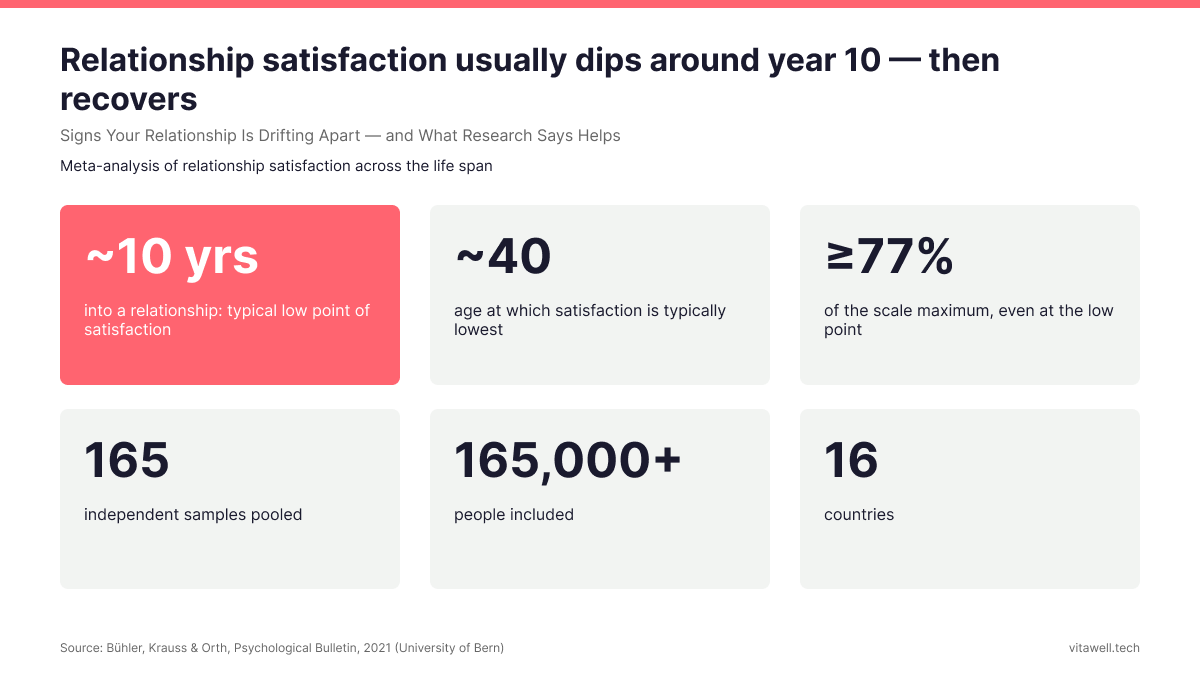
Timing matters. A 2021 meta-analysis in Psychological Bulletin (Bühler, Krauss and Orth, University of Bern) pooled 165 samples covering more than 165,000 people in 16 countries. It found that satisfaction typically falls to its lowest point about 10 years into a relationship and around age 40, then rises again until roughly the 20-year mark. Even at the low point, average satisfaction stayed above 77% of the scale maximum.
The practical reading: a dip is normal and often temporary, which makes it a good moment to act rather than a sign the relationship has failed. These are averages across many couples, so individual relationships can follow very different paths.
Sign 1 — You've Stopped Being Curious About Each Other
Early on, partners ask endless questions. Over time many couples assume they already know the answers and stop asking. People keep changing, though, and their hopes, worries and daily inner lives at 38 are not what they were at 28.
Curiosity helps create closeness from the start. In a University at Buffalo study (Kashdan, Rose and Fincham, 2002), 90 students were paired for 45-minute conversations. Highly curious participants felt closer to their partners, and were rated as closer by them, even when the conversation was only small talk. This was a lab study with strangers, so it shows how curiosity builds closeness rather than proving it sustains long relationships.
Gottman calls the up-to-date knowledge partners hold about each other love maps. When those maps go stale, partners start relating to an outdated version of each other. Ways to refresh them:
- Ask one new question a day about your partner's inner world, not logistics: "What's been on your mind lately?"
- Notice when you assume you know the answer, and ask anyway.
- Share something new about yourself; openness tends to invite openness back.
- Protect a short weekly conversation without phones; VitaWell's piece on the 15-minute weekly couple habit describes one format.
Sign 2 — You've Stopped Turning Toward Each Other
A bid for connection is any small attempt to get a partner's attention or warmth: a comment about something you read, a touch on the shoulder, a sigh that invites a question. Gottman describes three responses:
- Turning toward: acknowledging the bid and engaging, even briefly.
- Turning away: missing or ignoring it, usually through distraction rather than intent.
- Turning against: responding with irritation or criticism.
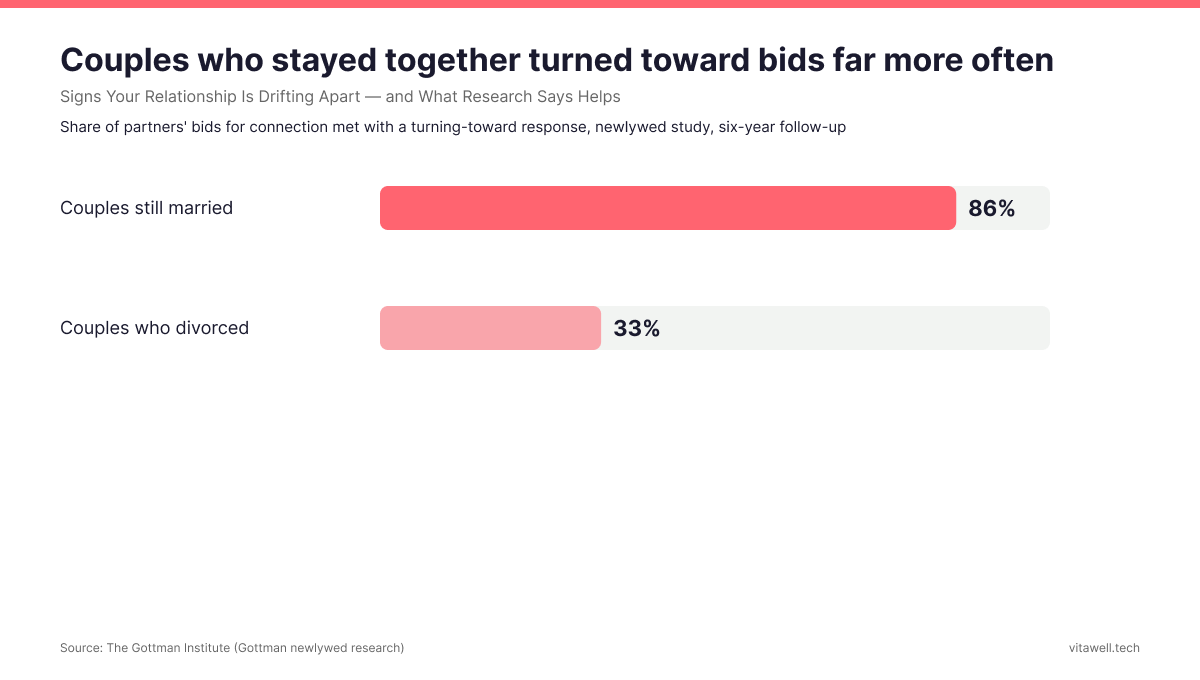
In Gottman's study of newlyweds, couples still married at the six-year follow-up had turned toward each other's bids 86% of the time, while couples who divorced averaged 33% (The Gottman Institute). When bids keep going unanswered, people make fewer of them, and the everyday warmth that makes a relationship feel alive fades with them.
The decline of everyday conversation adds to the problem; VitaWell's article on how much less people talk each year covers the wider trend.
Sign 3 — You've Stopped Repairing Small Ruptures
Conflict is unavoidable. What distinguishes lasting couples is repair: the small actions that restore goodwill after friction, such as a softer tone, a touch, a joke or "I'm sorry I snapped."
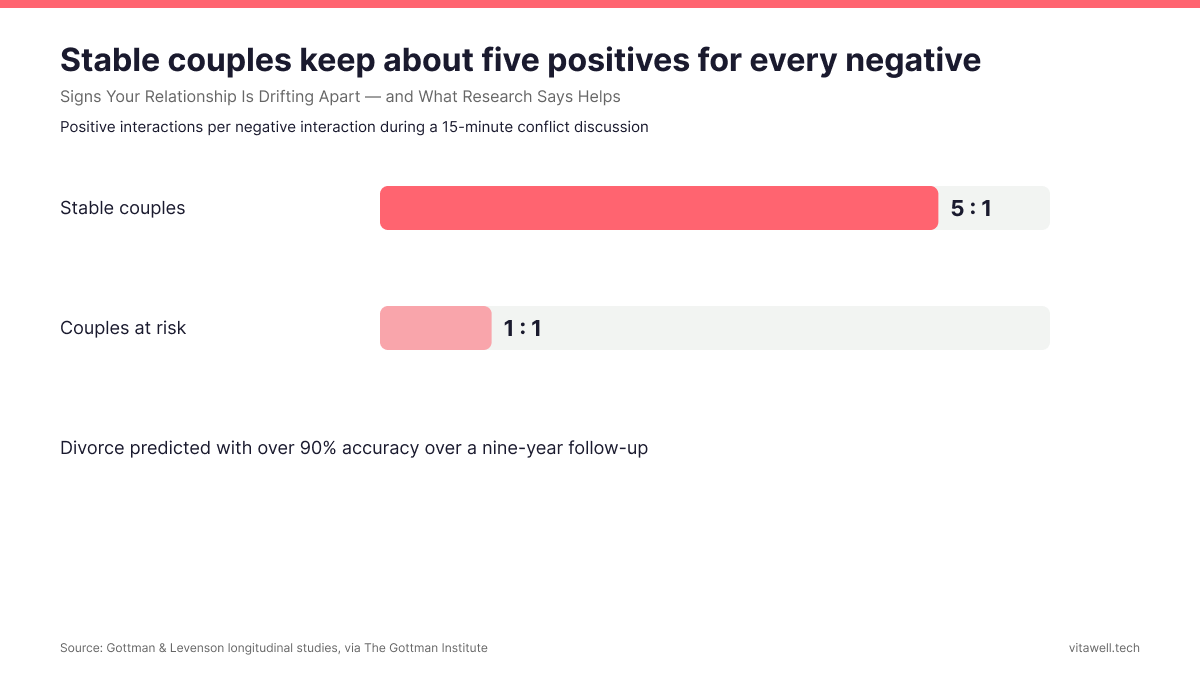
In Gottman and Levenson's long-term studies, couples discussed a disagreement for 15 minutes and were followed for nine years. According to The Gottman Institute, stable couples showed at least five positive interactions for every negative one during conflict, and the researchers predicted which couples would divorce with over 90% accuracy. A ratio of about 1 to 1 or lower signaled trouble.
A simple repair sequence to practice:
- Recognize the rising temperature in yourself and your partner.
- Reach out with a small signal: "Can we take a breath?"
- Restore calm and safety before trying to solve the problem.
For repairs after bigger breaches, see VitaWell's guide to rebuilding trust after a conflict.
Two Accelerators Most Lists Miss: Phones and Good News
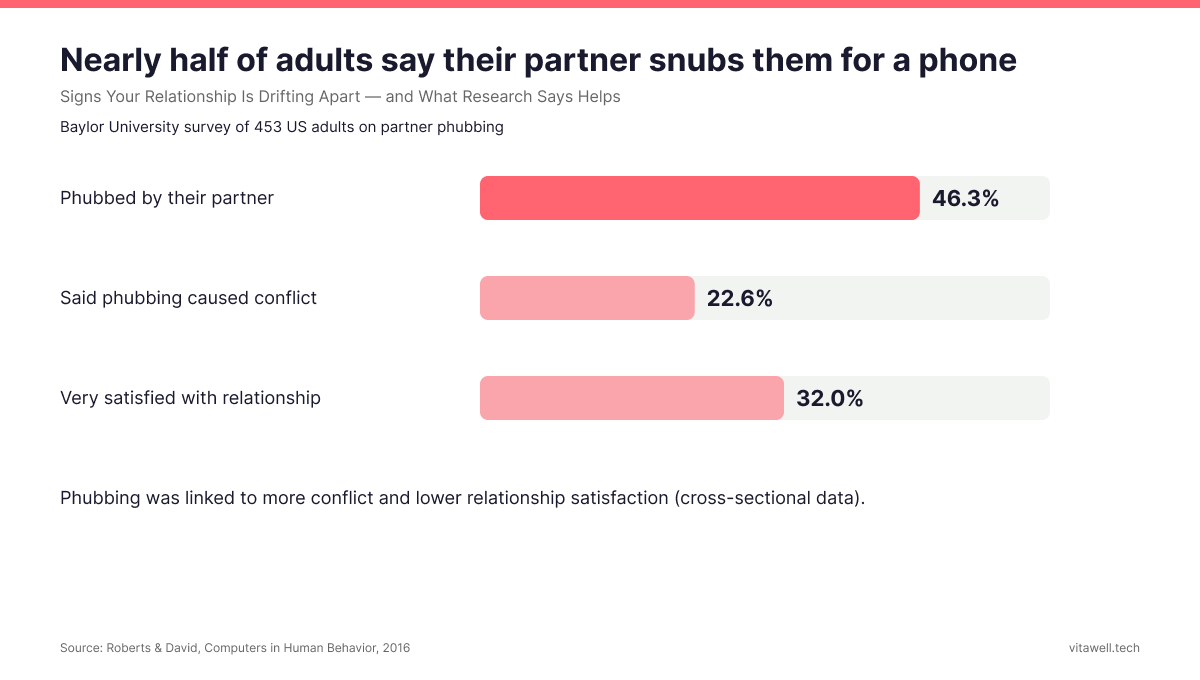
Phones. "Phubbing" means snubbing a partner by looking at your phone. In a Baylor University study of 453 US adults (Roberts and David, Computers in Human Behavior), 46.3% said their partner phubbed them and 22.6% said it caused conflict. Phubbing was linked to more conflict and lower relationship satisfaction. The data is cross-sectional, so it shows an association, not proof that phones cause drift.
Good news. How partners respond when things go right matters as much as support in hard times. In a study of 79 dating couples, Gable, Gonzaga and Strachman (Journal of Personality and Social Psychology, 2006) found that enthusiastic, engaged responses to a partner's good news, called active-constructive responding, were linked to higher commitment, satisfaction and passionate love. A distracted "nice" is a missed bid; "That's great, tell me how it happened" is a turn toward.
Drift Signals at a Glance
The table pulls the signs together with what research measured, how each shows up day to day, and one small counter-move.
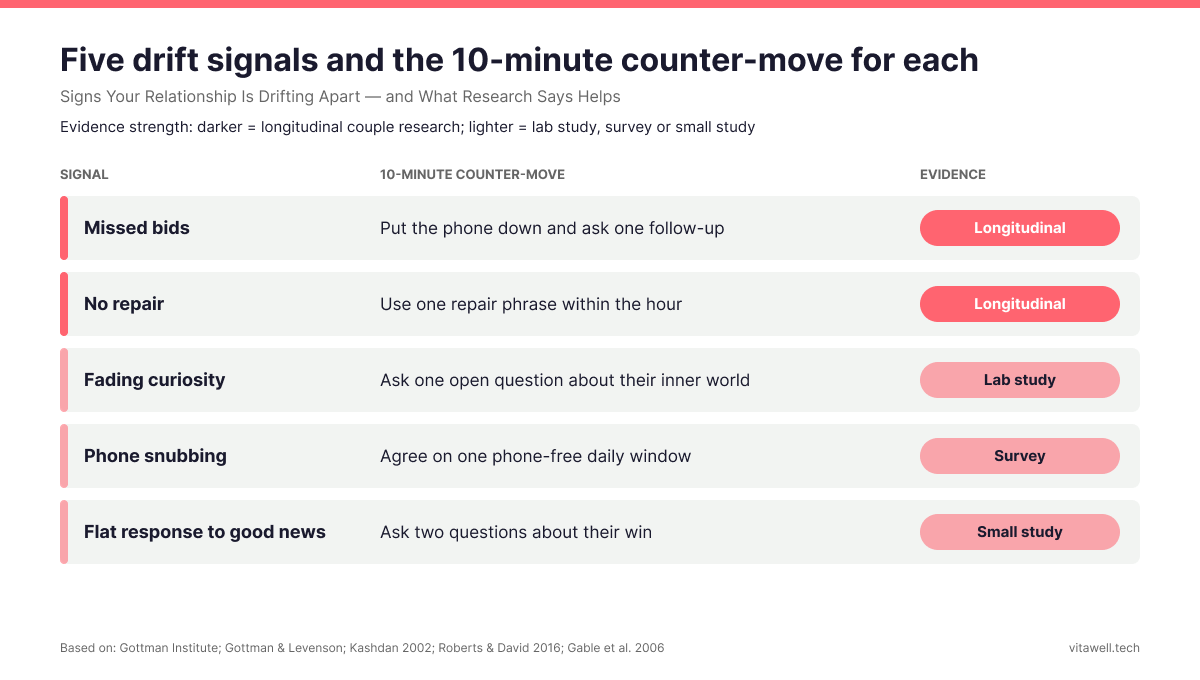
| Signal | What research measured | What it looks like day to day | 10-minute counter-move | Evidence strength |
|---|---|---|---|---|
| Fading curiosity | Curiosity and felt closeness in conversations (Kashdan, 2002) | Talk is about schedules and chores only | Ask one open question about their inner world | Lab study with strangers |
| Missed bids | Turning toward bids: 86% vs 33% (Gottman) | Comments get a nod without eye contact | Put the phone down and ask one follow-up | Longitudinal couple research |
| No repair | Positive-to-negative ratio during conflict, 5:1 (Gottman and Levenson) | Tension lingers for hours or days | Use one repair phrase within the hour | Longitudinal couple research |
| Phone snubbing | 46.3% report partner phubbing (Roberts and David) | Scrolling during meals or talks | Agree on one phone-free daily window | Cross-sectional survey |
| Flat response to good news | Active-constructive responding (Gable et al., 2006) | "Nice" without looking up | Ask two questions about their win | Small couple study |
Are These Signs Present in Your Relationship? A Quick Honest Check
Answer yes or no for the past month, then count your "no" answers:
- Do I regularly ask my partner about their inner life, not just logistics?
- Could I describe what my partner is currently worried about or excited by?
- When my partner reaches out, do I usually notice and respond?
- After tension, do we restore warmth within a day?
- Do we have at least one daily window without phones?
- When my partner shares good news, do I respond with real interest?
An informal rule of thumb, not a validated test: 0–1 "no" answers is normal wear and tear; 2–3 means the signs are worth watching and working on; 4 or more suggests a deliberate reset, ideally talked through together or with a couples therapist.
Practical Steps to Reconnect — Starting Today
A 7-day starter plan that targets each sign in turn:
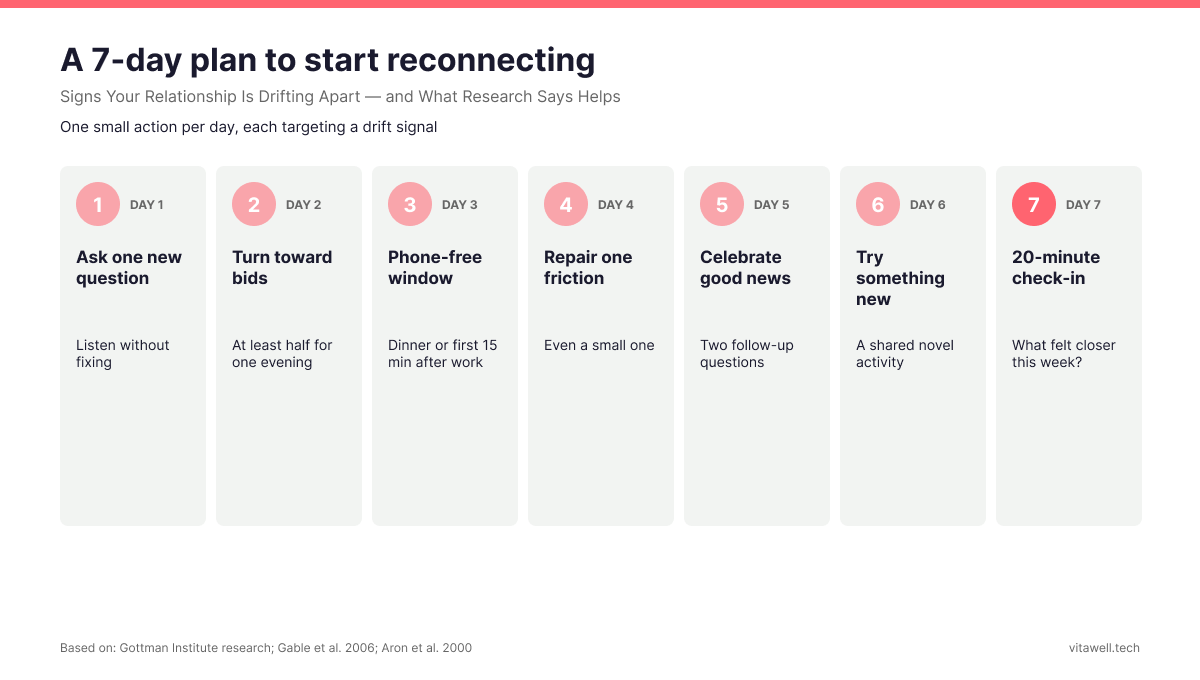
- Day 1: Ask one new question about your partner's inner world and listen without fixing.
- Day 2: Count your partner's bids for one evening and turn toward at least half of them.
- Day 3: Agree on one phone-free window, such as dinner or the first 15 minutes after work.
- Day 4: Repair one recent friction point, even a small one.
- Day 5: Respond to any good news with two follow-up questions.
- Day 6: Try something new together; shared novel activities were linked to higher relationship quality in experiments by Aron and colleagues (2000), and VitaWell's piece on self-expansion in relationships explains why.
- Day 7: Hold a 20-minute check-in: what felt closer this week, and what to keep.
When to Talk to a Professional
- The self-check above shows four or more signs, and a few weeks of effort has not shifted them.
- Conversations regularly turn into contempt, stonewalling or the same unresolved fight.
- One or both of you feel persistently low, anxious or lonely in the relationship.
- You are considering separation and want to decide carefully.
- You feel unsafe or afraid of your partner. In that case, contact a domestic violence helpline or local emergency services rather than couples therapy.
Couples therapy, including online formats, has a solid evidence base; VitaWell's review of whether online couples therapy works summarizes it.
Frequently Asked Questions
What are the first signs a couple is drifting apart?
The earliest signs are usually small: conversations shrink to logistics, partners stop asking about each other's inner lives, everyday bids for attention go unanswered, and minor tensions linger without repair. Big fights often come later, if at all. Noticing these quiet shifts early makes them much easier to reverse.
Is it normal to drift apart in a long-term relationship?
Some drift is common. A 2021 meta-analysis of more than 165,000 people found satisfaction typically dips to its lowest point about 10 years into a relationship and then recovers. A dip is not a verdict on the relationship, but it is a signal to invest attention deliberately.
Can a relationship recover from drifting apart?
Often, yes. Drift is built from small missed moments, and small repeated changes can rebuild it: turning toward bids, repairing tension quickly, asking new questions and doing new things together. When patterns feel stuck or painful, couples therapy can help both partners change them together.
How do you reconnect with your partner after growing distant?
Start small and consistent rather than grand. Add one phone-free window a day, respond to bids and good news with real interest, repair friction within hours, and try one new shared activity a week. Then check in together after a week or two about what is helping.
When should couples see a therapist?
Consider therapy when the same conflicts repeat without resolution, when contempt or withdrawal has become routine, when self-help efforts have not helped after a few weeks, or when either partner is thinking about leaving. If you feel unsafe, seek help from a domestic violence service first.
Conclusion
Drifting apart is rarely a single event and rarely final. The three signs, fading curiosity, missed bids and missing repair, are early warnings that something important has quietly stopped, and the research suggests that small, repeated actions can restart it. VitaWell's AI life planner can help you turn the 7-day plan into recurring rituals in your Relationships area, so reconnecting becomes a habit rather than a rescue mission.
Related on VitaWell
- Why You Can Feel Lonely Even in a Relationship — and the 5 Science-Backed Mindsets That Rebuild Connection — the inner side of the distance drift creates.
- When One Partner Grows and the Other Doesn't: How to Navigate Personal Development Without Growing Apart — when drift comes from one partner changing faster.
- Relationship Check-Ins: Do This Monthly — a simple structure for the day 7 conversation.
This article is for informational purposes only and is not a substitute for professional counseling or therapy.
Sources
- 3 Signs That a Couple Is Drifting Apart — Psychology Today
- University of Bern, 2021 — Relationship satisfaction at its lowest point after 10 years (Bühler et al., Psychological Bulletin)
- University at Buffalo, 2002 — Curiosity and closeness (Kashdan, Rose and Fincham)
- The Gottman Institute — Turn toward instead of away
- The Gottman Institute — The magic relationship ratio, according to science
- Baylor University via ScienceDaily, 2015 — Partner phubbing and relationship satisfaction (Roberts and David)
- Gable, Gonzaga and Strachman, 2006 — Will you be there for me when things go right? (JPSP)
- Aron et al., 2000 — Couples' shared participation in novel and arousing activities (JPSP)