When One Partner Grows and the Other Doesn't: How to Navigate Personal Development Without Growing Apart

The relationship was fine. Then one partner started therapy. Or changed careers. Or discovered a new community, a new way of eating, a new sense of purpose. The relationship didn't end in betrayal or sudden conflict. It started to wobble quietly — first in small disconnections, then in arguments that didn't quite make sense, then in a kind of loneliness that felt strange to name when you were still sleeping next to each other every night.
This is one of the most common and least discussed relationship challenges of our time. Personal growth is supposed to make you a better partner. So why does it sometimes feel like it's pulling you apart? New research and clinical frameworks — including a five-step model recently introduced by clinical psychologists in Psychology Today — help explain what's actually happening and how to navigate it without losing each other in the process.
Why Personal Growth Can Feel Like a Threat to Your Relationship
Growth changes things. It shifts routines, priorities, friendships, and ideas about the future. When you're the one growing, these shifts often feel exciting, clarifying, and long overdue. When you're the partner watching someone you love change — especially when you feel like you're not changing in the same way — the same shifts can feel destabilizing.
Research published in the Journal of Personality and Social Psychology found that high individual self-expansion — the personal growth, learning, and exploration that one person pursues independently — is associated with lower intimacy and passion in the couple over time. The more one person grows outside the relationship, without integrating that growth into it, the more the emotional connection erodes.
What looks like liberation from the inside can feel like abandonment from the outside. What feels like becoming who you were always meant to be can look, to your partner, like becoming someone they no longer recognize.
The Hidden Tension That Builds When One Partner Starts Changing
The tension usually doesn't announce itself. It starts with small things. The growing partner begins spending more time on their new interest, their new community, their new way of being in the world. Conversations shift. The vocabulary changes. The things that used to feel important start to feel different.
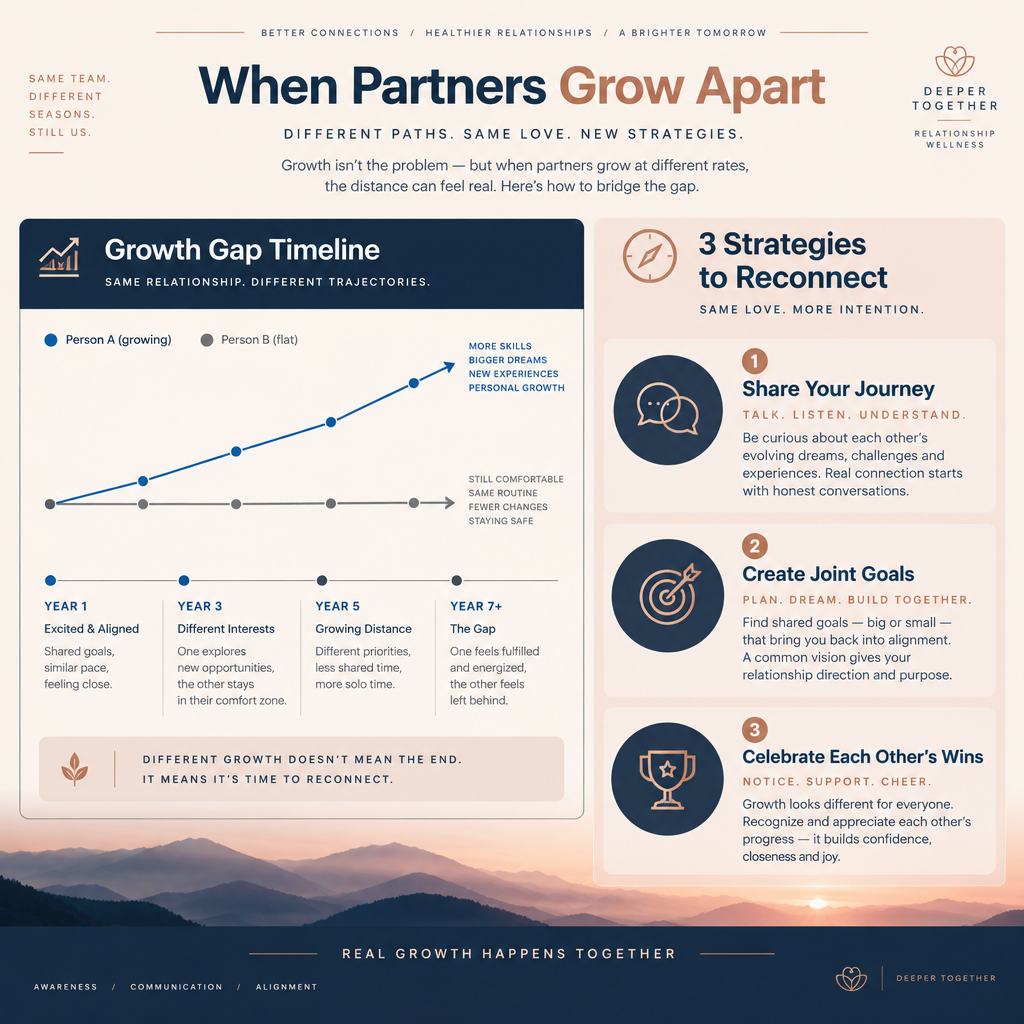
The growing partner often feels misunderstood — their excitement is met with quiet concern or subtle skepticism. The other partner often feels excluded — not from an argument, but from a life that's beginning to move in a direction they weren't consulted about. Without intervention, both partners may start to feel lonely inside the same relationship.
The defining feature of this period is that the conflict is rarely about what it appears to be about. Arguments about scheduling, money, or housework are often displacement — expressions of a deeper anxiety that neither partner has yet found words for.
Why Partners Experience the Same Change So Differently
The growing partner typically experiences change through a lens of expansion: possibilities are opening up, old limitations are falling away, new energy is flowing in. The partner who isn't currently in a similar growth phase often experiences the same change through a lens of threat: who we were together is shifting; am I still the right fit for who you're becoming?
Psychologists have identified what they call the Michelangelo Phenomenon — the idea that relationships thrive when partners actively help each other become their best selves, like sculptors helping to reveal a form already inside the marble. When this process is mutual and affirming, it deepens the bond. When only one partner feels like they're being sculpted — and the other feels like they're becoming redundant — the dynamic breaks.
What the 'Crash' Phase Looks Like in a Relationship
Clinical psychologists Mark B. Borg Jr. and Haruna Miyamoto-Borg, writing in Psychology Today in June 2026, named this friction zone the "Crash." It's the phase that arrives when personal growth creates uncertainty rather than excitement — when closeness gives way to distance, and small conflicts begin standing in for bigger fears.
Signs of the Crash phase include:
- Arguments that feel out of proportion to what triggered them
- Emotional withdrawal without a clear cause
- Defensive communication replacing what used to feel like easy conversation
- A sense of walking on eggshells around topics related to the growing partner's changes
- Feeling like you're living parallel lives rather than a shared one
The most important reframe: the Crash is not a sign the relationship is failing. It is a sign the relationship is being asked to evolve. Couples who understand this can approach the Crash as a transition rather than an ending.
Introducing PACER: A Framework for Couples Navigating Personal Growth
To help couples move through the Crash and into something healthier, Borg and Miyamoto-Borg offer the PACER framework — a five-step model that gives couples both a map and a shared vocabulary for navigating growth-related tension. PACER stands for: Pause, Accountability, Collaboration, Experiment, Reset.
Pause — Creating Space Before the Argument Spirals
The default response to relationship tension is immediate reaction. Pause is the practice of noticing that you're triggered before speaking from the trigger. It doesn't mean shutting down — it means recognizing the difference between speaking from clarity and speaking from fear.
In practice: "I need 20 minutes, and then I really want to talk about this" is not avoidance — it's regulation. The Pause is most powerful when you can name what you're pausing from: "I'm feeling scared right now, not angry."
Accountability — Recognizing How Fear Shows Up as Distance and Criticism
During periods of growth-related tension, both partners tend to protect themselves in patterns that hurt the relationship. The growing partner may withdraw from sharing their process to avoid conflict. The other partner may criticize or express skepticism — not from cruelty, but from fear.
Accountability is the step of asking yourself an honest question before engaging your partner: What am I actually afraid of right now? Fear rarely presents as fear. It presents as irritation, contempt, or withdrawal. Accountability means catching it earlier in the chain — before it becomes the look on your face or the edge in your voice.
Collaboration — Building a Shared Language Around Change
Growth doesn't have to be a solo journey. One of the most relationship-protective moves a growing partner can make is to actively invite their partner into what they're experiencing — not to justify the growth, but to share it.
Research consistently shows that couples who proactively discuss transitions report significantly higher relationship satisfaction. The goal is to make growth feel like something happening to us, not something happening to you that's affecting me. Practical collaboration rituals include weekly 20-minute check-ins, reading something together and discussing it, and creating a shared question — "What are we becoming as a couple right now?" — and returning to it regularly.
Experiment — Small Practices That Keep Couples Connected During Change
Research on the self-expansion model of love (Aron & Aron) consistently shows that couples who try new things together maintain higher levels of relationship satisfaction and emotional closeness. Novelty reactivates the feeling of discovery that characterized early relationship stages.
- A class or workshop neither partner has done before
- A trip to a new place, even a short one
- A "curiosity date" where each person asks three questions they've never asked the other
- Watching a documentary or reading something together and discussing it
Reset — Why Healthy Relationships Adapt Instead of Resist
Reset is the recognition that the relationship that existed before one partner began to grow is not necessarily the relationship you need to return to. It may be a relationship you need to update.
Every significant growth period is an invitation to ask: Who are we now? What do we want our relationship to look like at this stage? Research on long-term relationship satisfaction shows that couples who allow their relationship to evolve through developmental stages — rather than treating the initial form as the only acceptable form — report greater happiness, resilience, and connection over time.
Practical Questions to Ask Your Partner When Growth Creates Friction
- "What feels different to you lately?"
- "What would help you feel more included in where I'm headed?"
- "What are you afraid of when I change?"
- "What parts of our relationship do you most want to protect as we both keep changing?"
- "How can we grow individually and still feel like a team?"
The Bottom Line: Growing Individually Doesn't Have to Mean Growing Apart
The couples who make it through major growth periods aren't the ones where nobody changes. They're the ones who learned — often through trial and error — to talk about change before it turned into distance.
PACER gives couples a framework, not a formula. The Pause step alone can interrupt a conflict that would otherwise escalate. The Collaboration step alone can make a growing partner feel less alone in their process. The Reset step alone can give a struggling relationship a new direction instead of a dead end.
Personal growth is not the enemy of love. The inability to communicate about it is. Start with one step this week. Share this with your partner. Choose one question from the list above and ask it tonight.