
Why You Can Feel Lonely Even in a Relationship — and the 5 Science-Backed Mindsets That Rebuild Connection
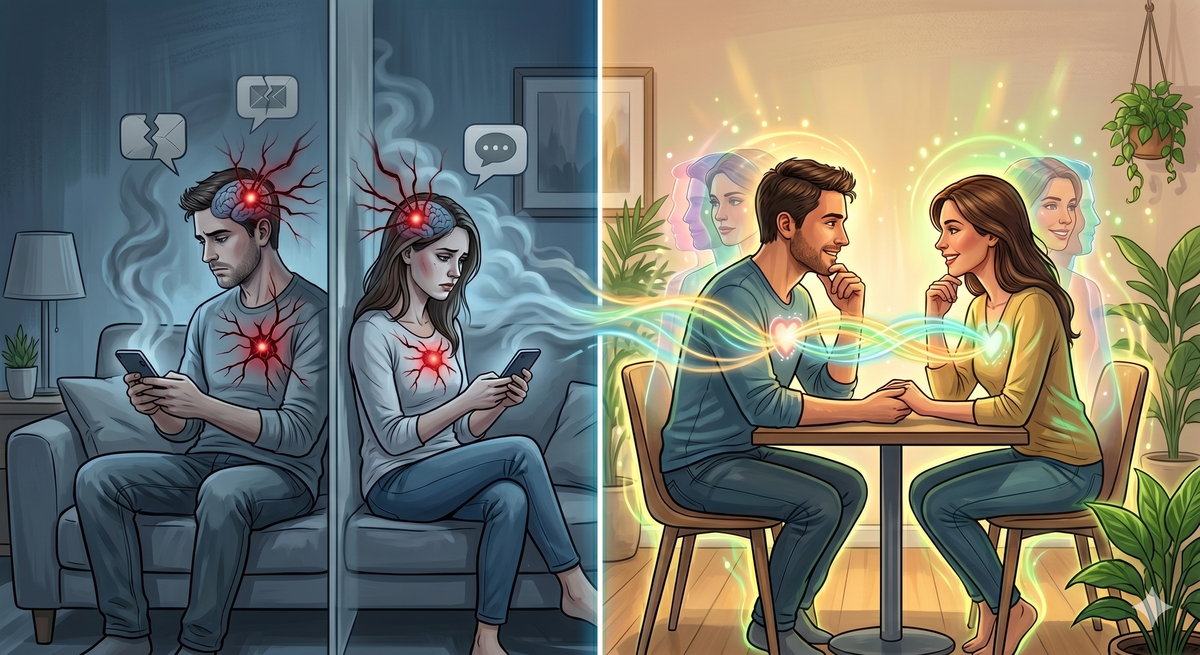
Up to 60% of people in committed relationships report feeling lonely — not occasionally, but as a persistent undercurrent. In a survey of nearly 2,000 American adults, 40% said they wished they felt more loved by their romantic partner. Relational loneliness is one of the most painful and least-discussed forms of emotional suffering. This article explains why it happens and what science says about rebuilding genuine connection.
The Hidden Epidemic: Loneliness Inside a Relationship
Most conversations about loneliness focus on people who are socially isolated. Far less attention is paid to the millions who feel profoundly alone inside a committed partnership. Research published in PMC by the National Institutes of Health found that people experiencing loneliness in relationships showed lower relationship awareness, higher conflict, and lower trust — and these factors reinforced each other in a self-perpetuating cycle.
The neuroscience is striking: brain imaging studies show that social pain caused by emotional disconnection from a close partner activates the same neural circuits as physical pain. Being unseen by your partner is not just emotionally uncomfortable — it registers in the brain as genuine hurt.
What makes this loneliness especially invisible is social expectation. Being “in a relationship” is assumed to mean you are not lonely. Admitting otherwise can feel like an accusation against your partner or a personal failure. That shame keeps people silent — and silence accelerates the distance.
Signs you may be experiencing relational loneliness:
- You talk every day but rarely say anything real
- You feel more like roommates than partners
- You stop sharing problems because it never leads anywhere
- You feel energized outside the relationship and drained inside it
- You feel unseen even in the moments when you are together
What Went Wrong? Understanding the Fantasy Bond
What Is the Fantasy Bond?
The concept of the fantasy bond was developed by psychologist Robert Firestone, Ph.D. It describes a psychological defense mechanism in which the outward form of a relationship is maintained while its emotional substance quietly disappears. Partners continue living together, celebrating occasions, and telling others they are fine — while the genuine felt sense of connection erodes beneath the surface.
The fantasy bond has its roots in infancy. When a baby’s caregiver is emotionally unavailable, the child copes by forming an internal image of connection to soothe the pain of absence. This is adaptive in childhood. But the same mechanism can be reactivated in adult romantic relationships, especially after the early intensity of a new partnership gives way to the demands of ordinary life.
How the Fantasy Bond Forms in Romantic Relationships
The shift from genuine intimacy to a fantasy bond usually happens gradually. Couples continue doing the right things externally — sharing a home, planning the future — while losing the spontaneous, vulnerable exchange that made the relationship feel alive. Early warning signs identified in Firestone’s research include:
- Less direct eye contact and spontaneous physical affection
- Increased bickering and point-scoring
- Speaking for each other (“we think,” “we feel”) rather than as individuals
- A mechanical or routine quality to physical intimacy
- Surface-level conversation replacing genuine sharing
Why We Accept the Fantasy Bond Without Realizing It
People maintain fantasy bonds not out of indifference but because they are caught between two fears: the fear of being truly known (intimacy feels risky) and the fear of being truly alone (separateness feels unbearable). The fantasy bond offers a way out of both — the social appearance of closeness without the emotional exposure genuine closeness requires.
Attachment styles developed in childhood play a significant role. Anxiously attached individuals cling to the form of the relationship to avoid abandonment, even when its substance has eroded. Avoidantly attached individuals find the emotional distance of a fantasy bond more comfortable than genuine vulnerability.
Gottman’s Insight: The Moment Connection Starts to Break
John Gottman’s decades of relationship research identified something deceptively simple: relationships deepen or deteriorate based on how partners respond to each other’s everyday bids for connection. A bid is any small gesture toward contact — a comment, a touch, a glance, a sigh.
Couples who “turn towards” these bids — acknowledging and engaging with them — build emotional reserves over time. Couples who turn away gradually become strangers. Gottman found that couples who eventually divorced had turned towards each other only 33% of the time; happily stable couples did so 87% of the time.
Four daily micro-habits that build connection:
- Give full eye contact when your partner speaks — put the phone down
- Ask one genuinely curious question each day that goes beyond schedules
- Offer at least one specific acknowledgment: “I noticed you…” or “I appreciate that you…”
- Share something real from your inner world — a worry, an excitement, a small joy
The Five Mindsets That Rebuild Genuine Love
Psychologist Sonja Lyubomirsky and relationship researcher Harry Reis synthesized decades of love science into a practical framework in their book How to Feel Loved. Their core finding: feeling loved is not a passive experience. It is actively co-created through five specific mindsets that both partners can cultivate.
1. The Sharing Mindset — Showing Your Vulnerable Self
The Sharing Mindset means allowing your partner to actually see you — your fears, your half-formed thoughts, your genuine needs. This is the direct antidote to the fantasy bond. Research consistently shows that self-disclosure — sharing things that feel risky to share — is one of the strongest predictors of relationship satisfaction. Couples who know each other’s inner worlds feel the least lonely, because they experience the rare gift of being genuinely known.
2. The Listening-to-Learn Mindset — Tuning In, Not Just Taking Turns
Most conversations in long-term relationships are functional: logistics, plans, updates. The Listening-to-Learn Mindset asks something different — listen to understand your partner’s inner experience, not just to process information. A practical starting point: once a day, ask a question you genuinely do not know the answer to. Not “how was your day?” but “what surprised you today?” or “is there something you’ve been thinking about that you haven’t told me?”
3. The Radical Curiosity Mindset — Staying Genuinely Interested
One of the most common dynamics in long-term relationships is the loss of curiosity. Partners develop fixed mental models of each other and stop actually looking. The Radical Curiosity Mindset treats your partner as someone who is still becoming, still changing, still capable of surprising you. Studies show that couples who regularly discover new things about each other — through novel experiences and genuine inquiry — report significantly higher relationship satisfaction.
4. The Open-Heart Mindset — Affirming Who Your Partner Really Is
The Open-Heart Mindset goes beyond compliments about actions to affirmations of character. Not “thanks for doing the dishes” but “you are genuinely one of the most patient people I know.” Psychological research on perceived partner responsiveness — the sense that your partner sees, understands, and values you — shows it is one of the most powerful drivers of feeling loved. The Open-Heart Mindset builds this directly.
5. The Multiplicity Mindset — Embracing the Full, Complex Person
Every person contains contradictions, unexpected depths, and parts that don’t fit neatly into any story. The Multiplicity Mindset resists reducing your partner to a fixed image. It makes room for their growth, their contradictions, and their evolution. When partners release the need for each other to be consistent and predictable, they experience less friction, less disappointment — and far more genuine interest in who the other person is becoming.
When to Seek Professional Help
The mindsets above are powerful, but they require willingness from both partners. If there is unresolved trauma driving the distance, or if resentment has reached a point where curiosity and openness feel impossible, professional support can be transformative. Emotionally Focused Therapy (EFT), developed by Dr. Sue Johnson, directly addresses the attachment dynamics underlying relational loneliness and has strong empirical support. The Gottman Method targets communication and emotional bids. Both approaches have helped couples reconnect after years of growing apart. Seeking help is not a sign that your relationship has failed — it is an act of commitment to what you believe is still possible.
Conclusion
Loneliness inside a relationship is real, far more common than most people know, and — crucially — reversible. Emotional distance is rarely the result of love disappearing. It is the result of specific patterns — the fantasy bond, missed bids, lost curiosity — that can be recognized and changed. You do not have to overhaul everything at once. Pick one of the five mindsets and try it this week. Ask one real question. Share one real fear. Affirm something about your partner that goes beyond what they do. Genuine love is not something that happens to you. It is something you build together, one deliberate moment at a time.
Sources
Psychology Today — How to Stop Feeling Lonely in Your Relationship