The Overlooked Office Details That Are Quietly Draining Your Focus and Energy — What Science Says
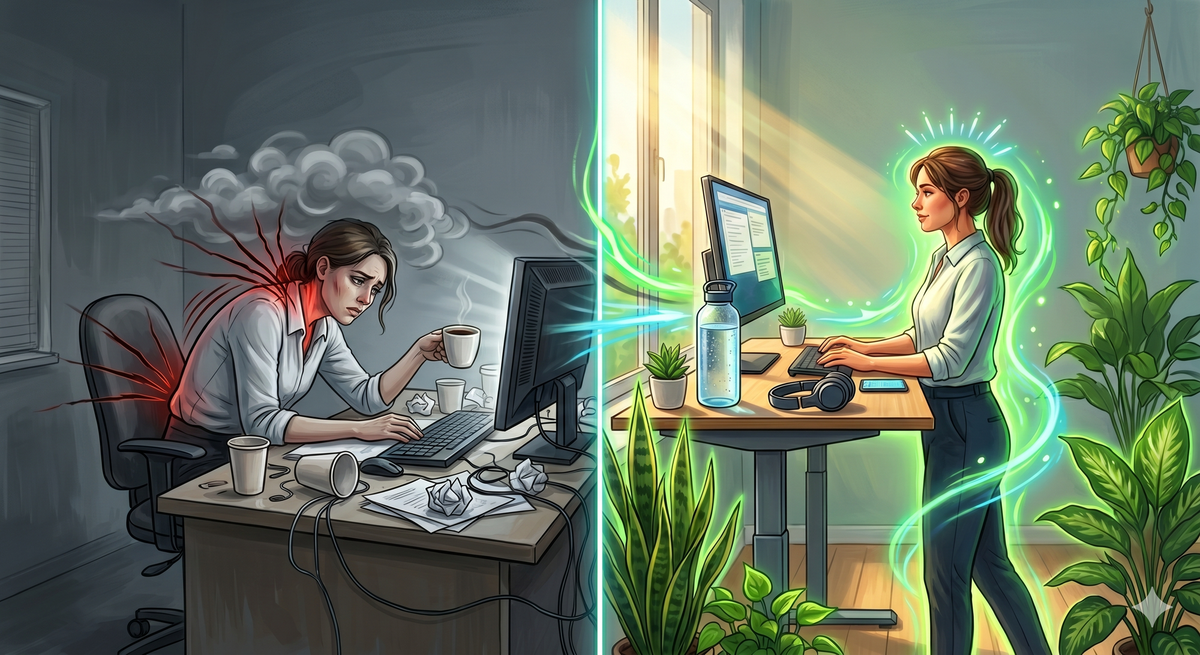
When you struggle to focus at work, the instinct is to blame yourself — your motivation, your discipline, your mindset. But a growing body of scientific evidence suggests the real culprit may be sitting right around you: your physical workspace. From the chair you sit in to the air you breathe to the water you drink, the details of your work environment are shaping your cognitive performance, energy, and long-term health in ways most people never consider.
The Invisible Toll of Your Physical Workspace
A landmark study published in JAMA Network Open followed more than 480,000 workers over an average of 13 years and found that people who predominantly sit at work have a 16% higher risk of all-cause mortality and a 34% higher risk of cardiovascular disease mortality compared to those who do not sit most of the day. That is not a marginal risk — it is a structural one, built into the daily routine of most knowledge workers.
73% of office workers are seated for the majority of their workday. Most of them are aware they should move more. Very few of them connect their afternoon mental fog, their difficulty concentrating, or their low creative output to the environment they are sitting in. The science of Cognitive Load Theory offers a critical insight: every mental resource your brain spends compensating for physical discomfort — a chair that doesn’t fit, a screen at the wrong height, air that’s too dry — is a resource no longer available for actual thinking.
Signs your workspace may be silently draining you:
- You feel mentally tired before midday despite adequate sleep
- You get frequent tension headaches during work hours
- Your concentration drops sharply after lunch
- You feel more energized working from a coffee shop than your desk
- You reach for caffeine or snacks to get through afternoons
The Problem Nobody Talks About: Sitting
What the Research Actually Says About Sitting All Day
The JAMA study’s findings are stark: to offset the mortality risk of predominantly sitting at work, a person needs an additional 15 to 30 minutes of physical activity per day on top of standard recommendations. That is not about fitness — it is about counteracting the specific physiological damage of prolonged sedentary time.
The cognitive effects are equally well documented. Research published in PMC found that prolonged sitting directly impairs executive function, memory, and sustained attention — precisely the cognitive capacities required for complex knowledge work. In studies of simulated office work, creative problem-solving errors increased measurably after just two hours of seated computer work. The brain, like the body, needs movement to function well.
How to Break the Sitting Pattern Without Leaving Your Desk
A systematic review published in BMC Musculoskeletal Disorders found that just 2 to 3 minutes of light physical activity every 30 minutes significantly improves cognitive performance, mental health, and brain health in sedentary workers. The activity does not need to be vigorous — standing, stretching, walking to a window, or doing shoulder rolls all qualify.
Four micro-movement strategies for desk workers:
- Set a 30-minute phone or computer reminder to stand and move for 2-3 minutes
- Take walking meetings for any call that doesn’t require you to be at a screen
- Position your printer, water station, or trash can away from your desk to create mandatory short walks
- Do standing or walking reviews for any task that doesn’t require active typing
On standing desks: research supports alternating between sitting and standing — not standing all day, which creates its own musculoskeletal risks. The goal is variation, not substitution.
Why Your Office Air and Light Are Affecting Your Brain
Natural Light and Circadian Rhythm
A Northwestern University study found that office workers who sat near windows slept an average of 46 minutes more per night than those without access to natural light — and reported higher physical activity levels and quality of life. The mechanism is circadian: natural light regulates the body’s internal clock, which in turn regulates energy, alertness, and cognitive sharpness throughout the day.
Temperature also matters more than most people realize. Research identifies the optimal cognitive performance range as 70–77°F (21–25°C). Offices that run too cold or too warm force the brain to allocate metabolic resources to temperature regulation rather than productive thinking.
Indoor Plants: More Than Decoration
A study published in PLOS ONE found that 5 to 18 indoor plants in a typical office space can stabilize indoor humidity within the recommended 30–60% range through natural evaporation. Low humidity increases the incidence of respiratory irritation and fatigue; stabilizing it has measurable effects on comfort and attention. Plants also reduce volatile organic compounds (VOCs) released by furniture, carpets, and electronics — compounds associated with headaches and cognitive fatigue.
Biophilic design research shows that incorporating natural elements into workspaces increases productivity by 6%, creativity by 15%, and self-reported well-being by 15%. You do not need a living wall. A single plant at eye level can begin shifting the environmental calculus of your workspace.
Best low-maintenance office plants backed by research:
- Snake plant (Sansevieria) — excellent air purifier, thrives in low light
- Pothos — highly effective at reducing VOCs, nearly indestructible
- Peace lily — increases humidity and removes formaldehyde and benzene
- Spider plant — proven air quality improver, very easy to maintain
- ZZ plant (Zamioculcas) — drought-tolerant, improves air quality in low-light conditions
The Role of Basic Physical Needs: Noise, Comfort, and Ergonomics
Noise: The Hidden Productivity Killer
Research consistently shows that noise is one of the most underestimated threats to cognitive performance in office environments. Overheard conversations are 50% more distracting than other types of background noise, because the human brain is hardwired to process language — you cannot choose not to partially process a conversation happening nearby. Studies measuring productivity loss from noise distraction report figures as high as 67%.
Practical approaches to noise management: noise-cancelling headphones for deep work sessions; designated quiet zones in shared offices; scheduling focused work during low-traffic hours; sound-masking systems that generate low-level ambient noise to reduce the intelligibility of conversations.
Ergonomics: Why Comfort Is a Cognitive Strategy
Ergonomic research is unambiguous: proper workplace design pays dividends far beyond physical health. Studies show that ergonomic interventions reduce absenteeism by 67%, increase productivity by 15%, and improve job satisfaction by 24%. These are not small effects. They represent the cognitive and motivational cost of making people work in environments that do not fit their bodies.
Cognitive Load Theory frames this precisely: when your chair forces you to shift your weight, when your monitor strains your neck, when your wrists are awkwardly angled — your brain is continuously performing micro-corrections, and each one depletes the finite pool of cognitive resources available for your actual work.
A six-point ergonomic desk setup checklist:
- Monitor at arm’s length, top of screen at eye level or slightly below
- Chair height adjusted so feet are flat on the floor, knees at 90 degrees
- Keyboard and mouse positioned so elbows are at 90 degrees, wrists straight
- Screen brightness and contrast matched to ambient room light
- No screen glare — position monitor perpendicular to windows
- Lumbar support that maintains the natural inward curve of your lower back
The Surprising Impact of Water Quality
Water makes up 75% of brain mass. It is the most fundamental resource for cognitive function, and yet hydration is the element of workplace wellness most consistently neglected. Research published in PMC found that mild dehydration — as little as 1 to 2% body water loss — impairs concentration, increases reaction time, and degrades short-term memory. You do not need to feel thirsty for dehydration to be affecting your thinking. Thirst is a lagging indicator, not a reliable early warning system.
A long-term study published in BMC Medicine found that workers with chronically lower physiological hydration showed greater decline in global cognitive function over a two-year follow-up period. Hydration is not just a daily performance factor — it is a long-term brain health factor.
Why water quality matters beyond quantity: taste, ease of access, and temperature all influence how much people drink. A filtered water source, a quality insulated bottle kept on the desk, and cool water (which most people prefer and drink more of) can meaningfully increase daily intake without requiring willpower.
Practical hydration habits for your desk: start each morning with 16oz of water before coffee; keep a large bottle visible on your desk at all times; set a midday hydration check-in; notice when afternoon brain fog arrives — dehydration is often the cause.
Your Practical Action Plan: Improving Your Workspace Today
You do not need a redesigned office to benefit from this research. Small changes, implemented consistently, compound into meaningful improvements in how you think, feel, and perform every workday. Here is a prioritized action plan, moving from immediate and free to more involved:
- Adjust your monitor and chair position — free, takes five minutes, immediately reduces physical strain
- Place one plant within your eyeline — a pothos or snake plant costs very little and improves air quality and mood
- Set a 30-minute movement reminder — 2-3 minutes of movement every 30 minutes is the single highest-return behavioral change for desk workers
- Put a large water bottle on your desk — visible water is consumed; water stored elsewhere is forgotten
- Address noise proactively — quality noise-cancelling headphones are among the highest-ROI investments a knowledge worker can make
- Maximize your exposure to natural light — position your primary work area near a window if possible; if not, consider a daylight lamp
Conclusion
Your workspace is not neutral. It is either working for you or against you, moment by moment, in ways your conscious mind rarely registers. The air quality, the noise level, the chair that fits or doesn’t, the glass of water you did or didn’t drink — all of these are quietly shaping your ability to think clearly, sustain focus, and bring your best to your work. The science is clear: you cannot think your way to peak performance if your environment is silently undermining your biology. Pick one item from the action plan above and change it today. Your brain will notice.
Sources
Psychology Today — Workplace Details That Can Make or Break Your Day