We’re Losing 300 Spoken Words a Day Every Year — What Research Reveals About the Decline of Real Conversation

We live in what historians will likely call the most connected era in human history. More platforms, more channels, more ways to reach each other than any previous generation could have imagined. And yet, hidden inside all that connectivity, something is quietly disappearing: the sound of human voices talking to each other. A landmark study published in 2026 has put a number on what we've been losing — and it turns out we're shedding roughly 300 spoken words per day, every year, year after year. What that means for our health, our relationships, and our sense of belonging is a question researchers are only now beginning to answer.
The Numbers Behind the Silence: What Two Decades of Research Reveal
In 2026, psychologists Dr. Valeria Pfeifer of the University of Missouri-Kansas City and Prof. Matthias Mehl of the University of Arizona published a study in Perspectives on Psychological Science titled "Sliding Into Silence? We Are Speaking 300 Daily Words Fewer Every Year." The research synthesized 22 studies conducted between 2005 and 2019, capturing the recorded speech of more than 2,200 people aged 10 to 94 from the United States, Europe, and Australia as they went about their daily lives.
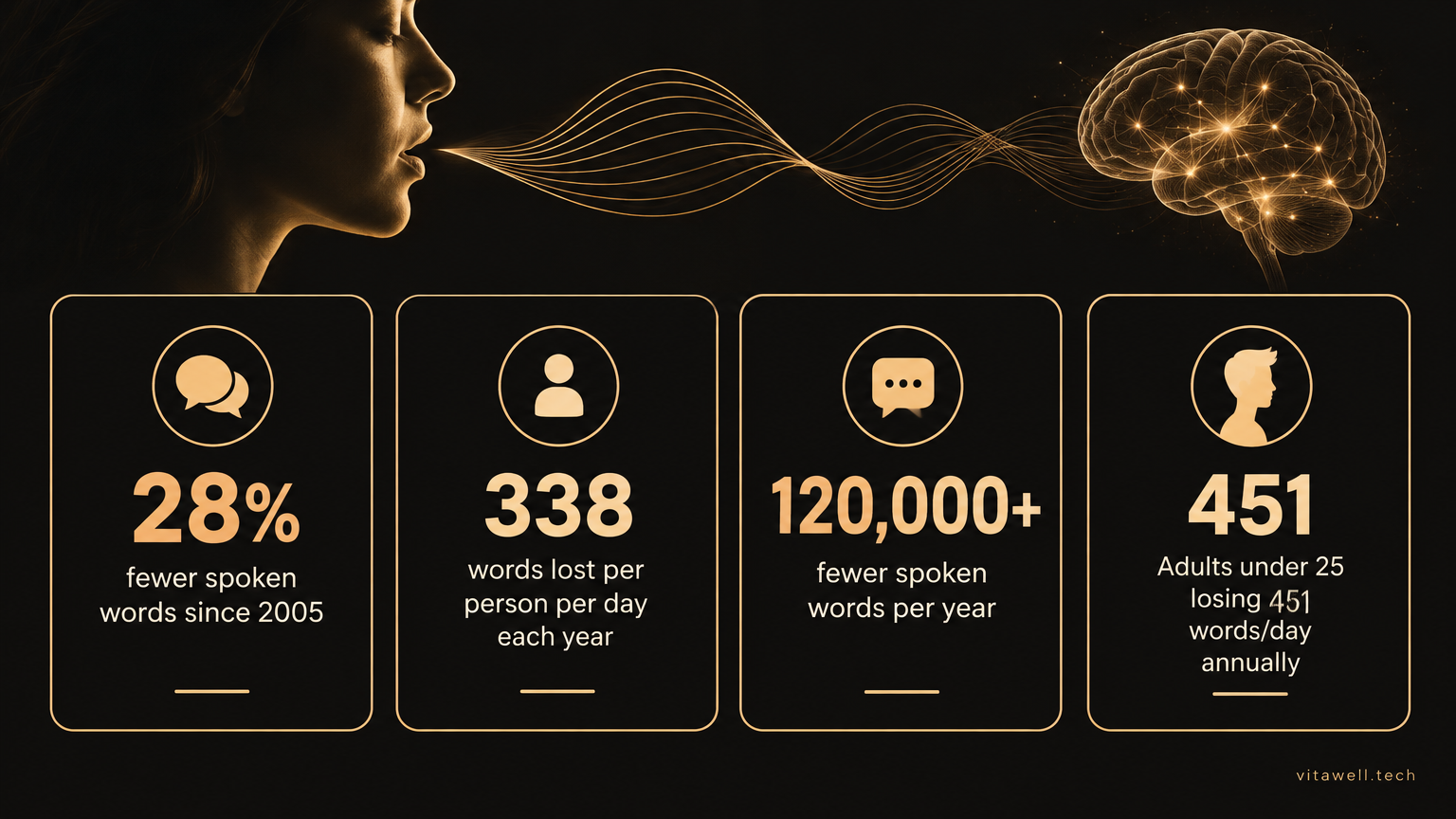
The findings are striking. Between 2005 and 2019, the average number of spoken words per day fell by approximately 28 percent. The annual rate of decline was around 338 fewer spoken words per person per day, every single year. Translated to a yearly figure, that amounts to more than 120,000 fewer spoken words per person per year compared to the year before.
Put it in human terms: a separate study published in 2025 by Tidwell and colleagues found the current average to be around 12,792 spoken words per day. Research from 2007 by Mehl and colleagues placed that figure at nearly 16,000 words per day. We have lost roughly 3,200 words per day over that span — the equivalent of several hours of real conversation, gone from the average person's life.
Who Is Losing the Most — and What It Tells Us
The decline is not uniform across age groups, and the pattern carries its own message. Participants under 25 showed the steepest drop, losing an estimated 451 spoken words per day, per year. Older adults were not far behind, losing approximately 314 words per day annually. The fact that both groups are declining is itself significant: this is not simply a story about younger people abandoning conversation for their phones.
As Dr. Pfeifer noted, age or technology use alone does not fully explain the trend. The decline among less tech-savvy older adults suggests that something broader is shifting in how people structure their days and their social lives — changes in work patterns, urban design, household composition, and the rhythm of daily life that makes incidental contact less likely regardless of whether a smartphone is involved.
What the data reveals is a cultural shift whose consequences are still unfolding. "Small changes in daily behaviour accumulate over time," Pfeifer has said. "A gradual decline in spoken conversation might not be obvious from day to day, but over many years, it could change how people connect with one another."
What We Actually Lose When We Stop Talking
The Texture of Spoken Connection
There is something that happens in a spoken conversation that text cannot replicate. It has to do with presence — the awareness that another human being is there, attending to you in real time, responding with their voice, their timing, their emotional register. Prof. Mehl captures this directly: "Spoken words carry something that typed words often don't — presence, tone, the spontaneity of a real exchange."
Much of what we lose in the declining word count is not the long, meaningful conversations — the deep talks with close friends or family — but what researchers sometimes call micro-connections: the small, incidental exchanges that once laced through an ordinary day. Mehl describes it plainly: "We've lost a lot of small, incidental conversations: asking a cashier for help, getting directions from a stranger, chatting with a neighbor." These interactions are easy to dismiss as trivial. Research suggests they are not.
Studies on what psychologists call "minimal social interaction" have consistently found that brief exchanges with strangers — a smile, a few words, a moment of acknowledgment — contribute meaningfully to daily well-being. When those exchanges are automated away, avoided, or replaced by a screen, something is subtracted from the texture of daily life that most people don't consciously notice — but whose absence accumulates.
The Health Case for Real Conversation
Spoken conversation is not just socially important — it carries measurable biological benefits. Dr. Pfeifer's work points to a body of evidence suggesting that regular verbal social contact is associated with lower blood pressure, reduced risk of depression and anxiety, and may offer some protection against the risk factors for dementia. The mechanism is not entirely clear, but stress regulation, cognitive engagement, and the immune-modulating effects of positive social contact all likely play roles.
Research from the University of Kansas reinforces this with a finding that feels almost too simple to be true: just one quality conversation per day is enough to produce meaningful improvements in well-being. Not an hour of deep soul-sharing — just one genuine, present, back-and-forth exchange. The bar for benefit from spoken conversation turns out to be surprisingly low. The problem is that even that low bar is increasingly going unmet.
Why Are We Speaking Less? What Researchers Have — and Haven't — Confirmed
The obvious hypothesis is that digital communication is replacing spoken conversation: that the texts, emails, DMs, and social media posts that now fill so much of our communication bandwidth have simply substituted for the words we used to say out loud. The timing of the decline — running from 2005 to 2019 — aligns with the rise of smartphones, the normalization of texting, and the explosive growth of social media platforms. It is a compelling correlation.
But the researchers are careful. Correlation is not causation, and the data does not let them draw a direct line between digital adoption and conversational decline. The fact that older adults — less immersed in digital communication than younger cohorts — are also declining suggests that technology is not the whole story. Changes in how and where people work (the rise of remote and hybrid work reducing casual office conversation), the decline of community institutions that once generated regular social contact, the shrinking of household sizes, and the privatization of daily life all likely contribute.
Mehl has also noted the emergence of a newer factor: AI chatbots. Some of what might once have been a conversational exchange — asking a question, working through a problem out loud, telling someone about your day — is increasingly directed at a machine rather than a person. Whether this substitution carries the same social benefits is unknown. As Pfeifer puts it: "Whether typed conversations provide the same social benefits as spoken conversations is still an open question, and one that future research needs to address."
What is certain is that something has changed, that it is not trivial, and that it is still going. Mehl has said he would be "surprised" if the trend had reversed. No data exists beyond 2019, but no structural reason has emerged to expect a turnaround.
The Loneliness Connection
The declining word count does not exist in isolation. It arrives alongside a concurrent and well-documented trend: the rise of what public health officials have called a loneliness epidemic. Former US Surgeon General Vivek Murthy made this designation official, declaring loneliness a public health crisis and placing its consequences — elevated mortality risk, cardiovascular disease, cognitive decline — on par with smoking and obesity.
The connection between conversational decline and loneliness is not direct; loneliness is a felt experience that does not reduce to a word count. But the two phenomena are tangled together in ways that researchers are increasingly taking seriously. Spoken conversation is one of the primary mechanisms through which people feel known, valued, and connected to others. When that mechanism atrophies — gradually, almost invisibly — the felt experience of connection may atrophy with it.
MIT researcher Sherry Turkle has spent years documenting the ways in which digital devices have transformed our relationship to conversation. Her argument, laid out in Reclaiming Conversation, is not that technology is inherently bad but that the particular habits it has instilled — the constant availability of distraction, the preference for asynchronous over real-time exchange, the retreat into curated communication — have eroded our tolerance for the discomfort and unpredictability of real dialogue. We have become, she argues, less practiced at the thing conversation requires: sitting with another person, paying full attention, tolerating silence, responding without a script.
Pfeifer frames the stakes in a way that is worth sitting with: "Humans have relied on spoken language for more than 200,000 years, and we do not yet know whether a shift toward more digital communication comes with social costs." And again: "Can we quantify the individual and societal costs of lost spoken conversations?" The honest answer is that we are only beginning to find out.
How to Reclaim Real Conversation in a Digital World
The trend is real, the consequences are likely significant, and the causes are partly structural. But spoken conversation is also a behavior — something that individuals and communities can choose to protect, revive, and prioritize. Here is what the evidence suggests about how to do that.
Start With the Small Stuff
Pfeifer herself points to everyday incidental exchanges as a meaningful intervention. Chatting with a barista, making eye contact and exchanging a few words with a cashier, stopping to actually talk to a neighbor rather than nodding past — these micro-connections are not a substitute for deep relationships, but they are not nothing. They are, it turns out, a meaningful part of what used to constitute a conversation-rich day. Rebuilding them costs little and yields measurable benefit.
Protect One Real Conversation Per Day
The University of Kansas finding — that a single quality conversation per day produces well-being benefits — suggests a concrete, achievable target. This does not need to be a profound exchange. It needs to be present, verbal, back-and-forth, and with an actual person. A phone call rather than a text. A walk with a friend rather than a voice memo. Dinner without phones present. The form matters less than the fact of genuine spoken exchange.
Be Deliberate About When You Choose Text Over Voice
Not every communication needs to be a conversation. Much of what we send as texts, emails, and messages is logistical and genuinely better in writing. The problem arises when text becomes the default for interactions that would benefit from voice — checking in on someone who is struggling, working through a disagreement, sharing something that actually matters. Developing a conscious habit of pausing and asking "would this be better as a conversation?" is a small intervention with potentially significant cumulative effects.
Rebuild Conversational Spaces
Some of what has been lost was not individual but structural: the shared meal, the communal gathering, the workplace that generated incidental contact. Recreating these deliberately — whether that means hosting a regular dinner, joining a club or group that meets in person, or simply leaving a device in another room during time with family — is not nostalgia. It is an evidence-based intervention in a trend that research now confirms is quietly costing us something important.
Conclusion: 300 Words at a Time
Three hundred spoken words per day, every year. It does not sound like much. The human voice is remarkably productive; 300 words takes about two to three minutes to speak. But compounded over a decade, it represents tens of thousands of conversations that never happened — a stranger not asked for directions, a neighbor not greeted, a friend not called, a family member not really heard. And the data suggests it is happening to virtually everyone, in every age group, in every country studied.
The loss is gradual enough to be nearly invisible. That is precisely what makes it worth naming clearly. Spoken conversation is not a luxury feature of human life — it is load-bearing infrastructure for health, connection, and belonging. We have spent two decades letting it quietly erode. The research now gives us the number. What we do with it is a choice.
Sources
Psychology Today — Are People Speaking Less in This Age of Online Communication? (Ronald E. Riggio)
BBC Science Focus — We're losing 338 spoken words every day (Hatty Willmoth)
The Independent — We're talking to each other less than we did a decade ago (Julia Musto)