The Neuroscience of Elite Performance: How Your Brain's Cerebro-Cerebellar Loop Drives Mastery in Any Skill
A 2026 fMRI study reveals the expert brain does less but detects errors better. Here's how to practice so your cerebro-cerebellar loop develops the same efficiency.
Elite performers don't just practice more than beginners — their brains have reorganized to do more with less. A 2026 fMRI study published in The Cerebellum found that expert athletes show simultaneously lower overall brain engagement and sharper error sensitivity in the circuit connecting the motor cortex to the cerebellum, a pathway neuroscientists call the cerebro-cerebellar loop. This "less but sharper" brain signature is not a gift of talent: it is the measurable end-state of structured repetition, and understanding it changes how you should practice any skill.
Key Takeaways
- Expert athletes show attenuated task engagement AND enhanced error sensitivity in the cerebro-cerebellar loop — the dual signature of neural efficiency that emerges from deliberate practice.
- A 2026 fMRI + NODDI study of 41 expert baseball and softball players found they have higher neurite density and faster T1ρ relaxation times in the cerebellum — markers of more organized, efficient neural tissue.
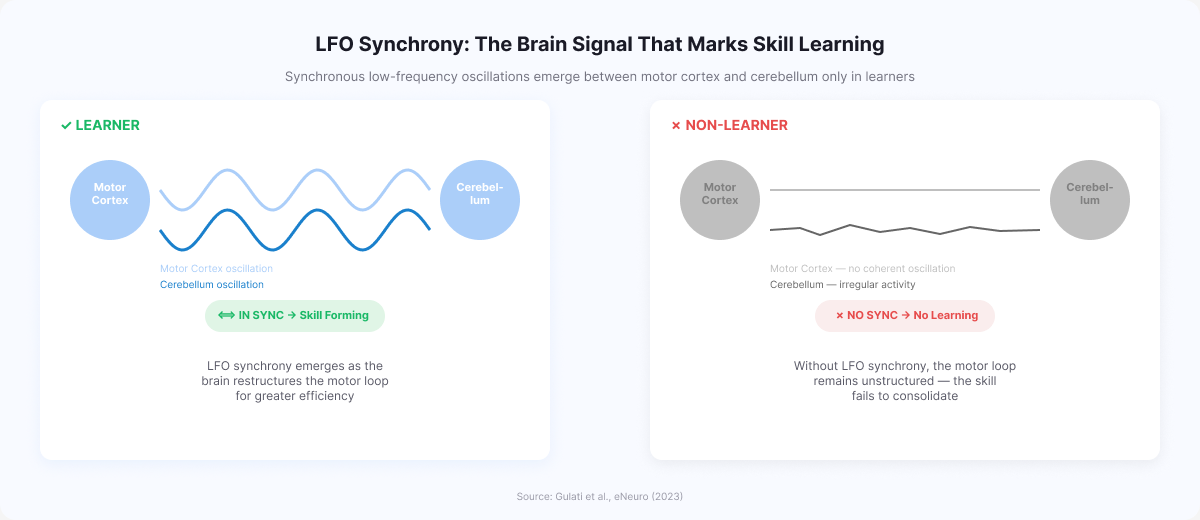
- Synchronous low-frequency oscillations between the motor cortex and cerebellum emerge only in learners, not in non-learners — a brain-state signature that can be targeted through how you structure practice.
- The cerebellum functions as the sensorimotor memory bank: patients with cerebellar degeneration lose the ability to consolidate motor learning when rest intervals are too long.
- The practical goal of deliberate practice is to shift the brain from effortful broad engagement to efficient, error-sensitive automation — achievable through spaced, error-focused sessions.
What Is the Cerebro-Cerebellar Loop?
The cerebro-cerebellar loop is a circuit connecting the motor cortex (where voluntary movement is planned and initiated) with the cerebellum (a dense structure at the base of the brain containing roughly half of all neurons) via two relay stations: the pons and the thalamus. The outbound signal travels from the motor cortex through the pons to the cerebellum; the cerebellum's response travels back through the thalamus to the cortex, where it adjusts the ongoing movement plan in real time.
The loop's principal job is predictive error correction: comparing intended movements with actual sensory feedback and generating adjustment signals before the error becomes visible. It governs timing, coordination, and the smooth sequencing of complex actions. What makes this loop neuroscientifically interesting is that its development during skill learning is now measurable in ways it wasn't a decade ago.
The Expert Brain Signature: Less Effort, Sharper Errors
The 2026 Filip Study: What fMRI Reveals About Elite Athletes
In a study published November 4, 2026 in The Cerebellum (Filip et al., 2026), researchers recruited 41 expert baseball and softball players (defined by collegiate or professional playing level) and 46 nonathletic controls. All participants performed predictive timing tasks inside an fMRI scanner while researchers simultaneously used NODDI (neurite orientation dispersion and density imaging) and adiabatic T1ρ mapping — two advanced neuroimaging techniques that measure the physical structure of brain tissue, not just activation.
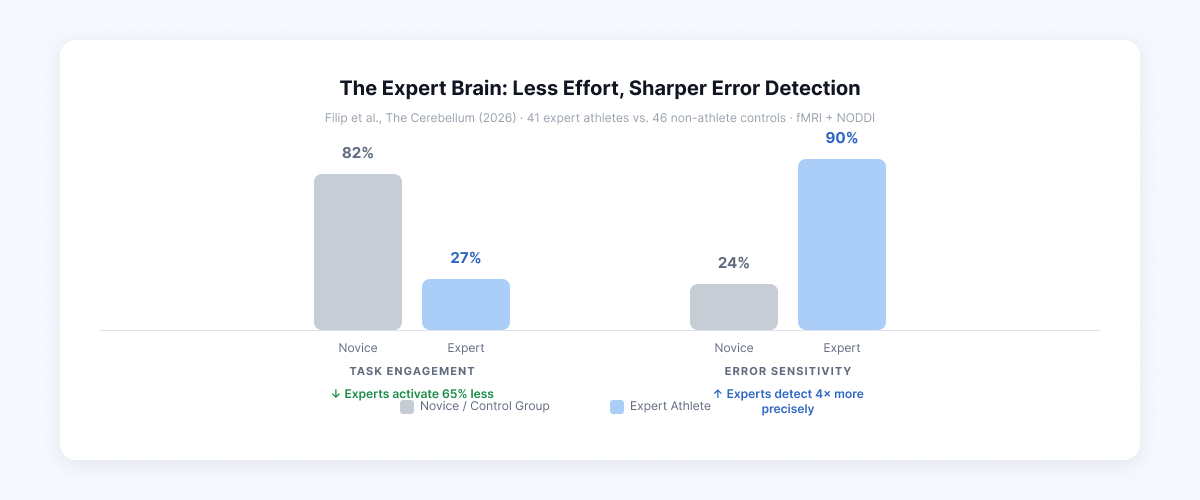
The results showed two things happening at once in the expert group. First, task engagement across the cerebro-cerebellar loop was attenuated — experts were doing measurably less work per movement. Second, error-related modulation was enhanced — experts' brains were detecting and responding to errors more sensitively. This is the hallmark of neural efficiency: the system is not lazier; it is more precisely tuned.
What Neural Efficiency Looks Like in Tissue
The tissue-level findings from the same study are equally striking. Expert athletes had higher neurite density in both cortical networks and the cerebellum — meaning more connections per neuron, the structural substrate of a richer information network. They also showed lower orientation dispersion (more organized fiber tracts) and faster T1ρ relaxation times in the cerebellum — indicators of healthier myelin and more efficient signal conduction. These are not fleeting activation differences; they are structural properties of the tissue itself.
The LFO Synchrony Signal: How the Brain Marks a Skill Taking Root
A 2023 study by Gulati and colleagues published in eNeuro identified a brain-state signature that appears specifically during skill learning: synchronous low-frequency oscillatory (LFO) activity in both the motor cortex and the cerebellum simultaneously. When rats were trained on a skilled forelimb task, this synchronous activity emerged and strengthened as the skill developed. In animals that failed to learn the task, the synchrony never appeared. As the authors stated: "We were able to show this activity is a marker of skill learning."
What makes this significant for anyone who practices a skill is that LFO synchrony is not simply a byproduct of movement — it is a marker of active neural consolidation. The brain is not just executing the movement; it is restructuring the loop to do so more efficiently. This connects to research on why insight moments are associated with sudden neural reorganization — the LFO signal may be the distributed brain-state version of that same process, playing out over sessions rather than seconds.
The Cerebellum as Sensorimotor Memory Bank
A 2024 study from Harvard SEAS by Hadjiosif and colleagues, published in PNAS, illuminates why the cerebellum's role goes beyond moment-to-moment error correction. The researchers compared motor learning between healthy controls and patients with cerebellar degeneration when intertrial intervals were systematically varied.
Healthy participants showed no meaningful difference whether trials were closely or widely spaced. Patients with cerebellar damage showed dramatically impaired motor learning when intertrial intervals were long — but performed closer to normal when trials were closely spaced. The implication is that the cerebellum consolidates sensorimotor memory in the gaps between trials, much as the hippocampus consolidates declarative memory during sleep. For practitioners, this finding reframes what happens during rest between repetitions: you are not idling. You are giving the cerebellum the consolidation window it needs to encode what just happened.
From Novice to Expert: What the Loop Is Doing at Each Stage
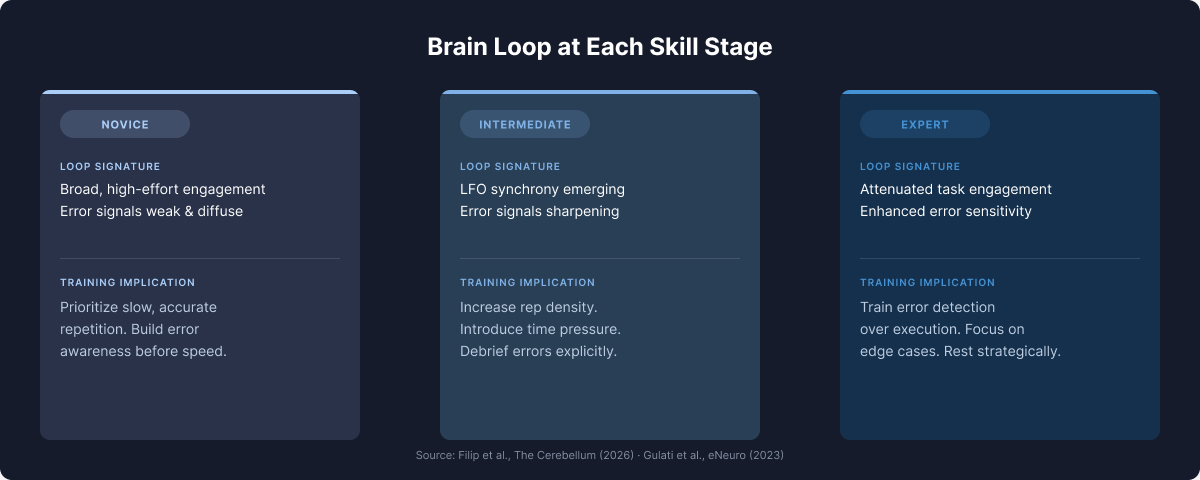
The convergent picture from Filip, Gulati, and Hadjiosif is that the cerebro-cerebellar loop changes in predictable ways as skill develops. The table below maps those changes to practical training implications.
| Skill Stage | Cerebro-Cerebellar Loop Signature | Training Implication |
|---|---|---|
| Novice | Broad, high-effort engagement across the loop; error signals weak and diffuse | Prioritize slow, accurate repetition; build error awareness before speed |
| Intermediate | Engagement narrowing to key nodes; LFO synchrony beginning to emerge; error signals sharpening | Increase rep density; introduce controlled time pressure; debrief errors explicitly after each session |
| Expert | Attenuated task engagement; enhanced error sensitivity; high neurite density and organized fiber tracts | Shift focus to edge-case scenarios; train error detection more than execution; use strategic rest between sessions |
The key insight from this table is that the direction of adaptation reverses between stages. At the novice level, more effort is unavoidable and appropriate. By the expert level, additional effort is a sign that training is not advancing the loop — only practice targeted at error detection and edge cases continues to develop the system.
The Practice Structure That Builds the Expert Loop
Translating the neuroscience into a training protocol requires addressing the two core mechanisms: LFO synchrony (which emerges from focused learning) and cerebellar consolidation (which requires adequate rest). The following five-step structure is consistent with what the evidence supports.
- Isolate the target movement. Practice one specific component, not the full sequence. The loop develops specificity — broad repetition of a full skill at low quality does not build the expert signature.
- Practice slowly to ceiling accuracy. Speed comes after precision. At the novice stage, the loop needs clean error signals; fast imprecise repetitions produce noise.
- Push speed to introduce manageable errors. Once accuracy is high, introduce time pressure until errors reappear. This is the state where error-related modulation sharpens — the brain's error-detection system engages most actively when errors are real but recoverable.
- Debrief errors explicitly. After each session, name what went wrong and what the correction would be. Research on building lasting learning habits suggests that verbal labeling of errors engages explicit memory systems alongside procedural ones, reinforcing consolidation.
- Rest before the next session. The cerebellar consolidation window is not a metaphor. Massed practice without rest distributes across a system that hasn't yet encoded what came before. Spaced sessions — even just 24 hours apart — allow each session to build on consolidated ground.
One structural threat to this process deserves mention: the constant low-grade stimulation and distraction of modern life. As explored in research on why the stone-age brain struggles in modern environments, the brain's attention systems evolved under conditions of focused effort alternating with genuine rest — not continuous partial attention. Sustained practice environments that allow full concentration and genuine inter-session rest are not just preferable; they are what the neuroscience requires.
Limitations: What the Research Cannot Yet Tell Us
The Filip et al. 2026 study is cross-sectional: it compared existing experts to non-athletes at a single point in time. It cannot prove that the loop changes observed in experts were caused by their training rather than selected for. The sample is limited to baseball and softball players; transfer to cognitive-motor skills like surgery, music, or language is scientifically plausible but not yet confirmed by this method. The LFO synchrony findings from Gulati et al. are based on rodent models and await human replication at scale.
What is consistent across these three independent research programs is a coherent mechanistic story: the cerebro-cerebellar loop becomes more efficient through practice, that efficiency is structurally encoded in neural tissue, and both the learning process and the consolidation gaps between sessions are essential parts of how that encoding happens.
When to Talk to a Professional
Consider speaking with a sports psychologist, performance coach, or occupational therapist if: you are plateauing despite consistent, structured practice; you notice motor learning difficulties — problems retaining skills between sessions — that seem disproportionate to your practice volume; or you are designing a performance program for high-stakes skills (surgery, music performance, athletic competition) and want guidance on structuring practice to optimize neural adaptation.
FAQ
What is the cerebro-cerebellar loop and what does it do?
The cerebro-cerebellar loop is a brain circuit connecting the motor cortex to the cerebellum via the pons and thalamus. Its primary function is predictive error correction: it continuously compares intended movements with sensory feedback and adjusts movement plans in real time. It governs timing, coordination, and smooth sequencing in all physical and cognitive-motor skills.
How does the brain change with practice and skill mastery?
With deliberate practice, the cerebro-cerebellar loop becomes structurally denser (higher neurite density), more organized (lower orientation dispersion), and more efficient at signal conduction (faster T1ρ relaxation times). Functionally, overall task engagement decreases while error sensitivity increases — the "less effort, sharper detection" signature of expertise.
What does "neural efficiency" mean in the context of expertise?
Neural efficiency refers to the brain's ability to accomplish a skilled task with less overall metabolic effort — fewer neurons firing more precisely. In the cerebro-cerebellar loop, this means lower activation during routine execution and heightened activation specifically in response to errors. It is not laziness; it is precision.
Can adults still build expert-level skills through deliberate practice?
Yes. The structural changes observed in expert brains — higher neurite density, more organized fiber tracts — reflect neuroplasticity that continues throughout adulthood. The rate of change slows with age, but the direction is the same: targeted, error-focused, spaced practice builds loop efficiency in adults as well as children.
How long does it take for the brain to consolidate a motor skill?
The Hadjiosif et al. PNAS study suggests the cerebellum consolidates sensorimotor learning in the intervals between practice trials. For healthy adults, 24-hour inter-session gaps appear to allow meaningful consolidation, though the exact time course depends on skill complexity and practice intensity.
Conclusion
The 2026 fMRI study by Filip and colleagues gives deliberate practice a mechanistic target that was previously invisible: the dual transformation of the cerebro-cerebellar loop, from effortful broad engagement to efficient error-sensitive precision. This is not a metaphor for getting better — it is a structural change in neural tissue that researchers can now image directly.
Understanding this changes how the goal of practice should be framed. You are not simply accumulating repetitions; you are progressively tuning a circuit to do more with less. The LFO synchrony that marks active learning, the cerebellar consolidation that happens in rest, and the error-detection sharpening that characterizes expertise are all parts of the same process. Structure your practice to serve all three, and you are working with the biology rather than around it.
For more on building the habits and routines that support brain-based skill development, explore VitaWell.
Related on VitaWell
- The Science of Why Midlife Might Be the Best Time of Your Life — research on adult cognitive development provides context for how the brain continues adapting to skill demands through midlife and beyond.
- Science Confirms Your Brain Works Harder When You Read on Screens — understanding how environmental design shapes cognitive processing connects to the broader question of how practice environments affect neural efficiency.
- New WHO Guidelines Reveal How to Prevent Up to 45% of Dementia Cases — cerebellar health and motor learning are part of the same neural reserve that protects against cognitive decline; this guide covers evidence-based prevention at the lifestyle level.
This article is for informational purposes only and does not constitute medical or professional advice. Consult a qualified professional before making decisions based on research findings.
Sources
- Filip, M. et al., "Motor Expertise Combines Lower Task Engagement With Enhanced Error Sensitivity," The Cerebellum (2026)
- Bergland, C., Psychology Today, "How Cerebro-Cerebellar Loop Fluidity Drives Sports Mastery" (Nov 10, 2026)
- Gulati, T. et al., "Cortico-cerebellar oscillations are a hallmark of motor learning," eNeuro (2023)
- Hadjiosif, A.M. et al., "Cerebellar consolidation of unsupervised motor learning," PNAS (2024)