Science Confirms Your Brain Works Harder When You Read on Screens — Why Paper Still Wins for Deep Learning

We live in the most text-rich environment in human history. More articles, more documents, more books are available to us than ever before — almost all of them on screens. And yet, reading comprehension scores are declining in countries around the world. The paradox has a surprisingly straightforward explanation, one that researchers have been building the evidence for over decades and have now confirmed at scale: the medium you read on is not neutral. It changes how deeply your brain processes what you're reading — and screens, despite their convenience, consistently come out behind.
The Screen Inferiority Effect: What Science Has Now Confirmed
The term screen inferiority effect describes a consistent finding across dozens of studies: people comprehend less when they read the same material on a screen compared to paper. This is not a cultural preference or a matter of opinion — it is a replicable, cross-language, cross-cultural finding that has now been validated at remarkable scale.
The Research in Numbers
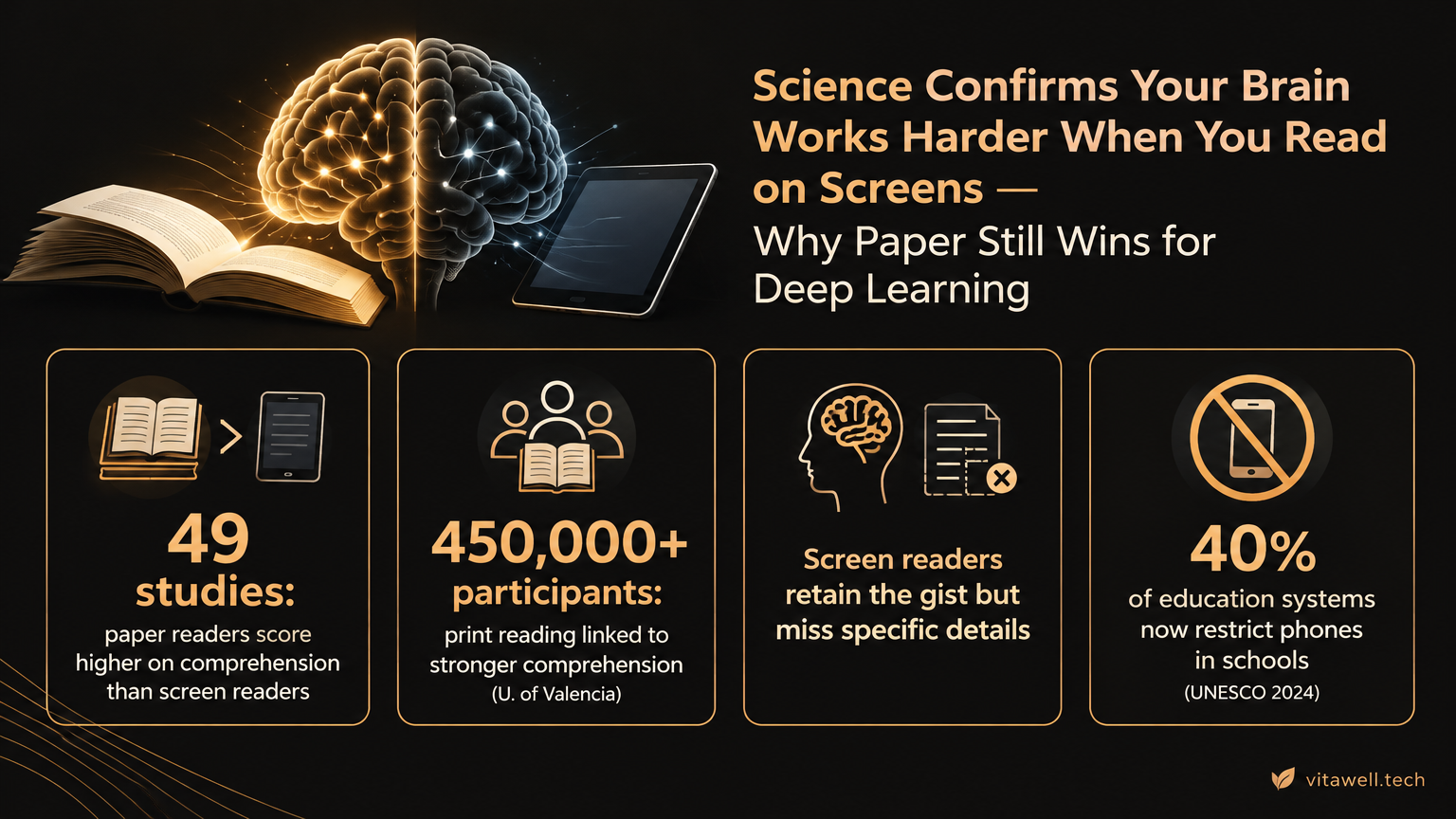
In 2024, a meta-analysis examining 49 controlled studies confirmed that students reading on paper scored higher on comprehension tests than those reading identical material on screens. The same year, a University of Valencia research team published findings based on data from more than 450,000 participants, concluding that print reading is more strongly associated with reading comprehension than digital reading. These are not small or idiosyncratic results. They represent what happens when the same research question is examined again and again, in different countries, with different populations, and the answer keeps coming back the same way.
A comprehensive 2023 review published in Trends in Cognitive Sciences by researchers at Macquarie University synthesized the cross-language evidence and reached the same conclusion: the screen inferiority effect is real, consistent, and meaningful for how we approach learning environments.
When the Gap Is Largest
The screen inferiority effect is not equally strong in all contexts. For simple, narrative reading — a short story, a casual article — the gap is relatively small. The effect becomes much larger when the material is dense, information-heavy, or technical. Reading a textbook chapter, studying a research summary, or working through a detailed explanation of a complex concept: these are exactly the reading tasks where paper consistently produces better comprehension outcomes. Time pressure amplifies the gap further — when readers are under a deadline, paper readers maintain their comprehension advantage while screen readers' performance drops more sharply. And less skilled readers face the most significant disadvantage on screens, meaning the medium that less proficient readers are most likely to encounter is also the one least suited to developing their abilities.
What's Happening Inside Your Brain When You Read on a Screen
Behavioral studies tell us that comprehension differs by medium, but neuroscience is beginning to explain why. Brain imaging research using EEG and functional near-infrared spectroscopy (fNIRS) has revealed measurable differences in how the brain activates during paper and screen reading — differences that illuminate the comprehension gap from the inside out.
Brain Imaging Reveals Different Activation Patterns
A Korean study published in Brain Sciences in January 2024 measured oxygenated hemoglobin levels in the prefrontal cortex of young adults reading on paper versus a screen. Reading on paper produced lower oxygenated hemoglobin levels in this region — a finding that researchers interpret as evidence of more efficient working memory use. The brain, in other words, doesn't have to work as hard to process text on paper, freeing cognitive resources for comprehension rather than consuming them in the act of reading itself.
An Israeli study published in PLOS ONE in 2023 examined brainwave activity in children aged 6 to 8 during paper and screen reading. Children reading on paper showed more high-frequency brainwave activity, associated with focused attention and active processing. Screen reading produced more low-frequency activity — a pattern linked to lower engagement and reduced attentional investment in the material. A 2024 study from Columbia University and Teachers College, also published in PLOS ONE, used EEG to track how children aged 10 to 12 processed ambiguous words as they read. The electrical responses to these words differed meaningfully by medium, with paper reading associated with patterns researchers interpreted as deeper semantic engagement with the text.
Semantic Processing Differences
Semantic processing is the cognitive work of extracting meaning from words — connecting a string of symbols not just to their definitions but to a network of related concepts, implications, and contexts. The EEG evidence suggests that paper reading triggers richer semantic processing. When you read the word "justice" on paper and it's part of a dense argument, your brain is more likely to engage fully with what that word means in this context, what it connects to, what ambiguities it might hold. On a screen, that same word may be processed more superficially — encoded for its basic meaning but without the deeper contextual integration that makes comprehension stick.
The Hidden Cost of Skimming
Perhaps the most practically significant finding from screen reading research comes not from brain imaging but from something simpler: watching what people's eyes actually do as they read. Eye-tracking technology has consistently shown that screen readers skim. They skip more text, process fewer words per line, and return to re-read key passages far less frequently than paper readers do. Print readers, by contrast, engage in what researchers call analytical re-reading — naturally looping back to review and consolidate information as they encounter it.
Eye-Tracking Studies: What Screen Readers Actually Do
The skimming pattern is not a conscious choice. It is a behavior that the medium elicits. Screens are associated in our nervous systems with quick, browsable content — social media feeds, news headlines, search results. The brain reads a screen the way it has learned screens work, even when the content demands something more sustained. The result is a reading style that works reasonably well for lightweight material but systematically fails us when the content requires careful, sequential, cumulative comprehension.
What Skimming Costs You in Retention and Detail Recall
The Trends in Cognitive Sciences review found a revealing asymmetry: screen readers are largely able to retain the gist of what they read — the general topic, the broad conclusion — but they struggle significantly to recall specific details. This matters enormously for practical comprehension. Understanding that an article was about climate change doesn't help you recall the specific temperature threshold or the year of the study. Understanding that a contract covered liability doesn't help you remember the specific clause. For any task where the details are the point — studying, professional development, complex decision-making — the screen's tendency to produce gist-only retention is a serious limitation.
Researchers have also flagged an underappreciated risk: screen reading may increase susceptibility to misinformation. When we skim rather than read carefully, we are less likely to notice discrepancies, inconsistencies, or nuances that would make a claim appear questionable. We absorb the headline and miss the caveat.
Why Physical Pages Have a Cognitive Advantage
It would be easy to dismiss the paper advantage as nostalgia or habit — something that will disappear as the generation that grew up with physical books ages out of the research pool. But the evidence suggests something more fundamental: the physicality of paper provides genuine cognitive advantages rooted in how human memory and attention actually work.
Spatial Memory and the Mental Map of a Book
When you read a physical book, you build a spatial map of the text as you go. You remember, often unconsciously, that the key argument was near the bottom of a right-hand page, two-thirds of the way through the chapter. This spatial indexing is not trivial — it creates a navigational framework that helps you locate, review, and integrate information. Research by Ernst Rothkopf as far back as 1971 established that readers create a mental index linking content to its physical location on the page. The absence of this spatial anchoring on screens, where text flows, resizes, and reflows without fixed coordinates, removes an important memory scaffold.
Haptic Feedback and How Touch Shapes Comprehension
Research by Anne Mangen and Adriaan van der Weel published in 2016 introduced the concept of embodied cognition in reading: the idea that the physical act of turning pages, feeling the thickness of text already read, and having a tactile sense of where you are in a document shapes how the reader constructs a mental representation of the text. The weight of a book, the resistance of its pages, the physical progress from cover to cover — these sensory signals are not irrelevant decoration. They are part of how the reading experience is encoded and remembered. Screens eliminate this sensory dimension entirely, replacing it with a scroll bar that provides far less intuitive information about where you are in a text.
Who Is Most Affected — And When the Gap Matters Most
Not all readers are equally affected by the medium they read on. The research identifies specific populations and contexts where the screen disadvantage is most pronounced.
Children and Developing Readers Face the Highest Risk
The developmental implications of screen reading habits are significant. MRI research has found that children who read more physical books show stronger brain connectivity in language processing and cognitive control regions, while greater screen time exposure is associated with fewer such connections. A preschool study found that children who watched a story on screen performed worse on attention tests six weeks later than children who had the same story read from a physical book — and their brainwave patterns resembled those of children with attentional difficulties. At the developmental stage when foundational reading circuits are being established, the medium may shape not just comprehension outcomes but the architecture of the reading brain itself.
When Time Pressure and Cognitive Load Are High
For adults, the screen disadvantage peaks under conditions of time pressure and high cognitive load. When you are reading quickly to prepare for a meeting, studying under a deadline, or working through complex technical material, paper consistently outperforms screens. The less cognitive slack you have available, the more the medium's effects on working memory and attentional management become decisive. For leisure reading of narrative fiction — a genre that makes relatively modest cognitive demands and is unlikely to be read under time pressure — the gap is much smaller. The practical implication is clear: match your medium to your reading purpose, with the most demanding reading tasks reserved for paper when possible.
What Education Systems Are Doing About It
Policymakers around the world are responding to the accumulating evidence in ways that would have seemed surprising a decade ago, when the push toward digital learning was near-universal.
40% of Education Systems Now Restrict Phones in Schools
UNESCO data shows that the proportion of education systems with school phone bans rose from approximately 30% in 2023 to roughly 40% — 79 education systems — by the end of 2024. A 2024 Pew Research survey found that 68% of U.S. adults support banning phone use during class in middle and high schools. The policy direction reflects a recognition that the constant availability of screens in learning environments is not improving outcomes — and may be actively harming them.
Finland's Policy Reversal: Back to Printed Textbooks
Finland, long regarded as a model of educational innovation and among the first countries to embrace digital learning environments comprehensively, made a notable policy reversal in 2024, with the city of Riihimäki returning to printed textbooks in its schools. This was not an isolated local decision — it reflected a broader reassessment by Finnish educators of what the evidence now says about digital learning mediums. When the country that pioneered digital education in schools starts walking it back, it signals that the research is saying something the field cannot continue to ignore.
Practical Strategies for Protecting Your Deep Reading Ability
The goal is not to reject digital reading — it is unavoidable in modern work and life, and it serves many purposes well. The goal is to be intentional about the medium you choose based on what you're trying to accomplish, and to protect your capacity for the kind of focused, analytical reading that screens systematically undermine.
When to Choose Paper Over Screen
- You are studying material you need to retain in detail, not just grasp generally.
- The text is dense, technical, or requires sequential comprehension — each part builds on the last.
- You are under time pressure and accuracy matters more than speed.
- You are a developing reader, or you are reading with a child.
- The reading requires critical evaluation — identifying inconsistencies, spotting gaps, assessing the strength of an argument.
Digital Reading Habits That Minimize the Comprehension Gap
When screen reading is unavoidable, there are evidence-informed adjustments that can partially close the gap. E-readers that mimic physical book formats — fixed pages, no notifications, no browser access — produce better comprehension than tablet or laptop screens in most studies. Reading in offline mode eliminates the ambient distraction of connectivity and reduces the urge to skim. Reading in longer, uninterrupted blocks rather than fragmented sessions allows the brain to shift into the deeper processing mode associated with paper reading. And annotating as you read — taking notes, marking passages — reintroduces an embodied element that partially compensates for the absence of physical page-turning and spatial anchoring. These adjustments will not fully replicate the paper reading experience, but they can meaningfully improve the quality of comprehension you get from a screen.
Conclusion: The Medium Is Part of the Message
The screen inferiority effect is not a relic of an older generation's attachment to print, and it will not disappear as digital natives age. It reflects something fundamental about how human cognition works — how spatial memory, haptic feedback, working memory efficiency, and attentional systems interact with the act of reading. For millennia, humans adapted to reading on physical surfaces. The brain developed deep reading circuits that are optimized for that experience. Screens are genuinely useful for many things — but deep reading, for now, is not among them. Understanding this is not a reason to feel defensive about your phone or your laptop. It is simply useful information: for how you study, how you teach, what you print out before an important meeting, and what you pick up at the bookshelf when the material truly matters.
Sources
Inc.com — Your Brain Prefers to Read on Paper Rather Than on Screens, New Study Says
The Hechinger Report — PROOF POINTS: This is your brain. This is your brain on screens.