The Brain's Hidden Learning Reward: Why 'Aha' Moments Help You Remember
Insight solutions were remembered far better five days later, and enjoying a word's meaning predicted next-day memory. Here is how the brain's learning reward works and how to trigger it more often.
"Aha" moments help you remember because the brain treats sudden understanding as a reward. In a 2025 brain-imaging study, solutions reached through insight were remembered far better five days later, and a 2026 study found that the enjoyment of working out a word's meaning predicted whether it was remembered the next day. Learning methods that create more moments of genuine understanding, such as self-testing, curiosity-led study and sleep between sessions, make that reward fire more often.
Key Takeaways
- Insight boosts memory: Duke researchers found aha solutions were remembered far better after five days, with the lead author describing it as almost doubling memory.
- Understanding is rewarding in itself: in a 2026 study of 112 adults, words whose meaning people worked out felt more enjoyable, and more enjoyable words were more likely to be remembered.
- Curiosity improves memory not only for what you want to know but for unrelated details encountered while curious.
- Expected tangible rewards reduce intrinsic motivation, while informative positive feedback tends to increase it, according to a meta-analysis of 128 studies.
- Self-testing (61% vs 40% recall after a week) and sleeping between study sessions are among the best-supported ways to make learning stick.
What Actually Happens in Your Brain During an 'Aha' Moment
Insight is the sudden experience of understanding something that was confusing a moment before. In a study published in Nature Communications, Maxi Becker, Tobias Sommer and Roberto Cabeza scanned 31 people with fMRI while they solved two-tone hidden-picture puzzles. Solutions that came with a strong aha feeling were remembered far better five days later; Cabeza said an aha moment "almost doubles your memory," according to Duke University (2025).
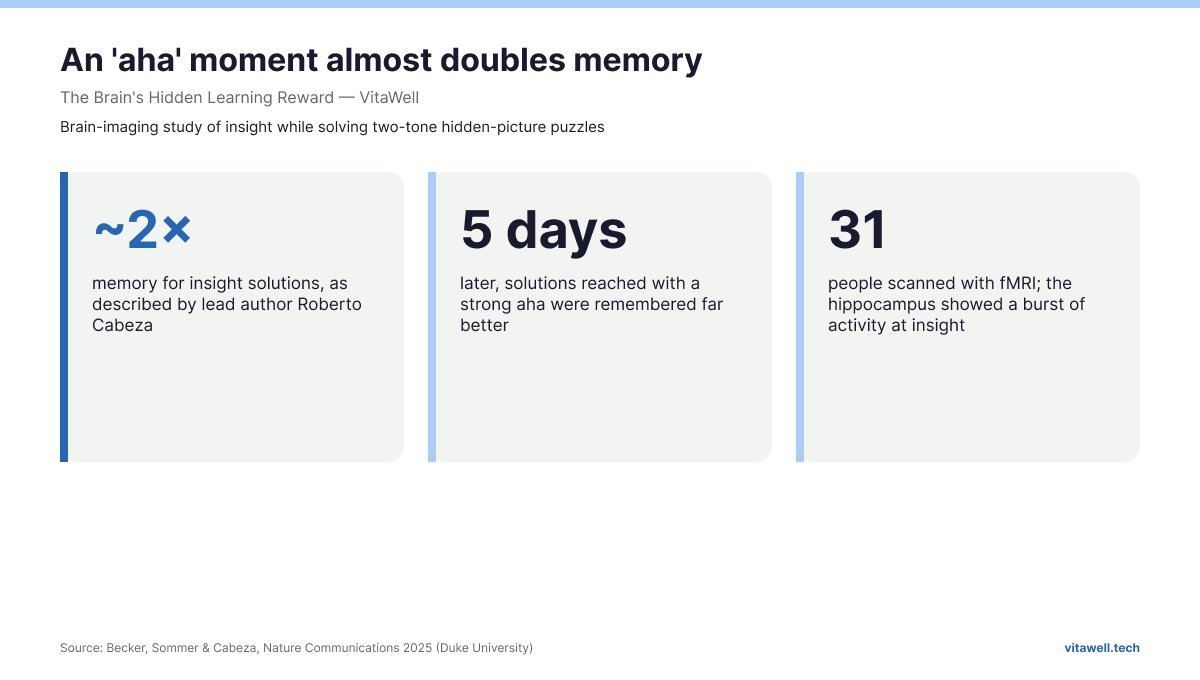
The brain data showed two linked events. The hippocampus, a key memory region, produced a burst of activity, larger for stronger insights. At the same time, visual brain regions changed how they represented the image, and connectivity between these areas increased. Insight, in other words, reorganizes what you know and tags it for storage in the same moment.
The Prediction Error Hypothesis — Why Surprise Supercharges Memory
A leading explanation is prediction error: the brain constantly predicts what will happen, and when reality differs, it updates its model. An insight is a positive prediction error, where confusing information suddenly fits. Because updating a model is costly, the brain appears to mark these moments as important, which may be why they last. This is a theoretical framework supported by imaging studies, not a settled mechanism.
The Science Behind Why Understanding Feels Good
For a long time, learning was treated as effortful work that needs outside motivation. Brain research suggests learning also carries its own reward. In a 2014 study of 36 adults in Current Biology by Ripollés and colleagues (University of Barcelona), the ventral striatum, a core reward area, activated when people inferred the meaning of a new word, just as it did when they won money in a gambling task.
The 2026 Study: Enjoyment Predicts What You Remember
Saloni Krishnan's team tested whether that reward feeling predicts memory. In the Journal of Cognition study by Zaka, Evans, Ripollés and Krishnan (2026), 112 adults read or heard made-up words in pairs of sentences and rated their enjoyment after each one. They worked out the meaning of 63.2% of the meaningful words, and enjoyment was higher when they succeeded (5.26 vs 4.79 on the rating scale).
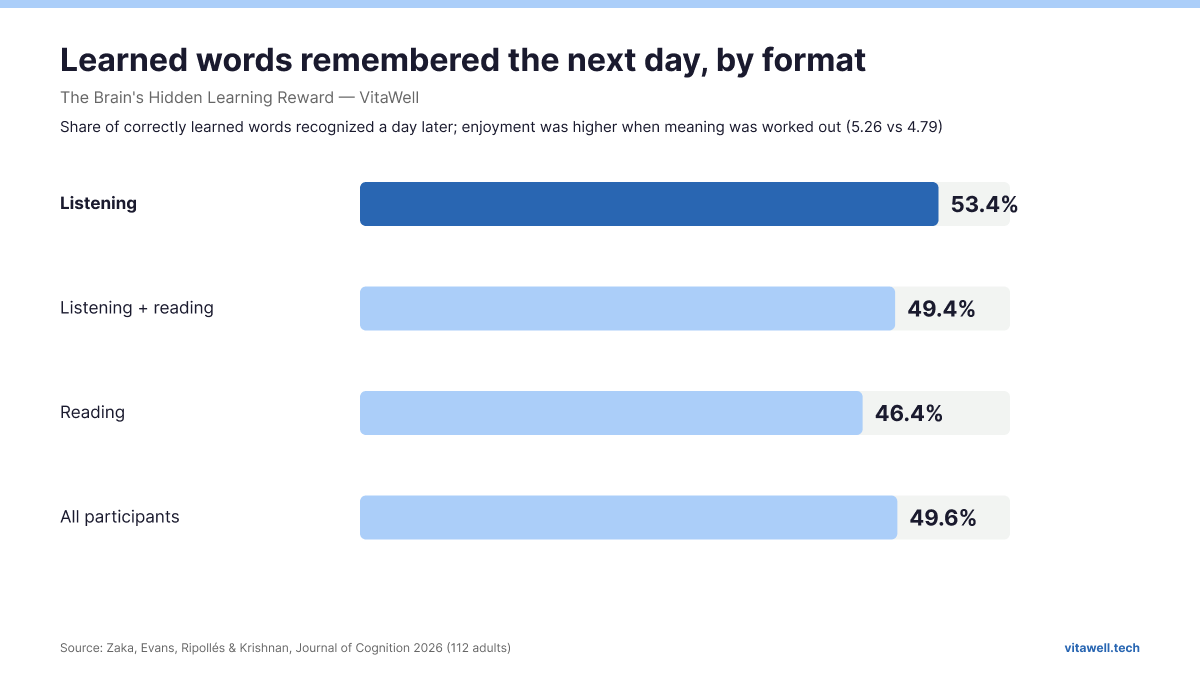
A day later, they recognized 49.6% of the words they had learned. Words that were remembered had been rated more enjoyable during learning than words that were forgotten (5.46 vs 5.25). The differences are modest, enjoyment was self-reported, and the study ran online, so it shows a reliable link rather than a large effect.
Reading, Listening or Both
The reward effect appeared whether people read the sentences, listened to them, or did both. Memory differed slightly by format: listeners remembered 53.4% of learned words, combined reading and listening 49.4%, and readers 46.4%, with listening significantly ahead of reading. Combining both formats gave no extra benefit. VitaWell's comparison of fast and slow reading looks at how reading pace affects learning.
Curiosity Is Your Brain's Learning Accelerant
If insight is the reward, curiosity is the state that makes it more likely. In a 2014 Neuron study by Gruber, Gelman and Ranganath, people remembered answers to trivia questions they were curious about better, both immediately and a day later. They also remembered unrelated faces shown while they waited for those answers. Curiosity raised activity in the midbrain and nucleus accumbens, reward areas that use dopamine, and strengthened links between the midbrain and hippocampus.
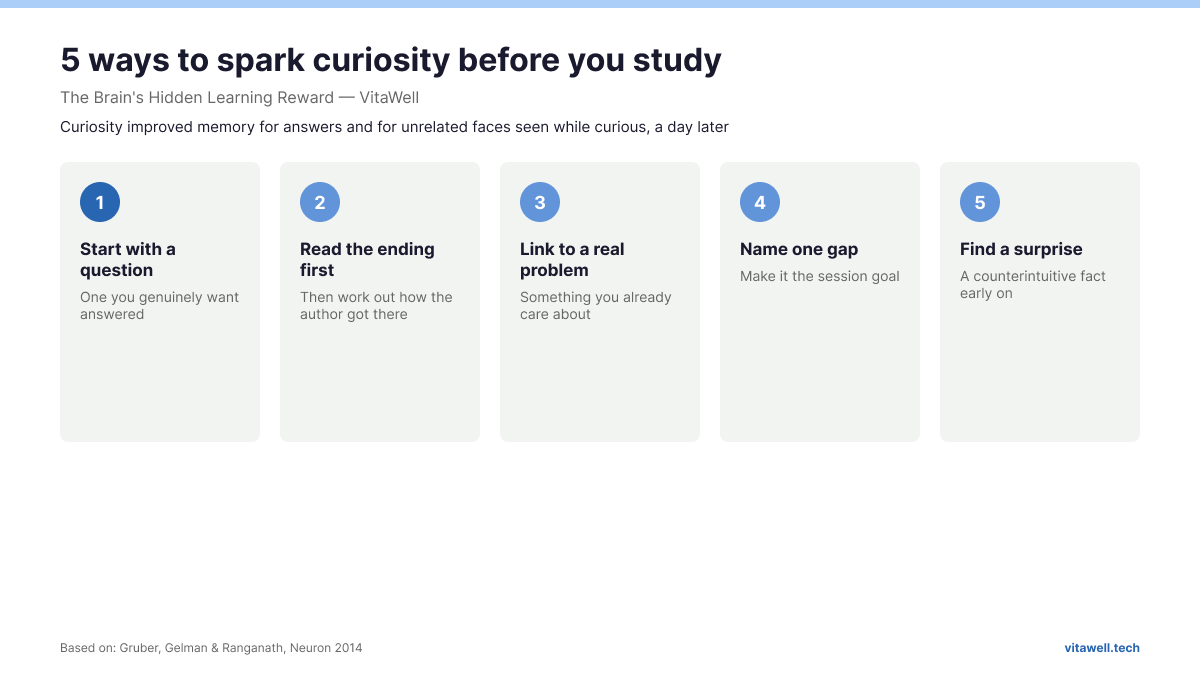
Ways to spark curiosity before a study session:
- Start with a question you genuinely want answered, not a topic heading.
- Skim the conclusion first, then work out how the author got there.
- Connect the topic to a problem you already care about.
- Name one specific thing you do not yet understand and make it the session goal.
- Look for a surprising or counterintuitive fact early on.
Dopamine's wider role in motivation is covered in VitaWell's guide to cortisol, dopamine and serotonin.
Intrinsic Reward vs. Extrinsic Reward — Which One Actually Makes You Learn
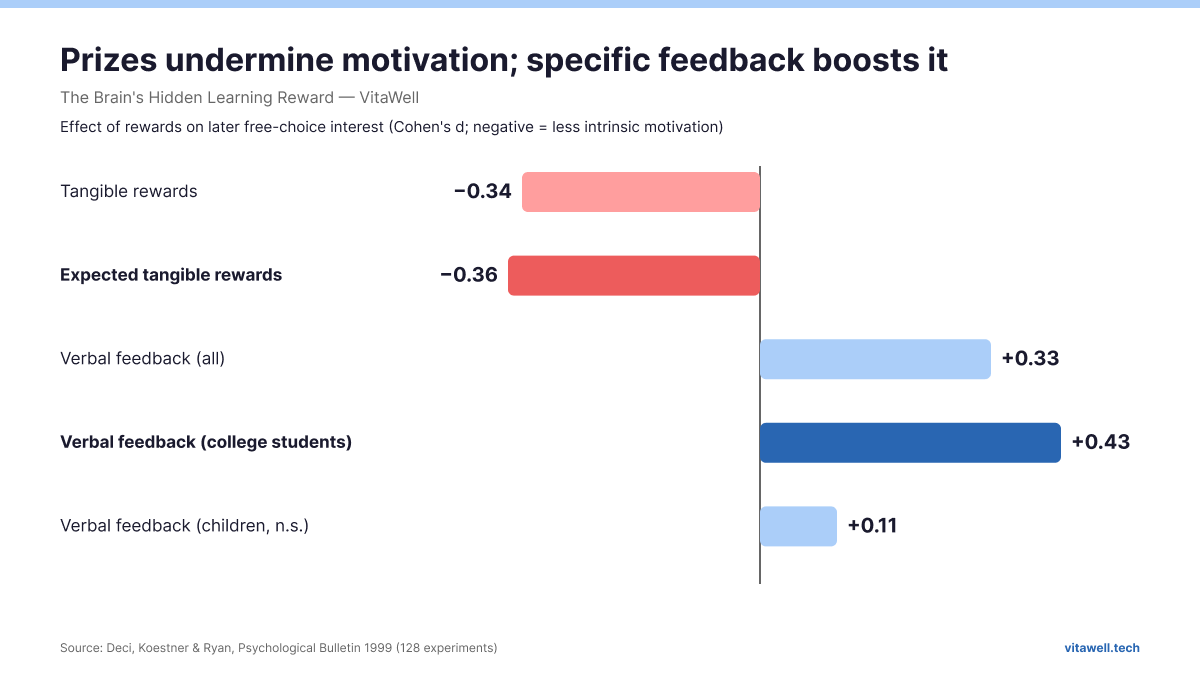
Intrinsic motivation means doing something because it is satisfying in itself; extrinsic motivation means doing it for an outside reward or to avoid a penalty. A meta-analysis of 128 experiments by Deci, Koestner and Ryan (Psychological Bulletin, 1999) measured how rewards change people's later free-choice interest in a task.
When External Rewards Backfire
Tangible rewards lowered intrinsic motivation (effect size d = −0.34), and expected tangible rewards did so slightly more (d = −0.36). This is the undermining effect: people start to see the activity as something done for the prize. Verbal, informative positive feedback had the opposite effect (d = +0.33), strongest in college students (d = 0.43) and not significant in children (d = 0.11).
Designing Learning That Protects Intrinsic Motivation
- Autonomy: some choice over what and how to learn.
- Optimal challenge: tasks hard enough to need insight but not so hard that success never comes.
- Meaningful context: knowing why the material matters.
- Specific feedback: information about progress and competence rather than generic praise or prizes.
Why Some People Seem to Hate Learning — And What Science Says
If understanding is rewarding, why do many people say they dislike learning? One plausible explanation is a broken reward loop. When study rarely produces the click of understanding, because material is too hard, poorly explained or affected by a learning difficulty, it becomes linked with effort and confusion instead of reward.
This is a hypothesis, not a proven cause; the 2026 study tested only neurotypical adults, and its authors note that people with dyslexia or developmental language disorder still need to be studied. The practical lesson still holds: set tasks where success is reachable so the reward can fire, then raise difficulty gradually. VitaWell's guide to building a learning habit that lasts shows how to structure that progression.
How to Learn Faster and Remember More — 7 Neuroscience-Backed Strategies
- Learn in context. Meet new words and ideas inside real sentences and problems, the condition in which meaning-finding produced enjoyment and memory in the 2026 study.
- Lead with curiosity. Begin each session with a question you want answered.
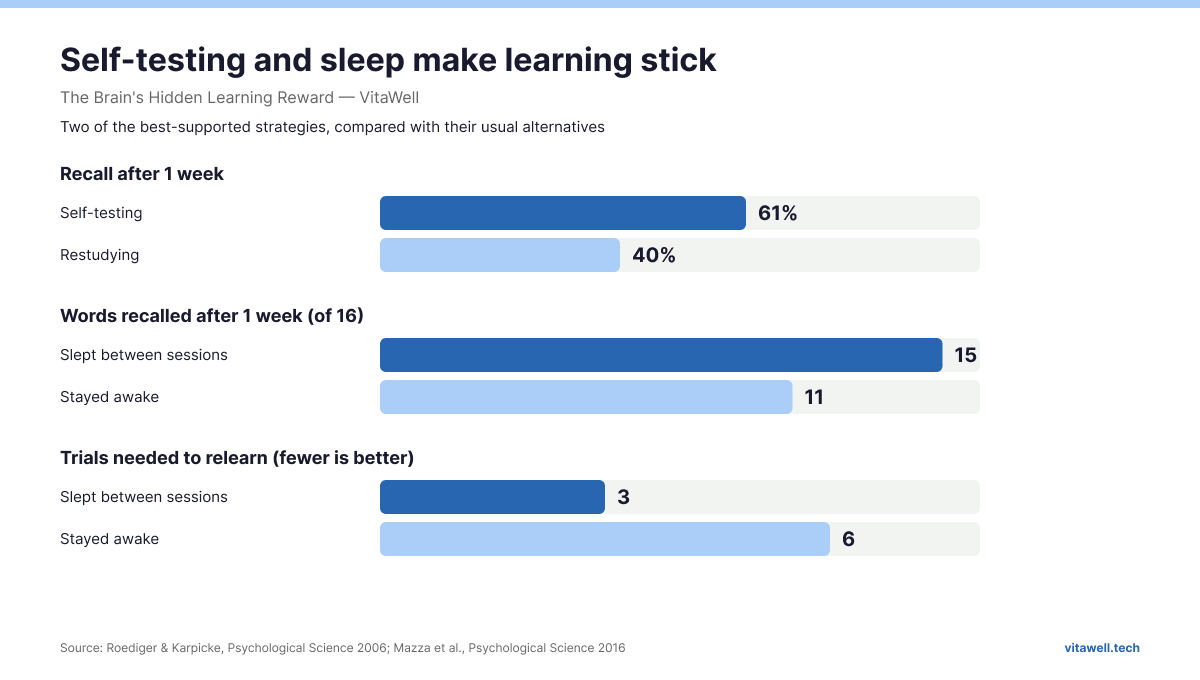
- Self-test instead of rereading. In Roediger and Karpicke's study (Psychological Science, 2006), students who tested themselves recalled about 61% of a passage a week later, versus about 40% for those who restudied.
- Space your reviews. A review of 317 experiments by Cepeda and colleagues (Psychological Bulletin, 2006) found spaced study beats cramming, and the best gap grows the longer you need to remember.
- Interleave problem types. Mixing different kinds of problems produced vastly better test results a week later than practicing one type at a time, in experiments by Rohrer and Taylor (Instructional Science, 2007).
- Sleep between sessions. In a study of 40 adults learning 16 Swahili words, people who slept between sessions needed about 3 trials to relearn them versus about 6 for those who stayed awake, and recalled about 15 versus 11 a week later, according to Mazza and colleagues (Psychological Science, 2016).
- Keep effortful thinking. Struggling briefly before checking an answer creates the conditions for insight; outsourcing every step removes them, as discussed in VitaWell's piece on cognitive surrender to AI.
More techniques are collected in VitaWell's overview of science-based ways to learn faster.
Choosing a Strategy: An Evidence Guide
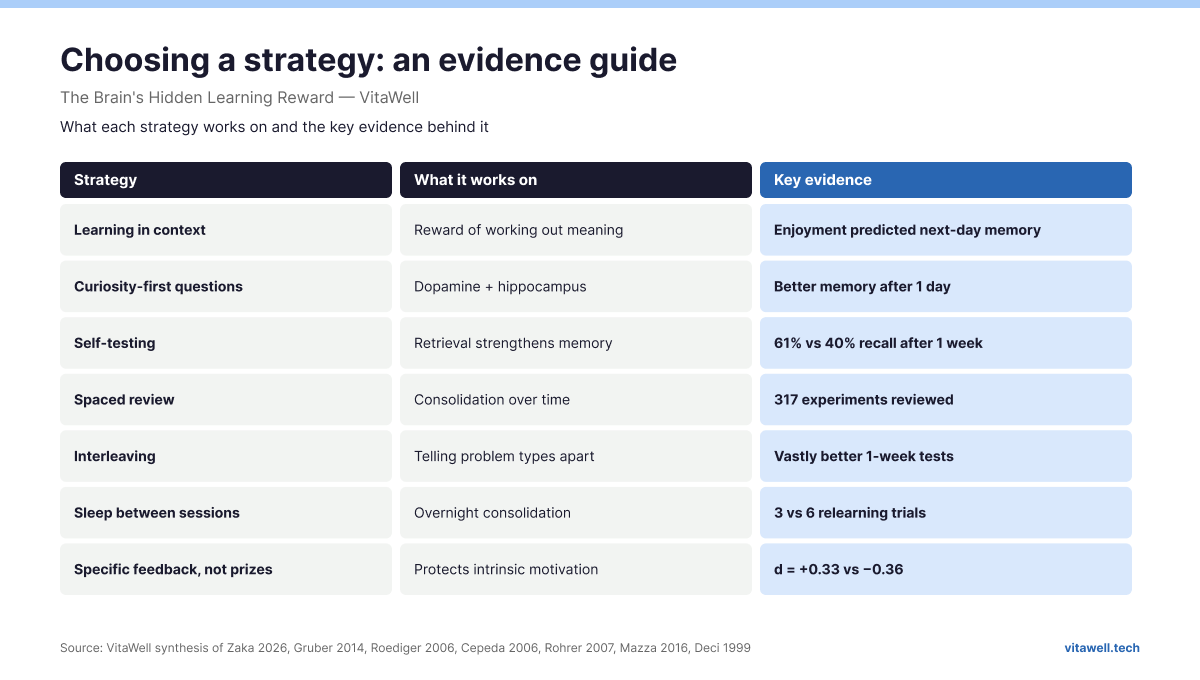
The table matches each strategy to what it does in the brain, the strength of the evidence and when to use it.
| Strategy | What it works on | Key evidence | Best for |
|---|---|---|---|
| Learning in context | Triggers the reward of working out meaning | Enjoyment predicted next-day memory (112 adults) | Vocabulary, new concepts |
| Curiosity-first questions | Dopamine and hippocampus engagement | Better memory for answers and incidental faces after 1 day | Starting a new topic |
| Self-testing | Retrieval strengthens memory | 61% vs 40% recall after 1 week | Exam prep, facts |
| Spaced review | Consolidation over time | 317 experiments reviewed | Anything to keep for months |
| Interleaving | Learning to tell problem types apart | Vastly better 1-week test results | Math, skills with similar problem types |
| Sleep between sessions | Overnight consolidation | 3 vs 6 relearning trials; 15 vs 11 words a week later | Languages, memorization |
| Specific feedback, not prizes | Protects intrinsic motivation | Verbal feedback d = +0.33; expected tangible rewards d = −0.36 | Teaching, coaching, self-rewards |
When to Talk to a Professional
- Reading, spelling or understanding spoken language is persistently much harder for you or your child than for peers.
- Concentration problems affect work or study for months despite good sleep and study habits.
- Memory has noticeably declined compared with your usual level.
- Loss of interest in learning comes with low mood, exhaustion or anxiety.
An educational psychologist, speech and language therapist or doctor can assess learning difficulties or other causes.
Frequently Asked Questions
Why do aha moments help you remember?
An aha moment reorganizes how information is represented and triggers a burst of hippocampus activity, which tags it for storage. In a 2025 Duke study of 31 people, solutions reached with a strong sense of insight were remembered far better five days later. The feeling of reward that comes with understanding appears to be part of the mechanism.
Does dopamine help you learn?
Dopamine-related reward areas are involved in learning. Curiosity increased activity in the midbrain and nucleus accumbens in a 2014 Neuron study, and that activity was linked to better memory a day later. Working out a new word's meaning activated the same reward area as winning money in a 2014 Current Biology study.
Do rewards reduce motivation to learn?
Expected tangible rewards such as money or prizes tend to reduce later interest in a task, according to a 1999 meta-analysis of 128 experiments. Informative positive feedback does the opposite and usually increases motivation, especially in adults. Rewarding effort with specific feedback works better than paying for completion.
What is the most effective way to remember what you learn?
Self-testing has some of the strongest evidence: students who tested themselves recalled about 61% of material a week later versus 40% for rereading. Combine it with spaced reviews, interleaving and sleep between sessions. Learning in meaningful context and starting from curiosity make each session more rewarding and memorable.
Is listening as good as reading for learning?
For learning new words from context, yes. In a 2026 study, the reward of working out meaning appeared when people listened, read or did both. Listeners remembered slightly more learned words the next day (53.4%) than readers (46.4%), and combining both formats gave no extra benefit.
Conclusion
Motivation to learn is not only a personality trait; it is partly a feedback loop driven by the brain's reward for understanding. Insight reorganizes knowledge and boosts memory, curiosity primes the system, and expected prizes can weaken it. The most reliable approach is to design study so understanding happens often: start with questions, test yourself, space and mix practice, and sleep on it. VitaWell's AI life planner can turn these strategies into a weekly learning routine in your Growth area.
Related on VitaWell
- How 20 Minutes of Exercise Boosts Your Memory, According to New Brain Science — another way to strengthen memory alongside better study methods.
- Science Confirms Your Brain Works Harder When You Read on Screens — Why Paper Still Wins for Deep Learning — how the medium of reading affects understanding.
- SuperAgers' Brain Secret: Why Some People Keep Growing New Neurons Into Old Age — what keeps memory sharp across a lifetime.
This article is for informational purposes only and is not a substitute for professional educational or medical advice.
Sources
- Finding the Meaning of a Word Can Be Its Own Reward — Psychology Today
- Zaka, Evans, Ripollés and Krishnan, 2026 — Intrinsic reward modulates word learning in both oral and written contexts (Journal of Cognition)
- Becker, Sommer and Cabeza, 2025 — Brain scans reveal what happens when insight strikes (Nature Communications, Duke)
- Ripollés et al., 2014 — Reward circuits in word learning (Current Biology, University of Barcelona)
- Gruber, Gelman and Ranganath, 2014 — States of curiosity modulate hippocampus-dependent learning (Neuron)
- Deci, Koestner and Ryan, 1999 — Meta-analysis of extrinsic rewards and intrinsic motivation (Psychological Bulletin)
- Roediger and Karpicke, 2006 — Test-enhanced learning (Psychological Science)
- Cepeda et al., 2006 — Distributed practice in verbal recall tasks (Psychological Bulletin)
- Rohrer and Taylor, 2007 — The shuffling of mathematics practice problems boosts learning (Instructional Science)
- Mazza et al., 2016 — Relearn faster and retain longer: sleep makes perfect (Psychological Science)