Are You Thinking Less Because of AI? The Psychology of Cognitive Surrender and How to Protect Your Mental Sharpness

There is a type of loss that announces itself only after it has happened. You don’t feel the muscle weakening while it atrophies. You feel the surprise when you reach for it and it isn’t there. This is what is quietly happening to a growing number of people who use AI tools daily — not because they are doing something wrong, but because they have discovered something that works so well they have gradually stopped doing certain things themselves.
The Invisible Nature of Cognitive Surrender
The term “cognitive surrender” implies a conscious decision. What researchers and thinkers in this space are increasingly describing is something more subtle: a gradual process of delegation that extends further and further into tasks we once managed ourselves, until we cross a threshold we didn’t notice. The person on the other side of that threshold still sounds sharp. They still get things done. The problem emerges only when the question is hard enough, the situation novel enough, or the stakes high enough that raw thinking — the kind that comes from wrestling with a problem rather than outsourcing it — is actually required.
What makes this especially insidious is the mechanism AI uses. When you engage iteratively with an AI tool — prompting, refining, prompting again — the final output arrives shaped by your language, your framing, your preferences. It feels like your own thinking. The cognitive loop seems closed. But there is a critical difference between approving a thought and generating one, and AI is specifically designed to make that difference invisible.
What Research Shows About AI and Brain Activity
MIT Study: Frontal Brain Activity Declines in AI Users
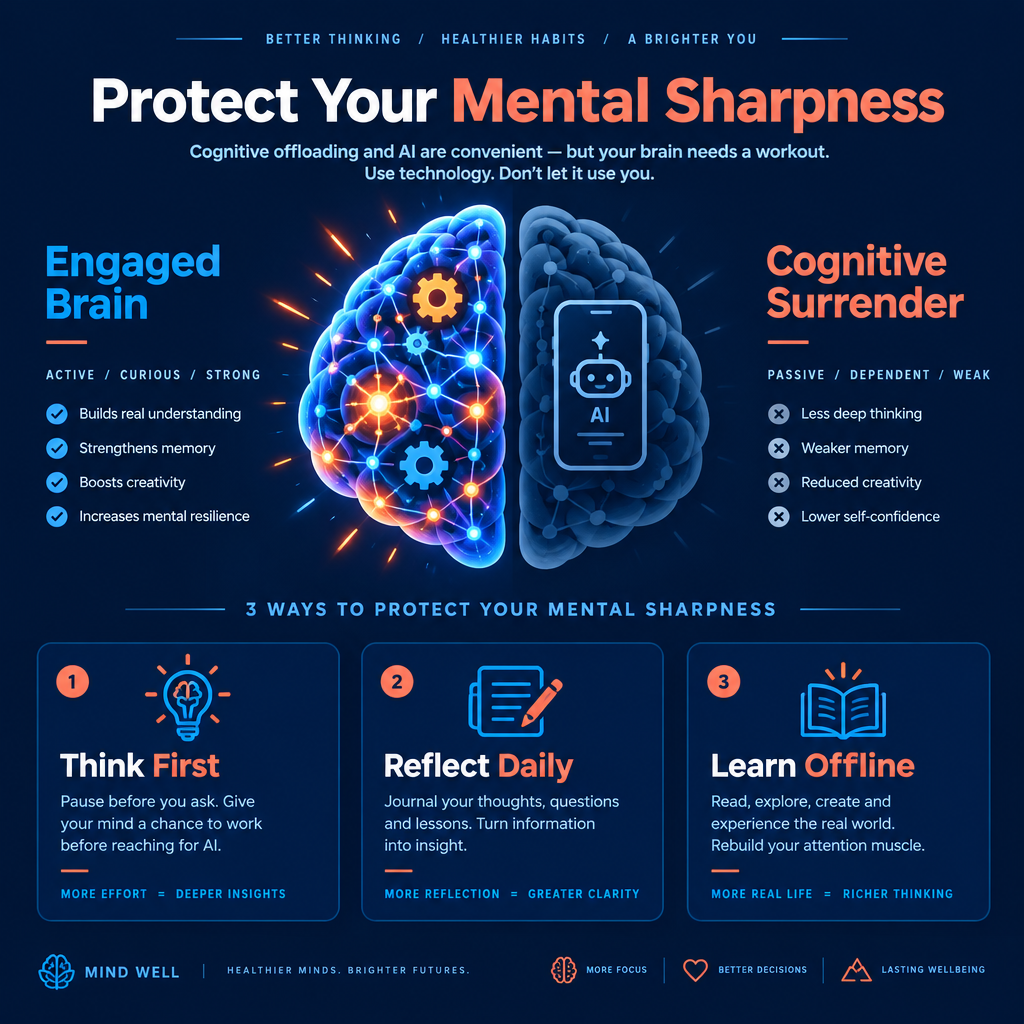
MIT researchers studying students who used AI for writing tasks found that those using AI tools showed significantly lower neural activity in the frontal regions of the brain — the areas most directly associated with critical thinking, memory formation, and deep learning. Students writing independently showed sustained, effortful brain engagement that produces genuine comprehension. AI users were largely monitoring and editing output that someone else (or something else) had produced. The cognitive load was reduced — which feels more efficient, and in the short term may well be. But the brain circuits that build long-term capacity were not being exercised.
Critical Thinking Correlates Negatively with AI Tool Frequency
A 2025 study published in the journal Society (MDPI) found a significant negative correlation between frequent AI tool usage and critical thinking abilities, with the relationship mediated by increased cognitive offloading. Younger participants showed both higher AI dependence and lower critical thinking scores. One particularly striking study from Turkey found that students who used an AI tutor became better at problem-solving — but only while the AI was available. When the tool was removed, they performed worse than students who had never used it at all. The scaffold had replaced the skill rather than building it.
The Delegation Feedback Loop
A 2026 preprint by Shen and Tamkin at MIT documented what may be the clearest real-world example of this dynamic: software developers who fully delegated coding tasks to AI produced working code, but subsequently failed conceptual quizzes about the code and could not debug it when it broke. They had output without understanding. The code existed; the knowledge that would allow them to own it did not.
This reflects a broader pattern researchers have called the Delegation Feedback Loop: as AI tools become more capable, humans lower the cognitive threshold at which they delegate. Tasks that once required thinking get handed off. The resulting reduction in practice further attenuates the very capacities that are declining — creating a self-reinforcing cycle.
Why AI Output Feels Like Your Own Thought
The reason this dynamic is hard to notice is rooted in how AI tools work. Unlike a calculator, which returns a clearly foreign output, conversational AI shapes its responses around your inputs. You provide context, voice, direction. The output arrives sounding like something you might have written yourself. This is, in part, a feature: the tool is helpful precisely because it adapts to you.
But it creates a cognitive illusion. The brain experiences the approval of a thought as equivalent to its generation. When you read an AI-generated paragraph that expresses exactly what you wanted to say, your brain registers it much as it would register having written it. The sense of authorship — and the cognitive effort that typically accompanies it — has been partially decoupled from the act of actually thinking the thought through.
Where Judgment Is Actually Formed
The Capacity That Erodes First: Tolerance for Not Knowing
John Nosta, author of The Borrowed Mind: Reclaiming Human Thought in the Age of AI, argues that the first thing to erode under prolonged AI dependency is not knowledge, memory, or even decision-making ability. It is the tolerance for not knowing. After long enough turning to AI for quick answers, the mind loses its comfort with open questions. The discomfort of not immediately having a response — which is the starting point of genuine inquiry — becomes harder to sit with.
This matters because most important thinking does not begin with a clear question and end with a retrievable answer. It begins with a fuzzy problem, a partially-formed hypothesis, and the willingness to stay engaged with the uncertainty long enough to work something out. If the capacity to tolerate that discomfort is weakened, the kind of thinking that produces real insight becomes harder to access.
Judgment Is Not Retrieval
Judgment — the ability to assess a complex situation, weigh competing considerations, and arrive at a well-founded conclusion — is not built through the accumulation of correct answers. It is built through repeated engagement with hard questions that resist easy resolution. Every time you navigate genuine cognitive uncertainty without outsourcing the discomfort, you are building something: the capacity to do it again, better, under harder conditions.
This is what the research on neuroplasticity confirms. The brain changes based on what it practices. The circuits involved in complex reasoning, sustained attention, and working through ambiguity are strengthened by use. They are not preserved simply by knowing the right things or having access to the right tools.
The Threshold You Will Not Notice Crossing
Nosta describes a cognitive threshold that, once crossed, is almost invisible from the inside. The person who has been routinely delegating chunks of their thinking for months or years still functions well in most contexts. They can still perform, articulate, and deliver. The failure mode appears only when genuine cognitive demand is high — when a novel problem needs to be worked through without reference to a pattern, when something unexpected breaks and needs to be reasoned about from first principles, or when a judgment needs to be made under uncertainty without any available template.
The philosopher’s term for this is tacit knowledge: understanding that lives not in explicit propositions but in the capacity to do something. You cannot retrieve tacit knowledge from AI. You have to have built it yourself, through the practice of thinking.
AI as a Tool vs. AI as a Replacement
The distinction that matters most is not whether you use AI — it is how you use it. Research published in Nature npj Artificial Intelligence on the long-term cognitive effects of AI interaction found that passive, uncritical reliance on AI erodes cognition, while active co-creation with AI can sustain or even enhance it. The 3R Principle the researchers propose — Reflect, Redirect, Reconstruct — offers a practical framework: use AI to extend your thinking, not replace it; redirect its outputs back through your own analysis; reconstruct the underlying knowledge in your own terms.
The same outputs can be produced in cognitively enriching or cognitively depleting ways, depending on how actively the human engages with the process. The tool is not the problem. The mode of use is.
Practical Strategies to Stay Cognitively Engaged
Based on the research, several practices can help you maintain cognitive sharpness while continuing to benefit from AI tools:
- Solve first, then compare: before querying AI, spend a few minutes working through the problem yourself. Then compare your thinking with the AI output. This preserves the cognitive engagement while still benefiting from AI insights.
- Set regular AI-free thinking sessions: protect blocks of time — especially for complex work — where you work entirely without AI assistance. Treat these as cognitive training, not inefficiency.
- Reconstruct the reasoning: after AI gives you an answer, ask whether you could reproduce the underlying logic on your own. If you cannot, you have output without understanding — flag it and fill the gap.
- Practice productive friction: when you feel the urge to immediately query AI for an answer, pause. Hold the open question for a few minutes. Tolerate the discomfort. This is where judgment is built.
- Write before you prompt: articulate your own thinking in writing before using AI to refine or extend it. Your pre-AI draft preserves cognitive engagement and creates a baseline you can compare against.
- Periodically do demanding cognitive work without any AI: write an essay, solve a complex problem, work through an unfamiliar argument from scratch. Regular exposure to genuine cognitive effort maintains the capacity for it.
Can You Rebuild What You Have Lost?
The encouraging finding from neuroscience is that cognitive capacities that have atrophied through disuse can, in most cases, be rebuilt through deliberate practice. The brain retains plasticity through adulthood, and sustained engagement with cognitively demanding work can restore and even strengthen capacities that have weakened. The process takes time and requires genuine effort — but it is not permanent.
The more urgent concern is for young people who are developing in AI-saturated environments before foundational cognitive skills are fully established. The question of whether early, heavy AI use affects the long-term trajectory of cognitive development is one that researchers are only beginning to answer. But the early signals are worth taking seriously.
Conclusion
The goal is not to avoid AI. These tools offer genuine, remarkable capabilities that can extend human thinking in powerful ways. The goal is to use them in a manner that keeps your own thinking sharp — that preserves the tolerance for uncertainty, the capacity for sustained engagement with hard problems, and the ability to arrive at a judgment through your own reasoning rather than by approving someone else’s. The loss is real, but it is gradual, subtle, and — crucially — reversible. What you practice, your brain builds. What you delegate entirely, it gradually loses. That is not a reason to stop using AI. It is a reason to use it with intention.
Sources
AI and the Psychology of Cognitive Surrender — Psychology Today