The Science of Why Midlife Might Be the Best Time of Your Life — What 30 Years of Research Actually Shows

Most people spend their late 30s quietly dreading the approach of 40. Pop culture has primed us to expect a midlife crisis — the sports car, the existential spiral, the sudden urge to quit everything and start over. But a growing body of science spanning more than three decades is quietly dismantling this narrative. For millions of people, midlife isn't a collapse. It's a culmination.
Why Do We Believe in a Midlife Crisis? The Origin of a Cultural Myth
The term "midlife crisis" was coined in 1965 by psychoanalyst Elliott Jaques, who noticed that some of his patients in their 30s and 40s became preoccupied with mortality and meaning. The concept spread quickly, amplified by popular books, films, and therapy culture throughout the 1970s and 1980s. By the 1990s, it had become a fixed cultural expectation — something that simply happened to people, like puberty or retirement.
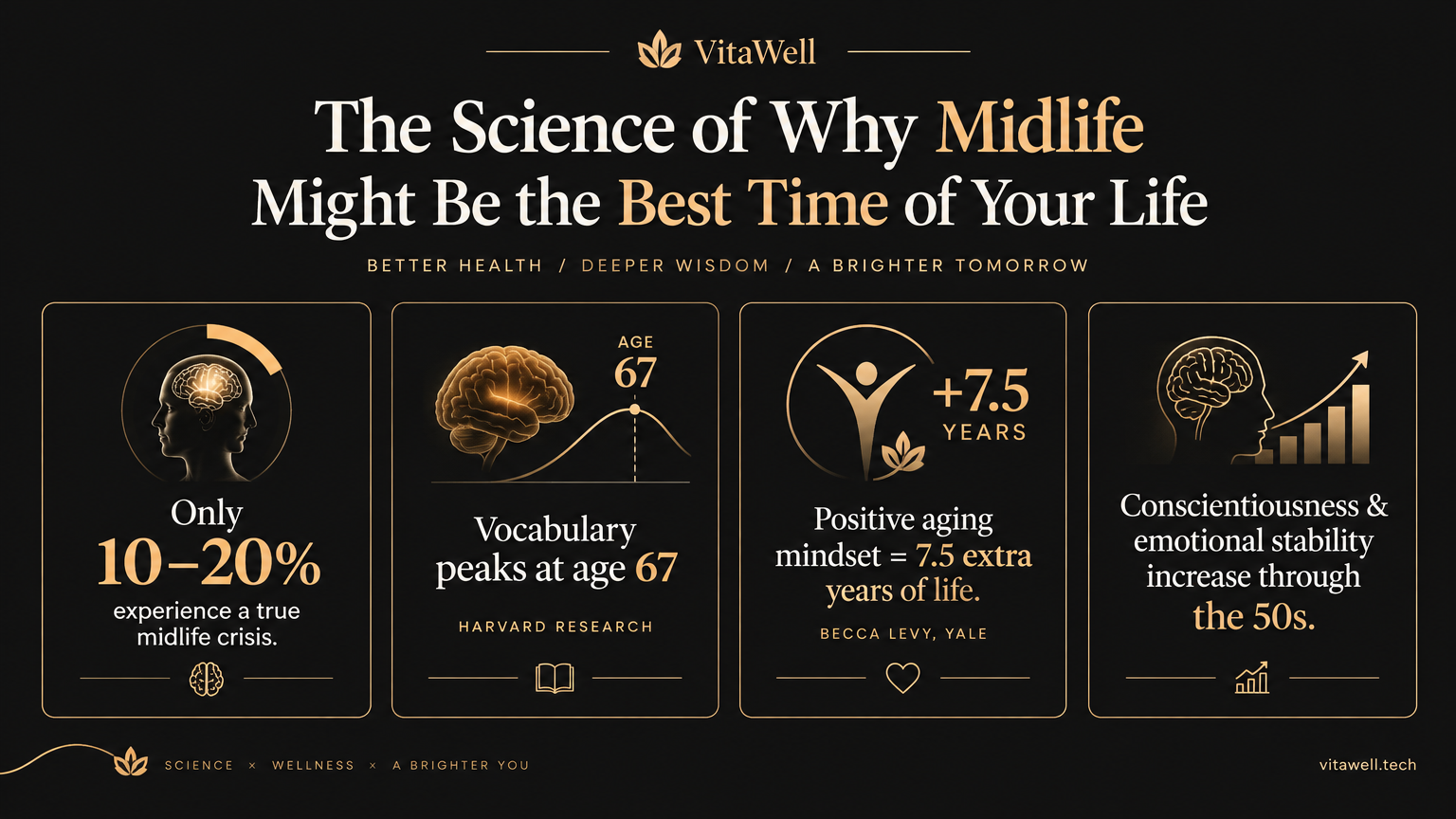
But the research tells a different story. Large-scale studies, including the landmark MIDUS study (Midlife in the United States) run by the MacArthur Foundation, found that only 10 to 20 percent of adults report experiencing anything resembling a classic midlife crisis. And among those who do, the trigger is usually a specific life event — job loss, divorce, illness — rather than age itself.
What Counts as a Real Midlife Crisis vs. Normal Life Transitions
Researchers distinguish between a true midlife crisis — a prolonged period of psychological distress, identity upheaval, and impulsive behavior triggered specifically by aging awareness — and ordinary life transitions that happen to occur in midlife. The latter are universal; the former is surprisingly rare. Many people who describe having had a midlife crisis, upon reflection, were simply navigating a difficult life event at a particular time in their life.
Why the Myth Persists Despite Contradicting Evidence
Cultural narratives are sticky. The midlife crisis story offers a convenient explanation for change, restlessness, and dissatisfaction — feelings that are entirely human but easier to attribute to a developmental stage than to examine individually. Media continues to reinforce the trope, and confirmation bias does the rest: we remember the cases that fit the narrative and forget the majority that don't.
What the Research Actually Shows: Happiness, Purpose, and Stability in Your 40s and 50s
Psychologist Carol Ryff at the University of Wisconsin-Madison has spent decades studying psychological wellbeing across the lifespan. Her research consistently shows that midlife adults score the highest of any age group on two critical dimensions: purpose in life and environmental mastery — the sense that you understand and can effectively manage your life circumstances.
When Researchers Control for Health and Income, the Dip Largely Disappears
The much-discussed "U-curve" of happiness — which suggests wellbeing dips in midlife before recovering in older age — has been questioned by newer research. When economists and psychologists control for variables like health status, income changes, and expectations, the dip either shrinks dramatically or disappears entirely.
Increased Emotional Regulation and Stress Management in Midlife
Studies consistently show that adults in their 40s and 50s are significantly better at regulating their emotions than younger adults. They experience fewer extreme emotional swings, ruminate less on negative events, and recover more quickly from setbacks.
The Cognition Trade-Off: What You Lose and What You Gain
The relationship between aging and cognition is more nuanced than "decline." Yes, some cognitive abilities change — but others strengthen considerably, often in ways that matter more for real-world performance.
Fluid vs. Crystallized Intelligence: The Key Distinction
Fluid intelligence — the ability to process new information quickly — peaks in the early 20s and gradually declines. But crystallized intelligence — accumulated knowledge, vocabulary, pattern recognition, and expertise — keeps growing through the 50s and into the 60s.
Cognitive Abilities That Often Improve With Age
- Vocabulary and verbal reasoning
- Emotional intelligence and reading social cues
- Pattern recognition based on experience
- Strategic thinking and long-term planning
- Conflict resolution and negotiation
How Chronic Stress Drives Inflammation in Midlife — and the Psychosocial Anti-Inflammatories That Fight It
Chronic stress contributes to low-grade systemic inflammation — a root driver of cardiovascular disease, metabolic disorders, and cognitive decline. But strong social connections, a clear sense of purpose, and engagement with community have all been shown to reduce inflammatory markers in the blood.
Generativity as a Natural Anti-Inflammatory
Erik Erikson's concept of generativity vs. stagnation is centered in midlife. Adults who embrace generativity report lower rates of depression, higher immune function, and reduced physiological stress responses.
Your Social Network in Midlife: Generativity and the Power of Giving Back
As people move through midlife, their social motivations shift. Research by Laura Carstensen and socioemotional selectivity theory suggests that as people become more aware of time's limits, they prioritize emotionally meaningful relationships over quantity.
Practical Ways to Cultivate Generativity in Midlife
- Mentor a younger colleague without expecting reciprocity
- Volunteer for causes connected to your lived experience
- Share hard-won knowledge through writing, teaching, or storytelling
- Invest intentionally in relationships with the next generation
- Contribute to community institutions: schools, local organizations, neighborhood initiatives
The Midlife Personality Glow-Up: Why You Keep Getting Better
Personality doesn't solidify in young adulthood — it continues to evolve significantly into the 50s and beyond. Longitudinal studies show that conscientiousness, agreeableness, and emotional stability all increase from young adulthood through midlife.
Why Your Mindset Is Your Greatest Asset for Thriving in Midlife and Beyond
Yale psychologist Becca Levy found that people with positive views about aging live an average of 7.5 years longer than those with negative views. Some research-backed reframes:
- Replace "I'm getting old" with "I'm getting better at what matters"
- Redefine peak performance — peak wisdom and leadership often happen in midlife
- Invest in generativity — shift from personal achievement to contribution
- Treat relationships as infrastructure — your social bonds are among the strongest predictors of health in later life
Conclusion: Midlife as a Peak, Not a Valley
The science is clear: midlife is not a crisis waiting to happen. It is a period of genuine psychological strength, deepening wisdom, richer relationships, and growing clarity about what matters. The best chapters of your story may well be the ones you haven't written yet.
Sources
Greater Good Science Center — Why Midlife Might Actually Be Awesome