
5 Science-Backed Habits of Naturally Confident People — And How to Build Them Starting Today
Five science-backed habits — calibrated self-assessment, self-efficacy training, clear limits, a morning routine, and cognitive reappraisal — sequenced in an 8-week roadmap backed by primary research.

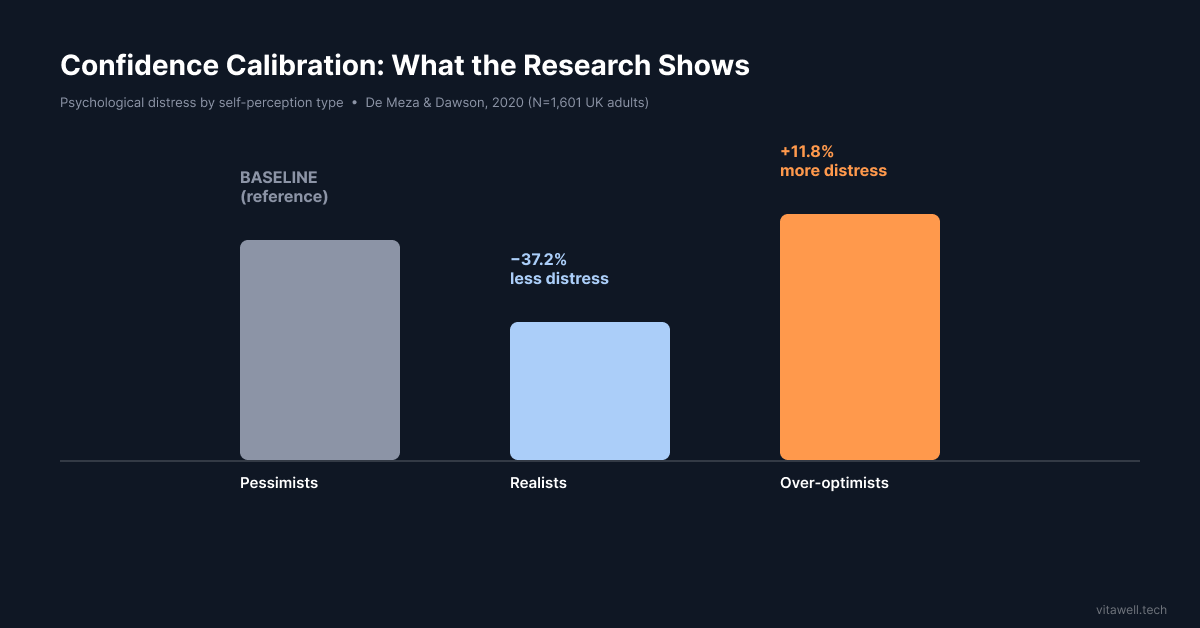
Naturally confident people are not born different — they practice specific, learnable habits that anchor them between under- and over-confidence. Research on over 1,600 adults shows that people whose self-assessments track reality closely (rather than tilting pessimistic or over-optimistic) carry 37.2% less psychological distress and report 21.8% higher life satisfaction than their counterparts (De Meza & Dawson, 2020). The five habits below are those science most reliably links to that calibrated self-assurance — and each one is teachable.
Key Takeaways
- Confidence is calibrated accuracy, not inflated positivity — realistic self-perception outperforms both pessimism and unchecked optimism on distress and life satisfaction.
- Self-efficacy (belief in your ability to do specific tasks in a specific domain) is trainable: a 2026 meta-analysis of 22 trials covering 3,152 participants found coaching interventions produce a medium-to-large effect (SMD = 0.66).
- Setting clear limits prevents confidence from tipping into overextension — a pattern linked to increased psychological strain and reduced long-term performance.
- A short morning anchor routine primes the sense of agency that underlies confident action throughout the day.
- Habit formation takes a median of 66 days, not 21 — having the right timeline expectations prevents premature discouragement.
What Scientists Mean by "Confidence" — And Why Getting It Wrong Derails You
Most self-help writing conflates confidence with positivity, but researchers draw a sharper line. Confidence, in the psychological literature, is not a feeling of certainty — it is the accuracy of your self-assessment relative to your actual capacities. A 2020 longitudinal study by De Meza and Dawson surveying 1,601 UK adults across multiple time points found that people classified as "realistic" (whose confidence tracked their observable performance) reported 37.2% lower psychological distress than pessimists (De Meza & Dawson, 2020). Over-optimists, however, showed 11.8% higher distress than realists, and 13.5% lower life satisfaction. The takeaway is counterintuitive but robust: inflated confidence is not a protective asset.
This is also why high achievers who push past their bandwidth often stumble — not from too little confidence but from miscalibrated confidence. The habit of chasing achievements without updating your self-model is closely tied to the well-documented arrival fallacy, where accomplishing goals leaves people feeling inexplicably flat. The five habits below address the calibration problem directly.
Habit 1 — Calibrate Your Self-Assessment (Not Just Your Goals)
Why Accurate Self-Perception Outperforms Positive Thinking
The De Meza and Dawson 2020 data makes a subtle but important point: the goal is not to become a pessimist, nor to adopt forced positivity. The optimal zone is what researchers call "realistic" — holding an accurate model of your current capabilities while remaining open to updating it as you grow. One useful note: "defensive pessimism" (strategically expecting the worst to manage anxiety before a performance) is not the same as calibrated assessment and was treated as a separate category in the study.
Practically, calibrating your self-assessment means creating feedback loops that give your internal model accurate data. Most people get this backward — they form their self-view from feelings, not from evidence. The fix is to treat your self-assessment like a hypothesis and test it regularly.
The Weekly Calibration Exercise
This three-step practice takes under ten minutes once a week. First, before an important task or decision, write a brief prediction: how well will you perform, and what result do you expect? Second, carry out the task as planned. Third, compare the actual outcome to your prediction and note the gap — not to judge yourself but to update your model. Social Cognitive Career Theory identifies this kind of "mastery experience" feedback loop as one of the primary inputs through which self-efficacy beliefs are updated and refined over time.
Habit 2 — Build Self-Efficacy Through Mastery Experiences
How Self-Efficacy Differs from General Self-Confidence
Psychologist Albert Bandura distinguished self-efficacy — belief in your ability to execute a specific task in a specific domain — from global confidence. Self-efficacy is domain-specific, which means it can be trained surgically, one domain at a time. Bandura identified four sources: mastery experiences (direct performance outcomes), vicarious learning (observing others succeed at similar tasks), social persuasion (credible encouragement), and physiological state (managing anxiety signals during performance). Of these, mastery experiences carry the strongest and most durable updating effect.
A 2026 systematic review and meta-analysis by Yao and colleagues synthesized 22 randomized controlled trials covering 3,152 participants and found that coaching and training interventions targeting self-efficacy produced a standardized mean difference of 0.66 — a medium-to-large effect size in clinical research terms (Yao et al., 2026). That effect held across age groups and professional settings, making this one of the more persuasive recent evidence bases for a trainable confidence variable.
The Three-Step Mastery Loop
The mastery loop is what turns "practice" into something that actually updates your self-model rather than just adding repetitions. Step 1: select a task just above your current comfortable level — close enough to attempt successfully, challenging enough to generate meaningful feedback. Step 2: carry it out and log the specific outcome, noting what you did that worked. Step 3: explicitly state the updated belief: "I now have evidence that I can do [X] at [Y] level." That third step is the one most people skip, and without it the feedback loop closes before it can update your confidence model.
Habit 3 — Set Limits That Protect Your Confidence Zone
When Confidence Tips Into Overextension
Genuine confidence is bounded by realistic self-knowledge. When people consistently commit beyond their actual capacity — accepting too many responsibilities, projecting competence in areas where they haven't built it — the result is overextension, and overextension erodes the calibration that confidence requires. A longitudinal occupational study by Virtanen and colleagues following 2,214 participants from the UK Whitehall II cohort found that chronic overwork was associated with significantly elevated psychological distress over time (Virtanen et al., 2009). Persistent overextension is one of burnout's main entry points, and recovering from it takes considerably longer than avoiding it.
The Confidence Temperature Check
Before agreeing to a new commitment, run three quick questions. Can I deliver this at the level I am implying? Does saying yes here require me to silently sacrifice something else? Am I agreeing because I want to, or to avoid someone else's disappointment? If two or more answers are "no" or genuinely uncertain, that is the signal to renegotiate the scope, timeline, or involvement. Treating limits as a confidence-protection tool rather than a character flaw shifts the frame: declining when you cannot deliver well is the more confident move.
Habit 4 — Anchor Your Day With a Morning Routine That Primes Agency
What a Confidence-First Morning Looks Like
Most people begin their day in reactive mode — phone notifications, news, inbox — before they have established any sense of agency or intent. Research on optimism, positive affect, and proactive behavior suggests that the subjective sense of control established early in a day shapes how subsequent challenges are appraised (Conversano et al., 2010). A confidence-first morning is not about rigid discipline — it is about spending the first few minutes generating evidence of agency before the day's demands begin.
For a detailed evidence-based protocol, VitaWell's guide to morning routines that boost energy and focus walks through the full research.
A 15-Minute Morning Protocol
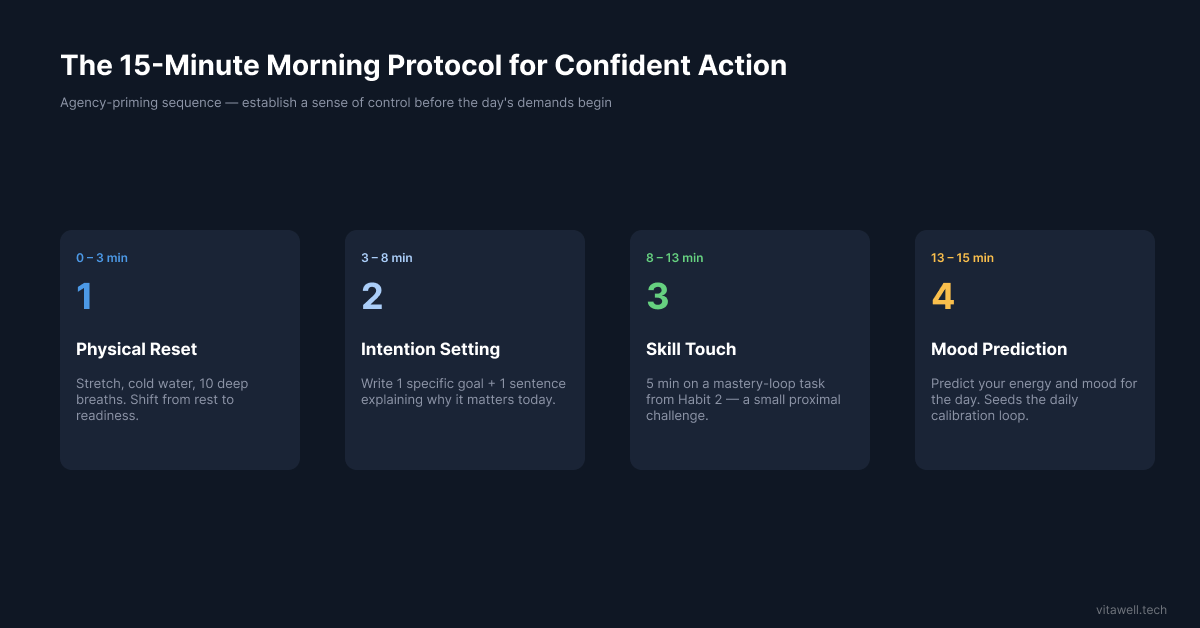
Minutes 0–3: Physical reset. Stretch briefly, splash cold water on your face, take ten slow deep breaths. This signals your nervous system to shift from resting state to alert readiness. Minutes 3–8: Intention-setting. Write one specific thing you will accomplish today and one sentence explaining why it matters. Research on implementation intentions — concrete "when-then" plans — consistently shows they increase follow-through compared to vague goal statements. Minutes 8–13: Skill-touch. Spend five minutes on a mastery-loop task from Habit 2, a small proximal challenge in the domain where you are actively building competence. Minutes 13–15: Predict your mood and energy for the day. This seeds the calibration habit from Habit 1 and closes the morning anchor loop.
Habit 5 — Use Cognitive Reappraisal to Interrupt Confidence Leaks
The Three Most Common Confidence Leaks
Confidence does not erode all at once — it leaks through specific cognitive patterns that go largely unnoticed. The three most common are comparison spirals (upward social comparison that tips from motivating to self-deflating), attribution errors (taking credit for lucky outcomes while internalizing failures as evidence of incompetence), and perfectionism paralysis (refusing to act until certainty is guaranteed). Each is well-documented in the cognitive-behavioral literature and each has a targeted reappraisal response. Cognitive reappraisal means deliberately examining the interpretation of an event and replacing distorted readings with accurate ones — a skill closely related to psychological flexibility over perfectionism.
Evidence-Based Responses to Each Leak
For comparison spirals: when you notice upward comparison triggering self-deflation, ask "is this comparison giving me information I can act on, or is it a verdict I am accepting passively?" Information can be used; verdicts should be examined before they are accepted. For attribution errors: once a week, review three recent wins and three recent setbacks and explicitly assign causes — this trains the balanced attribution style that high-calibration people use naturally. For perfectionism paralysis: before starting any significant task, write a one-sentence definition of "done enough" — a threshold, not a ceiling. Deciding in advance what finished looks like removes the moving goalposts that perfectionism inserts.
5 Confidence-Building Habits at a Glance
| Habit | Core Mechanism | Evidence Type | Expected Timeline | Implementation Friction |
|---|---|---|---|---|
| Calibrate self-assessment | Reduces miscalibration-driven distress | Longitudinal survey, N=1,601 | 2–4 weeks to notice shifts | Low — weekly journaling only |
| Build self-efficacy | Mastery → updated belief → behavior | 22-RCT meta-analysis, N=3,152 | 8–12 weeks to measurable gain | Medium — needs designed challenges |
| Set clear limits | Prevents overextension erosion | Longitudinal occupational cohort, N=2,214 | 2–4 weeks of reduced strain | Medium — requires social friction tolerance |
| Morning anchor routine | Agency priming + mood regulation | Systematic review / multiple RCTs | 3–6 weeks to habituation | Low — time cost only |
| Cognitive reappraisal | Interrupts confidence leak loops | Multiple CBT meta-analyses | 4–8 weeks | Medium — skill to build |
Your 8-Week Confidence-Building Roadmap
Building all five habits simultaneously would itself be a miscalibration error. The roadmap below sequences them so each layer reinforces the next.
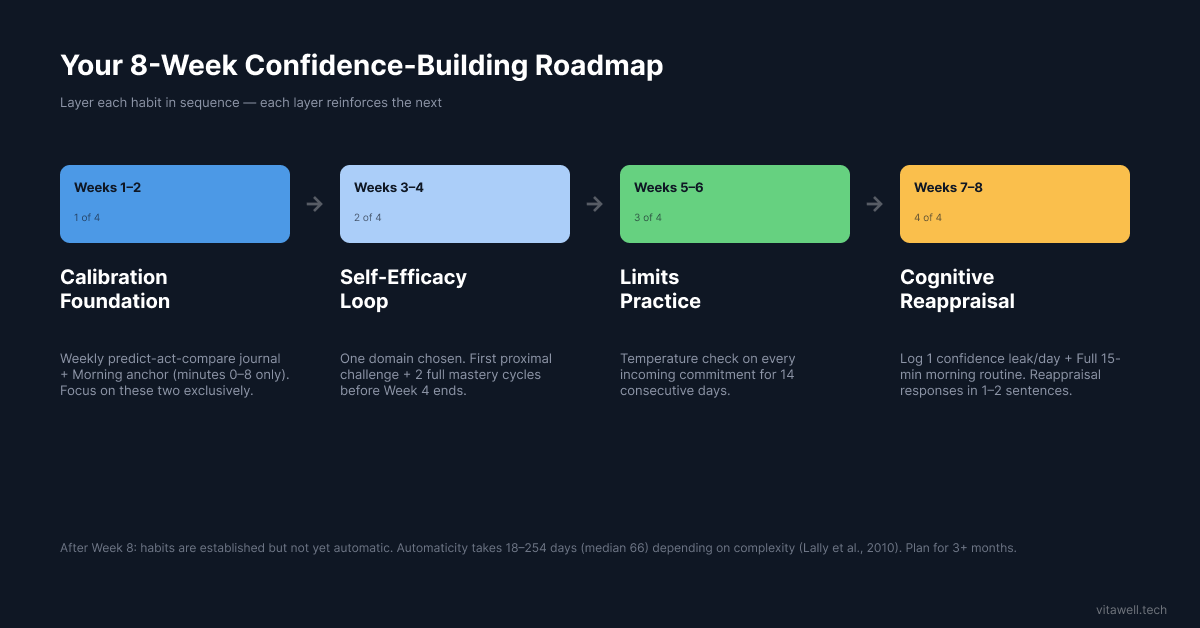
Weeks 1–2: Calibration foundation. Start the weekly predict-act-compare journal and begin the morning anchor (minutes 0–8 only). Focus on these two practices exclusively.
Weeks 3–4: Add the self-efficacy loop. Choose one domain where you want measurable competence growth. Design the first proximal challenge and complete at least two full mastery cycles before the end of Week 4.
Weeks 5–6: Add limits practice. Run the confidence temperature check on every incoming commitment for 14 consecutive days. Notice which question you most frequently answer "no" to — that is the clearest signal about where your limits need attention.
Weeks 7–8: Layer cognitive reappraisal. Log one confidence leak per day and write the reappraisal response in one or two sentences. Expand the morning protocol to the full 15 minutes.
What comes after Week 8? The seeding phase is complete, but automaticity takes longer. Lally and colleagues (2010) followed 96 people learning new behaviors for 12 weeks and found that behavioral automaticity took between 18 and 254 days depending on complexity, with a median of 66 days (Lally et al., 2010) — which means your Week 8 habits are well-established but not yet running on autopilot. As the habit loop James Clear made famous illustrates, consistency during this formation window matters more than intensity. Plan for 3+ months before the system feels fully effortless.
FAQ
Can confidence be learned, or is it genetic?
Confidence has a heritable component, but research consistently shows the larger share — particularly self-efficacy — is built through experience. The 2026 meta-analysis by Yao and colleagues synthesizing 22 RCTs across 3,152 participants found that coaching interventions targeting self-efficacy produced a standardized mean difference of 0.66, indicating meaningful, measurable change is achievable within structured practice.
What is the fastest way to build real confidence?
The evidence points to mastery experiences: completing a task just beyond your previous limit, logging the outcome, and explicitly updating your self-assessment. This produces faster gains than affirmations or visualization because it generates actual evidence your self-model can use. One well-designed proximal challenge per week produces compounding effects within 4–6 weeks.
How do you rebuild confidence after a major failure or setback?
Start with calibration, not motivation. A failure is information: what exactly went wrong, what was within your control, and what wasn't? Running this attribution audit honestly — rather than catastrophizing or dismissing the event — gives your self-model accurate data. From there, re-enter the mastery loop at a level where early wins are achievable, then progressively increase the challenge.
What is the difference between confidence and arrogance?
The clearest functional difference is feedback-responsiveness. Confident people update their self-assessment when outcomes do not match predictions. Arrogant people dismiss disconfirming evidence. The calibration habit this article describes first is precisely the mechanism that keeps confidence honest and prevents it from sliding into arrogance.
How long does it take to build lasting confidence?
Expect 8–12 weeks for measurable gains in a specific domain, 3–6 months for the habits to feel automatic. The popular "21-day rule" is not supported by habit formation research. Lally and colleagues (2010) found that behavioral automaticity developed at 18–254 days depending on the complexity of the behavior, with a median of 66 days (Lally et al., 2010).
Conclusion
Confidence is not a trait you either have or don't — it is a system of habits that keep your self-assessment calibrated, your self-efficacy growing, your limits defended, your mornings anchored, and your cognitive leaks repaired. The science behind each of these habits is robust enough to build on, and the roadmap above sequences them in the order that lets each reinforce the others. Start with calibration. Everything else follows.
Explore more growth tools and science-backed strategies in VitaWell's Growth category.
Related on VitaWell
- When Ambition Becomes Exhausting: 5 Questions High Achievers Should Ask Themselves — Five diagnostic questions for high achievers whose drive is tipping into depletion, the confidence habit system's natural companion check.
- The Hidden Variable in Mental Well-Being: Why How You Relate to Your Thoughts Matters More Than What You Think — The decentering technique described there amplifies cognitive reappraisal (Habit 5) by targeting the meta-relationship to thoughts themselves.
- The Science of Why Midlife Might Be the Best Time of Your Life — What 30 Years of Research Actually Shows — Thirty years of data showing that confidence and personality integration naturally improve with age, the long game on these habits.
Sources
- De Meza & Dawson, 2020 — Psychological Science
- Yao et al., 2026 — Self-efficacy coaching interventions meta-analysis, 22 RCTs
- Virtanen et al., 2009 — Whitehall II occupational cohort, overwork and distress
- Conversano et al., 2010 — Optimism and Its Impact on Mental and Physical Well-Being
- Lally et al., 2010 — How are habits formed: Modelling habit formation in the real world