Science Says Reading Just 30 Minutes a Day Can Lower Your Risk of Death by 20%
A Yale study of 3,635 adults shows book reading for 30 minutes a day reduces mortality risk by 20% and extends life by an average of 23 months.

A 12-year Yale study tracking 3,635 adults found that reading books for roughly 30 minutes a day — about 3.5 hours a week — reduces the risk of dying by 20% compared to non-readers. The survival advantage held after controlling for age, education, income, and existing health conditions. Newspapers and magazines produced no comparable effect. If you read books regularly, you are, on average, expected to live about 23 months longer than someone who does not.
Key Takeaways
- Book readers in a 3,635-person Yale study had a 20% lower risk of death over 12 years, controlling for all major health and lifestyle factors (Bavishi et al., 2016, Social Science & Medicine)
- The benefit grows with reading time: heavy readers (3.5+ hours per week) had a 23% lower mortality risk; light readers saw 17% lower risk
- Frequent reading slows cognitive decline by 32% and can delay the symptoms of Alzheimer's pathology — even after brain plaques have formed (Wilson et al., 2013, Neurology)
- Books outperform newspapers, magazines, and phone scrolling for every measured health outcome
- Reading before bed captures both benefits at once: you gain longevity protection and improved sleep quality in a single habit
The 20% Finding — What the Yale Study Actually Showed
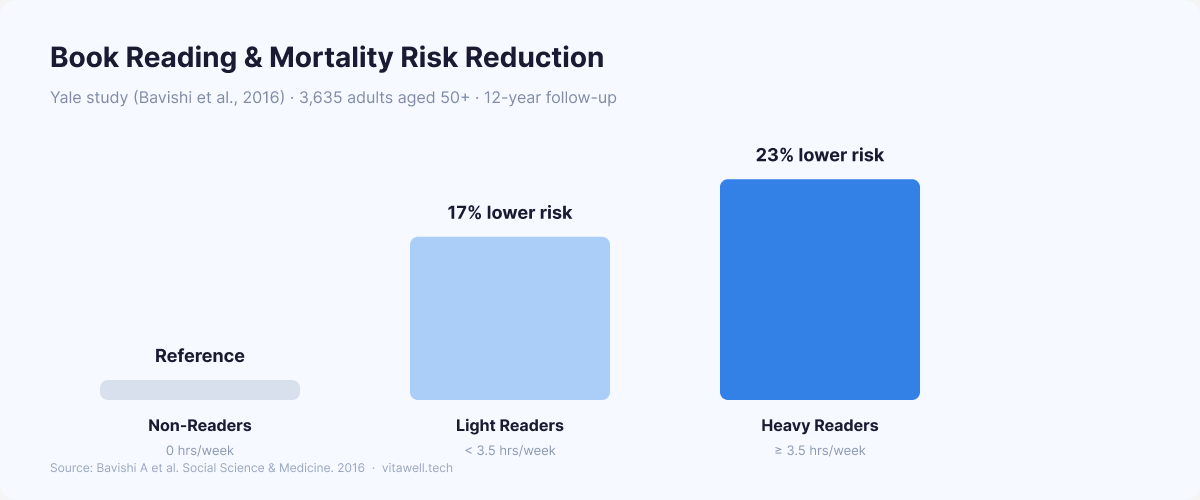
The core research is a 2016 observational study published in Social Science & Medicine by Avni Bavishi, Martin D. Slade, and Becca R. Levy of Yale School of Public Health (Bavishi et al., 2016). It followed 3,635 adults aged 50 and older from the nationally representative Health and Retirement Study over 12 years, measuring how much time participants spent reading books versus newspapers or magazines.
The findings were striking in their precision. Book readers in the highest reading group — those spending more than 3.5 hours per week — had a hazard ratio of 0.77, meaning a 23% lower risk of dying during the study period compared to non-readers. Even lighter readers, those reading less than 3.5 hours weekly, had a hazard ratio of 0.83, translating to a 17% reduction in mortality risk. The relationship was dose-dependent: more reading, more protection.
| Reading Level | Weekly Hours | Mortality Risk Reduction | Hazard Ratio |
|---|---|---|---|
| None | 0 hr | — (reference) | 1.00 |
| Light (< 30 min/day) | < 3.5 hr | 17% lower | 0.83 |
| Heavy (≥ 30 min/day) | ≥ 3.5 hr | 23% lower | 0.77 |
At the point where 80% of the original study group was still alive, book readers had survived an average of 23 months longer than non-readers. The researchers also found that cognition statistically mediated the relationship between book reading and survival (p = 0.04) — meaning that part of how reading keeps you alive is by keeping your mind sharper. This longevity-habit pairing mirrors what researchers have found more broadly about circadian health and longevity.
Why Books and Not Magazines — The Deep-Reading Difference
One of the study's most important and overlooked findings is that newspapers and magazines produced no meaningful survival benefit. The mortality advantage was specific to books. This matters because it rules out the idea that any kind of reading or intellectual engagement is equally protective. Something about books, specifically, is driving the effect.
The likely explanation is what researchers call "deep reading" or narrative transport — the sustained, immersive engagement a book demands. Reading a novel or a nonfiction book requires you to track characters, follow arguments, integrate new information with what came before, and maintain focus over hours or days. Skimming a news article or scrolling a feed engages a fundamentally different neural mode: reactive, fragmentary, and low in cognitive demand.
Brain imaging research suggests that sustained narrative engagement activates language processing regions and areas associated with physical sensation and emotion simultaneously, with effects that persist for days after reading. This is not what happens when you scan headlines. The depth of engagement is the mechanism — which is why the study found books outperform other reading formats, and why the longevity effect does not extend to shorter, more passive reading.
What Reading Does to Your Brain Over Time — The Cognitive Reserve Hypothesis
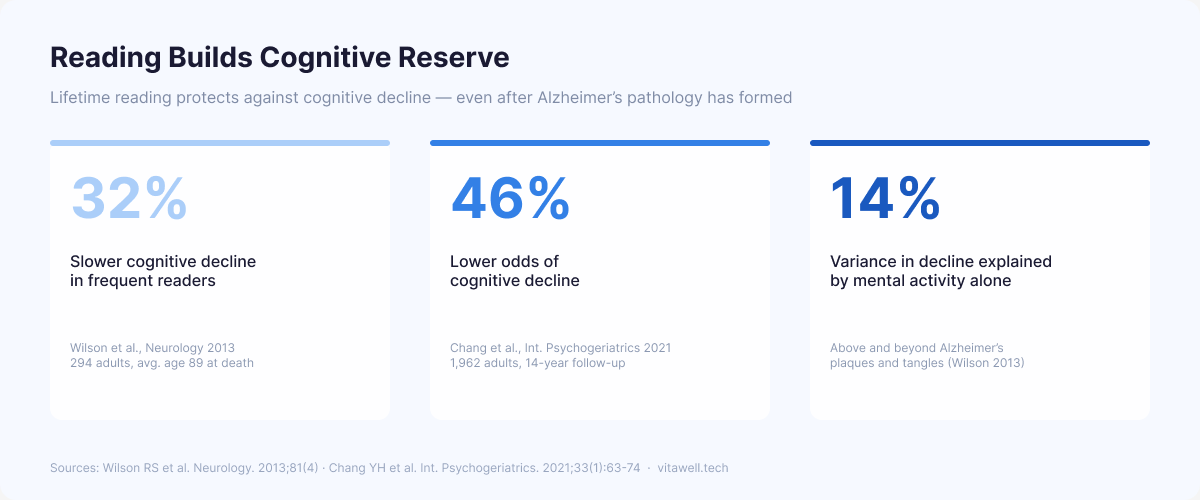
The most compelling biological explanation for why reading extends life comes from cognitive neuroscience. A landmark 2013 study published in Neurology by Robert S. Wilson and colleagues at Rush University Medical Center followed 294 elderly adults — average age at death, 89 — through annual cognitive testing in their final years, then examined their brains at autopsy (Wilson et al., 2013, Neurology).
The results showed that participants who reported frequent reading and writing throughout their lives experienced a 32% slower rate of cognitive decline compared to the average. Those who rarely engaged in mental activity declined 48% faster than average. Crucially, mental activity — including reading — accounted for 14% of the variance in cognitive decline above and beyond what could be explained by Alzheimer's plaques, tangles, and other neuropathology in the brain. Even participants with significant Alzheimer's pathology showed slower symptom onset if they had a history of reading.
This is the cognitive reserve hypothesis: reading over a lifetime builds redundant neural connections. When Alzheimer's pathology inevitably forms, the brain can recruit alternative pathways for the same cognitive tasks. The symptoms appear later, or more slowly, because the brain has more resources to draw on. Reading, in effect, buys your brain time. This is part of a broader toolkit for protecting cognitive health — WHO guidelines show up to 45% of dementia cases may be preventable — and builds the same mental agility that science-backed techniques show can accelerate learning.
A separate 14-year longitudinal study of 1,962 adults aged 60 and older in Taiwan, published in International Psychogeriatrics by Chang, Wu, and Hsiung in 2021, found that higher reading frequency was associated with roughly 46% lower odds of cognitive decline at both the 6-year, 10-year, and 14-year follow-up points (Chang et al., 2021, International Psychogeriatrics). The benefits held across all education levels, with the least-educated participants showing some of the strongest long-term protection.
Books vs. Your Phone — A Head-to-Head
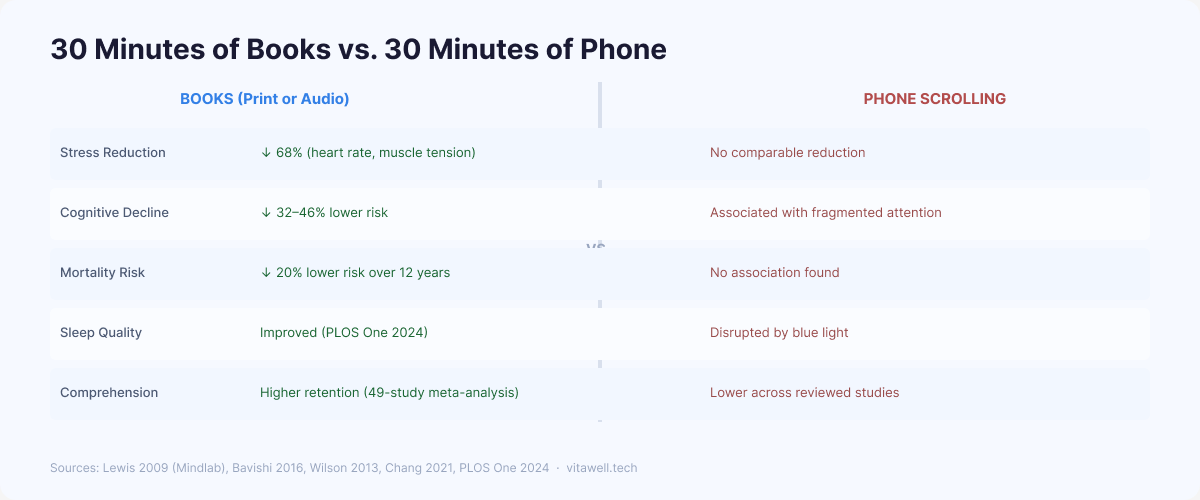
The case for books becomes even clearer when you compare them directly with the main thing most people reach for instead.
A 2009 study conducted by Dr. David Lewis at Mindlab International found that just 6 minutes of reading reduced measurable stress markers — heart rate, muscle tension — by up to 68%, outperforming music (61%), tea (54%), walking (42%), and video games (21%). It is worth noting that this study was commercially commissioned rather than independently funded, so the specific figures should be treated with appropriate caution. But the directional finding — reading is profoundly calming — is consistent with broader research on immersive, absorbing activity.
What is backed by independent meta-analysis: a 2024 review of 49 studies found that print reading produces significantly better comprehension and information retention than digital screen reading, a phenomenon researchers call the "screen inferiority effect." And a 2024 study published in PLOS One found that print reading and audiobooks reduced anxiety and depression and improved sleep quality, while electronic reading showed weaker or no effect. This research changes how we think about where reading happens — not just whether it does, much like the research showing that social relationships literally shape our health.
| Outcome | 30 Min of Books (Print or Audio) | 30 Min of Phone Scrolling |
|---|---|---|
| Stress reduction | Up to 68% reduction (Lewis, 2009) | No comparable reduction documented |
| Cognitive decline protection | 32–46% lower risk (Wilson 2013; Chang 2021) | Associated with fragmented attention |
| Mortality benefit | 20% lower risk (Bavishi 2016) | No association found |
| Sleep quality | Improved with print/audio (PLOS One 2024) | Disrupted by blue light and stimulation |
| Comprehension retention | Consistently higher (2024 meta-analysis, 49 studies) | Lower across reviewed studies |
2024 Research: What the Newest Studies Add
The longevity evidence is now reinforced by a newer wave of research focused on younger populations and digital-era comparisons.
A 2024 study published in Psychological Medicine by researchers at Cambridge University — led by Barbara Sahakian — analyzed data from more than 10,000 teenagers and found that early pleasure reading was linked to better attention, better memory, stronger academic performance, fewer mental health problems, and greater brain surface area and volume in regions associated with higher cognitive function. The benefits appeared to be cumulative: adolescents who read regularly showed measurable structural brain differences compared to peers who did not. The implication is that cognitive reserve begins building early, and reading is one of the most effective ways to build it.
A 2025 study in Frontiers in Psychology found that paper and audiobook reading reduced anxiety and depression in college students, while electronic reading showed a significantly smaller effect. The convergence of findings across age groups — from teenagers to adults aged 50+ in the Yale cohort — makes the case for reading as a lifespan habit, not just a later-life intervention.
How to Build a 30-Minute Reading Habit — A 6-Step Plan
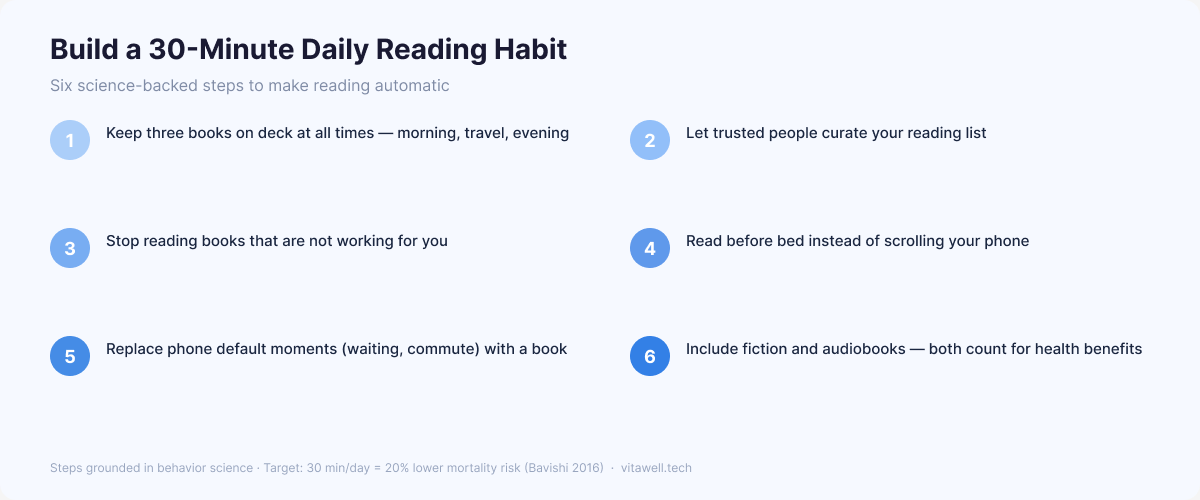
Knowing that 30 minutes a day changes your odds is one thing. The harder question is how to actually do it. These six steps, grounded in behavior science, make the habit automatic rather than aspirational.
- Keep three books on deck at all times. Have one for mornings, one for travel, one for evenings — in different genres to match your mood. Decision fatigue is the main reason reading habits fail.
- Let trusted people curate your list. A recommended-books feed from one person whose taste you trust removes the friction of choosing. You are more likely to start and finish a book you are genuinely curious about.
- Stop reading books that are not working. The sunk-cost fallacy keeps many people stuck in books they dislike. Quitting a bad book immediately frees that time for one you will finish.
- Read before bed instead of scrolling. This is the highest-leverage swap you can make. Research shows print reading improves sleep quality, while phone screens disrupt it. You capture the longevity benefit and the sleep benefit in the same habit — including the brain-recovery processes that happen while you dream.
- Replace phone default moments with a book. Waiting room, bus, lunch alone — these are phone moments by default. A physical book or an e-reader loaded with your current title converts dead time into reading time without requiring willpower.
- Include fiction and audiobooks. The curiosity and narrative engagement from a novel, a biography, or even a thriller counts. Audiobooks are physiologically equivalent to reading for most health outcomes. There is no requirement that every book build a professional skill.
When to Talk to a Professional
Reading is a powerful habit, but it is not a clinical intervention. If you are noticing memory problems, difficulty concentrating, or significant mood changes, these warrant evaluation by a healthcare provider. The evidence on cognitive reserve means that reading alongside medical treatment may help — not instead of it. Similarly, if anxiety or sleep issues are significantly affecting your life, a mental health professional can offer support that goes beyond any single habit.
Frequently Asked Questions
How much should I read a day to get health benefits?
The Yale study found the threshold for maximum benefit was about 3.5 hours per week — roughly 30 minutes a day. Even lighter reading (less than 3.5 hours per week) reduced mortality risk by 17%. Any amount appears better than none, but 30 minutes daily is the target backed by survival data.
Do newspapers or magazines give the same longevity benefit as books?
No. The Bavishi 2016 study specifically found that the survival advantage applied to book reading and not to newspapers or magazines. The depth of engagement required by books — narrative tracking, sustained attention, comprehension over time — appears to be what drives the effect.
Can audiobooks count the same as reading?
For anxiety, depression, and sleep, yes: a 2024 PLOS One study found audiobooks as effective as print for these outcomes. The brain processes audio and printed narratives through overlapping neural systems, according to Journal of Neuroscience research. For cognitive decline and mortality specifically, the evidence is from print reading studies, so we cannot say definitively — but audiobooks are a reasonable and research-consistent substitute.
Can reading prevent Alzheimer's disease?
Observational evidence is consistent and strong: a JAMA study of 801 adults aged 65 and older found 33% lower Alzheimer's risk in frequent readers. The cognitive reserve hypothesis explains the mechanism. But observational studies cannot prove causation, and no reading habit replaces medical care. It is accurate to say reading is one of the most evidence-backed protective habits available.
Is reading before bed a good idea or will it keep me awake?
Print reading before bed improves sleep quality, according to 2024 PLOS One data. This is the opposite of phone use, which disrupts sleep via blue light and stimulation. High-adrenaline thrillers may keep some readers too alert, so genre matters if you are sensitive. As a default, 20–30 minutes of print or audiobook reading is one of the best sleep hygiene habits available.
Conclusion
The numbers are specific enough to act on: 30 minutes, 20% lower mortality risk, 23 extra months. The mechanism is not mystical — reading builds cognitive reserve, reduces stress, and keeps the brain engaged in sustained, demanding ways that passive consumption simply does not replicate. And the best time to do it costs nothing you would not otherwise spend staring at a phone: before bed.
If you want to build more evidence-based habits into your day, the VitaWell Growth area covers what the research says about how people actually change — and what sticks.
Related on VitaWell
- The Science of Why Midlife Might Be the Best Time of Your Life — Research on aging shows cognitive potential and wellbeing often peak in your 40s and 50s, making now the best time to invest in brain-protective habits like reading.
- Get Things Done: Simple Habits to Stay Focused and Productive Every Day — Reading builds the sustained attention that productivity depends on; this post covers the companion habits that keep focus sharp.
- How AI Is Affecting Your Brain Differently Than Your Child's — With digital tools replacing deep reading, understanding the cognitive stakes matters more than ever.
This article is for informational purposes only and does not constitute medical advice. Consult a qualified healthcare professional with any questions about your health.
Sources
- Inc.com — Jeff Haden, Nov 6, 2026
- Bavishi A, Slade MD, Levy BR. A chapter a day: Association of book reading with longevity. Social Science & Medicine. 2016;164:44-48
- Wilson RS et al. Life-span Cognitive Activity, Neuropathologic Burden, and Cognitive Aging. Neurology. 2013;81(4)
- Chang YH, Wu IC, Hsiung CA. Reading activity prevents long-term decline in cognitive function in older people. International Psychogeriatrics. 2021;33(1):63-74
- Kashdan TB, Steger MF. Curiosity and pathways to well-being. Motivation and Emotion. 2007;31(3):159-173