The Three Elements of Meaning That Science Says Are Essential for True Happiness
Science has identified three distinct components of meaning — coherence, purpose, and significance — and each one protects your health in a different way.
Meaning in life isn't a single feeling—it's built from three distinct elements: coherence (understanding why things happen to you), purpose (having goals that drive you forward), and significance (feeling that your existence matters to others). A growing body of research shows that all three are required for sustained well-being, and that they build on one another in a specific sequence: coherence first, then purpose, then significance.
Key Takeaways
- Meaning has three scientifically validated components: coherence, purpose, and significance
- Having a high sense of meaning is linked to 13% lower all-cause mortality (UK Biobank, N=153,505)
- Purpose alone halved 8-year mortality risk among adults over 50 (36.5% vs. 15.2%)
- Coherence is the prerequisite: a 2026 longitudinal study confirmed it must develop before purpose and significance can fully form
- 1 in 3 Gen Z adults currently reports lacking a sense of meaning, according to Gallup (2026)
Why Meaning Is Not the Same as Happiness
Most people use "meaning" and "happiness" interchangeably, but psychologists treat them as separate dimensions of well-being—each measurable, each with its own predictors.
Where Meaning Fits in the Science of Well-Being
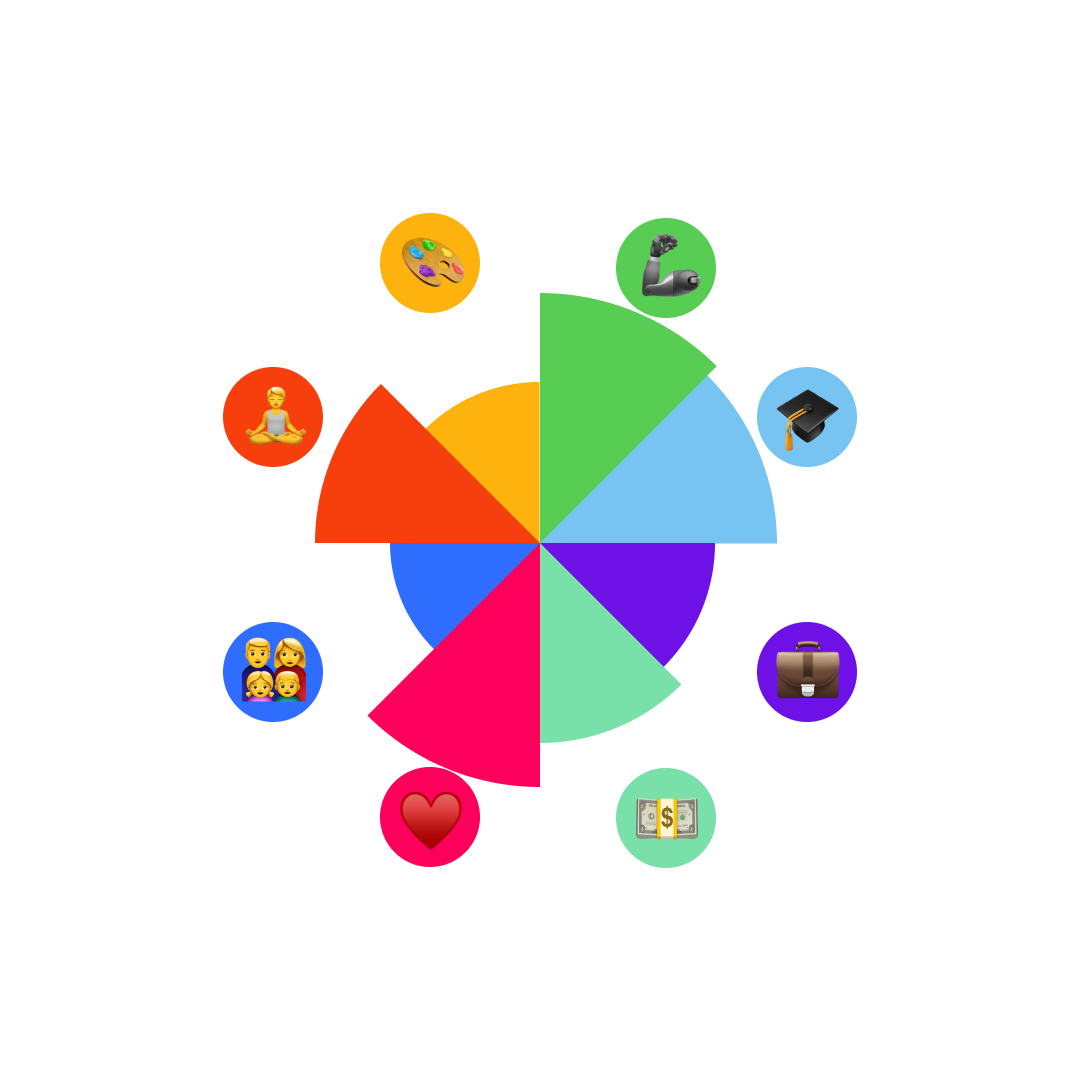
Martin Seligman's PERMA-V model identifies six pillars of flourishing: Positive Emotion, Engagement, Relationships, Meaning, Accomplishment, and Vitality. Meaning occupies its own pillar—separate from positive emotion—because you can experience deep meaning without feeling happy in the moment, and you can feel happy without sensing that your life adds up to something. Victor Frankl observed this dynamic among concentration camp survivors: those who maintained a sense of meaning endured suffering that those without it could not.
What Happens When You Have One but Not the Other
Positive emotion without meaning tends to be transient—it lifts mood but doesn't buffer against existential anxiety or health threats. Meaning without positive emotion is associated with what researchers call a "bittersweet" quality: life feels significant, even if difficult. King & Hicks (Annual Review of Psychology, 2021, 72:561–584) characterize meaning as a cognitive-motivational construct that organizes experience and provides direction, while happiness is primarily an affective state. The practical implication: optimizing only for good feelings leaves the deeper architecture of well-being unaddressed.
The Three Elements — What Research Says Each One Does
The framework that has gained the most empirical support breaks meaning into three components, each with distinct psychological functions and distinct effects on physical health.
Coherence — Making Sense of Your World
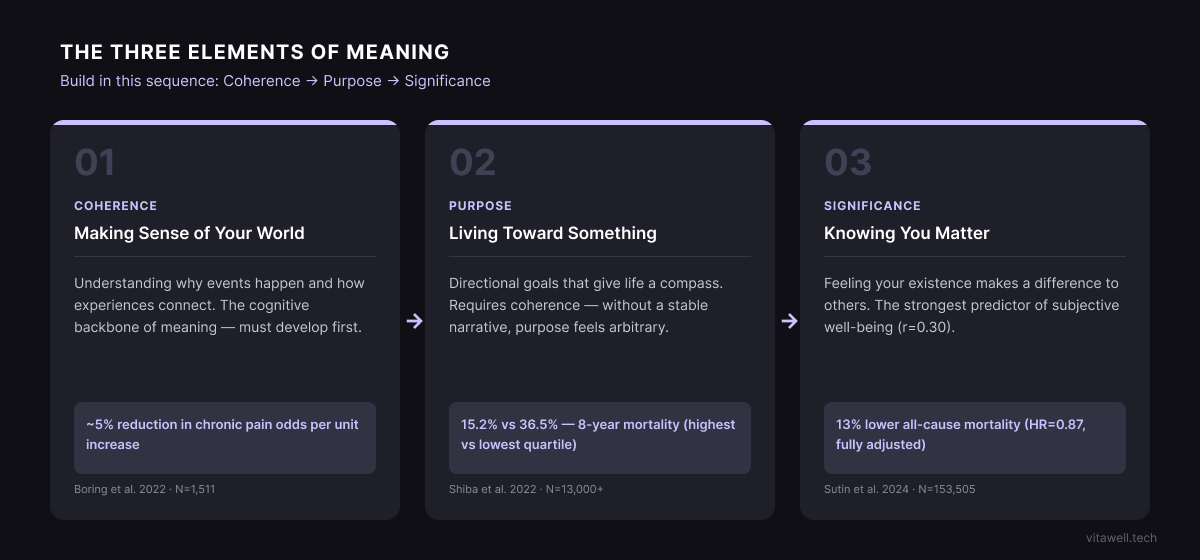
Coherence is the sense that your experiences follow a comprehensible pattern—that life is ordered, predictable enough to navigate, and that the events you live through fit into a larger narrative you can understand. It is the cognitive backbone of meaning.
A study of 519 adults by Boring et al. (Journal of Pain Research, 2022, PMC8820455) found that coherence correlated at r=−0.253 with pain severity. In a larger sample from the MIDUS dataset (N=1,511), those with higher coherence had an odds ratio of 0.948 for chronic pain—meaning each unit increase in coherence reduced chronic pain odds by roughly 5%. These are meaningful, dose-response relationships, not incidental associations.
Coherence also predicts resilience after setbacks: when people can make sense of what happened, they recover faster from loss, illness, and failure. Building coherence doesn't require that life be fair—only that you have a framework for interpreting what happens to you. Daily habits that guard against burnout work partly through coherence: regular routines create predictability that makes life feel more legible.
Purpose — Living Toward Something
Purpose is the motivational dimension of meaning: the sense that you are oriented toward goals that matter. Unlike a simple to-do list, purpose is directional—it gives you a reason to get up, a compass for decision-making, and a sense that your efforts accumulate into something worth having.
The mortality data here is striking. Shiba et al. (Preventive Medicine, 2022) followed more than 13,000 US adults aged 50 and older for eight years. Among those in the highest-purpose quartile, the 8-year mortality rate was 15.2%. Among those in the lowest quartile, it was 36.5%—more than double. After adjusting for health behaviors, socioeconomic status, and baseline health, purpose remained a significant independent predictor of survival.
Purpose also interacts with the science-backed habits of naturally confident people: confidence grows when your actions consistently align with what you say matters to you, creating a feedback loop between purpose and self-efficacy.
Significance — Knowing You Matter to Someone
Significance is the relational dimension of meaning: the felt sense that your existence makes a difference to at least one other person, community, or cause. It answers the question: "Would anything be missing from the world if I weren't here?"
The health effects are the most dramatic of the three elements. Sutin et al. (Journal of Psychosomatic Research, 2024) analyzed 153,505 adults in the UK Biobank over a 7-year follow-up. High meaning in life was associated with a hazard ratio of 0.87 for all-cause mortality—a 13% reduction—with a fully adjusted HR of 0.91. Broken down by cause of death, the reductions were: external causes −47%, respiratory disease −41%, nervous system disorders −32%, COVID-19 −28%, and cancer −8%.
The cancer finding, often considered difficult to shift with psychological interventions, is particularly striking. It suggests significance—and meaning more broadly—may operate through biological pathways including immune function, inflammatory regulation, and health behavior maintenance. Activities that tie you to larger social contexts, such as reading regularly, which is linked to lower mortality risk, work partly through this same mechanism.
The Order Matters — How the Three Elements Build on Each Other
For decades, researchers assumed the three components of meaning operated independently or in parallel. A 2026 longitudinal study challenged that assumption.
Chen, Wu & Yu (Journal of Happiness Studies, 2026, 27(7)) tracked 277 adults over 12 weeks, measuring all three meaning components and subjective well-being (SWB) at monthly intervals. They found that coherence predicted both purpose and significance at the next time point, while significance (not purpose) most strongly predicted SWB at the end of the 12 weeks. Significance correlated with SWB at r=0.30; coherence at r=0.29; purpose was an intermediary.
The practical translation: if you are low on meaning, the entry point is coherence, not purpose. Many self-help frameworks encourage people to "find your purpose" before they have made sense of their lives—which may be why this advice so often fails. Without a coherent narrative, purpose feels arbitrary, and significance feels impossible to achieve. The sequence is: first understand your story (coherence), then identify where you are going (purpose), then feel that your journey matters to others (significance).
How Each Element Affects Your Health Differently
Not all three elements produce the same health benefits. The evidence points to distinct mechanisms and magnitudes.
| Element | Primary Health Benefit | Key Study | Effect Size |
|---|---|---|---|
| Coherence | Reduced chronic pain | Boring et al. 2022, N=519+1,511 | r=−0.253; OR=0.948 |
| Purpose | Lower 8-year mortality | Shiba et al. 2022, N>13,000 | 15.2% vs. 36.5% |
| Significance | Lower all-cause mortality (13 causes) | Sutin et al. 2024, N=153,505 | HR=0.87 |
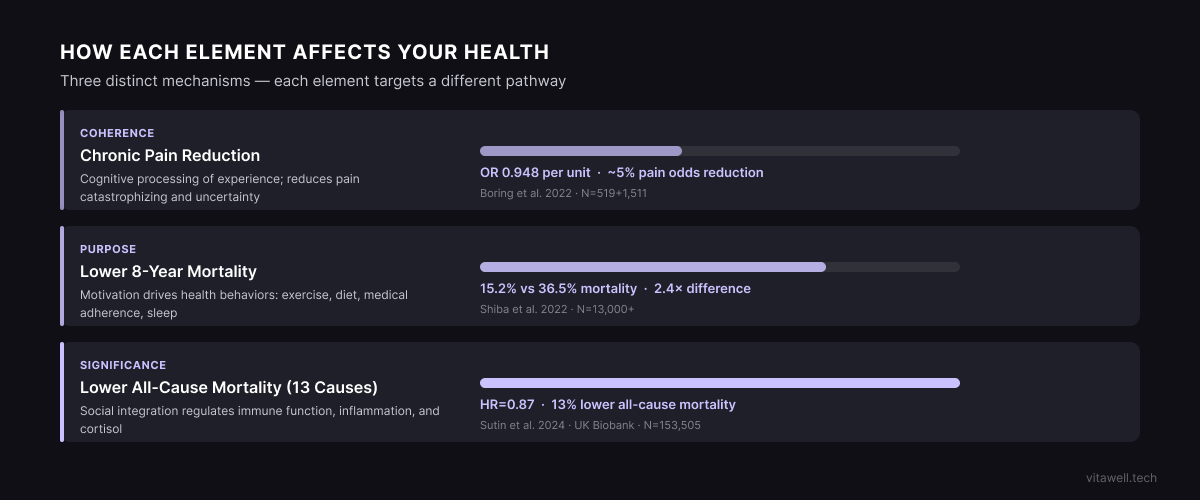
This table should not be read as a ranking. Chronic pain affects quality of life as profoundly as mortality risk for many people, and the pain findings from Boring et al. are among the most replicable in the meaning literature. The point is that interventions can be tailored: someone whose primary struggle is chronic pain may benefit most from coherence work; someone concerned with longevity and cardiovascular health may benefit most from building significance.
The Meaning Diagnostic — Which Element Are You Missing?
Michael Steger's Meaning in Life Questionnaire (MLQ), validated across cultures in 2006, is the gold-standard research measure. For everyday self-assessment, three diagnostic questions—one per element—can help you identify where your meaning architecture is weakest.
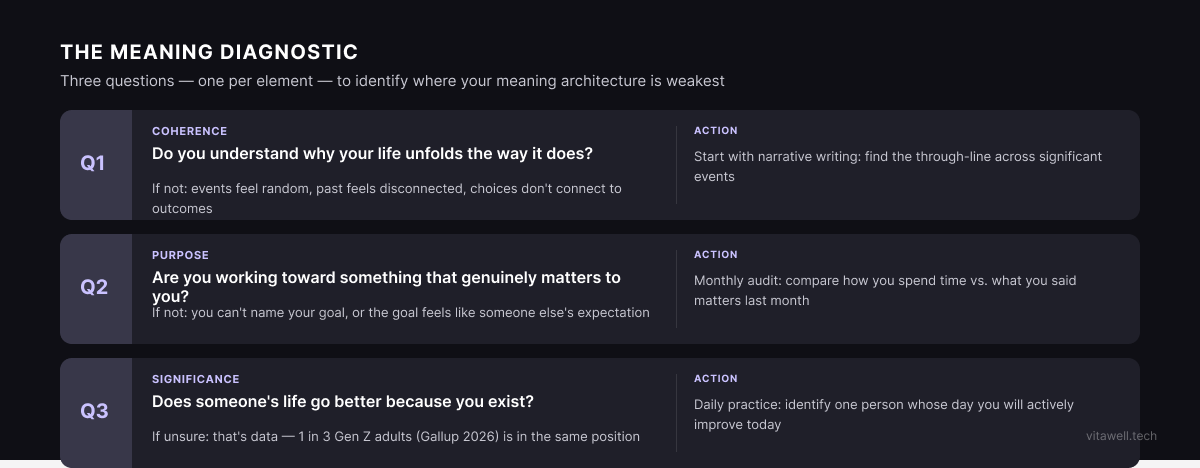
Question 1 — Do You Understand Why Your Life Unfolds the Way It Does? (Coherence)
If the honest answer is "not really"—if events feel random, your past feels like a jumble of disconnected episodes, or you struggle to see how your choices connect to outcomes—coherence is your weakest link. Work here looks like narrative therapy techniques: writing about significant events to find the through-line, or working with a therapist trained in story-based approaches to trauma and identity.
Question 2 — Are You Working Toward Something That Matters to You? (Purpose)
If you can't name what you're working toward, or if your named goal feels like someone else's expectation, purpose needs attention. Arthur Brooks, in The Meaning of Your Life (Portfolio/Penguin, 2026), argues that purpose must be freely chosen and other-directed—it can't be purely self-interested and still function as a meaning anchor. The monthly goal-review practice described below is a minimal starting intervention.
Question 3 — Does Someone's Life Go Better Because You Exist? (Significance)
If you're unsure, that's data. Gallup (2026) reports that 1 in 3 adults aged 18–29 currently lacks a sense of meaning—a figure that maps closely onto studies showing declining social connection in this age group. The antidote is not grand gestures but reliable micro-contributions: the person who always has a good conversation with you, the colleague whose work improves when you give feedback, the friend who calls you first because you listen well.
One Practical Protocol for Each Element
The following weekly protocol is designed to address all three elements without requiring major life restructuring.
Coherence Protocol (weekly, 20 minutes): Each Sunday evening, write three events from the past week—one you chose, one that happened to you, one involving another person. Ask: what do these have in common? What do they say about who you are and what you value? Over 4–8 weeks, patterns emerge that constitute your personal narrative.
Purpose Protocol (monthly, 30 minutes): On the first of each month, list your three most time-intensive activities from the past month. Ask: do these advance what I said matters to me last month? If not, identify one specific change to make in the coming month—not a wholesale life overhaul, one reallocation.
Significance Protocol (daily, 5 minutes): Each morning, identify one person whose day you will actively improve today. Each evening, record whether you did it and what the outcome was. This creates a habit of contributory attention—shifting the question from "how am I feeling?" to "what difference am I making?"
The 1 in 3 Problem — Why Meaning Is Declining
Gallup (2026) finds that one in three adults aged 18–29 lacks a felt sense of meaning—a figure substantially lower in earlier decades. The shift tracks several structural changes: longer periods of institutional dependence, delayed relationship formation, and an attention economy designed to maximize engagement rather than significance.
Arthur Brooks, in The Meaning of Your Life (2026), argues that modernity has made it easy to substitute stimulation for meaning—to feel busy without feeling purposeful, to have an audience without feeling like you matter. The three-element framework offers a diagnostic tool for distinguishing genuine meaning from its substitutes: stimulation without coherence, activity without purpose, followers without significance.
When to Talk to a Professional
If the absence of meaning is accompanied by persistent low mood, social withdrawal, difficulty finding motivation, or feelings of worthlessness, these may indicate depression or another condition requiring clinical attention—not simply a philosophical problem to reason your way through. Therapists trained in Acceptance and Commitment Therapy (ACT) or logotherapy (the approach Viktor Frankl developed) specialize in meaning-related distress and have a strong evidence base for this work. If you're unsure where to start, your primary care provider can provide a referral.
FAQ — What People Ask About Meaning
What are the three elements of meaning in life? The three scientifically validated elements are coherence (understanding why things happen and how your experiences fit together), purpose (having goals that give you direction), and significance (feeling that your existence matters to others). Research suggests they develop in sequence: coherence first creates the foundation for purpose, which then enables a felt sense of significance.
Can you have meaning without happiness? Yes. Research consistently shows that meaning and happiness are distinct dimensions of well-being. People can report high meaning in life while also experiencing grief, difficulty, or emotional pain. Viktor Frankl observed this in extreme conditions—meaning sustained people through suffering that happiness alone could not. Conversely, high happiness without meaning is associated with more shallow, transient well-being.
How do I find my purpose in life? Purpose is less about discovering a hidden identity and more about choosing and committing to goals that matter to you and benefit others. A practical starting point is a monthly audit: compare how you spend your time against what you say matters to you. The gap between those two lists is usually where purpose work begins.
What is the difference between meaning and happiness? Happiness is primarily an affective state—how much positive feeling you experience relative to negative feeling. Meaning is a cognitive-motivational construct—your sense that life is comprehensible, directed, and significant. Happiness tends to correlate with present-moment pleasant experiences; meaning correlates with long-term commitments, challenges, and relationships.
Why do people feel like their life lacks meaning? Common causes include insufficient coherence (life feels random or disconnected), absent purpose (no compelling goals), and low significance (feeling replaceable or invisible). Structural factors also play a role: declining community participation, weaker civic institutions, and digital communication that substitutes reach for depth. Gallup (2026) finds 1 in 3 Gen Z adults lacking meaning—a generation navigating these conditions without established frameworks for addressing them.
Conclusion
Meaning is not a luxury—it's a health asset with mortality data behind it. The science now confirms that the question is not whether meaning matters for well-being, but which element you need to work on first. Start with coherence: build the narrative that makes your life legible to you. From there, purpose becomes achievable. From purpose, significance follows naturally.
VitaWell covers all eight life areas that research links to long-term flourishing. If you found this useful, explore our full section on Meaning—or start with the practical frameworks in adjacent areas that often intersect with meaning: relationships, growth, and community.
Related on VitaWell
- 5 Science-Backed Habits of Naturally Confident People — Confidence and purpose reinforce each other: purpose gives direction, confidence sustains the commitment to follow it.
- Daily Book Reading and Lower Mortality Risk — Reading connects you to ideas and characters beyond yourself—a proven route to the felt significance that sustains well-being.
- 3 Science-Backed Daily Habits That Protect You from Burnout — Coherence—the sense that life is ordered and navigable—is built through consistent daily structure, the same structure that guards against burnout.
This article provides general educational information about the psychology of meaning and well-being. It is not intended as medical or psychological advice. If you are experiencing distress related to a loss of meaning or persistent low mood, please consult a qualified mental health professional.
Sources
- Hartmann PM (2026). Happiness and the Role of Meaning in Your Life. Psychology Today.
- Sutin et al. (2024). Meaning in life and all-cause and cause-specific mortality in the UK Biobank. Journal of Psychosomatic Research.
- Shiba et al. (2022). Purpose in life and 8-year mortality in older US adults. Preventive Medicine.
- Chen, Wu & Yu (2026). Temporal sequence of meaning elements and subjective well-being. Journal of Happiness Studies, 27(7).
- Boring et al. (2022). Coherence and chronic pain. Journal of Pain Research.
- King & Hicks (2021). The science of meaning in life. Annual Review of Psychology, 72:561–584.
- Steger et al. (2006). The Meaning in Life Questionnaire (MLQ). Journal of Counseling Psychology.