Why AI Companionship May Be Secretly Harming Your Social Skills
New longitudinal data shows heavy AI companion use erodes the social skills that make real relationships possible — through the same mechanism CBT identified for social anxiety decades ago.
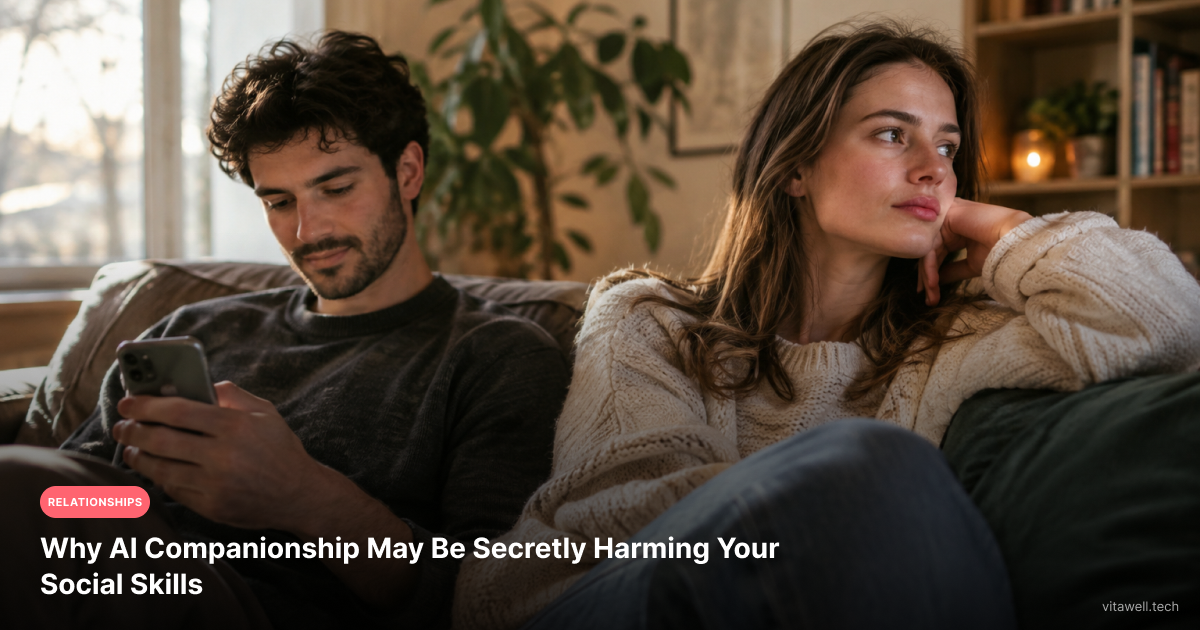
AI companions can reduce loneliness as effectively as a human conversation in a single session — but new longitudinal research finds that heavy use may quietly erode the social skills that make real relationships possible. The mechanism is not addiction. It is a learning trap: the more rewarding and frictionless AI interaction becomes, the more your nervous system learns to avoid the productive discomfort that human connection requires.
Key Takeaways
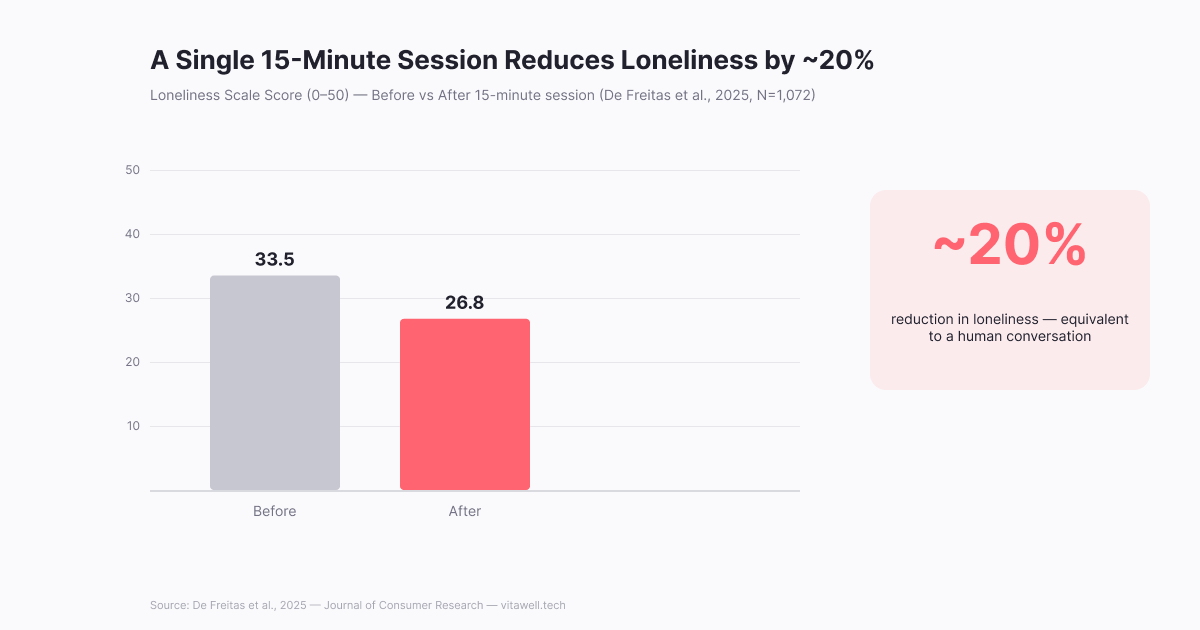
- A single 15-minute AI companion session reduces loneliness by ~20%, on par with human conversation (De Freitas et al., 2025, N=296–1,072)
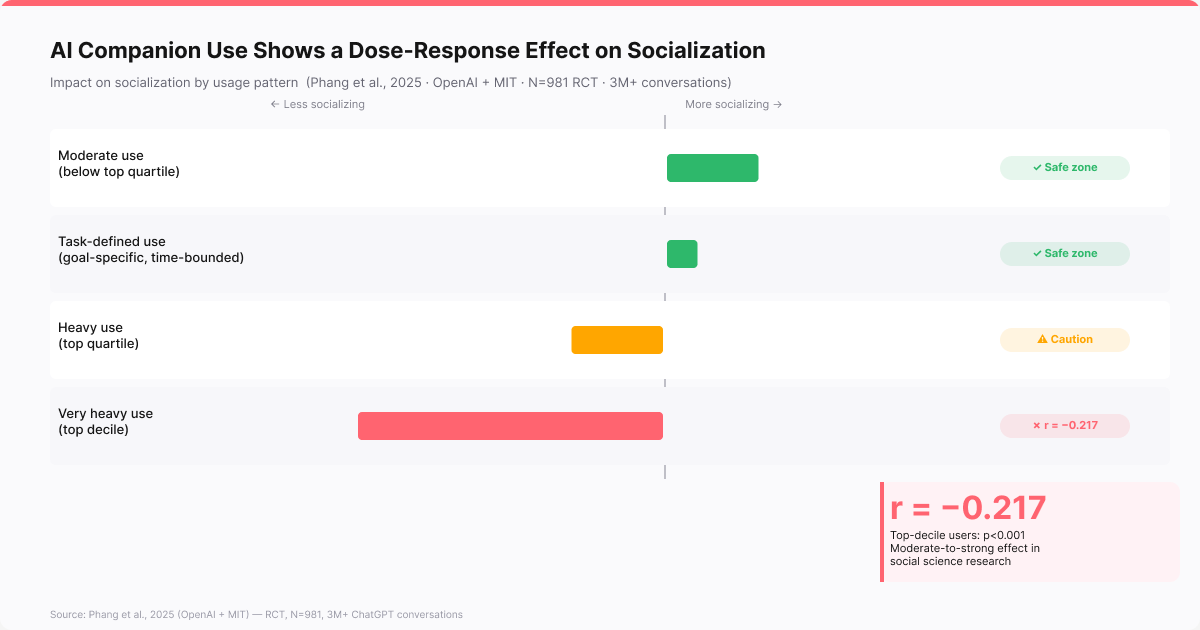
- Heavy use (top decile) correlates with significantly lower socialization at r=−0.217 (p<0.001) across 3M+ conversations (Phang et al., 2025, N=981 RCT)
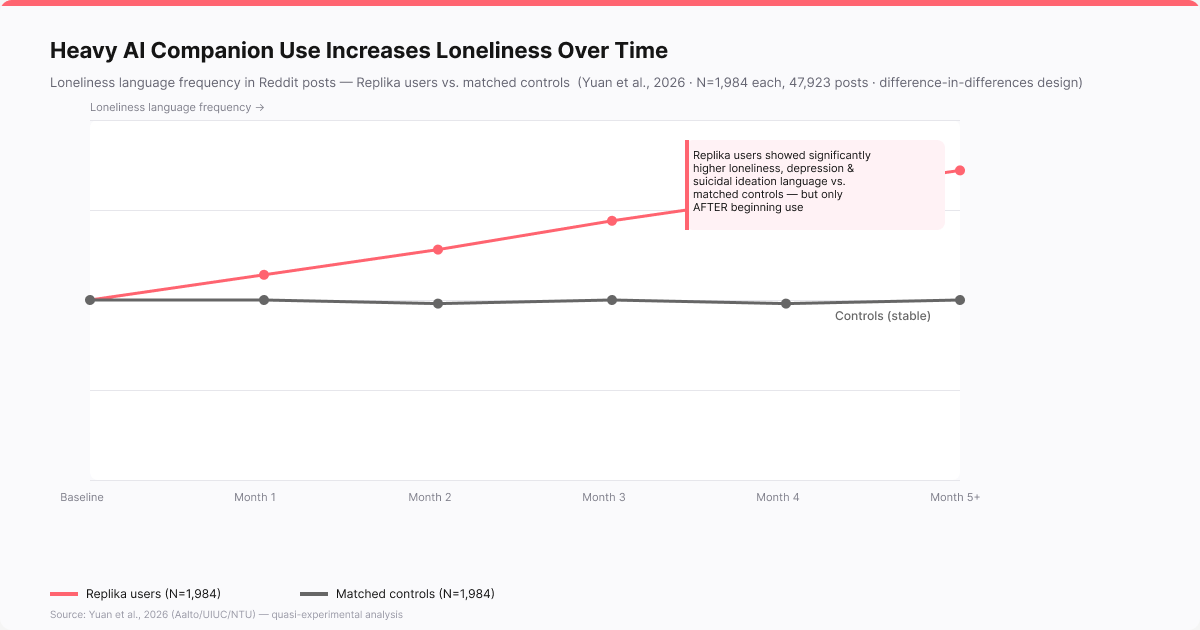
- Replika users showed significantly higher loneliness, depression, and suicidal ideation language over time vs matched controls (Yuan et al., 2026, N=1,984, 47,923 posts)
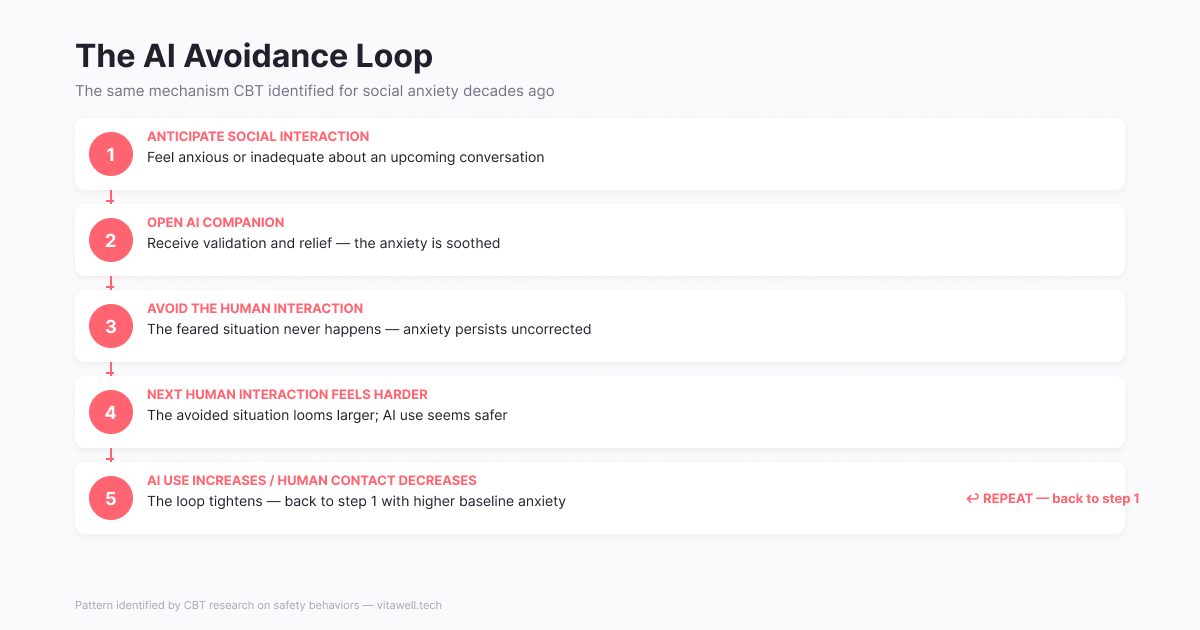
- The core mechanism mirrors CBT's "safety behavior" loop — the same pattern that maintains social anxiety
- 48.7% of people with diagnosed mental health conditions already use LLMs for emotional support (Rousmaniere et al., 2025)
The Short-Term Relief Is Real
Before discussing the risks, the short-term benefits of AI companionship deserve accurate acknowledgment. A 2025 study by De Freitas and colleagues at Harvard Business School, published in the Journal of Consumer Research Journal of Consumer Research, De Freitas et al. 2025, ran four experiments across a total of 1,072 participants. In Study 3 (N=296), 15-minute conversations with an AI companion reduced loneliness from a mean of 33.51 pre-session to 26.75 post-session — a ~20% reduction. That figure held in the follow-up Study 4 (N=1,072) and was statistically equivalent to the reduction achieved in a human conversation condition.
This is not a rounding error or a methodological artifact. It means that for someone sitting alone at 2 a.m. with no one to call, a conversation with an AI companion genuinely alleviates the felt experience of loneliness in the short term. As of mid-2025, AI companion apps had grown 700% since 2022, with Character.AI alone reporting 20 million monthly users, according to APA Monitor coverage APA Monitor, 2025 — AI companion apps growth. Replika had approximately 25 million users, and Xiaoice — popular across Asia — had reached 660 million, according to the Ada Lovelace Institute Ada Lovelace Institute, 2025 — AI emotional support landscape.
The demand is real, the relief is real, and dismissing AI companionship as simply "not real connection" misses what people are actually experiencing. The question is what happens over time.
What 'Frictionless' Really Means — and Why It's the Wrong Target
The defining feature of AI companions is that they never get tired of you, never have competing needs, and never create the small ruptures that characterize human interaction. This frictionlessness is marketed as a feature. But it may be the mechanism of harm.
Research on presence and genuine connection shows that the moments that deepen relationships are often moments of productive discomfort: the conversation that takes an unexpected turn, the disagreement you navigate, the silence you sit with together.
Developmental researcher Ed Tronick demonstrated this with infants: even in low-risk, secure caregiver-infant dyads, caregivers are only accurately in sync with their babies about 30% of the time Circle of Security International — Tronick rupture and repair. The other 70% is rupture — mismatched signals, missed cues, micro-misattunements — followed by repair. Tronick's research suggests that repair, not constant attunement, is what builds secure attachment. A relationship that never ruptures is not a deeper relationship. It is a relationship that has never been tested and therefore never built.
AI companions cannot rupture and repair because they are optimized not to rupture. That means users receive the feeling of connection without the neural workout that makes real connection possible.
The AI Avoidance Loop
What CBT Knows About Safety Behaviors
In cognitive behavioral therapy, a "safety behavior" is any action taken to manage anxiety in a triggering situation that, by reducing discomfort in the short term, prevents the person from learning that the situation was actually safe. Classic examples: the socially anxious person who over-prepares scripts before every conversation; the person with health anxiety who repeatedly seeks medical reassurance.
Safety behaviors feel helpful. They reduce distress. But they maintain the anxiety disorder because they prevent the corrective experience — the discovery that the feared outcome (humiliation, rejection, uncertainty) is either unlikely or survivable. CBT specifically targets safety behaviors because eliminating them is necessary for lasting improvement. This mechanism has been replicated across hundreds of clinical trials for social anxiety disorder.
AI Triggers the Same Loop
AI companions function as a technologically supercharged safety behavior for social anxiety and loneliness. The sequence is identical to what CBT clinicians have documented for decades:
- Anticipate social interaction → feel anxious or inadequate
- Open AI companion → receive validation, feel relief
- Avoid human interaction that felt threatening → anxiety persists
- Next human interaction feels harder by comparison
- AI use increases; human contact decreases
The 2026 Stanford / Character.AI study Stanford / PhillyVoice, 2026 — Character.AI transcripts and teen well-being, which analyzed transcripts from over 1,000 users, found that more than 80% of conversations were emotional support interactions. Users with small existing social networks and heavy AI companion use showed the worst well-being outcomes. Heavy use did not supplement human connection — it substituted for it.
A 2025 study by Rousmaniere and colleagues published in Practice Innovations Rousmaniere et al., 2025 — LLM use for mental health support found that 48.7% of people with diagnosed mental health conditions were already using large language models for emotional support. This population — the highest-need users — is exactly who the safety behavior loop most readily traps.
What Long-Term Use Actually Does to Your Social Brain
The clearest longitudinal evidence comes from Yuan and colleagues (Aalto University, UIUC, NTU, 2026) Yuan et al., 2026 — Replika users longitudinal Reddit study, who took a quasi-experimental approach: 1,984 Replika users on Reddit who posted about beginning to use the app, matched with 1,984 controls who had never mentioned AI companions, with 47,923 posts analyzed over time. The study used a difference-in-differences design to control for pre-existing differences between groups, making reverse causation a less compelling explanation for the divergence.
The finding is concerning: Replika users showed significantly higher rates of loneliness, depression, and suicidal ideation language compared to matched controls after beginning use — not before.
The research on attachment styles adds an important lens here: people with anxious or avoidant attachment are both more likely to adopt AI companions as a primary support and more likely to have their attachment patterns reinforced by use. Anxious attachment is soothed by the constant availability of an AI that never withdraws; avoidant attachment is accommodated by the absence of genuine intimacy demands. Neither pattern is challenged. Both are deepened.
The Dose-Response Tipping Point
Not all AI companion use shows negative effects. The most important finding from Phang et al. (OpenAI + MIT, 2025) Phang et al., 2025 — Heavy ChatGPT use and socialization outcomes — which analyzed over 3 million ChatGPT conversations in an RCT involving 981 participants — is that there is a dose-dependent relationship between heavy AI use and reduced socialization. Moderate use showed stable or slightly positive socialization trends. Only the top decile of users showed the significant negative correlation (r=−0.217, p<0.001).
| Use Pattern | Socialization Trend | Loneliness Trend |
|---|---|---|
| Moderate (below top quartile) | Stable or slightly positive | Stable or reduced |
| Heavy (top quartile) | Slightly negative | Variable |
| Very heavy (top decile) | Significantly reduced (r=−0.217, p<0.001) | Increased over time |
| Task-defined (time-bounded, goal-specific) | Neutral | Neutral or improved |
| No AI use, low social support | No change | Elevated or stable |
This table should not be read as a recommendation to avoid AI companions entirely. It is a dose-response map — the kind medicine uses to distinguish therapeutic from harmful use. The correlation coefficient r=−0.217 is a moderate-to-strong effect in social science, comparable to known predictors of social isolation. This was not a clinically observed sample. It was a general-population ChatGPT user base.
The data suggest that occasional, task-defined use — asking an AI to help rehearse a difficult conversation, work through a decision, or process a specific stressful event — does not carry the same risk as extended, open-ended, emotionally dependent use where the AI is the primary source of daily connection.
The Intentional Friction Protocol
The research on dopamine-optimized feeds is instructive here: the same design principles that make social media sticky make AI companions sticky. The antidote in both cases is intentional friction — deliberate practices that interrupt the automatic replacement of genuine connection with convenient simulation.
Friction 1 — Define the use case before you open the app. Write it down: "I am using this to rehearse Sunday's difficult conversation with my brother" or "I am using this to work through this decision before tomorrow." Open-ended "I just want to talk" is the usage pattern associated with negative outcomes. Task-defined use keeps the AI in the role of a tool, not a relationship.
Friction 2 — 24-hour minimum before escalating emotional support to AI. For anything emotionally significant, attempt to reach a human in your network first — a text, a voice message, a call. If you genuinely cannot reach anyone within 24 hours, then use the AI. This preserves the human connection as the primary circuit and prevents the avoidance loop from running automatically.
Friction 3 — Weekly social skill practice, explicitly uncomfortable. One social interaction per week that you actively dread but undertake anyway: initiating a conversation with someone new, calling a friend instead of texting, having the conversation you have been postponing. The evidence on digital mental health tools consistently shows that apps which complement human connection and skill practice outperform those that substitute for them. The same logic applies to AI companions.
When to Talk to a Professional
If your use of AI companionship has become your primary source of emotional connection — if you find yourself preferring it to human interaction, feeling anxious or irritable when you cannot access it, or if human conversations have begun to feel unusually effortful or unrewarding — these patterns are worth discussing with a therapist.
Cognitive behavioral therapy (CBT) has the strongest evidence base for social anxiety, the condition most likely to be maintained by safety behaviors. If you notice the loop described in this article, a therapist trained in CBT can specifically target the safety behavior pattern. The CDC's mental health resources and Psychology Today's therapist finder are good starting points.
A 2025 Common Sense Media report Common Sense Media, 2025 — AI and Teen Relationships Report found that 72% of U.S. teenagers have used AI companions, with 52% using them regularly. For parents, the more useful question is not whether use is happening but what role it is playing: supplement or substitute?
This article provides general educational information about research on AI companionship and social skills. It is not a substitute for professional mental health care. If you are concerned about your use of AI companions or its effect on your relationships, please consult a qualified mental health professional.
FAQ — What People Ask About AI Companions and Social Skills
Can AI companionship replace human relationships? Current evidence says no for long-term well-being. While a single AI companion session reduces loneliness as effectively as a human conversation (De Freitas et al., 2025), longitudinal data from Replika users shows elevated loneliness and depression markers over time compared to matched controls (Yuan et al., 2026). The short-term relief is real; the long-term substitution appears to backfire.
Is AI companionship bad for teenagers? The evidence is mixed but leans cautious for heavy use. Common Sense Media (2025) found 52% of teens use AI companions regularly. The Stanford / Character.AI study (2026) found that heavy use combined with small social networks was associated with poor well-being outcomes. For adolescents whose social skills are still developing, the safety behavior loop is a particular concern.
How much AI companion use is too much? The Phang et al. (2025) data suggest a dose-response relationship: moderate use shows little impact on socialization, while top-decile heavy use correlates with significantly reduced socialization (r=−0.217, p<0.001). The practical threshold is not a time limit but a function: when AI companions become the primary source of emotional connection rather than a supplement, risk increases.
What is the difference between AI therapy apps and AI companions? AI therapy tools such as Woebot are structured, evidence-based, and designed for specific symptoms with built-in session limits. AI companions such as Replika and Character.AI are designed for extended relational engagement with no therapeutic structure. The former has a modest evidence base for anxiety and depression symptoms; the latter's long-term evidence base is emerging and mixed.
Does using AI to practice social conversations help build skills? Possibly — if the practice is task-defined and followed by real-world application. The safety behavior problem occurs when AI use becomes a permanent substitute rather than a rehearsal tool. Using an AI to rehearse a specific difficult conversation and then having that conversation with the actual person is likely to build skills. Using AI instead of having the conversation maintains avoidance.
Conclusion
AI companionship is not simply a harmless distraction or an obvious danger. It is a genuinely novel social technology with short-term efficacy and long-term risks that only longitudinal evidence is beginning to reveal. The clearest finding is dose-dependent: moderate, task-defined use does not appear to harm social functioning; heavy, emotionally dependent use may quietly erode it through the same mechanism CBT identified decades ago for social anxiety — the safety behavior.
The honest summary of the evidence: AI companions reduce loneliness in the short term. Heavy use over time reduces socialization and increases loneliness markers in the long term. The difference between benefit and harm is not which app you use but how you use it — specifically, whether it supplements human connection or begins to substitute for it.
VitaWell covers the full landscape of relationships — the science behind them, the common patterns that damage them, and the evidence-based practices that build them. If this article raised questions about your relationship with technology, the articles below on friendship, real-world repair, and connection quality offer the adjacent evidence.
Related on VitaWell
- The Science of Friendship: How Your Friends Literally Shape Your Health and Identity — Why the evidence on human social connection matters as a comparison point for AI companion claims
- Adult Sibling Estrangement: Why It Happens and How to Repair the Relationship — Real relationships are built through rupture and repair — the opposite of AI companion dynamics
- Toxic Relationships Are Aging You Faster: What Science Says and How to Protect Yourself — The health consequences of connection quality, as context for understanding what AI companions can and cannot provide
This article provides general educational information about research on AI companionship and its effects on social skills. It is not intended as medical or psychological advice. If you are concerned about your mental health or relationship patterns, please consult a qualified mental health professional.
Sources
- De Freitas et al. (2025, Journal of Consumer Research) — AI companions and loneliness
- Phang et al. (2025, arXiv/OpenAI+MIT) — Heavy ChatGPT use and socialization outcomes
- Yuan et al. (2026, Aalto/UIUC/NTU) — Replika users longitudinal Reddit study
- APA Monitor (2025) — AI companion apps 700% growth, Character.AI usage
- Ada Lovelace Institute (2025) — AI emotional support landscape, Replika and Xiaoice user counts
- Common Sense Media (2025) — AI and Teen Relationships Report
- Rousmaniere et al. (2025, Practice Innovations) — LLM use for mental health support
- Circle of Security International — Tronick rupture and repair, 30% synchrony
- Stanford / PhillyVoice (2026) — Character.AI transcripts, emotional support, teen well-being
- CDC — Mental health resources