
How Eating Sugary Foods More Than Twice a Week May Increase Breast Cancer Risk
New research finds eating high-sugar processed foods more than twice a week raises breast cancer risk by 28% — but fruit consumption shows no link. Here's what the science says and what to do next.
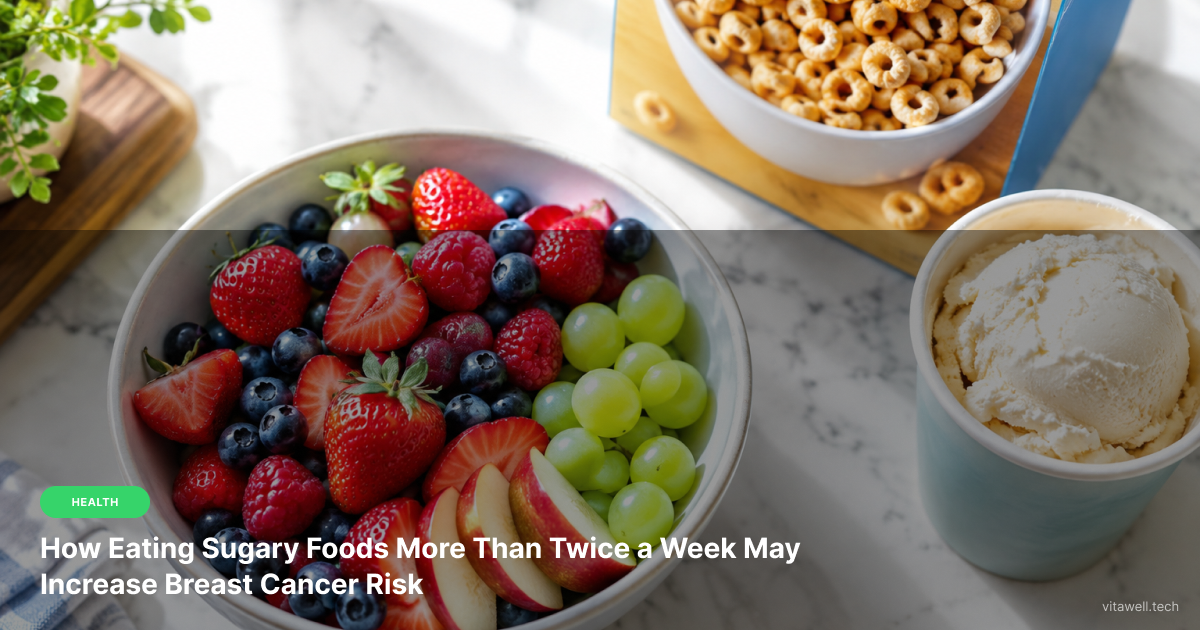
Eating processed high-sugar foods more than twice a week is linked to a 28% higher risk of breast cancer, according to a large 2026 Korean cohort study of over 71,000 women. The risk isn't evenly spread: sugary cereals carry the highest association (+34%), ice cream comes next (+26%), and fruit consumption shows no increased risk at all. This article breaks down exactly which foods matter most, the biological mechanism behind the link, and practical steps you can take today.
Key Takeaways
- Eating high-sugar processed foods more than twice a week was linked to 28% higher breast cancer risk in a study of 71,264 women
- Sugary cereals carry the strongest individual food association (+34%), followed by ice cream (+26%)
- Carbonated drinks, cakes, cookies, and sweets showed no significant association with breast cancer risk in this study
- Fruit consumption — despite accounting for ~43% of dietary sugar in the cohort — did NOT increase breast cancer risk
- Women under 50 showed the strongest age-specific association, suggesting premenopausal biology may amplify the effect
What the HEXA Study Actually Found
Study Design and Population
The Health Examinees (HEXA) study recruited 169,718 adults aged 40–69 across 38 centers in South Korea between 2004 and 2013. For this breast cancer analysis (Shin et al., 2026, European Journal of Nutrition), researchers followed 71,264 women for a mean of 9.2 years, identifying 713 incident breast cancers via linkage to the Korea Central Cancer Registry.
Participants completed a 106-item semi-quantitative food frequency questionnaire assessing past-year diet. Researchers grouped seven high-sugar food categories — carbonated drinks, Korean traditional sugar tea, cakes and cookies, sweets, sugary cereals, ice cream, and jam and butter — into a composite "high-sugar food" exposure. Cox proportional hazards models adjusted for smoking, alcohol use, education, exercise, reproductive history, family history, BMI, and total energy intake.
Breaking Down the Risk by Food Type
The headline finding — a 28% higher breast cancer risk for women consuming high-sugar foods more than twice per week compared to those consuming them once a month or less — is striking. But the per-food analysis tells a more precise and actionable story.
Women who ate sugary cereals at least once every two months had a 34% higher breast cancer risk compared to those who never consumed them. Women who ate ice cream at least once weekly had a 26% higher risk (borderline statistical significance) compared to non-consumers. These are the most specific, priority-setting findings from the study.
What Did NOT Increase Risk
Notably, carbonated drinks, cakes and cookies, sweets, and jam or butter showed no statistically significant association with breast cancer risk. This is an important distinction: the problem is not every sweet food, but specific processed categories — particularly cereals and ice cream — that may interact differently with the insulin response.
Not All Sugar Is Equal — Why Fruit Is Off the Hook
Fruit accounted for approximately 43% of total dietary sugar in this cohort, with a mean total sugar intake of 44 g/day across all participants. Yet the researchers found no significant association between fruit consumption and breast cancer risk. The same was true for total dietary sugar in aggregate — the signal came specifically from high-sugar processed food categories.
This distinction matters deeply. Whole fruits deliver sugar alongside fiber, water, polyphenols, vitamins, and phytochemicals. The fiber slows absorption and blunts the insulin spike that processed sugars produce. The polyphenols carry anti-inflammatory and antioxidant properties. Food matrix — the full biological package surrounding the sugar — appears to determine how the body processes and responds to it.
Eating sugary cereal is a fundamentally different physiological event than eating an apple, even if both contain sugar. The practical implication: don't avoid fruit to lower breast cancer risk. The evidence points in the opposite direction.
The Biological Pathway — How Sugar May Feed Cancer
The leading hypothesis connecting processed sugar to breast cancer risk runs through the insulin-IGF-1 axis. When you eat rapidly absorbed processed sugar, blood glucose rises sharply, triggering an insulin response. Elevated insulin in turn stimulates the production of insulin-like growth factor 1 (IGF-1). According to the Susan G. Komen Foundation, citing multiple studies, elevated circulating IGF-1 is associated with increased breast cancer risk — IGF-1 binds to receptors on breast cells and can promote their proliferation.

This pathway helps explain why the association may be stronger for processed, rapidly-absorbed sugar foods like cereals and ice cream than for whole foods. It also explains why the WHO recommends keeping free sugars below 10% of total daily energy intake — the same dietary principle that underpins cancer, cardiovascular, and metabolic disease prevention. As WHO guidelines on dementia prevention illustrate, evidence-based dietary choices shape long-term disease risk across multiple organ systems simultaneously.
The reality is that most people already exceed these limits. US adults consume approximately 12.7% of their energy from added sugars, based on national dietary survey data — above the WHO's 10% threshold.
High-Sugar Foods Ranked by Breast Cancer Risk
The table below synthesizes the HEXA study's per-food findings into a decision-grade guide — letting you see clearly which foods to prioritize reducing.
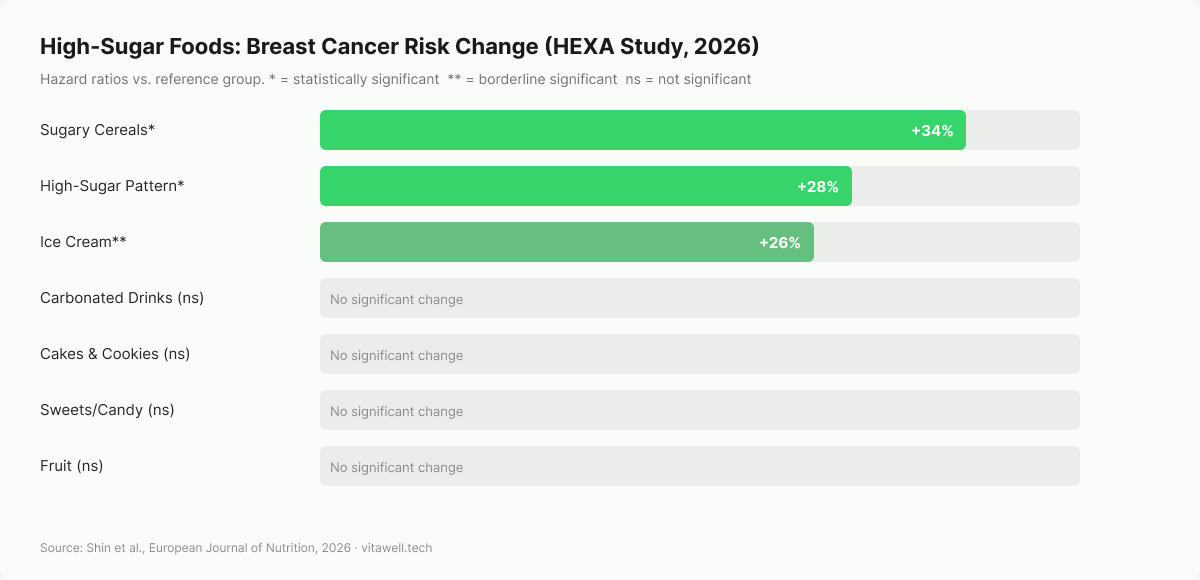
| Food Type | Consumption vs. Comparison | Risk Change | Statistical Significance |
|---|---|---|---|
| Sugary cereals | ≥once every 2 months vs. never | +34% (HR 1.34) | Significant |
| Overall high-sugar food pattern | >2x/week vs. ≤1x/month | +28% (HR 1.28) | Significant |
| Ice cream | ≥once weekly vs. never | +26% (HR 1.26) | Borderline significant |
| Carbonated drinks | Any frequency vs. none | No significant change | Not significant |
| Cakes & cookies | Any frequency vs. none | No significant change | Not significant |
| Sweets/candy | Any frequency vs. none | No significant change | Not significant |
| Fruit consumption | Any amount | No significant change | Not significant |
Source: Shin et al., European Journal of Nutrition, 2026. Observational cohort study; associations do not prove causation. HR = hazard ratio adjusted for BMI, lifestyle, and reproductive factors.
Who Is Most at Risk — Age, Alcohol, and Lifestyle
The HEXA study's subgroup analyses revealed important moderating factors. The association between high-sugar food intake and breast cancer risk was statistically significant specifically among women under 50 — the premenopausal group. For women over 50, the trend existed but did not reach statistical significance, suggesting that hormonal context, particularly pre-menopausal estrogen levels, may interact with the dietary sugar-IGF-1 pathway.
Alcohol consumption also compounded the risk. Women who drank alcohol and consumed high-sugar foods showed a stronger association than non-drinkers, though formal interaction tests were not conclusive. The researchers also noted possible effect modification by physical activity level and BMI.
Excess body weight is itself an independent breast cancer risk factor, particularly after menopause, as adipose tissue produces estrogen. This creates a double pathway: high-sugar diets can contribute to weight gain, and that weight compounds cancer risk independently. Research on how sedentary work and overwork patterns drive weight gain illustrates how modern lifestyle factors can compound long-term health risks.
A Practical Risk-Reduction Plan
Based on the evidence, here are seven specific actions you can start this week:
- Cap high-sugar processed foods at 1–2 times per week — the threshold where the significant association was found in this study
- Swap morning sugary cereal for oats, eggs, or plain yogurt — cereal showed the strongest individual food association (+34%) and is the highest-priority swap
- Replace ice cream with frozen fruit or Greek yogurt — same satisfaction, different metabolic profile
- Keep eating whole fruit — the evidence is clear that fruit does not increase breast cancer risk; don't restrict it
- Target WHO's sugar guideline: aim to keep free sugars below 10% of daily energy (about 50g on a 2,000-calorie diet)
- Reduce or eliminate alcohol — especially if you consume sugary foods regularly, as these may compound the risk
- Build a consistent movement habit — regular physical activity supports insulin sensitivity, reducing the IGF-1 elevation that may link processed sugar to breast cancer
For dietary inspiration on what to eat more of, research on berries and antioxidants offers a compelling case for the foods that may actively protect against cellular damage.
The Bigger Picture — Why This Matters Now
Breast cancer is the most common cancer in women worldwide. GLOBOCAN 2022 data from IARC estimated 2.3 million new breast cancer cases in 2022 alone, representing 23.8% of all cancers diagnosed in women globally.

The trajectory is worrying. The WHO projects that global breast cancer diagnoses and deaths will surge by almost 40% by 2050, driven by population aging, urbanization, and shifting dietary patterns. Diet is one of the few modifiable risk factors available to individuals — and the growing evidence linking processed sugar to cancer risk makes it a priority lever for prevention.
When to Talk to a Professional
This article is about dietary risk factors, not diagnostic advice. Talk to your doctor or a qualified dietitian if:
- You have a family history of breast cancer or carry a known BRCA1/BRCA2 mutation
- You want to make significant dietary changes and have an underlying condition such as diabetes or metabolic syndrome
- You are at or past the recommended age for your first mammogram (typically 40–50 depending on your country's guidelines)
- You notice any new lumps, skin changes, nipple discharge, or other breast changes
Regular breast screening remains the most reliable tool for early detection. For proactive thinking about cancer prevention beyond diet, it is worth reviewing how evolving cancer screening guidelines are expanding early detection options for other cancers too.
FAQ — Your Questions Answered
Does sugar cause breast cancer?
Current evidence does not establish that sugar causes breast cancer. The 2026 HEXA study found an association between processed high-sugar foods and higher breast cancer risk — but as an observational study, it cannot prove causation. The likely mechanism involves the insulin-IGF-1 pathway, and diet is one of many interacting risk factors.
How much sugar is too much for breast cancer risk?
The HEXA study found significant risk increases at more than two servings of high-sugar processed foods per week. The WHO recommends keeping free sugars below 10% of daily energy intake (approximately 50g on a 2,000-calorie diet) — a threshold most adults already exceed based on national dietary data.
Can eating fruit increase my breast cancer risk?
No. The HEXA study found no significant association between fruit consumption and breast cancer risk, even though fruit accounted for ~43% of total dietary sugar in the cohort. Whole fruit delivers sugar in a food matrix of fiber and phytochemicals that differ fundamentally from processed sugary foods in their metabolic effect.
Are carbonated drinks (soda) linked to breast cancer in this study?
No. Carbonated drinks did not show a statistically significant association with breast cancer risk in this study, despite being a major added-sugar vehicle. The pattern suggests that food type and delivery matrix — not just sugar quantity — may matter for the breast cancer-sugar relationship.
Is the breast cancer-sugar link the same for all women?
Not exactly. The HEXA study found the association was statistically significant specifically among women under 50 (premenopausal) and among alcohol consumers. For women over 50, the trend existed but was not statistically significant, suggesting hormonal context may modulate the relationship between dietary sugar and breast cancer risk.
Conclusion — Small Choices, Big Impact
A single study cannot rewrite dietary guidelines, but the HEXA cohort's findings add meaningful weight to a growing body of evidence: processed high-sugar foods appear to have consequences beyond weight and metabolic disease. The practical guidance is specific and actionable — cap sugary cereals and ice cream, keep eating whole fruit, stay within WHO sugar limits, and move regularly. These aren't dramatic restrictions; they are precise, evidence-guided choices. Start with one swap this week and build from there.
Related on VitaWell
- New Colorectal Cancer Screening Guidelines: Blood Tests and At-Home Stool Tests Are Now Officially Recommended — Essential reading if you're thinking proactively about early cancer detection and prevention strategies beyond diet.
- Two Best Exercise Types to Lower Blood Pressure — Exercise is a key pillar of cancer risk reduction alongside dietary changes, supporting insulin sensitivity and healthy weight.
- NOVOS Core Supplement and Blood Vessels — Cellular health and vascular function form part of the broader picture of long-term disease prevention.
This article is for informational purposes only and does not constitute medical advice. Consult a qualified healthcare professional before making any changes to your diet or health routine.
Sources
- News-Medical.net — Eating sugary foods more than twice a week was linked to 28% higher breast cancer risk
- Shin et al., 2026 — High-sugar foods and breast cancer risk in the Health Examinees study, European Journal of Nutrition
- IARC/WHO — GLOBOCAN 2022 Breast Cancer Fact Sheet
- WHO 2025 — Global breast cancer diagnoses and deaths to surge almost 40% by 2050
- WHO 2015 — Guideline: Sugars intake for adults and children
- Susan G. Komen Foundation — IGF-1 and Breast Cancer Risk