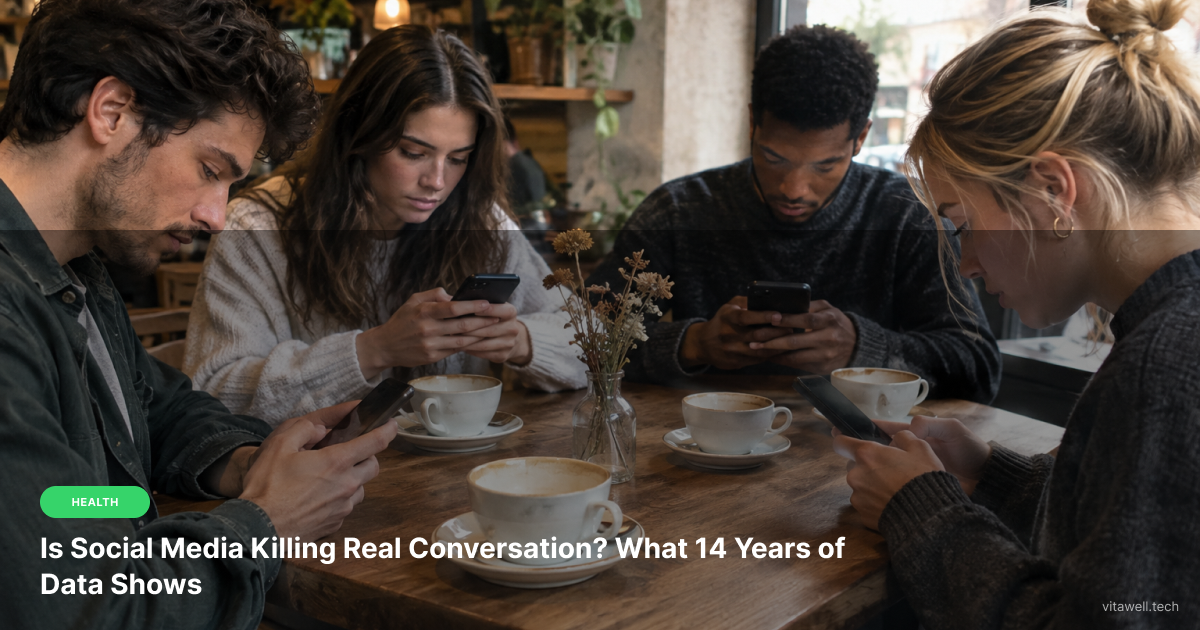
Is Social Media Killing Real Conversation? What 14 Years of Data Shows
A 2026 study tracking 2,200 people found Americans speak about 3,300 fewer words daily than in 2005 — and the story of why is more nuanced than 'social media is the culprit.'
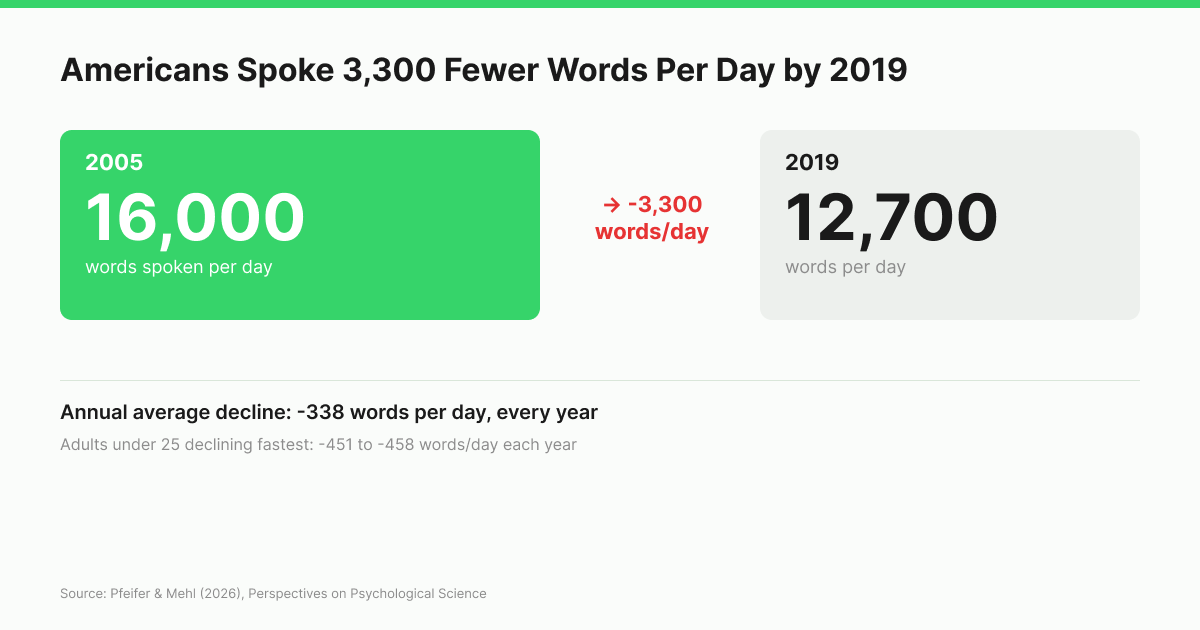
Americans spoke an average of roughly 16,000 words per day in 2005. By 2019 — before the pandemic reshaped everything — that number had fallen to around 12,700. A 2026 study published in Perspectives on Psychological Science, tracking spoken word counts across 22 research projects and more than 2,200 people, found Americans are shedding approximately 338 words per day every year. The question is not whether we are talking less. The data says we clearly are. The more important question is why — and the evidence suggests social media is a contributing factor, but not the simple villain the narrative usually makes it out to be.
Key Takeaways
- Americans spoke roughly 16,000 words/day in 2005; by 2019 that had fallen to ~12,700 — a loss of about 3,300 words daily
- The annual decline averages ~338 words per day per year; adults under 25 show the steepest drop, losing ~451–458 words/day each year
- Social media worsened social skill development only for teens with high social anxiety — most adolescents were unaffected or more socially active
- The decline began before smartphones were ubiquitous, pointing to cultural forces beyond technology alone
- In-person contact with close friends delivers the highest wellbeing boost; passive social media scrolling delivers the least
- Young Americans are spending more time eating alone than at any point in this century
What 14 Years of Word-Count Data Actually Reveals
The Study That Measured the Silence
Researchers Verena A. Pfeifer (University of Missouri-Kansas City) and Matthias R. Mehl (University of Arizona) pooled data from 22 studies conducted between 2005 and 2019 — studies originally designed around topics like breast cancer coping, divorce adjustment, and relationships — and analyzed a single variable those studies all shared: how much participants spoke in daily life. The result, published in Perspectives on Psychological Science (Pfeifer & Mehl, 2026), covered about 2,200 participants ranging in age from 10 to 94.
The finding was stark. In 2005, participants spoke an average of roughly 16,000 words per day — a figure that closely tracks Mehl's 2007 estimate of 15,900 daily words. By 2019, that estimate had fallen to approximately 12,700. The average annual rate of decline: about 338 fewer words spoken per day, every year.
The Generational Gap: Young Adults Are Losing Words Fastest
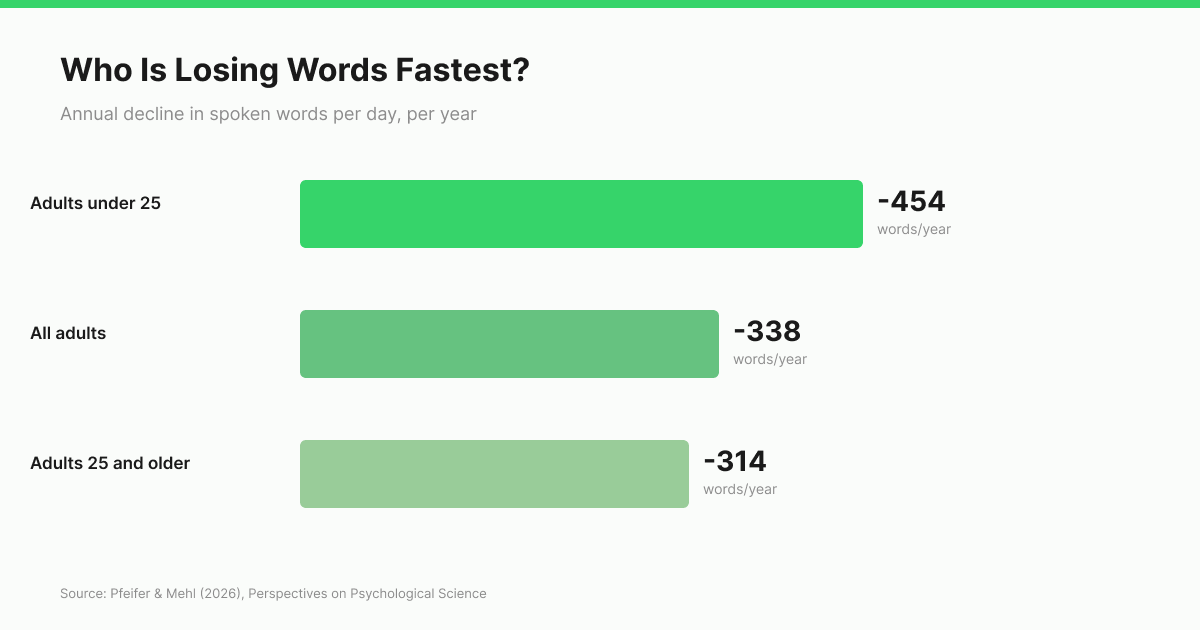
The decline is not evenly distributed. Adults under 25 show the steepest drop, losing approximately 451 to 458 words per day, per year — meaningfully faster than the rate for adults 25 and older, which runs at about 314 words per year. The practical implication is significant. As Mehl noted in coverage by Local12/The National Desk, "small incidental conversations" — the kind you have with a checkout clerk, a neighbor, a stranger asking for directions — are quietly disappearing. Each one seems minor; collectively, their loss compounds.
Social Media Is Not the Simple Villain — The Research Is More Nuanced
When Social Media Helps Social Bonds (and When It Hurts)
A 2024 Norwegian longitudinal study (Steinsbekk et al., Computers in Human Behavior, PMC11540422) tracked children and adolescents and found something counterintuitive: kids who posted, commented, and liked more on social media were more socially active offline, not less. For most teens, higher social media engagement correlated with more in-person connection — not less.
There was one critical exception. Adolescents with high social anxiety showed worse social skill development when they engaged heavily with social media. For this group, the platform appeared to substitute for rather than supplement real-world interaction — and the substitution left their skills underdeveloped. The finding reframes the debate entirely: social media's impact on social connection is not uniform. It interacts with pre-existing psychological vulnerability. For the majority of users, the evidence does not support the claim that social media is driving social withdrawal.
Why the Decline Began Before the Smartphone Era
The Pfeifer & Mehl study covers 2005 to 2019. The iPhone launched in 2007; mass social media adoption — Facebook, Twitter, Instagram — took hold around 2009 to 2012. Yet the word-count data shows a downward trend that was already underway before most people owned a smartphone.
This timing matters. Longer average commute times, suburban sprawl, screen-based home entertainment replacing shared social spaces, and the rise of remote work all contributed to reducing everyday verbal contact before social media became a dominant force. Research on how overwork and long working hours compound sedentary, isolated modern lifestyles illustrates how structural forces — not just digital habits — reshape human connection.
What We Lose When We Stop Talking — The Wellbeing Stakes
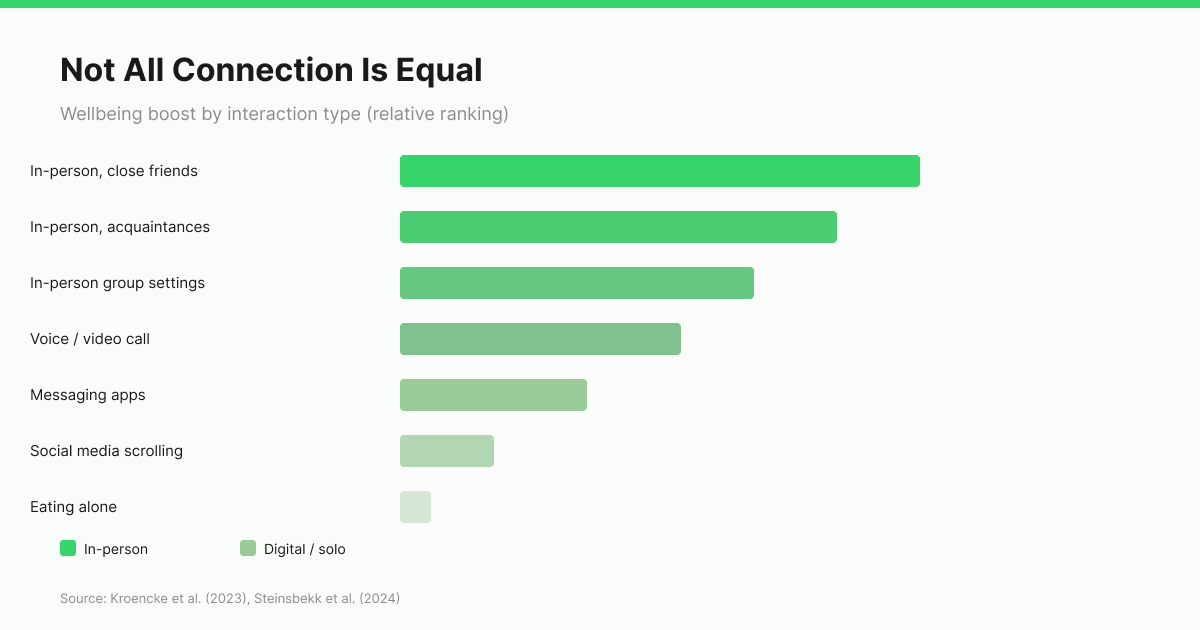
The stakes of declining verbal connection are not trivial. Research by Kroencke et al. (2023, Journal of Personality and Social Psychology) established that any social interaction — digital or in-person — boosts wellbeing, but the type of interaction matters enormously. In-person contact with close friends delivered the highest wellbeing benefit; digital-only contact added meaningfully less. The gap is not marginal.
This matters for long-term brain health in particular. Evidence reviewed in WHO guidelines on preventing dementia identifies social engagement as a protective factor — regular in-person connection is one of the lifestyle levers most strongly associated with lower dementia risk. The erosion of daily spoken connection carries neurological as well as social consequences.
A parallel trend reinforces the concern. American Time Use Survey data analyzed in the World Happiness Report shows Americans — especially young people — are eating alone more than at any point since 2003. Rising social isolation and declining social connection were documented from 2003 to 2020 — well before COVID — by Kannan & Veazie (2022, SSM Population Health). The pandemic likely accelerated what was already in motion.
Social Interaction Ranked by Wellbeing Impact
The table below synthesizes findings from the Pfeifer & Mehl word-count study, Kroencke et al.'s wellbeing research, Steinsbekk et al.'s longitudinal data, and Hall (2023) on messaging apps, into a practical decision guide for your social investment.
| Interaction Type | Format | Wellbeing Boost | Conversation Depth | Key Note |
|---|---|---|---|---|
| In-person with close friends | Face-to-face | Highest | Deep | Most protective; full verbal and nonverbal engagement |
| In-person with acquaintances | Face-to-face | High | Moderate | Incidental daily exchanges add up — don't skip them |
| In-person group settings | Face-to-face | Moderate-High | Variable | Shared physical experience amplifies connection |
| Voice/video call | Real-time digital | Moderate | Moderate | Vocal tone preserved; better than text, less than in-person |
| Messaging apps (Snapchat, WhatsApp) | Digital text | Low-Moderate | Low | Some face-to-face benefits per Hall (2023); no vocal cues |
| Social media scrolling/posting | Digital passive | Low | None | No reciprocity; lowest wellbeing return of all types |
| Eating alone | Solitary | Minimal | None | Increasing trend among young Americans since 2003 |
Source: Synthesized from Pfeifer & Mehl (2026), Kroencke et al. (2023), Steinsbekk et al. (2024), Hall (2023). Wellbeing rankings are relative, not absolute measures.
5 Practical Habits to Protect Real Conversation in a Digital Age
Based on the evidence, five specific actions can reverse the trend in your own life:
- Schedule one weekly "no-phones" shared meal — in-person meals with close friends or family deliver the highest wellbeing return of any social investment. The absence of phones is not a small detail: it restores the full verbal engagement that makes the interaction count.
- Reclaim the small incidental conversations — greet the checkout clerk, acknowledge the neighbor, chat with the person in the elevator. These micro-interactions are disappearing and their cumulative loss matters.
- Default to voice or video over text — when you can't meet in person, a phone or video call preserves vocal cues that text strips out. The wellbeing benefit is meaningfully higher than a text exchange.
- If you experience social anxiety, limit passive scrolling — this is the specific usage pattern most clearly linked to worse social outcomes. Posting and commenting are less clearly harmful than passive consumption; reducing mindless scrolling is the highest-priority change for anxious individuals.
- Combine movement with social time — walking and talking, exercising with a friend, or joining a group fitness class combines two wellbeing levers at once. Research on the exercise types most effective for cardiovascular health shows that even brief moderate activity supports physical and mental resilience — and doing it with others amplifies both.
When to Seek Support
This article discusses population-level trends, not diagnostic advice. Consider speaking with a therapist or counselor if:
- You consistently withdraw from in-person plans in favor of digital interaction
- Digital connection feels like a substitute for in-person presence you're actively avoiding
- You feel lonelier despite being digitally "connected"
- Social anxiety is driving you toward platforms as a safer alternative to real-world interaction and you want to change that pattern
FAQ — Your Questions Answered
Is social media making us less social in real life?
The relationship is not simple. For most people, social media use does not appear to cause real-world social withdrawal — the 2024 Norwegian longitudinal study (Steinsbekk et al.) found that more-active social media users were also more socially active offline. The exception is teens and young adults with high social anxiety, for whom heavy use was linked to worse social skill development. The clearest risk is passive scrolling, which offers no reciprocal interaction and minimal wellbeing benefit.
Why are Americans speaking fewer words per day?
A 2026 study (Pfeifer & Mehl, Perspectives on Psychological Science) documented a decline from roughly 16,000 spoken words per day in 2005 to about 12,700 by 2019 — an average drop of 338 words per day, every year. The decline predates smartphone ubiquity, suggesting structural factors — longer commutes, overwork, suburban isolation, the rise of screen entertainment — are as important as social media in driving it.
How many words does the average person speak per day?
Based on pooled data from 22 studies across more than 2,200 participants (Pfeifer & Mehl, 2026), the 2019 estimate was approximately 12,700 words per day — down from roughly 16,000 in 2005. The 2007 baseline from the same research group put the figure at 15,900 words.
Does texting replace real conversation?
Partially, but not fully. Hall (2023) found messaging apps can deliver some benefits of face-to-face interaction. However, Kroencke et al. (2023) found in-person contact with close friends delivers measurably greater wellbeing than digital-only contact. Texting supplements conversation; it does not replicate the full cognitive and emotional value of spoken, in-person exchange.
Is declining conversation a risk for long-term health?
The evidence suggests yes. Social connection — especially in-person — is associated with lower dementia risk and better overall wellbeing across multiple health domains. Rising social isolation, documented continuously from 2003 through 2020 (Kannan & Veazie, 2022), is a population-level health concern that tracks closely with the decline in spoken interaction.
Conclusion — Talk More, and Make It Count
We are speaking roughly 3,300 fewer words per day than we did in 2005 — and the trend was already underway before most of us had smartphones. Social media is a factor, but its effects are more conditional than headlines suggest: it most clearly harms people who are already most vulnerable to social anxiety. The practical guidance from the data is specific: prioritize in-person contact with people who matter to you, reclaim the small conversations you've let slide, choose voice over text when you can't meet in person, and treat passive scrolling as the lowest-return social activity in your day. The science of wellbeing is consistent — talking more, in person, to people we care about remains one of the most reliable investments in mental and physical health we can make.
Related on VitaWell
- Berries as Superfoods: Are Antioxidants the Real Hero? — Dietary choices that actively protect cellular health, complementing the lifestyle habits that also protect social and mental wellbeing.
- Eating Sugary Foods More Than Twice a Week Was Linked to Higher Breast Cancer Risk — Diet and lifestyle choices interact with long-term disease risk — a 2026 study on processed sugar and cancer explores how daily habits compound over time.
- Working Long Hours Is Making You Heavier: What New Research Reveals About Overwork and Obesity — How modern work patterns create the structural conditions for isolation, sedentary behavior, and compound health risks.
This article is for informational purposes only and does not constitute medical or psychological advice. Consult a qualified healthcare professional before making changes to your health routine.
Sources
- Fridland, V. (2026) — Is Social Media Killing Conversation and Connection? Psychology Today
- Pfeifer & Mehl (2026) — Sliding Into Silence? Perspectives on Psychological Science, 21(4), 447–449
- Steinsbekk et al. (2024) — Social media use and social outcomes, Computers in Human Behavior (PMC11540422)
- Adolescent in-person time study — Journal of Social and Personal Relationships (SAGE, 2019)
- Kannan & Veazie (2022) — Social isolation trends 2003–2020, SSM Population Health (PMID 36618547)
- Earth.com — People Are Speaking Less Every Year and the Drop Is Accelerating
- Local12 / National Desk — Fact Check: Are Americans Speaking Less?