Science Proves Gratitude Works — Here's How to Make It Work for You
Randomized trials show specific gratitude practices reduce inflammation, improve heart rate variability, and produce lasting well-being gains — when done correctly. Here's what the evidence actually shows.

Gratitude practices are one of the most studied interventions in positive psychology — and also one of the most misunderstood. The science is genuine: randomized controlled trials show that specific gratitude exercises reduce inflammatory biomarkers, improve heart rate variability, and produce measurable gains in well-being that last weeks after the practice ends. The problem is that most people do it wrong. They journal too frequently, write too vaguely, or treat gratitude as a forced positivity exercise — and then wonder why it doesn't work. This guide covers what the research actually shows about how gratitude works, which practices are worth your time, and what to avoid.
Key Takeaways
- Gratitude journaling 1–3 times per week outperforms daily journaling in randomized trials — daily entries become habituated and lose effect
- Writing a gratitude letter and delivering it in person (the “gratitude visit”) is the highest-impact single gratitude intervention in the literature
- A 2015 randomized trial published in Spirituality in Clinical Practice found gratitude journaling significantly reduced inflammatory markers (F=9.7, p=.004) and improved heart rate variability (F=4.2, p=.036) in heart failure patients
- Gratitude works through two distinct mechanisms: dopaminergic reward circuitry (the act of noticing good) and narrative reframing (shifting how you interpret experience)
- The most common mistake is using gratitude as a tool to suppress negative emotions — research shows this backfires and reduces authenticity
Why Most People Use Gratitude Wrong
The cultural shorthand for gratitude — “just be thankful for what you have” — has quietly corrupted how most people practice it. When gratitude becomes an obligation to feel positive, it loses the properties that make it work in research settings.
There are three common failure modes. First, journaling too often: in Lyubomirsky and colleagues’ landmark study, participants who journaled once per week showed significantly greater well-being gains than those who journaled three times per week. Daily journaling produced the weakest outcomes. The mechanism is habituation — the more frequently you catalogue the same categories of appreciation, the less neurological response each entry generates.
Second, writing too generically. “I’m grateful for my family” does not activate the same neural reward circuitry as “I’m grateful that my partner made coffee this morning without being asked because I’d had a rough week.” Specificity is not a stylistic preference — it is functionally different at the level of attention and memory consolidation.
Third, using gratitude to suppress or bypass negative emotions. Research on emotional suppression consistently shows that attempting to override negative affect through positive reappraisal — when done under pressure — reduces authenticity and increases cognitive load. Gratitude works best as an addition to emotional processing, not a substitute for it.
What Gratitude Actually Does to Your Brain and Body
We’ve previously covered how gratitude rewires the brain at the neural level. The short version: gratitude activates the medial prefrontal cortex (the region associated with learning and decision-making), releases dopamine via the reward pathway, and strengthens connections in circuits associated with social bonding.
What is less well known is what gratitude does to your body. A randomized controlled trial published in Spirituality in Clinical Practice (Mills et al., 2015) assigned heart failure patients to a gratitude journaling condition versus a standard care control. After eight weeks, the gratitude group showed significantly lower inflammatory cytokine levels (IL-6 and TNF-α; F=9.7, p=.004) and significantly improved heart rate variability (F=4.2, p=.036) — a measure of autonomic nervous system balance that predicts cardiac outcomes. The researchers also found improvements in sleep quality and reduced depression scores.
This matters because inflammation and autonomic dysregulation are not abstract health concepts — they are mechanisms that connect psychological states to disease outcomes. The fact that a journaling intervention moved these biomarkers suggests that gratitude practices are doing something physiologically substantive, not merely changing self-report scores.
A separate line of evidence comes from neuroscience. fMRI studies show that grateful people show greater activation in the anterior cingulate cortex and medial prefrontal cortex when processing social information — regions associated with empathy and social cognition. This may explain why gratitude reliably improves relationship quality: it appears to change how the brain processes interpersonal interactions, not just how people feel about them.
Gratitude Practices: What the Evidence Actually Shows
Not all gratitude practices produce equivalent outcomes. Here is what the evidence shows across the main intervention types:
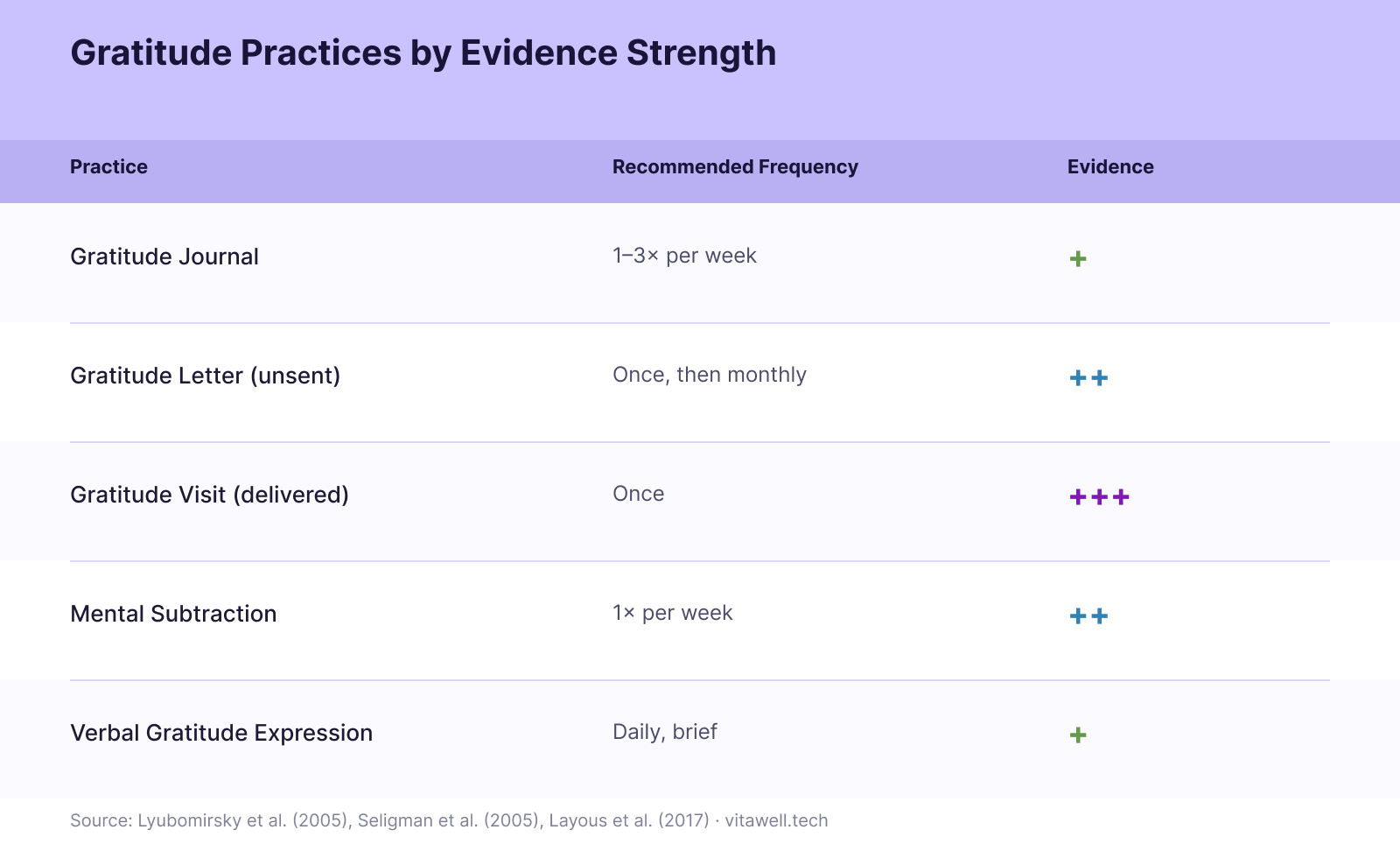
| Practice | Recommended Frequency | Key Evidence | Effect on Well-Being |
|---|---|---|---|
| Gratitude journaling | 1–3× per week | Lyubomirsky et al. (2005) | +, diminished with daily use |
| Gratitude letter (not sent) | Once, then monthly | Layous et al. (2017) | ++ |
| Gratitude visit (letter delivered) | Once | Seligman et al. (2005) | +++ (1-month effect) |
| Mental subtraction | 1× per week | Koo et al. (2008) | ++ |
| Verbal gratitude expression | Daily, brief | Gordon et al. (2012) | + (relationship-focused) |
Gratitude Journaling: Frequency Is the Variable That Matters Most
The standard recommendation of “write three things you’re grateful for every day” contradicts the actual experimental findings. Lyubomirsky and colleagues randomized participants to once-per-week versus three-times-per-week journaling and found the weekly group showed significantly greater gains in positive affect at the six-week follow-up. The researchers attributed this to hedonic adaptation: when you journal daily, the same categories of experience lose their capacity to generate positive affect.
The practical implication: set a recurring slot once or twice per week, and treat it as a deliberate reflection rather than a checkbox.
Gratitude Letters: The Highest-Impact Single Intervention
The gratitude letter is straightforward: write a letter of genuine appreciation to someone who has meaningfully affected your life and who you have never properly thanked. The evidence is consistent: this single exercise produces larger well-being gains than gratitude journaling in head-to-head comparisons. The effect is amplified — dramatically — when the letter is delivered in person. Seligman and colleagues’ original study found that the gratitude visit produced the largest one-month happiness increase of any intervention they tested.
You do not need to deliver it. The writing alone produces benefit. But if the relationship allows for it, delivery roughly doubles the effect.
Mental Subtraction: A Counterintuitive Shortcut
Mental subtraction is the practice of vividly imagining that a positive event in your life had not occurred — a relationship, an opportunity, a decision that worked out. This runs counter to the standard advice to focus on what you have. What the research shows is that imagining absence activates appreciation more powerfully than simply noting presence. Koo and colleagues (2008) found that mental subtraction outperformed direct positive reflection on well-being outcomes.
The technique: pick one genuinely positive element of your life. Spend five minutes writing about how your life would be different if it had never happened. What would you have missed? Who would you not have met? What would you not know? Then return to the present. The contrast effect is what drives the benefit.
What Doesn’t Work
Gratitude has acquired a reputation in some circles as toxic positivity training. This critique is worth engaging seriously. Research does show that forced or obligatory gratitude — particularly in workplaces or relationships where there is a power differential — can suppress legitimate negative emotions and function as a mechanism of compliance rather than well-being. If you feel you have to be grateful, the effect reverses.
The same applies to gratitude practiced in the context of grief or trauma. People experiencing acute loss should not be encouraged to “find the silver lining.” The evidence on positive reappraisal in acute grief is mixed at best, and gratitude practiced as an avoidance mechanism produces worse long-term outcomes than processing negative emotion directly.
Gratitude works when it is voluntary, specific, and additive — not when it is compelled, vague, or used to avoid. Building a daily routine that supports mental health provides the stable foundation within which a gratitude practice can function; it is not a replacement for that foundation.
Who Benefits Most from Gratitude Practices
The evidence suggests gratitude practices produce larger effects in certain populations. People with low baseline trait gratitude show the most room for gain. If you are already dispositionally high in gratitude — you naturally notice and appreciate positive events — a formal practice adds less than it does for someone who doesn’t naturally attend to positive experience.
People experiencing low-to-moderate negative affect benefit meaningfully. Depression is not a contraindication for gratitude practices in controlled research — in fact, gratitude interventions show moderate effects in populations with mild-to-moderate depressive symptoms. However, clinical depression warrants professional support, and gratitude journaling should complement, not replace, evidence-based treatment.
People with strong social networks show amplified relationship benefits when they practice verbal or written gratitude expression directed toward specific people. This aligns with the research on habits that protect against burnout — social connection is one of the most robust buffers against stress, and gratitude practices that explicitly strengthen social bonds compound their benefit.
When to Talk to a Professional
If you are experiencing persistent low mood, anhedonia (inability to experience pleasure), or significant life disruption, a gratitude practice is not the right starting point. Those are clinical presentations that benefit from evaluation by a psychologist or therapist. Gratitude research has largely been conducted in non-clinical populations, and the evidence does not support it as a primary intervention for clinical depression or anxiety disorders. What the evidence does support is its value as an adjunct practice for people who are functioning reasonably well and want to shift the baseline of their daily experience.
FAQ
How often should I write in a gratitude journal?
The evidence points to once or twice per week as optimal. Lyubomirsky and colleagues found that participants who journaled once per week showed significantly greater well-being gains than those who journaled three times per week at the six-week follow-up. Daily journaling appears to produce habituation — the entries lose their positive-affect-generating capacity. Set a recurring weekly slot and treat it as a deliberate reflection.
What is the most effective gratitude practice?
The gratitude visit — writing a letter of appreciation to someone who has positively influenced your life and reading it to them in person — produces the largest well-being gains of any single gratitude intervention in the research. If in-person delivery is not possible, writing the letter alone still produces meaningful benefit. For ongoing practice, weekly gratitude journaling with specific rather than generic entries is well-supported.
Can gratitude make depression worse?
Forced or obligatory gratitude can amplify negative affect in people experiencing grief, trauma, or acute loss. For people with clinical depression, gratitude practices should complement professional treatment, not replace it. In populations with mild-to-moderate depressive symptoms, controlled research shows modest benefit — but those participants were receiving the practice as a voluntary, structured intervention, not being told to “just be grateful.”
How specific should gratitude journal entries be?
Specific enough to activate a memory. “I’m grateful for my colleague Alex noticing I looked overwhelmed and offering to cover the afternoon call” is more effective than “I’m grateful for my team.” The specificity matters because it engages memory consolidation and genuine attention — the mechanisms through which gratitude produces its neurological effects.
Does gratitude actually reduce inflammation?
A randomized controlled trial (Mills et al., 2015, Spirituality in Clinical Practice) found that eight weeks of gratitude journaling significantly reduced inflammatory cytokine markers in heart failure patients, with F=9.7 and p=.004. This is a single study in a specific clinical population and should not be overstated — but it is peer-reviewed, randomized, and controlled, and consistent with the broader literature on stress, autonomic function, and inflammation.
Conclusion
Gratitude practices have genuine evidence behind them — not as inspirational tools, but as behavioral interventions that move measurable psychological and physiological outcomes in clinical trials. The gap between how most people use gratitude and how it performs in research is largely a matter of technique: frequency, specificity, and voluntariness are the variables that determine whether the practice works. Start with once-per-week journaling at the level of specific events, not abstract categories. If you want the highest-impact single session, write a gratitude letter. For more evidence-based approaches to building the kind of daily life that supports genuine well-being, explore the three elements of meaning science says are essential for happiness.
Related on VitaWell
- What fMRI Research Reveals About How Gratitude Rewires Your Brain — The neuroscience of gratitude: how it activates reward circuitry, strengthens social cognition, and produces lasting neural changes.
- The Three Elements of Meaning That Science Says Are Essential for True Happiness — Purpose, coherence, and mattering: the research-backed framework for a life that feels worthwhile, beyond day-to-day mood.
- 3 Science-Backed Daily Habits That Protect You From Burnout — The habits that build stress resilience at the physiological level, with the evidence behind each one.
This article is for informational purposes only and does not constitute medical or psychological advice. For concerns about depression, anxiety, or mental health, consult a licensed mental health professional.
Sources
- Mills PJ, Redwine L, Wilson K, et al. (2015). The Role of Gratitude in Spiritual Well-being in Asymptomatic Heart Failure Patients. Spirituality in Clinical Practice, 2(1), 5–17. PMC4927423
- Lyubomirsky S, Sheldon KM, Schkade D. (2005). Pursuing Happiness: The Architecture of Sustainable Change. Review of General Psychology, 9(2), 111–131. doi.org
- Seligman MEP, Steen TA, Park N, Peterson C. (2005). Positive Psychology Progress. American Psychologist, 60(5), 410–421. doi.org
- Koo M, Algoe SB, Wilson TD, Gilbert DT. (2008). It’s a Wonderful Life: Mentally Subtracting Positive Events Improves People’s Affective States. Journal of Personality and Social Psychology, 95(5), 1217–1224. doi.org
- Gordon AM, Impett EA, Kogan A, et al. (2012). To Have and to Hold: Gratitude Promotes Relationship Maintenance. Journal of Personality and Social Psychology, 103(2), 257–274. doi.org
- Emmons RA, McCullough ME. (2003). Counting Blessings Versus Burdens. Journal of Personality and Social Psychology, 84(2), 377–389. doi.org
- Layous K, Sweeny K, Armenta C, et al. (2017). The Proximal Experience of Gratitude. PLOS ONE, 12(7), e0179123. doi.org