
How Sticking to a Daily Routine Can Reduce Pain and Depression, According to Science
New research: consistent daily routines reduce pain by 5.84 points and depression scores. The zeitgeber mechanism explained + 5-step anchoring protocol.

Maintaining consistent behavioral-social rhythms — regular wake times, meals, social contact, and exercise — is independently associated with lower pain intensity and fewer depressive symptoms, according to new research published in the Journal of Behavioral Medicine. Among 67 older adults, each one-point increase in daily routine regularity predicted a 5.84-point reduction in pain scores, a 0.68-point drop in depression scores, and a 1.60-unit decrease in BMI (Tracy et al., 2026). The mechanism runs through the brain's master circadian clock, which depends on these predictable behavioral cues to coordinate the body's inflammatory, hormonal, and immune cycles. You do not need a rigid schedule — five repeatable daily anchors may be enough to shift your pain and mood trajectory.
Key Takeaways
- Each 1-point increase in routine regularity predicted a 5.84-point reduction in pain intensity and a 0.68-point drop in depression scores (Tracy et al., Journal of Behavioral Medicine 2026, n=67)
- Insomnia (present in 55% of the study group) strengthened the link between poor routine and worse depression
- Irregular behavioral rhythms disrupt the brain's master circadian clock, amplifying systemic inflammation and blunting the brain's natural pain-modulation pathways
- Social Rhythm Therapy (IPSRT), a clinically structured routine intervention, extended time to relapse in bipolar I disorder from roughly 11 months to roughly 20 months (Frank et al., JAMA Psychiatry 2005)
- Five daily anchor points — consistent wake time, morning light, first meal, social contact, and bedtime — are enough to stabilize circadian rhythms without overhauling your life
What Are Behavioral-Social Rhythms?
A behavioral-social rhythm is a recurring pattern of daily activity — not just when you sleep, but when you wake, eat your first meal, see another person, exercise, and go to bed. The term was formalized by clinical psychiatrists Timothy Monk and Ellen Frank in the 1980s, who developed the Social Rhythm Metric (SRM) a validated instrument that scores the regularity of five core daily activities on a scale from zero to seven, where higher scores mean more consistent timing.
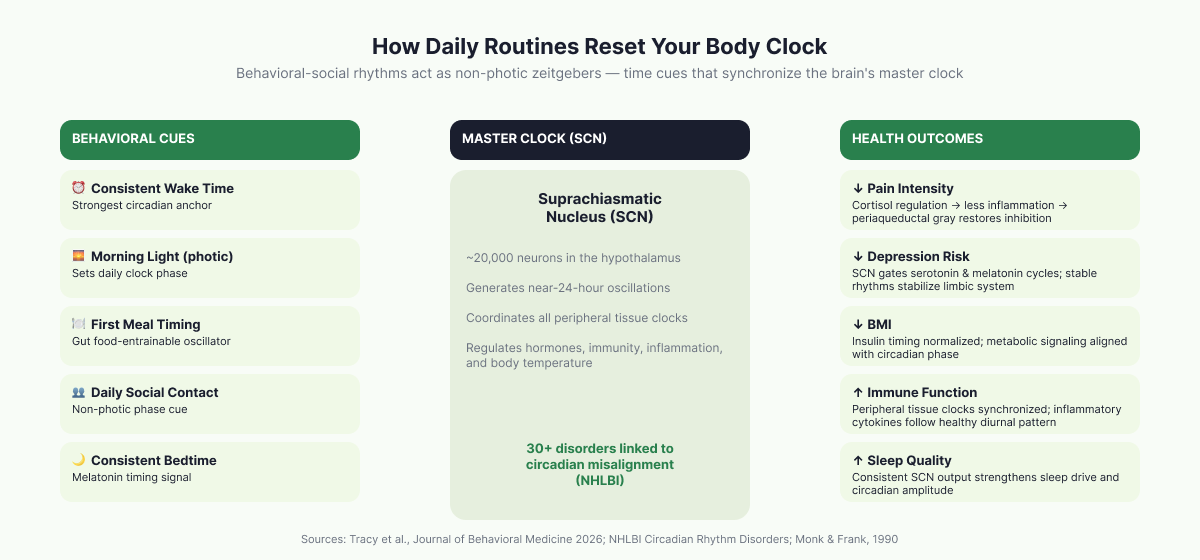
The SRM works by tracking how often each day a person engages in those anchor activities within a consistent 45-minute window. Someone who wakes at 7 AM every day and eats breakfast between 8:00 and 8:45 AM scores higher than someone whose wake time ranges from 6 AM to 10 AM and whose first meal shifts accordingly. High SRM scores indicate a lifestyle synchronized to a stable circadian template; low scores indicate circadian fragmentation. Research on circadian rhythms and long-term health has established that this synchrony affects far more than sleep quality — it governs cellular aging, metabolic function, and cognitive performance across the lifespan.
What the New Research Found
The Tracy et al. 2026 study, published in the Journal of Behavioral Medicine, enrolled 67 older adults with a mean age of 68.3 years. Thirty-seven participants met diagnostic criteria for insomnia disorder; 30 were healthy sleepers serving as a comparison group. All completed a battery of standardized assessments: the Social Rhythm Metric for routine regularity, the Brief Pain Inventory for pain intensity, the Center for Epidemiologic Studies Depression Scale (CES-D) for depressive symptoms, and standard anthropometric measures for BMI.
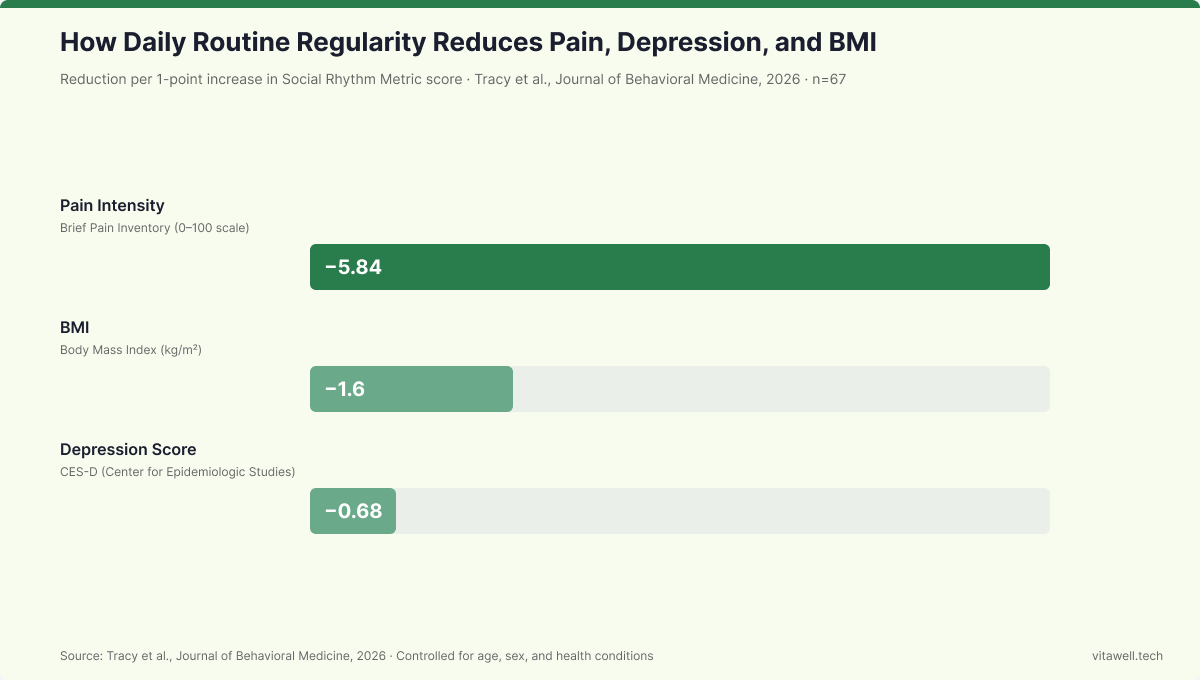
The regression analysis controlled for age, sex, and health conditions, allowing the team to isolate the independent contribution of routine regularity to each outcome. The results were statistically significant across all three variables: a one-unit increase in SRM score was associated with a 5.84-point reduction in pain (b = −5.84, SE = 2.68, p = 0.03); a 0.68-point drop in depression score (b = −0.68, SE = 0.29, p = 0.02); and a 1.60-unit reduction in BMI (b = −1.60, SE = 0.70, p = 0.03). These effect sizes are clinically meaningful — a 5.84-point shift on the Brief Pain Inventory represents a change that most patients describe as noticeable in daily functioning.
The insomnia subgroup did not show a significantly stronger routine-pain relationship, but the insomnia-routine interaction term for depression was significant: among people with insomnia, irregular routines were associated with disproportionately higher depression scores compared to good sleepers with equivalent irregularity. This suggests that sleep disorder and routine disruption may compound each other in driving mood outcomes. Because this was a cross-sectional observational study, the design cannot prove that irregular routines cause pain or depression — it shows a robust association that is consistent with known mechanisms and prior intervention data.
Why It Works: The Zeitgeber Mechanism
The body's master circadian clock sits in the suprachiasmatic nucleus (SCN) of the hypothalamus — a cluster of roughly 20,000 neurons that generates a near-24-hour oscillation governing hormone release, inflammation, immune activity, and body temperature. The SCN was long thought to be driven exclusively by light, but research over the past two decades has established that it also responds to non-photic zeitgebers — external time cues that are not light-based. The National Heart, Lung, and Blood Institute now links circadian misalignment to more than 30 recognized health disorders, spanning cardiovascular, metabolic, neurological, and immune categories.
Behavioral-social rhythms function as a primary class of non-photic zeitgebers. When meal times, activity periods, and social interactions occur at consistent clock times, they reinforce the SCN's oscillation and keep peripheral tissue clocks — in the gut, liver, pancreas, immune cells, and brain regions governing pain and mood — synchronized to the master clock. When those rhythms are irregular, the SCN receives conflicting timing signals, and the downstream organs fall out of phase with each other. In the context of pain, this circadian fragmentation suppresses the diurnal variation in cortisol that normally modulates inflammatory signaling: chronic low-grade inflammation increases, and the periaqueductal gray — the brain's main pain-dampening hub — reduces its inhibitory output.
For depression, irregular rhythms disrupt the tight coupling between the SCN and the limbic system. The SCN gates melatonin and serotonin cycles; when that gating becomes erratic, it destabilizes mood regulation circuits in the prefrontal cortex and amygdala. This is the same pathway implicated in seasonal affective disorder, jet lag-induced dysphoria, and the mood disruption that follows overwork schedules and shift work. The Tracy et al. findings fit squarely within this mechanistic framework, moving the association out of correlation and into a testable biological account.
When Sleep Trouble Is Already Part of the Picture
The Tracy et al. sample was split nearly in half between people with insomnia and healthy sleepers, and the interaction between insomnia and routine irregularity was most pronounced for depression. This matters clinically because insomnia is itself a form of circadian disruption: inconsistent sleep onset and offset times are both a symptom of poor rhythms and a cause of their further breakdown, creating a feedback loop where fragmented behavior leads to fragmented sleep, which makes routine-keeping harder the next day.
A digital-free evening routine is a practical first step for people whose insomnia is linked to screen-driven delays in sleep onset — but the key insight from the Tracy study is that routine regularity is independently valuable even before sleep improves. Anchoring wake time, first meal, and morning activity can stabilize the SCN output even when nighttime sleep quality remains imperfect, because those morning and daytime cues carry sufficient zeitgeber strength to begin resetting the circadian phase.
The Clinical Evidence: Social Rhythm Therapy
The most rigorous human evidence for the value of structured routines in mood and pain management comes from Social Rhythm Therapy — specifically the Interpersonal and Social Rhythm Therapy (IPSRT) model developed by Ellen Frank at the University of Pittsburgh. IPSRT is a structured psychotherapy that trains patients to increase their SRM scores by identifying and stabilizing their five core daily rhythms, while simultaneously addressing interpersonal triggers of rhythm disruption (grief, role transitions, disputes, and social isolation).
A landmark randomized controlled trial by Frank et al., published in JAMA Psychiatry, assigned 175 adults with bipolar I disorder to either IPSRT plus pharmacotherapy or intensive clinical management plus pharmacotherapy during acute treatment, then continued both treatments into a maintenance phase. Participants who received IPSRT during the acute phase and continued it in maintenance had a mean time-to-recurrence of approximately 20 months — nearly double the roughly 11 months seen in those who received clinical management alone (p < 0.05). The survival curves showed that IPSRT's protective effect accumulated over time, with its advantage widening in the second year of maintenance.
IPSRT is now considered a first-line adjunct to pharmacotherapy for bipolar disorder, and adapted versions have shown benefits for unipolar depression and anxiety disorders. The common active ingredient is not the interpersonal component but the social rhythm component: patients who showed the greatest increases in SRM scores during acute treatment had the best long-term outcomes, regardless of which treatment arm they were in.
Your Routine-Pain-Depression Risk Matrix
Not all routine disruption carries the same risk. The combination of insomnia and low routine regularity created the highest depression burden in the Tracy et al. data, while people with high routine regularity showed lower pain and mood scores regardless of their sleep status. The table below maps the two key dimensions — routine regularity and sleep quality — to the clinical risk profile that emerges from the combined evidence.
| Routine Regularity | Sleep Quality | Pain Risk | Depression Risk | Priority Action |
|---|---|---|---|---|
| High SRM (consistent timing) | Good (no insomnia) | Lowest | Lowest | Maintain and protect anchor times from schedule drift |
| High SRM (consistent timing) | Poor (insomnia present) | Low-moderate | Moderate | Routine is a protective factor; address sleep separately |
| Low SRM (irregular timing) | Good (no insomnia) | Moderate | Moderate | Add 2–3 daily anchor points to build a stabilizing scaffold |
| Low SRM (irregular timing) | Poor (insomnia present) | Highest | Highest (compounded) | Priority: establish consistent wake and bedtime first, then layer additional anchors |
A key takeaway from this framework: even people with insomnia can lower their depression risk by increasing routine regularity independently of sleep improvement. Waiting for sleep to normalize before beginning to structure the day is a missed intervention window.
The 5-Step Zeitgeber Anchoring Protocol
The following protocol draws directly on the Social Rhythm Metric domains and the mechanistic evidence reviewed above. It is ordered from highest to lowest circadian impact. Begin with step one and add each subsequent step once the previous one has been consistent for one week. Consult a healthcare provider before making significant changes to your daily schedule if you have a sleep disorder, mood disorder, or chronic pain condition.
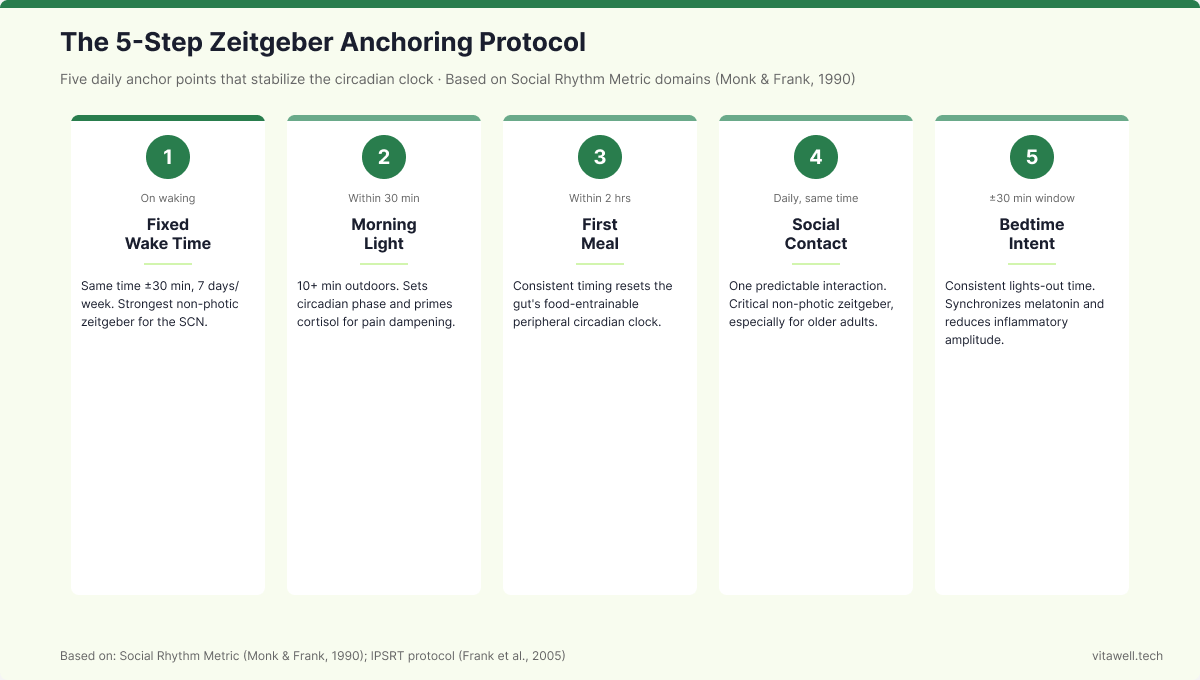
- Set a fixed wake time and protect it on weekends. Wake time is the single strongest non-photic zeitgeber for the SCN. Social jetlag — sleeping in on weekends — shifts the circadian phase and re-creates the disruption each Monday. Keeping wake time within 30 minutes of a fixed target seven days a week anchors the master clock more reliably than any other single behavior.
- Get outdoor light within 30 minutes of waking. Direct morning light — even 10 minutes outdoors on an overcast day — delivers the strongest photic zeitgeber signal and sets the circadian clock's phase for the day. It also triggers the cortisol awakening response, which establishes the day's inflammatory baseline and primes pain-dampening pathways. Building a morning routine that energizes and focuses can anchor this light exposure as part of a broader morning anchor sequence.
- Eat your first meal at a consistent time and within 2 hours of waking. The gut's food-entrainable oscillator is a peripheral clock that is reset by the timing of the first meal. Research on meal timing and metabolic outcomes has shown that consistent, early first meals stabilize insulin signaling and reduce inflammatory markers — the same downstream pathways through which routine regularity reduces pain in the Tracy et al. findings.
- Schedule one consistent social contact each day. The fifth SRM domain — first contact with another person — is the most underrated zeitgeber. Even a brief predictable interaction at a consistent time (a morning call, a shared lunch, a walk with a friend) gives the SCN a reliable non-photic phase cue. Social isolation, which eliminates this cue, is the single strongest predictor of SRM collapse in older adults — the demographic group studied by Tracy et al.
- Set a consistent lights-out time within a 30-minute window. Consistent sleep onset, like wake time, reduces the variance in melatonin timing that the SCN uses to synchronize peripheral clocks. It does not require perfect sleep — it requires consistent intent. Even if sleep onset takes 30–60 minutes, beginning the wind-down at the same time every night delivers a reliable darkness cue to the pineal gland and reduces the circadian amplitude of inflammation markers associated with chronic pain.
When to Talk to a Professional
Behavioral-social rhythm irregularity is frequently a symptom of an underlying condition rather than a lifestyle choice — shift work, caregiving demands, chronic pain itself, and mood disorders all fragment daily routines. Consider a conversation with a healthcare provider if:
- Your pain has been rated 5 or above on a 10-point scale for more than three months
- Your depression screen (PHQ-9) scores 10 or above, or you have experienced persistent low mood, loss of interest, or fatigue for more than two weeks
- Your insomnia has persisted for more than three months and is affecting daytime function
- You are a shift worker or have occupational demands that make consistent routine impossible without structural change — a conversation with an occupational health clinician may identify feasible accommodations
- You have been diagnosed with bipolar disorder and are not currently receiving IPSRT alongside pharmacotherapy — the Frank et al. evidence for IPSRT as an adjunct is among the strongest in mood disorder maintenance
Cognitive Behavioral Therapy for Insomnia (CBT-I) and IPSRT are both evidence-based structured routine interventions that a psychologist or trained therapist can deliver. If self-directed routine structuring does not produce improvement in four to six weeks, a referral to one of these treatments is an appropriate next step.
Frequently Asked Questions
Can fixing my daily routine really reduce chronic pain? Research evidence is associational rather than causal at this stage, but the effect size in Tracy et al. 2026 — a 5.84-point pain reduction per one-unit SRM increase — is clinically meaningful, and the mechanism linking routine regularity to inflammatory control and pain-modulation pathways is well-supported. Structured routine interventions like IPSRT have shown significant clinical outcomes in mood disorders over randomized trials. Routine is best understood as an adjunct to, not a replacement for, medical pain management.
What is a Social Rhythm Metric score? The Social Rhythm Metric (SRM) scores the regularity of five daily anchor activities — wake time, first contact with another person, start of work or main activity, dinner, and bedtime — on a 0–7 scale. A score of 4–5 reflects moderate regularity; clinical research with IPSRT typically targets scores above 4.5 as a treatment goal.
Does this apply to younger adults, or only older people? The Tracy et al. study enrolled adults with a mean age of 68.3 years, so direct generalization to younger adults requires caution. However, the mechanism — circadian misalignment driving inflammation and mood dysregulation — applies across age groups. The Frank et al. IPSRT trial included adults across a wide age range and showed benefits regardless of age.
How does insomnia interact with routine disruption? In the Tracy et al. data, insomnia strengthened the link between low routine regularity and depression, suggesting the two factors compound each other. People with insomnia who maintain high routine regularity show better depression outcomes than those with both insomnia and irregular schedules. Establishing consistent wake time is typically the first behavioral target in Cognitive Behavioral Therapy for Insomnia (CBT-I), which supports a combined approach.
How long does it take for a routine change to affect pain or mood? Human circadian clock phase shifts of 1–2 hours typically consolidate within 7–14 days when the new zeitgeber schedule is maintained consistently. Clinical improvements in depression outcomes in IPSRT trials typically became statistically significant at 12–16 weeks of consistent practice. Pain outcomes in routine-based studies have not been tracked longitudinally with high resolution, but the mechanistic pathway through inflammation suggests a similar 4–8 week lag for detectable changes.
Conclusion
A growing body of evidence positions the regularity of daily behavioral-social rhythms as an independent, modifiable driver of pain intensity, depressive symptoms, and metabolic health. The Tracy et al. 2026 findings quantify this link with clinically significant effect sizes, and the mechanistic evidence from circadian biology explains why: a stable daily schedule delivers the non-photic zeitgeber signals the brain's master clock needs to keep downstream inflammatory and mood-modulation systems synchronized. The clinical translation of this mechanism — Social Rhythm Therapy — has already demonstrated 20-month recurrence-free intervals in bipolar I disorder, nearly double the control condition.
You do not need IPSRT to benefit from this research. Setting consistent wake time, getting morning light, eating a first meal at a predictable hour, maintaining one daily social contact, and going to bed within a 30-minute window each night are five behaviors that most people can begin this week. No equipment, no supplements, no medical referral required — just the deliberate repetition of timing. For more evidence-based strategies across all eight life areas, explore VitaWell.
Related on VitaWell
- Your Daily Routine Is Either Aging You Faster or Slower — Johns Hopkins research on how circadian habits directly influence cellular aging and long-term health, with the same SCN mechanisms that drive the routine-pain link.
- Eating Late and Metabolic Syndrome Risk — New research on how meal timing disrupts the gut's circadian clock, complementing the routine-regularity evidence reviewed here.
- Building a Digital-Free Evening Routine — A practical guide to anchoring the wind-down end of the daily schedule that the Zeitgeber Anchoring Protocol depends on.
This article is for informational purposes only and does not constitute medical or nutritional advice. Consult a qualified healthcare provider before making significant changes to your daily schedule, particularly if you have a diagnosed sleep disorder, mood disorder, or chronic pain condition.
Sources
- Medical News Today — Sticking to a daily routine may ease pain and depression
- Tracy EL, et al. Behavioral-social rhythm regularity is associated with pain, depressive symptoms, and body mass index. Journal of Behavioral Medicine. 2026
- Frank E, et al. Two-year outcomes for interpersonal and social rhythm therapy in individuals with bipolar I disorder. Archives of General Psychiatry. 2005
- Monk TH, et al. The Social Rhythm Metric: an instrument to quantify the daily rhythms of life. Journal of Nervous and Mental Disease. 1990
- National Heart, Lung, and Blood Institute. Circadian Rhythm Disorders