
Menopausal Hormone Therapy and Dementia Risk: What New Research Reveals About Timing and Genetics
New research shows MHT's brain-protective effect depends on menopause type, timing, and genetics — with up to 43% dementia risk reduction for the right candidates. Here's what three 2026 studies found.

Three major 2026 studies agree: menopausal hormone therapy (MHT) can reduce dementia risk — but only under specific conditions. The largest study, covering 183,450 women, found up to a 43% lower dementia risk for women with surgical menopause who started MHT between ages 51 and 56. Your type of menopause, the age you begin treatment, and your APOE4 genetic status each determine whether MHT will protect your brain.
Key Takeaways
- Three 2026 studies consistently show MHT reduces dementia risk, especially for women with surgical menopause (up to 43% lower risk)
- Timing is critical: starting MHT at ages 51–56 provides the strongest brain protection; starting after 56 shows no measurable benefit
- Women with the APOE4 gene (which raises Alzheimer's risk) show measurable brain benefits from MHT, including higher cortical thickness in key brain regions
- The 2002 WHI study caused MHT use to collapse from ~27% to under 5%; the FDA reversed course in 2025 by removing its outdated black-box warning
- Women with natural menopause see minimal to no overall dementia risk reduction from MHT — the benefit is concentrated in surgical menopause cases
Why MHT and Dementia Are Back Under the Microscope
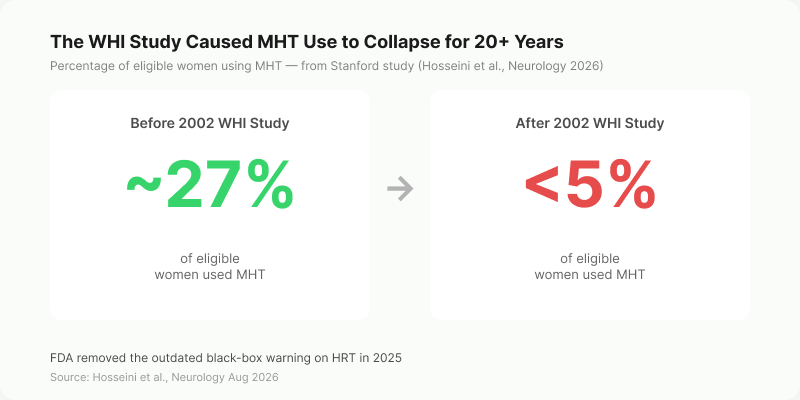
For two decades, millions of women avoided hormone therapy because of a 2002 study — the Women's Health Initiative (WHI) — that linked HRT to increased breast cancer and cardiovascular risk. After that study published, MHT use dropped from roughly 27% of peri- and postmenopausal women to under 5%. Women stopped asking their doctors about it. And brain-health research stalled.
Then, in 2025, the FDA quietly reversed the most consequential piece of that fallout: it removed the black-box warning it had placed on HRT. The warning had been based on a study that many researchers now argue was poorly designed — using doses and formulations no longer in common use, and enrolling women who were on average 63 years old, far past the window when hormones might protect the brain.
Today, the science looks different. New research on midlife women's health shows that decisions made in your early 50s shape cognitive outcomes decades later. Three independent studies published in 2026 all point in the same direction: for specific groups of women, the right hormone therapy at the right time substantially lowers dementia risk.
What Three New 2026 Studies Found
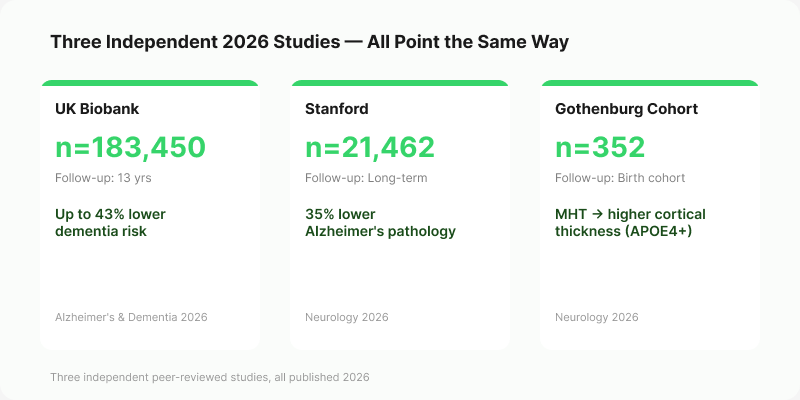
The UK Biobank Study — 183,450 Women, 13 Years of Follow-Up
The largest and most comprehensive analysis to date comes from Squires et al., published in Alzheimer's & Dementia in 2026. The study tracked 183,450 postmenopausal women from the UK Biobank over an average of 13.3 years, accumulating more than 2.43 million person-years of data. Among those women, 3,948 developed dementia during follow-up.
Across all participants, women who had used HRT for at least one year showed a 10% lower risk of all-cause dementia. But that average conceals substantial variation. Women who had undergone surgical menopause — meaning their ovaries were removed — showed a 26% lower dementia risk. Women with natural menopause showed no statistically significant benefit overall. About 15% of women aged 45 to 64 in England currently use HRT, the study noted.
The Stanford Brain Scan Study — 21,462 Participants
A parallel study from Stanford, led by Hosseini et al. and published in Neurology in August 2026, took a different approach. Rather than tracking dementia diagnoses, it examined brain biomarkers — Alzheimer's pathology as measured by imaging and clinical markers — in 21,462 participants, including 258 women who had used estrogen-only MHT.
The findings were striking. Women who had used estrogen-only MHT had 35% lower odds of showing Alzheimer's pathology, and 39% lower odds of clinical dementia, compared to non-users. The Stanford team also documented the collapse in MHT use: before the WHI study, roughly 27% of eligible women used hormones; that number fell to under 5% and stayed there.
The Swedish Gothenburg Cohort — 352 Women
A smaller but important third study, published in Neurology in November 2026, examined 352 Swedish women from the Gothenburg H70-1944 birth cohort, tracking both brain health markers and reproductive history. It found that for every additional year a woman's natural reproductive lifespan lasted, her odds of small vessel disease — damage to the brain's tiny blood vessels that raises dementia risk — were 8% lower. Among women who carried the APOE4 gene variant, those who used MHT showed higher cortical thickness — a marker of preserved brain tissue — in regions typically affected by Alzheimer's disease.
Why Surgical Menopause Changes the Risk Equation
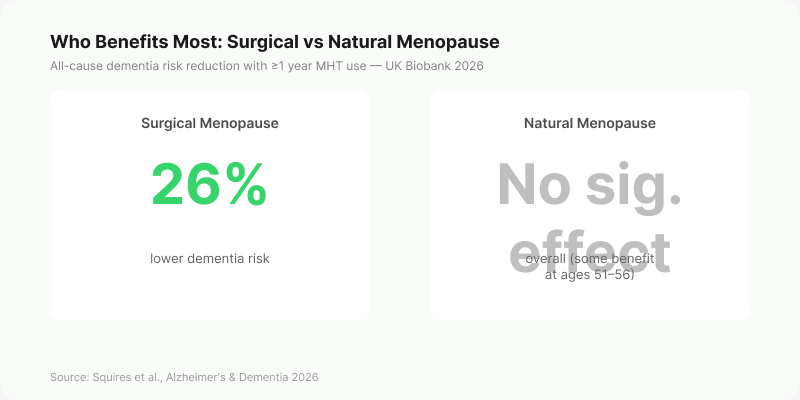
The consistent finding across all three studies is that women who had surgical menopause — hysterectomy with or without removal of the ovaries — appear to benefit most from MHT. Why?
The key is the speed and severity of estrogen loss. During natural menopause, estrogen declines gradually over several years. During surgical menopause, particularly when both ovaries are removed, estrogen levels drop abruptly and completely. Research suggests this sudden withdrawal may trigger more neurological disruption, leaving the brain more vulnerable if hormones aren't replaced.
The UK Biobank data shows this in detail: among women with surgical menopause, Alzheimer's-specific dementia risk was 32% lower with HRT use. Among women with natural menopause, it was only 11% lower. For non-Alzheimer's dementias, surgical menopause still showed a 21% reduction, while natural menopause showed no significant benefit.
Women with a shorter reproductive lifespan — less than 37 years between first menstrual period and menopause — also had 16% lower dementia risk on HRT compared to those with longer reproductive spans, suggesting that women whose bodies experienced less lifetime estrogen may respond more strongly to replacement. This aligns with WHO-backed evidence that modifiable biological factors earlier in life shape dementia risk decades later.
The Timing Window That Determines Whether MHT Protects the Brain
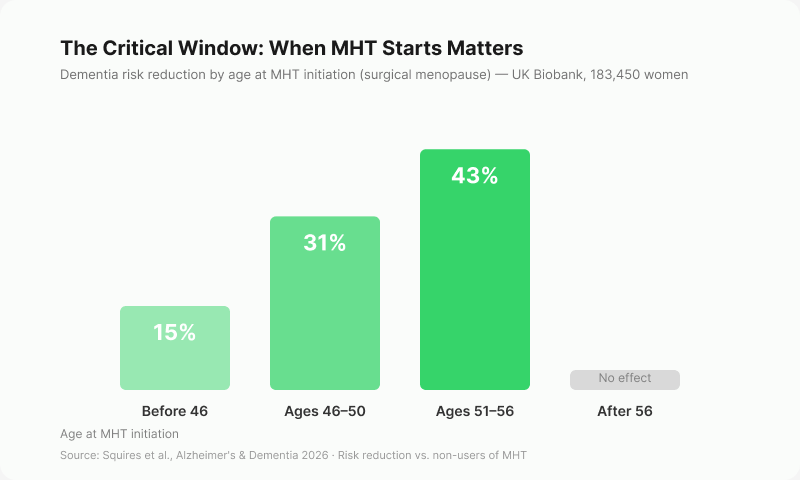
Researchers have proposed a "critical window hypothesis" to explain why the timing of MHT initiation matters so much. The idea is that estrogen has neuroprotective effects, but only when the brain is in an early stage — before neurological damage begins to accumulate. Starting hormones after that window may offer little benefit, or even risk accelerating harm in tissue already compromised.
The UK Biobank data gives that window concrete numbers. Among all women (surgical and natural combined), those who started HRT between ages 51 and 56 saw a 23% lower dementia risk. Women who started between ages 46 and 50 had a 13% lower risk. Women who started after age 56 showed no statistically significant reduction.
The benefit was sharpest for surgical menopause, where the full timing picture looked like this: women who started MHT before age 46 had 15% lower risk; those who started at ages 46–50 had 31% lower risk; those who started at 51–56 had the strongest benefit at 43% lower risk. Women with natural menopause who started at 51–56 also gained — 18% lower risk — though those outside that window saw no significant benefit.
The APOE4 Gene Factor
Roughly one in four people carries at least one copy of the APOE4 gene variant, the most significant genetic risk factor for late-onset Alzheimer's disease. Carriers face up to three times the typical lifetime risk.
The question is whether MHT helps more or less for this group. The UK Biobank study found that APOE4 carriers on HRT had a 13% lower dementia risk overall. The interaction between HRT use and APOE4 status was not statistically significant across all women, but subgroups showed differences: women with surgical menopause and the APOE4 gene had 28% lower dementia risk on HRT, compared to 20% for APOE4-negative women with surgical menopause. The Stanford study added a brain-level piece: among APOE4 carriers, those who had used MHT showed higher cortical thickness specifically in regions associated with Alzheimer's disease. For APOE4 carriers, combining MHT with other neuroprotective strategies — including diet — may compound the benefit.
Who Benefits Most — A Decision Guide
The research points to clear differences in who stands to gain most. This table synthesizes the key subgroup findings from the UK Biobank (Squires et al., Alzheimer's & Dementia 2026):
| Menopause Type | APOE4 Carrier? | Best MHT Timing | Estimated Dementia Risk Reduction |
|---|---|---|---|
| Surgical | Yes | Ages 51–56 | Up to 43% lower |
| Surgical | No | Ages 51–56 | Up to 43% lower |
| Surgical | Yes | Ages 46–50 | ~31% lower |
| Surgical | Any | Before age 46 | ~15% lower |
| Natural | Any | Ages 51–56 only | ~18% lower |
| Natural | Any | After age 56 | No significant effect |
Sources: UK Biobank (Squires et al., Alzheimer's & Dementia 2026)
What Reproductive Lifespan Reveals About Your Brain Health
Your body's natural estrogen exposure over a lifetime carries meaning beyond whether you used MHT. The Swedish Gothenburg study found that for every additional year of reproductive lifespan, a woman's risk of small vessel brain disease dropped by 8% (observational cohort, 352 women, Neurology 2026). The UK Biobank adds that women with fewer than 37 years between menarche and menopause had a 16% lower dementia risk on HRT compared to those with longer lifespan.
This matters most for women who experienced early menopause — whether through surgery or other causes — before age 46. These women may have had less lifetime estrogen exposure, which appears to increase both their dementia risk and their potential responsiveness to MHT.
What the Research Cannot Yet Tell Us
It is important to understand what these studies are and are not. All three are observational: they tracked women over time and found associations between MHT use and dementia risk. None randomly assigned women to use or not use MHT. This means the studies can identify patterns, but cannot prove that MHT causes the reduction in risk. Confounding factors — women who choose to use hormones may differ from those who don't in many ways — cannot be fully ruled out.
The UK Biobank study also lacked information on HRT type (estrogen-only vs. combined estrogen-progestogen), dose, and route (oral vs. transdermal). Earlier research has suggested estrogen-only formulations may carry different risks and benefits than combined HRT, but this study could not examine that. The cohort is also predominantly of European ancestry and skewed toward the socioeconomically advantaged, limiting generalizability.
The authors of all three studies call for randomized controlled trials to generate more definitive guidance on who should use MHT, at what dose, and in what formulation.
5 Things to Discuss With Your Doctor About MHT and Brain Health
If you are approaching or already past menopause, here is a concrete starting point for a conversation with your physician:
- Tell your doctor whether you had surgical menopause (hysterectomy with or without oophorectomy). The research consistently shows the greatest brain benefit for this group.
- Ask about APOE4 genetic testing if Alzheimer's runs in your family. Knowing your genotype may inform the risk-benefit calculation.
- Consider your current age and when menopause occurred. The 51–56 initiation window shows the clearest benefit; evidence for starting after 56 is not supportive.
- Ask specifically about estrogen-only formulations if you've had your uterus removed. The Stanford study found particularly strong effects with this type.
- Discuss your full health profile. Brain health benefits need to be weighed against cardiovascular disease history, breast cancer risk, and other individual factors.
When to Talk to a Professional
This article covers population-level research. Individual decisions about hormone therapy depend on your personal health history, risk factors, and goals. If you are approaching menopause or have already gone through it — particularly if you had surgical menopause or carry a family history of Alzheimer's — speak with a gynecologist or menopause specialist about whether MHT is appropriate for you. Genetic counselors can help you understand APOE4 carrier status and what it means for your risk. Your doctor is the right person to weigh the totality of your health picture.
Frequently Asked Questions
Does hormone replacement therapy lower the risk of dementia?
Current evidence suggests yes, for specific groups of women. Three major 2026 studies found that HRT is associated with 10–43% lower dementia risk depending on menopause type, timing, and genetics. The benefit is clearest for women who had surgical menopause and started MHT between ages 51 and 56. Women with natural menopause show minimal overall benefit from HRT.
Does taking HRT increase the risk of Alzheimer's disease?
Recent evidence suggests the opposite for many women, particularly those with surgical menopause. The 2002 WHI study that raised Alzheimer's concerns has since been criticized for studying older women (average age 63) outside the protective timing window. The FDA removed the outdated black-box warning on HRT in 2025. Current studies show 35–43% lower Alzheimer's risk in key subgroups.
Does starting hormone therapy early in menopause protect the brain better than starting later?
Yes, timing matters significantly. Data from the UK Biobank found that women who started HRT at ages 51–56 had the greatest brain benefit (23–43% lower dementia risk depending on menopause type). Starting after 56 showed no significant protection. This supports the "critical window hypothesis" — that hormones are neuroprotective only when given before neurological damage accumulates.
Does the APOE4 gene change how hormone therapy affects dementia risk?
Carriers of the APOE4 gene appear to benefit from MHT, particularly after surgical menopause. UK Biobank data found 28% lower dementia risk for APOE4-positive women with surgical menopause on HRT. Stanford researchers found that APOE4 carriers on MHT had higher cortical thickness in Alzheimer's-linked brain regions. The overall MHT-APOE4 interaction was not statistically significant across all women.
Is estrogen therapy after menopause a way to prevent Alzheimer's?
It is associated with lower Alzheimer's risk in certain groups, but it is not a proven prevention strategy. The Stanford study found 35% lower Alzheimer's pathology odds with estrogen-only MHT — a meaningful signal from observational data. All current studies are observational, meaning they cannot prove cause and effect. Experts call for randomized controlled trials before recommending MHT specifically for Alzheimer's prevention.
Conclusion
For many years, women and their doctors avoided hormone therapy based on a fear that turned out to be incomplete — shaped by a flawed study, overstated warnings, and a treatment population that was too old to benefit. Three independent studies published in 2026 now tell a more precise story: MHT can substantially reduce dementia risk, but the benefit is not universal. It depends on when your menopause happened, when you start treatment, and what your genetic background looks like.
The clearest signal is for women who had surgical menopause and began MHT between ages 51 and 56. For this group, the data shows up to a 43% lower risk — a figure that warrants serious attention. For women with natural menopause, the evidence is more modest, though those who start within the same window still see some benefit.
If you are navigating menopause decisions, the research now gives you and your doctor a richer framework to work with. VitaWell covers the evolving science of women's health, aging, and brain resilience across all eight life areas.
Related on VitaWell
- GLP-1 Medications and Fertility: What New Research Says for Men and Women With Obesity — another look at how pharmacological interventions interact with hormonal health in women
- Burnout Recovery: Why Your Nervous System Still Feels Stuck and What Rebuilds Capacity — covers brain-body resilience and nervous system health, relevant to cognitive outcomes in midlife
- The Two Best Exercise Types for Lowering Blood Pressure — What a 31-Trial Meta-Analysis Says — cardiovascular health and dementia prevention intersect; exercise is a key modifiable factor
This article is intended for informational purposes only and does not constitute medical advice. Consult a qualified healthcare provider before making any decisions about hormone therapy or other medical treatments.
Sources
- News-Medical (2026) — HRT linked to lower dementia risk, but timing and menopause type matter
- Squires S. et al. (2026). Hormone replacement therapy and dementia risk — UK Biobank. Alzheimer's & Dementia.
- Hosseini S.M.H. et al. (2026). Estrogen-only MHT and Alzheimer's pathology. Neurology.
- Gothenburg H70-1944 Cohort (2026). Reproductive lifespan, MHT and brain health. Neurology.
- Alzheimer's Association — APOE and Alzheimer's risk